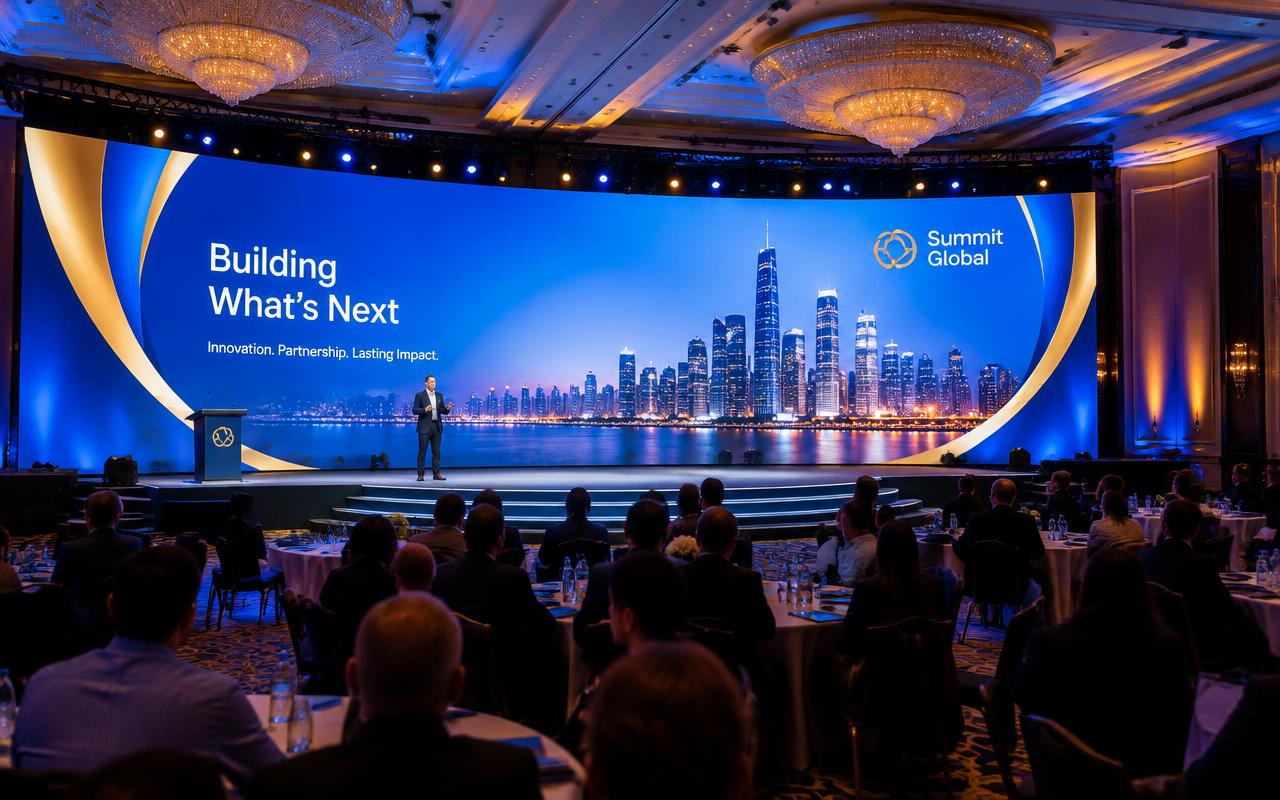
Visual · Jammu, Jammu & Kashmir
LED Wall Rental in Jammu
Jammu's event economy runs on the pilgrim corridor to Vaishno Devi at Katra, the administrative and defence establishment of a Union Territory that hosts Northern Command, and a Dogra wedding market with its own customs. It is a city where security clearance is as much a part of the production schedule as the load-in. Prime AV Solutions supplies the LED wall rental behind those events — designed on paper, proven in rehearsal and run by our own crew.
- Lead time
- From 5 weeks
- Peak season
- Oct–Mar
- Coverage
- Jammu & Jammu & Kashmir
Key takeaway
LED Wall Rental for Jammu’s biggest events
Creative LED is a maths problem before it is a visual one. Pixel pitch sets the minimum comfortable viewing distance — as a working rule, the distance in metres at which the image resolves cleanly is roughly the pitch in millimetres, so a P3.9 panel reads well from about four metres and a P2.6 from under three. We choose pitch from where the nearest audience actually stands and from what the content is: a logo-and-colour backdrop forgives a coarser pitch than live text or a camera that will push in on the surface. The panel grid is then drawn to native resolution so content is authored pixel-for-pixel rather than scaled.
Scenic LED is shaped around the room — ceiling trim, sightlines and the position of the nearest seat decide pitch, geometry and whether the build flies or stacks. In Jammu that plays out at venues like Radisson Blu Jammu, Abhinav Theatre, Maulana Azad Stadium, and across Gandhi Nagar, Trikuta Nagar, Bahu Plaza, Channi Himmat.
Processing decides whether the wall looks like a screen or like a surface. Novastar MCTRL4K and Brompton Tessera SX40 handle large canvases, and the Brompton path adds the tools that matter for cameras: high refresh rates, ShutterSync to lock panel refresh to the camera shutter, and genlock so the wall and the broadcast chain share a clock. Without that, a wall sitting at a low refresh rate will show rolling bands and tearing on every camera cut even though it looks perfect to the eye. Indoor walls typically run 800 to 1,500 nits; outdoor daylight surfaces need 5,000 nits and upwards to hold an image against sun.
What’s included
- P1.9 to P4.8 pixel pitch
- Curved, corner, floor & ceiling LED
- Novastar & Brompton processing
- Ground-stack or flown
Equipment we carry
Why Jammu chooses Prime AV
- Crews and trucks positioned for fast load-in at Radisson Blu Jammu and venues in Gandhi Nagar and Trikuta Nagar.
- Pitch is chosen from the real nearest-audience distance, and where seating cannot move we specify a finer pitch for the lower sections only.
- Brightness and colour calibration report across the surface
- Working knowledge of Jammu & Kashmir venue rules, power sanctions and permission timelines.
Local conditions
Producing LED wall rental in Jammu
Weather & the rig
LED panels are the first thing a climate punishes — humidity creeps into ribbon cables, direct sun washes out anything under 5,000 nits, and wind load on a flown wall rises fast with height and surface area. Jammu is the hot anomaly of a cold Union Territory — the plains here reach 44°C in May and June, hotter than anywhere in the Kashmir valley, and the Jul–Sep monsoon brings the Tawi up fast with flash-flood risk on riverside ground. Winter is the operational problem: January fog closes Jammu airport for hours at a stretch, slows the NH-44 run to a crawl and makes projection and any aerial plan unworkable, while 4–20°C days require heating for every outdoor function. May–Jun plains heat; Jul–Sep monsoon and Tawi flooding; and dense-fog January for anything depending on air freight, projection or drone work.
Power & redundancy
A large LED canvas draws several hundred watts per square metre at peak and spikes on white frames, so distribution is sized to the worst content frame rather than to an average. Among the more demanding power environments in north India. JPDCL operates scheduled curtailment in both the winter heating peak and the summer cooling peak, so a show here is planned DG-primary with the mains treated as a bonus, and N+1 redundancy with automatic changeover is standard rather than premium. Fuel storage and a bowser plan matter because a long outage is normal, not exceptional.
Permits & noise rules
Flown scenic LED needs structural sign-off on point loads, and outdoor builds attract both wind-load scrutiny and, near residential frontage, light-spill objections. Jammu Municipal Corporation for the licence and temporary structures, the SSP Jammu and the district magistrate for assembly and loudspeaker permission, and the J&K noise rules with the 10 pm outdoor limit. Two constraints are specific to this city: Jammu's airfield is a shared civil-military field effectively inside the urban area, which closes drone operations in practice, and any event near an Army or paramilitary installation needs security clearance with crew lists submitted for verification well in advance. Everything within Katra and on the track is governed by the Shri Mata Vaishno Devi Shrine Board, whose rules on content, catering and structures supersede the municipal file.
Load-in & access
Panel cases are heavy, numerous and must arrive in build order, so dock height, lift capacity and the available load-in window set how much surface can realistically go up. Delhi is 600 km and a realistic 10–11 hours on NH-44, with the Lakhanpur toll and security checks adding unpredictable hours. Pathankot at 100 km is the useful staging point, and rail parcel into Jammu Tawi is reliable. Northbound movement towards the valley is regularly halted for highway closures, so never plan a Jammu show on gear still sitting past Udhampur. In the city, Residency Road and the old town bar heavy vehicles through the day; 10 pm–6 am is the window.
Season & booking
Both Navratris — Chaitra in spring and Sharad in autumn — bring peak Vaishno Devi footfall and absorb the region's hospitality, transport and police capacity. The Jhiri Mela in Oct–Nov, Lohri and Baisakhi, the Bahu Mela, and the Army Day and Republic Day ceremonial calendar all lock dates. The Dogra wedding grid runs Oct–Mar around the auspicious tithis, with the pre-winter weeks busiest. Peak demand runs Oct–Mar.
Crew & dispatch
Local crew based in Jammu with working stock held in the city, because the Delhi run is too long and too interruptible to rely on for a tight call time; Delhi supplies large-format LED and specialist inventory with at least 48 hours in hand, and Pathankot serves as the staging point. Load-in support covers Gandhi Nagar, Trikuta Nagar and the rest of the city.
What it costs here
Government and defence work is tendered, documented and reliable but slow to settle, and the paperwork load is heavier here than in most states. Dogra weddings spend confidently on stage, lighting and entry production. Honest pricing has to carry the real cost of redundancy — DG sizing, fuel and a spare-stock position that this grid and this highway demand — rather than pretending to a plains cost base.
Local expectations
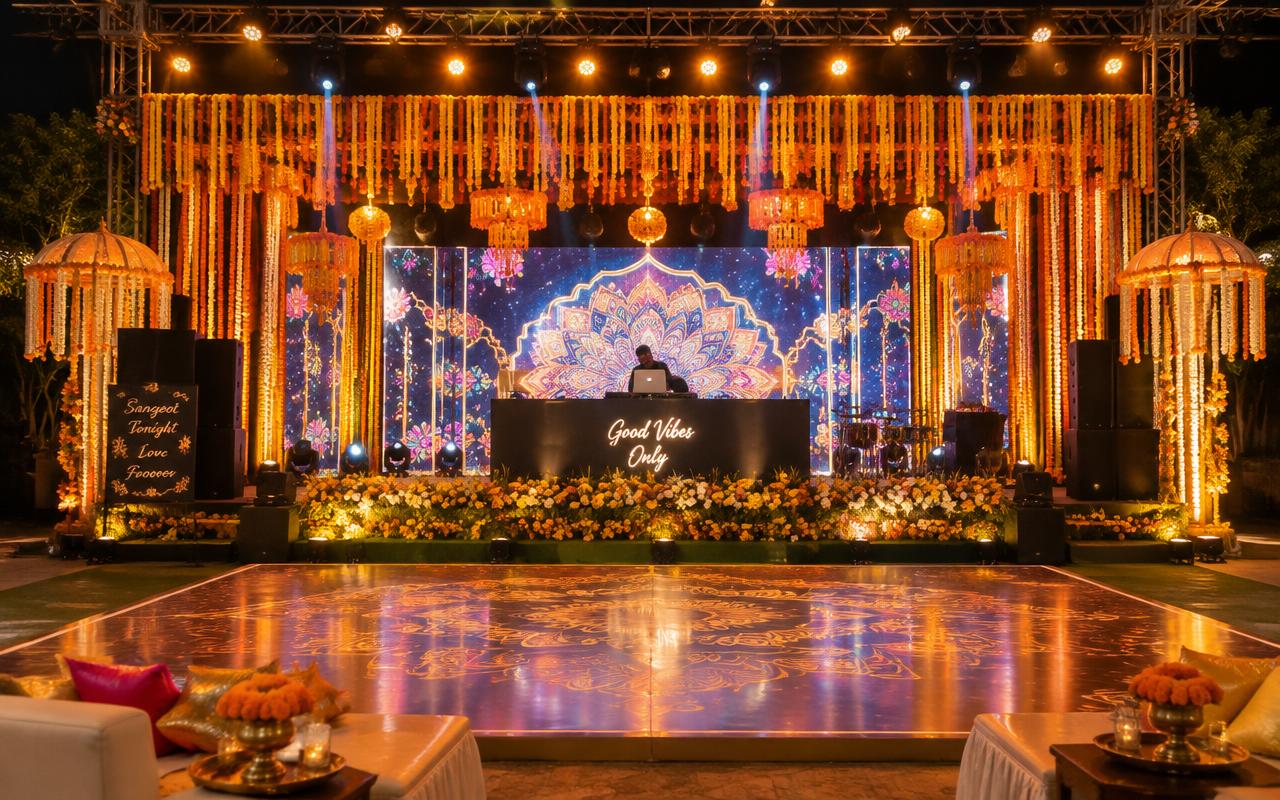
Dogra weddings carry their own ritual sequence, with the baraat, dhol and Dogri wedding songs needing acoustic space before the sangeet takes over at full level. A large share of functions have serving or retired defence families in the room, which sets a formal tone: punctual starts, clear protocol order, accurate rank and title on every name board. Hindi and Dogri scripting with English for official events, and a visible preference for dignified formality over spectacle in institutional work.
Specification
LED Wall Rental: technical specification
| Specification | Detail |
|---|---|
| Pixel pitch range | P1.9 – P4.8 indoor, P4.8 – P10 outdoor |
| Viewing distance rule | Minimum comfortable distance in metres ≈ pixel pitch in mm |
| Brightness | 800 – 1,500 nits indoor, 5,000 – 7,500 nits outdoor daylight |
| Panel refresh for camera | 3,840 Hz or higher, with ShutterSync and genlock on Brompton |
| Processing | Novastar MCTRL4K / VX1000, Brompton Tessera SX40 with Hydra calibration |
| Ingress protection | IP43 indoor cabinets, IP65 front and rear for outdoor builds |
| Power draw | Approximately 150 – 350 W per square metre average, peaks higher on white |
| Geometry | Flat, curved, corner, cube, floor-rated, transparent mesh and kinetic builds |
| Rigging | Flown on certified motors with point-load report, or ground-stacked on goalpost frames |
| Spares carried | Five per cent spare panels plus receiving cards, PSUs and ribbon cables |
Creative geometry is where scenic LED earns its budget. Curved and corner builds, suspended cubes, floor tiles rated for foot traffic, transparent mesh over a set and kinetic panels on winches all come from the same panel families but each changes the rigging and the power plan. A flown wall needs a point-load calculation and a wind-load assessment outdoors, because a solid LED surface is effectively a sail and the load rises steeply with height and area. Cable dressing matters too: data and power loop through panels in a defined order, and a single ribbon cable creeping out of its socket in humidity takes out a column.
Sizing
What size rig does your event actually need?
| Scale | Guests | Recommended setup |
|---|---|---|
| Panel backdrop | 100 – 400 | 6 m x 3 m at P3.9, ground-stacked, single processor, 18 sq m |
| Stage width wall | 400 – 1,500 | 10 m x 5 m at P2.6 or P3.9, flown, Brompton with ShutterSync, 50 sq m |
| Wrapped stage design | 1,500 – 5,000 | Main plus side panels and a floor section, 120 – 180 sq m, media server playback |
| Immersive room | 200 – 800 | Three-wall plus floor at P2.6, edge-matched, 250 sq m, calibrated as one canvas |
| Festival scenic | 10,000+ | Outdoor IP65 at P4.8 – P6.9, 300 sq m+, wind-load assessed, redundant power |
Scope
LED Wall Rental scope tiers in Jammu
Backdrop Canvas
Conferences and award stages, up to 40 sq m of surface
- P2.6 or P3.9 indoor panels on a ground-stacked goalpost
- Novastar processing with native-resolution canvas mapping
- Content playback with one operator and a hot backup machine
- Five per cent spare panels and consumables on site
- LED technician plus one rigger for the build
Scenic Build
Launches, concerts and award nights, 50 – 180 sq m with shaped geometry
- Curved, corner or multi-surface build with flown sections
- Brompton processing with ShutterSync and genlock for cameras
- disguise or Resolume media server with timecoded playback
- Point-load report and certified rigging
- Two LED technicians, a media server operator and a rigging crew
Immersive Surface
Large stage designs and immersive rooms, 200 sq m and above
- Multi-plane design with floor LED, cubes and kinetic elements
- Redundant processing with hot-standby servers and dual data paths
- Full panel calibration pass for colour and brightness uniformity
- Content pipeline support with pixel maps issued to your studio
- Full-time crew across build, show days and strike
Government and defence work is tendered, documented and reliable but slow to settle, and the paperwork load is heavier here than in most states. Dogra weddings spend confidently on stage, lighting and entry production. Honest pricing has to carry the real cost of redundancy — DG sizing, fuel and a spare-stock position that this grid and this highway demand — rather than pretending to a plains cost base.
Venues
Where we work in Jammu
| Venue | Capacity | Production note |
|---|---|---|
| Radisson Blu Jammu | Up to 1,000 across ballroom and lawns | The city's most capable conference property, bypass-side with a usable service approach; ballroom rigging provision is conservative, and winter load-ins have to be planned around the dense January fog that slows every vehicle movement into the city. |
| Abhinav Theatre | Roughly 700 fixed seats | The J&K Academy's proscenium house at Kachi Chawni — a real theatre with a house grid and wings, but the electrical infrastructure is dated and sized for house lighting, so a substantial rig needs a parallel temporary supply, and the stage door restricts case dimensions. |
| Maulana Azad Stadium | 15,000-plus with the field in use | City-centre stadium near Residency Road with no permanent rigging and turf that needs full boarding before any vehicle or tower goes on; one service gate and a congested surrounding block mean a staged, shuttled load-in across two nights rather than one. |
| General Zorawar Singh Auditorium | Roughly 1,000 fixed seats | Jammu University's main auditorium for convocations and cultural programmes; campus security logs every vehicle, academic-calendar blackouts are firm, and the in-house technical team's processes have to be worked with rather than around. |
| KC Residency | Up to 600 seated across halls | Established Residency Road hotel where the load-in is from a busy commercial street with no dock at all — a hand-carry and goods-lift operation that has to run overnight. |
Crew
Who turns up on show day
- LED technician
Builds the panel grid, maps the canvas to native resolution and chases any dead panel, card or ribbon on sight.
- Media server operator
Runs disguise or Resolume, holds the content timeline against timecode and keeps a hot backup machine mirrored.
- Rigger
Flies the sections, checks point loads against the report and manages any kinetic or winch elements.
- Video engineer
Owns processing, refresh rate, ShutterSync and genlock so the wall behaves correctly on every camera.
- Content technician
Conforms incoming content to the pixel map, fixes aspect and colour issues and version-controls what plays.
What you receive
- Pixel map with native canvas resolution, aspect ratio and safe areas
- Panel grid drawing with data and power loop order
- Point-load report and, outdoors, a wind-load assessment
- Processor configuration record including refresh, ShutterSync and genlock settings
- Brightness and colour calibration report across the surface
- Content playlist with timecode cues and a backup on two drives
- Spares inventory log and a record of any panel swapped during the run
Timeline
From enquiry to load-out
- T-5 weeks
Pitch and geometry decision
Nearest viewing distance, camera plan and content type set the pixel pitch and the panel grid.
- T-4 weeks
Pixel map issue
Your content studio receives the exact canvas resolution, aspect and safe areas so nothing is authored to be scaled.
- T-2 weeks
Rigging and power sign-off
Point-load report, wind-load assessment for outdoor builds and the power schedule go to the venue.
- Show day −2 to −1
Build and calibration
Panels built, data and power looped, canvas mapped, then a brightness and colour calibration pass across the surface.
- Show day −1
Camera check
Refresh, ShutterSync and genlock verified live through the actual cameras, with content on screen.
- Show day to +6 hours
Show and strike
Operated through the show with spares on hand, then de-rigged panel by panel into cases in build order.
Risk control
What goes wrong, and how we stop it
What can go wrong
How we prevent it
- What can go wrong
The front row sits three metres from a P4.8 panel and sees pixels rather than an image.
How we prevent itPitch is chosen from the real nearest-audience distance, and where seating cannot move we specify a finer pitch for the lower sections only.
- What can go wrong
Average power is calculated from the spec sheet and the breaker trips on a full-white frame.
How we prevent itDistribution is sized for peak draw on white content, not average, with phases balanced across the panel grid and content peak-limited where sensible.
- What can go wrong
The wall looks flawless to the eye but shows rolling bands on every camera.
How we prevent itRun panels at 3,840 Hz or higher and lock ShutterSync and genlock to the camera chain, then verify through the actual cameras before the show, not at rehearsal.
- What can go wrong
Content authored at 1920 x 1080 is stretched onto a non-standard canvas and every logo distorts.
How we prevent itThe pixel map goes to the content studio at T-4 weeks with exact resolution and safe areas, and we conform and review every file before build day.
Honest comparison
Is this the right choice for your event?
- Projection instead of LED for a stage backdropOur verdict
Projection is far cheaper per square metre for very large surfaces and looks beautiful on texture. LED wins whenever there is ambient light, a camera, or performers who would walk through a projector beam.
- A coarser pixel pitch to save budgetOur verdict
Often the right call. If the nearest viewer is eight metres away and the content is graphics rather than text, P4.8 looks identical to P2.6 at a fraction of the cost. It only fails when a camera pushes in.
- Ground-stacking instead of flying the wallOur verdict
Ground stacks are cheaper, faster and avoid a rigging sign-off. The trade-off is a visible frame, a higher bottom edge and lost stage depth, which matters on a set but not behind a lectern.
Demand
What Jammu books most
Jammu event mix
- Dogra community weddings and multi-day functions
- Government, administrative and UT-level conferences
- Defence and paramilitary ceremonial functions
- Vaishno Devi pilgrim-season and Shrine Board events
- Trade exhibitions and regional dealer meets
- University convocations and cultural programmes
Ideal for
Events we power with LED wall rental in Jammu
Process
From brief to standing ovation
01
Brief & recce
We visit the venue, map power and rigging, and understand your show flow.
02
Design & quote
CAD plans, 3D previews and an itemised quote within 24 hours.
03
Build & rehearse
Load-in, system tuning, content checks and full technical rehearsal.
04
Show & strike
Show-caller-led execution, then a quick, clean load-out.
FAQ
LED Wall Rental in Jammu: FAQs
More services in Jammu
LED Wall Rental in nearby cities
Areas we cover in Jammu
Events in Jammu