Visual
LED Wall Rental across India
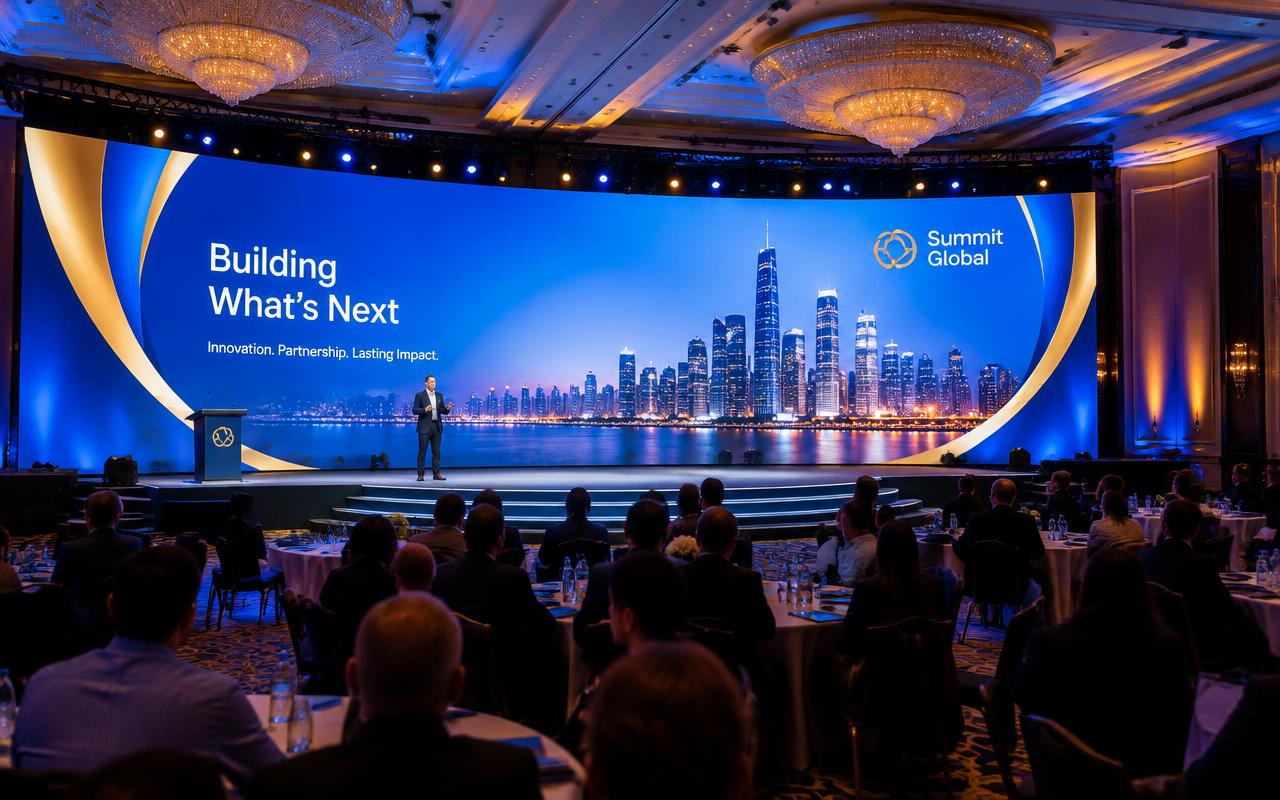
Indoor P2.6/P3.9 and outdoor P4.8 LED walls in any size or shape — curved, cubes, floor LED and kinetic panels — powered by Novastar processing.
- Lead time
- T-5 weeks
- Category
- Visual
- Coverage
- 90+ Indian cities
Key takeaway
How we deliver LED wall rental
Creative LED is a maths problem before it is a visual one. Pixel pitch sets the minimum comfortable viewing distance — as a working rule, the distance in metres at which the image resolves cleanly is roughly the pitch in millimetres, so a P3.9 panel reads well from about four metres and a P2.6 from under three. We choose pitch from where the nearest audience actually stands and from what the content is: a logo-and-colour backdrop forgives a coarser pitch than live text or a camera that will push in on the surface. The panel grid is then drawn to native resolution so content is authored pixel-for-pixel rather than scaled.
Processing decides whether the wall looks like a screen or like a surface. Novastar MCTRL4K and Brompton Tessera SX40 handle large canvases, and the Brompton path adds the tools that matter for cameras: high refresh rates, ShutterSync to lock panel refresh to the camera shutter, and genlock so the wall and the broadcast chain share a clock. Without that, a wall sitting at a low refresh rate will show rolling bands and tearing on every camera cut even though it looks perfect to the eye. Indoor walls typically run 800 to 1,500 nits; outdoor daylight surfaces need 5,000 nits and upwards to hold an image against sun.
Creative geometry is where scenic LED earns its budget. Curved and corner builds, suspended cubes, floor tiles rated for foot traffic, transparent mesh over a set and kinetic panels on winches all come from the same panel families but each changes the rigging and the power plan. A flown wall needs a point-load calculation and a wind-load assessment outdoors, because a solid LED surface is effectively a sail and the load rises steeply with height and area. Cable dressing matters too: data and power loop through panels in a defined order, and a single ribbon cable creeping out of its socket in humidity takes out a column.
What you get
- P1.9 to P4.8 pixel pitch
- Curved, corner, floor & ceiling LED
- Novastar & Brompton processing
- Ground-stack or flown
Equipment we carry
Ideal for
Specification
LED Wall Rental: technical specification
| Specification | Detail |
|---|---|
| Pixel pitch range | P1.9 – P4.8 indoor, P4.8 – P10 outdoor |
| Viewing distance rule | Minimum comfortable distance in metres ≈ pixel pitch in mm |
| Brightness | 800 – 1,500 nits indoor, 5,000 – 7,500 nits outdoor daylight |
| Panel refresh for camera | 3,840 Hz or higher, with ShutterSync and genlock on Brompton |
| Processing | Novastar MCTRL4K / VX1000, Brompton Tessera SX40 with Hydra calibration |
| Ingress protection | IP43 indoor cabinets, IP65 front and rear for outdoor builds |
| Power draw | Approximately 150 – 350 W per square metre average, peaks higher on white |
| Geometry | Flat, curved, corner, cube, floor-rated, transparent mesh and kinetic builds |
| Rigging | Flown on certified motors with point-load report, or ground-stacked on goalpost frames |
| Spares carried | Five per cent spare panels plus receiving cards, PSUs and ribbon cables |
Sizing
What size rig does your event actually need?
| Scale | Guests | Recommended setup |
|---|---|---|
| Panel backdrop | 100 – 400 | 6 m x 3 m at P3.9, ground-stacked, single processor, 18 sq m |
| Stage width wall | 400 – 1,500 | 10 m x 5 m at P2.6 or P3.9, flown, Brompton with ShutterSync, 50 sq m |
| Wrapped stage design | 1,500 – 5,000 | Main plus side panels and a floor section, 120 – 180 sq m, media server playback |
| Immersive room | 200 – 800 | Three-wall plus floor at P2.6, edge-matched, 250 sq m, calibrated as one canvas |
| Festival scenic | 10,000+ | Outdoor IP65 at P4.8 – P6.9, 300 sq m+, wind-load assessed, redundant power |
Scope
LED Wall Rental scope tiers
Backdrop Canvas
Conferences and award stages, up to 40 sq m of surface
- P2.6 or P3.9 indoor panels on a ground-stacked goalpost
- Novastar processing with native-resolution canvas mapping
- Content playback with one operator and a hot backup machine
- Five per cent spare panels and consumables on site
- LED technician plus one rigger for the build
Scenic Build
Launches, concerts and award nights, 50 – 180 sq m with shaped geometry
- Curved, corner or multi-surface build with flown sections
- Brompton processing with ShutterSync and genlock for cameras
- disguise or Resolume media server with timecoded playback
- Point-load report and certified rigging
- Two LED technicians, a media server operator and a rigging crew
Immersive Surface
Large stage designs and immersive rooms, 200 sq m and above
- Multi-plane design with floor LED, cubes and kinetic elements
- Redundant processing with hot-standby servers and dual data paths
- Full panel calibration pass for colour and brightness uniformity
- Content pipeline support with pixel maps issued to your studio
- Full-time crew across build, show days and strike
Crew
Who turns up on show day
- LED technician
Builds the panel grid, maps the canvas to native resolution and chases any dead panel, card or ribbon on sight.
- Media server operator
Runs disguise or Resolume, holds the content timeline against timecode and keeps a hot backup machine mirrored.
- Rigger
Flies the sections, checks point loads against the report and manages any kinetic or winch elements.
- Video engineer
Owns processing, refresh rate, ShutterSync and genlock so the wall behaves correctly on every camera.
- Content technician
Conforms incoming content to the pixel map, fixes aspect and colour issues and version-controls what plays.
What you receive
- Pixel map with native canvas resolution, aspect ratio and safe areas
- Panel grid drawing with data and power loop order
- Point-load report and, outdoors, a wind-load assessment
- Processor configuration record including refresh, ShutterSync and genlock settings
- Brightness and colour calibration report across the surface
- Content playlist with timecode cues and a backup on two drives
- Spares inventory log and a record of any panel swapped during the run
Timeline
From enquiry to load-out
- T-5 weeks
Pitch and geometry decision
Nearest viewing distance, camera plan and content type set the pixel pitch and the panel grid.
- T-4 weeks
Pixel map issue
Your content studio receives the exact canvas resolution, aspect and safe areas so nothing is authored to be scaled.
- T-2 weeks
Rigging and power sign-off
Point-load report, wind-load assessment for outdoor builds and the power schedule go to the venue.
- Show day −2 to −1
Build and calibration
Panels built, data and power looped, canvas mapped, then a brightness and colour calibration pass across the surface.
- Show day −1
Camera check
Refresh, ShutterSync and genlock verified live through the actual cameras, with content on screen.
- Show day to +6 hours
Show and strike
Operated through the show with spares on hand, then de-rigged panel by panel into cases in build order.
Risk control
What goes wrong, and how we stop it
What can go wrong
How we prevent it
- What can go wrong
The wall looks flawless to the eye but shows rolling bands on every camera.
How we prevent itRun panels at 3,840 Hz or higher and lock ShutterSync and genlock to the camera chain, then verify through the actual cameras before the show, not at rehearsal.
- What can go wrong
Content authored at 1920 x 1080 is stretched onto a non-standard canvas and every logo distorts.
How we prevent itThe pixel map goes to the content studio at T-4 weeks with exact resolution and safe areas, and we conform and review every file before build day.
- What can go wrong
Humidity works a ribbon cable loose and a column of panels goes dark mid-show.
How we prevent itCables are dressed and strain-relieved at build, connections are reseated after the first full power cycle, and five per cent spare panels and cards are on site.
- What can go wrong
An outdoor flown wall becomes a sail and the wind load exceeds the structure's rating.
How we prevent itA wind-load assessment is run against panel area and trim height, with a documented wind speed at which the wall is lowered or the show pauses.
- What can go wrong
The front row sits three metres from a P4.8 panel and sees pixels rather than an image.
How we prevent itPitch is chosen from the real nearest-audience distance, and where seating cannot move we specify a finer pitch for the lower sections only.
- What can go wrong
Average power is calculated from the spec sheet and the breaker trips on a full-white frame.
How we prevent itDistribution is sized for peak draw on white content, not average, with phases balanced across the panel grid and content peak-limited where sensible.
Honest comparison
Is this the right choice for your event?
- Projection instead of LED for a stage backdropOur verdict
Projection is far cheaper per square metre for very large surfaces and looks beautiful on texture. LED wins whenever there is ambient light, a camera, or performers who would walk through a projector beam.
- A coarser pixel pitch to save budgetOur verdict
Often the right call. If the nearest viewer is eight metres away and the content is graphics rather than text, P4.8 looks identical to P2.6 at a fraction of the cost. It only fails when a camera pushes in.
- Ground-stacking instead of flying the wallOur verdict
Ground stacks are cheaper, faster and avoid a rigging sign-off. The trade-off is a visible frame, a higher bottom edge and lost stage depth, which matters on a set but not behind a lectern.
- Buying a small wall outright instead of rentingOur verdict
For a venue or a brand running weekly events, ownership pays back within a year or two. For anything less frequent, rental covers the processing, the spares, the calibration and the crew that a purchased wall quietly needs.
Process
How we deliver
01
Brief & recce
We visit the venue, map power and rigging, and understand your show flow.
02
Design & quote
CAD plans, 3D previews and an itemised quote within 24 hours.
03
Build & rehearse
Load-in, system tuning, content checks and full technical rehearsal.
04
Show & strike
Show-caller-led execution, then a quick, clean load-out.
Locations
LED Wall Rental by city
Tier 1 metros
Tier 2 cities
FAQ