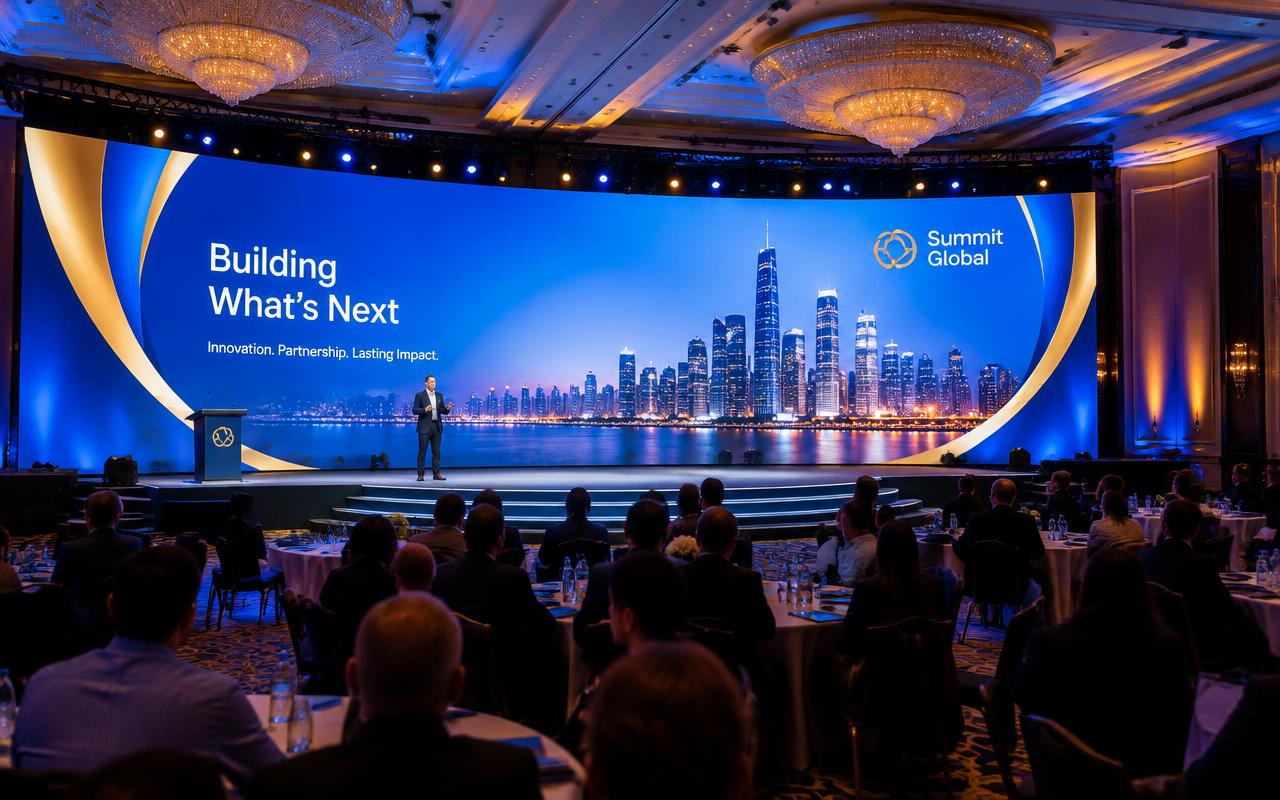
Visual · Amravati, Maharashtra
LED Wall Rental in Amravati
Booking LED wall rental in Amravati means solving Amravati's particular problems: march to mid-june is too hot for daytime outdoor work and crew heat stress becomes the limiting constraint. june–september monsoon makes black-soil ground unusable for vehicles and structures alike. october to february is the season, and farmer-facing events track the post-harvest months when there is money in the belt, venue load-in windows, and dates that disappear once the season turns.
- Lead time
- From 5 weeks
- Peak season
- Oct–Feb
- Coverage
- Amravati & Maharashtra
Key takeaway
LED Wall Rental for Amravati’s biggest events
Creative LED is a maths problem before it is a visual one. Pixel pitch sets the minimum comfortable viewing distance — as a working rule, the distance in metres at which the image resolves cleanly is roughly the pitch in millimetres, so a P3.9 panel reads well from about four metres and a P2.6 from under three. We choose pitch from where the nearest audience actually stands and from what the content is: a logo-and-colour backdrop forgives a coarser pitch than live text or a camera that will push in on the surface. The panel grid is then drawn to native resolution so content is authored pixel-for-pixel rather than scaled.
Scenic LED is shaped around the room — ceiling trim, sightlines and the position of the nearest seat decide pitch, geometry and whether the build flies or stacks. In Amravati that plays out at venues like Hotel Mahfil, Sant Gadge Baba grounds, Camp Area lawns, and across Camp Area, Rajapeth, Badnera Road, Shegaon Naka.
Processing decides whether the wall looks like a screen or like a surface. Novastar MCTRL4K and Brompton Tessera SX40 handle large canvases, and the Brompton path adds the tools that matter for cameras: high refresh rates, ShutterSync to lock panel refresh to the camera shutter, and genlock so the wall and the broadcast chain share a clock. Without that, a wall sitting at a low refresh rate will show rolling bands and tearing on every camera cut even though it looks perfect to the eye. Indoor walls typically run 800 to 1,500 nits; outdoor daylight surfaces need 5,000 nits and upwards to hold an image against sun.
What’s included
- P1.9 to P4.8 pixel pitch
- Curved, corner, floor & ceiling LED
- Novastar & Brompton processing
- Ground-stack or flown
Equipment we carry
Why Amravati chooses Prime AV
- Crews and trucks positioned for fast load-in at Sant Gadge Baba grounds and venues in Rajapeth and Badnera Road.
- A wind-load assessment is run against panel area and trim height, with a documented wind speed at which the wall is lowered or the show pauses.
- Panel grid drawing with data and power loop order
- Working knowledge of Maharashtra venue rules, power sanctions and permission timelines.
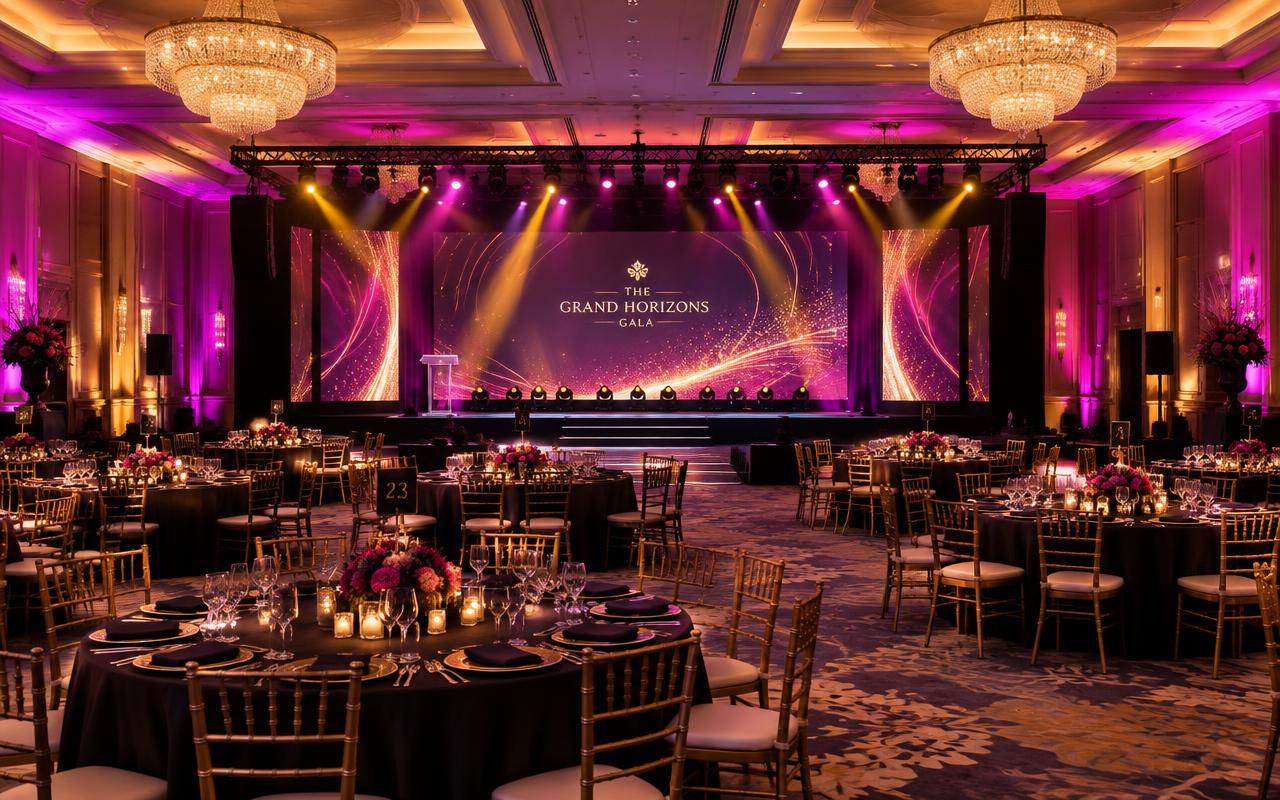
Local conditions
Producing LED wall rental in Amravati
Weather & the rig
LED panels are the first thing a climate punishes — humidity creeps into ribbon cables, direct sun washes out anything under 5,000 nits, and wind load on a flown wall rises fast with height and surface area. Western Vidarbha is among the hottest regions in Maharashtra and May routinely reaches 45–47°C with a dry searing wind that makes any daytime outdoor rehearsal unsafe without shade and crew rotation. The region is also drought-prone, which makes water for dust suppression scarce and expensive in the pre-monsoon months. The south-west monsoon from June to September delivers the year's rain in heavy spells, and the local black cotton soil becomes a slick, load-bearing nightmare when wet — the single most underestimated ground condition in this belt. March to mid-June is too hot for daytime outdoor work and crew heat stress becomes the limiting constraint. June–September monsoon makes black-soil ground unusable for vehicles and structures alike. October to February is the season, and farmer-facing events track the post-harvest months when there is money in the belt.
Power & redundancy
A large LED canvas draws several hundred watts per square metre at peak and spikes on white frames, so distribution is sized to the worst content frame rather than to an average. MSEDCL supply into the city centre is adequate but the district's feeders carry heavy irrigation load and managed interruption is routine, worse in the surrounding talukas than in the city itself. Venue sanctioned loads are small, so diesel generation covers show load on almost every job; the local hire fleet is agriculture and construction oriented with a lot of older open sets, so specify silent canopies and verify the actual condition of the plant before it arrives.
Permits & noise rules
Flown scenic LED needs structural sign-off on point loads, and outdoor builds attract both wind-load scrutiny and, near residential frontage, light-spill objections. The Amravati Municipal Corporation allots grounds and issues pandal permissions, the district police handle assembly and traffic, and the Maharashtra Noise Pollution Rules apply with the state's characteristic seriousness — silence-zone provisions near hospitals and schools, the 10 pm outdoor amplified-sound limit, and Bombay High Court directions on festival loudspeaker use that are applied rather than ignored. Amravati has no scheduled commercial airport, which simplifies drone clearance to DGCA registration plus police intimation, and Melghat tiger reserve conditions apply to anything on that side of the district.
Load-in & access
Panel cases are heavy, numerous and must arrive in build order, so dock height, lift capacity and the available load-in window set how much surface can realistically go up. NH-53 runs through, putting Nagpur about three hours east, and freight into the campus and industrial venues is uncomplicated. The friction is the old city — Rajkamal Chowk, Itwara Bazaar and the lanes around the temple are congested and take nothing larger than a tempo in daylight, and day-time truck entry is restricted. Monsoon-season movement onto black-soil ground needs matted access roads laid before the first vehicle, not after.
Season & booking
Ganeshotsav in August–September commits mandal-grade sound and lighting across the city for ten days and is the busiest community production period of the year. The Ambadevi Navaratri fair draws large crowds, Gudi Padwa and Akshaya Tritiya open wedding seasons, and the post-harvest window from November to February is when agri trade bodies and farmer conventions actually meet. Marathi college festival season takes January and February dates. Peak demand runs Oct–Feb.
Crew & dispatch
Run from our Nagpur depot, 155 km on NH-53 at about three hours, which keeps same-day movement practical; labour, mandap structure and barricading are hired locally in Amravati and Akola, with Nagpur supplying anything specialised. Load-in support covers Rajapeth, Badnera Road and the rest of the city.
What it costs here
Genuinely tied to the agricultural cycle — a poor cotton season visibly shrinks wedding and trade budgets across the district, and clients will say so openly. Committee-run trade bodies and cooperative institutions negotiate hard against local suppliers who work cheaply. The segments that hold up are branded agri-input and automotive dealer meets, where a national marketing standard sets the specification, and the university sector, which books predictably if modestly.
Local expectations
Vidarbha Marathi convention shapes the social and civic work: a shubharambha and lamp-lighting sequence with its own lighting state, long satkar and felicitation segments needing several roving mics, and bhajan or kirtan ensembles that want warm natural reinforcement. Farmer conventions are judged entirely on whether the speaker was intelligible at the back of a wide, open, noisy ground. Wedding work is expressive but spends on decor before AV, so the proposition is usually sound quality and a video deliverable the family will keep.
Specification
LED Wall Rental: technical specification
| Specification | Detail |
|---|---|
| Pixel pitch range | P1.9 – P4.8 indoor, P4.8 – P10 outdoor |
| Viewing distance rule | Minimum comfortable distance in metres ≈ pixel pitch in mm |
| Brightness | 800 – 1,500 nits indoor, 5,000 – 7,500 nits outdoor daylight |
| Panel refresh for camera | 3,840 Hz or higher, with ShutterSync and genlock on Brompton |
| Processing | Novastar MCTRL4K / VX1000, Brompton Tessera SX40 with Hydra calibration |
| Ingress protection | IP43 indoor cabinets, IP65 front and rear for outdoor builds |
| Power draw | Approximately 150 – 350 W per square metre average, peaks higher on white |
| Geometry | Flat, curved, corner, cube, floor-rated, transparent mesh and kinetic builds |
| Rigging | Flown on certified motors with point-load report, or ground-stacked on goalpost frames |
| Spares carried | Five per cent spare panels plus receiving cards, PSUs and ribbon cables |
Creative geometry is where scenic LED earns its budget. Curved and corner builds, suspended cubes, floor tiles rated for foot traffic, transparent mesh over a set and kinetic panels on winches all come from the same panel families but each changes the rigging and the power plan. A flown wall needs a point-load calculation and a wind-load assessment outdoors, because a solid LED surface is effectively a sail and the load rises steeply with height and area. Cable dressing matters too: data and power loop through panels in a defined order, and a single ribbon cable creeping out of its socket in humidity takes out a column.
Sizing
What size rig does your event actually need?
| Scale | Guests | Recommended setup |
|---|---|---|
| Panel backdrop | 100 – 400 | 6 m x 3 m at P3.9, ground-stacked, single processor, 18 sq m |
| Stage width wall | 400 – 1,500 | 10 m x 5 m at P2.6 or P3.9, flown, Brompton with ShutterSync, 50 sq m |
| Wrapped stage design | 1,500 – 5,000 | Main plus side panels and a floor section, 120 – 180 sq m, media server playback |
| Immersive room | 200 – 800 | Three-wall plus floor at P2.6, edge-matched, 250 sq m, calibrated as one canvas |
| Festival scenic | 10,000+ | Outdoor IP65 at P4.8 – P6.9, 300 sq m+, wind-load assessed, redundant power |
Scope
LED Wall Rental scope tiers in Amravati
Backdrop Canvas
Conferences and award stages, up to 40 sq m of surface
- P2.6 or P3.9 indoor panels on a ground-stacked goalpost
- Novastar processing with native-resolution canvas mapping
- Content playback with one operator and a hot backup machine
- Five per cent spare panels and consumables on site
- LED technician plus one rigger for the build
Scenic Build
Launches, concerts and award nights, 50 – 180 sq m with shaped geometry
- Curved, corner or multi-surface build with flown sections
- Brompton processing with ShutterSync and genlock for cameras
- disguise or Resolume media server with timecoded playback
- Point-load report and certified rigging
- Two LED technicians, a media server operator and a rigging crew
Immersive Surface
Large stage designs and immersive rooms, 200 sq m and above
- Multi-plane design with floor LED, cubes and kinetic elements
- Redundant processing with hot-standby servers and dual data paths
- Full panel calibration pass for colour and brightness uniformity
- Content pipeline support with pixel maps issued to your studio
- Full-time crew across build, show days and strike
Genuinely tied to the agricultural cycle — a poor cotton season visibly shrinks wedding and trade budgets across the district, and clients will say so openly. Committee-run trade bodies and cooperative institutions negotiate hard against local suppliers who work cheaply. The segments that hold up are branded agri-input and automotive dealer meets, where a national marketing standard sets the specification, and the university sector, which books predictably if modestly.
Venues
Where we work in Amravati
| Venue | Capacity | Production note |
|---|---|---|
| Hotel Mahfil | 400–800 across the banquet hall and lawn | The city's most dependable commercial venue, with a modest sanctioned load and a narrow service approach, so stage and LED arrive on tempos in sequence rather than in a single delivery. |
| Sant Gadge Baba grounds | 5,000–20,000 across the university and adjoining open ground | Large bare campus ground with easy vehicle access and ample room for a generator compound, but no rigging, a dusty black-soil surface that turns greasy after rain, and availability governed entirely by the academic calendar. |
| Camp Area lawns | 800–2,500 across the lawn and hall circuit | The established wedding and function belt, running on lighting-grade connections with no spare capacity and no drainage, with residential neighbours close enough that array rear-rejection matters more than output. |
| Ambadevi temple precinct and adjoining grounds | 3,000–10,000 for devotional programming | Temple-trust controlled with continuous darshan queues that cannot be obstructed, so the structure footprint is tightly constrained and every cable run has to be ramped or trenched. |
| Nandgaon Peth industrial area function spaces | 1,000–4,000 in industrial and exhibition layouts | Developing industrial estate with genuine three-phase capacity close by and unrestricted truck access, but an unsurfaced, exposed site with no wind break, so structures need engineered ballast and walkways need matting. |
Crew
Who turns up on show day
- LED technician
Builds the panel grid, maps the canvas to native resolution and chases any dead panel, card or ribbon on sight.
- Media server operator
Runs disguise or Resolume, holds the content timeline against timecode and keeps a hot backup machine mirrored.
- Rigger
Flies the sections, checks point loads against the report and manages any kinetic or winch elements.
- Video engineer
Owns processing, refresh rate, ShutterSync and genlock so the wall behaves correctly on every camera.
- Content technician
Conforms incoming content to the pixel map, fixes aspect and colour issues and version-controls what plays.
What you receive
- Pixel map with native canvas resolution, aspect ratio and safe areas
- Panel grid drawing with data and power loop order
- Point-load report and, outdoors, a wind-load assessment
- Processor configuration record including refresh, ShutterSync and genlock settings
- Brightness and colour calibration report across the surface
- Content playlist with timecode cues and a backup on two drives
- Spares inventory log and a record of any panel swapped during the run
Timeline
From enquiry to load-out
- T-5 weeks
Pitch and geometry decision
Nearest viewing distance, camera plan and content type set the pixel pitch and the panel grid.
- T-4 weeks
Pixel map issue
Your content studio receives the exact canvas resolution, aspect and safe areas so nothing is authored to be scaled.
- T-2 weeks
Rigging and power sign-off
Point-load report, wind-load assessment for outdoor builds and the power schedule go to the venue.
- Show day −2 to −1
Build and calibration
Panels built, data and power looped, canvas mapped, then a brightness and colour calibration pass across the surface.
- Show day −1
Camera check
Refresh, ShutterSync and genlock verified live through the actual cameras, with content on screen.
- Show day to +6 hours
Show and strike
Operated through the show with spares on hand, then de-rigged panel by panel into cases in build order.
Risk control
What goes wrong, and how we stop it
What can go wrong
How we prevent it
- What can go wrong
An outdoor flown wall becomes a sail and the wind load exceeds the structure's rating.
How we prevent itA wind-load assessment is run against panel area and trim height, with a documented wind speed at which the wall is lowered or the show pauses.
- What can go wrong
The front row sits three metres from a P4.8 panel and sees pixels rather than an image.
How we prevent itPitch is chosen from the real nearest-audience distance, and where seating cannot move we specify a finer pitch for the lower sections only.
- What can go wrong
Average power is calculated from the spec sheet and the breaker trips on a full-white frame.
How we prevent itDistribution is sized for peak draw on white content, not average, with phases balanced across the panel grid and content peak-limited where sensible.
- What can go wrong
The wall looks flawless to the eye but shows rolling bands on every camera.
How we prevent itRun panels at 3,840 Hz or higher and lock ShutterSync and genlock to the camera chain, then verify through the actual cameras before the show, not at rehearsal.
Honest comparison
Is this the right choice for your event?
- Buying a small wall outright instead of rentingOur verdict
For a venue or a brand running weekly events, ownership pays back within a year or two. For anything less frequent, rental covers the processing, the spares, the calibration and the crew that a purchased wall quietly needs.
- Projection instead of LED for a stage backdropOur verdict
Projection is far cheaper per square metre for very large surfaces and looks beautiful on texture. LED wins whenever there is ambient light, a camera, or performers who would walk through a projector beam.
- A coarser pixel pitch to save budgetOur verdict
Often the right call. If the nearest viewer is eight metres away and the content is graphics rather than text, P4.8 looks identical to P2.6 at a fraction of the cost. It only fails when a camera pushes in.
Demand
What Amravati books most
Amravati event mix
- Cotton, soybean and agri-input trade and farmer conventions
- University and college festivals, convocations and annual days
- Marathi community weddings and receptions
- Devotional programming on the Ambadevi and temple calendar
- Cooperative bank, sugar and textile industry functions
- Political rallies and public outreach events
Ideal for
Events we power with LED wall rental in Amravati
Process
From brief to standing ovation
01
Brief & recce
We visit the venue, map power and rigging, and understand your show flow.
02
Design & quote
CAD plans, 3D previews and an itemised quote within 24 hours.
03
Build & rehearse
Load-in, system tuning, content checks and full technical rehearsal.
04
Show & strike
Show-caller-led execution, then a quick, clean load-out.
FAQ
LED Wall Rental in Amravati: FAQs
More services in Amravati
LED Wall Rental in nearby cities
Areas we cover in Amravati
Events in Amravati