Sound · Amravati, Maharashtra
Wedding Sound & Lighting in Amravati
Booking wedding sound & lighting in Amravati means solving Amravati's particular problems: march to mid-june is too hot for daytime outdoor work and crew heat stress becomes the limiting constraint. june–september monsoon makes black-soil ground unusable for vehicles and structures alike. october to february is the season, and farmer-facing events track the post-harvest months when there is money in the belt, venue load-in windows, and dates that disappear once the season turns.
- Lead time
- From 8 weeks
- Peak season
- Oct–Feb
- Coverage
- Amravati & Maharashtra
Key takeaway
Wedding Sound & Lighting for Amravati’s biggest events
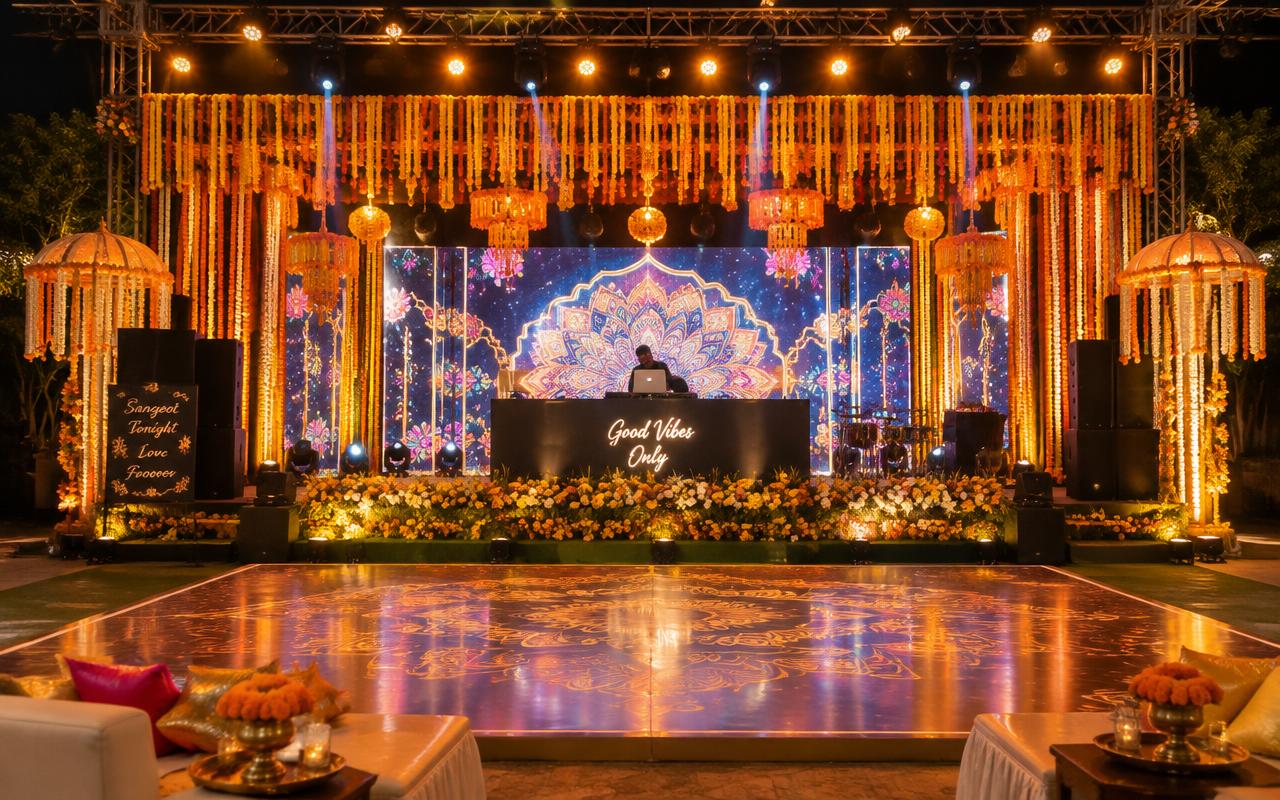
A wedding is not one event; it is four or five productions sharing a site and a crew. Mehendi wants soft daytime coverage and a live dholak that will not feed back. Sangeet needs performance-grade sound, a dance-floor rig and a cue stack that follows rehearsed choreography. The pheras demand near-silence from the system beyond gentle reinforcement of the mantras, and the reception needs speech intelligibility at conversational volume plus a band or DJ afterwards. We design each function as its own zone plan, then sequence the changeovers so the crew is never rebuilding a system while guests are in the room.
Palace courtyards, hotel lawns and banquet halls each impose different speaker positions and rigging options, and the decorator's drape plan usually gets first claim on the good ones. In Amravati that plays out at venues like Hotel Mahfil, Sant Gadge Baba grounds, Camp Area lawns, and across Camp Area, Rajapeth, Badnera Road, Shegaon Naka.
Speech is the part most often lost. Vows, speeches and the pandit's recitation sit at 65 to 75 dBA and compete with open-air ambience, clattering service and a decor team that hates visible speakers. The answer is distribution rather than volume: small cabinets on slim stands or hidden in decor every 10 to 15 metres, delayed to the source so the sound arrives coherently, with lavalier and headset microphones on separate coordinated frequencies and a technician holding a spare handheld within arm's reach of the mandap. Low frequency is deliberately restrained during ceremony so the system never muddies consonants.
What’s included
- Separate setups per function with fast changeovers
- Pixel-mapped decor lighting
- Wireless mics for vows & speeches
- LED walls for visuals & live feed
Equipment we carry
Why Amravati chooses Prime AV
- Crews and trucks positioned for fast load-in at Sant Gadge Baba grounds and venues in Rajapeth and Badnera Road.
- Zoned levels with the dance floor hot and the dining area 12 to 15 dB quieter, achieved with directional boxes rather than a single master fader.
- LED content playlist and backup on two drives
- Working knowledge of Maharashtra venue rules, power sanctions and permission timelines.
Local conditions
Producing wedding sound & lighting in Amravati
Weather & the rig
Wedding rigs live outdoors across multiple functions and multiple days, so battery fixtures, covered racks and a canopy decision taken on the forecast matter more here than on any other kind of show. Western Vidarbha is among the hottest regions in Maharashtra and May routinely reaches 45–47°C with a dry searing wind that makes any daytime outdoor rehearsal unsafe without shade and crew rotation. The region is also drought-prone, which makes water for dust suppression scarce and expensive in the pre-monsoon months. The south-west monsoon from June to September delivers the year's rain in heavy spells, and the local black cotton soil becomes a slick, load-bearing nightmare when wet — the single most underestimated ground condition in this belt. March to mid-June is too hot for daytime outdoor work and crew heat stress becomes the limiting constraint. June–September monsoon makes black-soil ground unusable for vehicles and structures alike. October to February is the season, and farmer-facing events track the post-harvest months when there is money in the belt.
Power & redundancy
Hotel lawns and heritage properties rarely offer the clean three-phase a multi-function build needs, so the generator and distribution plan is sized for the whole weekend rather than for one evening. MSEDCL supply into the city centre is adequate but the district's feeders carry heavy irrigation load and managed interruption is routine, worse in the surrounding talukas than in the city itself. Venue sanctioned loads are small, so diesel generation covers show load on almost every job; the local hire fleet is agriculture and construction oriented with a lot of older open sets, so specify silent canopies and verify the actual condition of the plant before it arrives.
Permits & noise rules
Weddings run late and loud in residential surroundings, which makes the local noise curfew and any open-flame or fireworks restriction a design constraint on the sangeet and the after-party. The Amravati Municipal Corporation allots grounds and issues pandal permissions, the district police handle assembly and traffic, and the Maharashtra Noise Pollution Rules apply with the state's characteristic seriousness — silence-zone provisions near hospitals and schools, the 10 pm outdoor amplified-sound limit, and Bombay High Court directions on festival loudspeaker use that are applied rather than ignored. Amravati has no scheduled commercial airport, which simplifies drone clearance to DGCA registration plus police intimation, and Melghat tiger reserve conditions apply to anything on that side of the district.
Load-in & access
Multi-function builds mean repeated load-ins around guests, decor teams and caterers, so dock access and the hours when trucks can move decide the changeover plan. NH-53 runs through, putting Nagpur about three hours east, and freight into the campus and industrial venues is uncomplicated. The friction is the old city — Rajkamal Chowk, Itwara Bazaar and the lanes around the temple are congested and take nothing larger than a tempo in daylight, and day-time truck entry is restricted. Monsoon-season movement onto black-soil ground needs matted access roads laid before the first vehicle, not after.
Season & booking
Ganeshotsav in August–September commits mandal-grade sound and lighting across the city for ten days and is the busiest community production period of the year. The Ambadevi Navaratri fair draws large crowds, Gudi Padwa and Akshaya Tritiya open wedding seasons, and the post-harvest window from November to February is when agri trade bodies and farmer conventions actually meet. Marathi college festival season takes January and February dates. Peak demand runs Oct–Feb.
Crew & dispatch
Run from our Nagpur depot, 155 km on NH-53 at about three hours, which keeps same-day movement practical; labour, mandap structure and barricading are hired locally in Amravati and Akola, with Nagpur supplying anything specialised. Load-in support covers Rajapeth, Badnera Road and the rest of the city.
What it costs here
Genuinely tied to the agricultural cycle — a poor cotton season visibly shrinks wedding and trade budgets across the district, and clients will say so openly. Committee-run trade bodies and cooperative institutions negotiate hard against local suppliers who work cheaply. The segments that hold up are branded agri-input and automotive dealer meets, where a national marketing standard sets the specification, and the university sector, which books predictably if modestly.
Local expectations
Vidarbha Marathi convention shapes the social and civic work: a shubharambha and lamp-lighting sequence with its own lighting state, long satkar and felicitation segments needing several roving mics, and bhajan or kirtan ensembles that want warm natural reinforcement. Farmer conventions are judged entirely on whether the speaker was intelligible at the back of a wide, open, noisy ground. Wedding work is expressive but spends on decor before AV, so the proposition is usually sound quality and a video deliverable the family will keep.
Specification
Wedding Sound & Lighting: technical specification
| Specification | Detail |
|---|---|
| Function zones | Separate designs for mehendi, sangeet, pheras, reception and after-party |
| Speech target level | 65 – 75 dBA at the guest position, distributed not centralised |
| Distributed fill spacing | One cabinet every 10 – 15 m, time-aligned to the primary source |
| Dance-floor SPL | 95 – 100 dBA for sangeet, 100 – 105 dBA for the after-party |
| Uplighter spacing | 3 m centres along drapes and perimeter walls |
| Colour reference | Single white point per function, typically 2,700 – 3,200 K for warm looks |
| Microphones | Lavalier, headset and handheld on coordinated UHF frequencies plus a held spare |
| Changeover window | 90 – 180 minutes between functions on a shared site |
| LED backdrop | P2.6 – P3.9 indoor, P4.8 outdoor, with live camera feed input |
Lighting on a wedding is architectural before it is theatrical. Battery or cabled uplighters on 3-metre centres wash drapes and walls in the palette the decorator has chosen; pixel-mapped tape and tubes carry the sangeet's beat; warm-white pin spots pick out the mandap, the cake and the entrance walkway so that photography and video have something to work with. Everything is colour-matched to one reference white point, typically around 3,000 K for warm functions, because a stage lit at 3,200 K beside decor lit at 5,600 K looks wrong in every photograph regardless of how good either looks alone.
Sizing
What size rig does your event actually need?
| Scale | Guests | Recommended setup |
|---|---|---|
| Intimate lawn | 100 – 250 | Two compact tops per side, one sub, two distributed fills, 16 uplighters, four pin spots |
| Banquet hall | 250 – 600 | Four tops per side, two subs, four delayed fills, 32 uplighters, 12 moving heads, 3 m LED backdrop |
| Hotel lawn | 600 – 1,200 | Compact array per side, four subs, six distributed fills, 60 uplighters, 24 fixtures, 6 m LED wall |
| Palace or fort | 800 – 1,500 | Zoned systems per courtyard, façade wash, battery fixtures where cabling is restricted, generator-fed |
| Multi-venue resort | 1,000 – 2,000+ | Duplicate rigs per venue, central control, 100+ uplighters, two LED walls, full travelling crew |
Scope
Wedding Sound & Lighting scope tiers in Amravati
Single Function
One evening — sangeet or reception — for 200 to 500 guests
- Compact PA with distributed fills and four wireless microphones
- Twenty-four uplighters colour-matched to the decor palette
- Eight moving heads over the stage and dance floor
- A 3 m x 2 m LED backdrop with content playback
- Sound engineer, lighting operator and one technician
Full Wedding Weekend
Three to four functions across two or three days, 400 – 1,000 guests
- Separate zone designs per function with rehearsed changeovers
- Pixel-mapped decor lighting plus pin spots on mandap, cake and entry
- Sangeet performance rig with monitors and IEM channels
- LED wall with live IMAG feed from two cameras
- Full-time crew across all functions including a show caller
Destination Production
Palace, resort and overseas weddings, 600 – 2,000 guests
- Multi-venue design across lawn, ballroom and poolside builds
- Duplicate systems so no function waits for a de-rig
- Architectural façade lighting and perimeter landscape wash
- Weatherised outdoor rig with covered racks and tented FOH
- Travelling crew, local labour coordination and spares inventory
Genuinely tied to the agricultural cycle — a poor cotton season visibly shrinks wedding and trade budgets across the district, and clients will say so openly. Committee-run trade bodies and cooperative institutions negotiate hard against local suppliers who work cheaply. The segments that hold up are branded agri-input and automotive dealer meets, where a national marketing standard sets the specification, and the university sector, which books predictably if modestly.
Venues
Where we work in Amravati
| Venue | Capacity | Production note |
|---|---|---|
| Hotel Mahfil | 400–800 across the banquet hall and lawn | The city's most dependable commercial venue, with a modest sanctioned load and a narrow service approach, so stage and LED arrive on tempos in sequence rather than in a single delivery. |
| Sant Gadge Baba grounds | 5,000–20,000 across the university and adjoining open ground | Large bare campus ground with easy vehicle access and ample room for a generator compound, but no rigging, a dusty black-soil surface that turns greasy after rain, and availability governed entirely by the academic calendar. |
| Camp Area lawns | 800–2,500 across the lawn and hall circuit | The established wedding and function belt, running on lighting-grade connections with no spare capacity and no drainage, with residential neighbours close enough that array rear-rejection matters more than output. |
| Ambadevi temple precinct and adjoining grounds | 3,000–10,000 for devotional programming | Temple-trust controlled with continuous darshan queues that cannot be obstructed, so the structure footprint is tightly constrained and every cable run has to be ramped or trenched. |
| Nandgaon Peth industrial area function spaces | 1,000–4,000 in industrial and exhibition layouts | Developing industrial estate with genuine three-phase capacity close by and unrestricted truck access, but an unsurfaced, exposed site with no wind break, so structures need engineered ballast and walkways need matting. |
Crew
Who turns up on show day
- Show caller
Runs the order of events against the family's timeline, cues entries and keeps sound, lighting and video in step.
- Sound engineer
Mixes speech, live musicians and performances, and holds the ceremony level low enough to stay transparent.
- Lighting programmer
Builds and runs the cue stack for entries, performances and the first dance, and colour-matches to decor samples.
- Microphone technician
Fits and checks lavaliers and headsets, stays within reach of the mandap, and swaps a failing pack silently.
- Changeover crew lead
Owns the clock between functions — strike, rebuild, test and clear before guests return.
What you receive
- Zone plan and speaker placement drawing per function
- Lighting plot with colour references matched to decor samples
- Microphone allocation chart naming who wears which pack
- Order-of-events cue sheet shared with the planner and the family
- LED content playlist and backup on two drives
- Power requirement schedule and generator load sheet
- Rehearsal notes and the final running order as actually run
Timeline
From enquiry to load-out
- T-8 weeks
Design and decor alignment
We take the decorator's palette, drape plan and mandap design and build the lighting and speaker placement around them.
- T-4 weeks
Function-by-function plan
Zone plans, microphone counts, changeover sequence and power requirement issued per function.
- T-2 weeks
Content and cue build
LED content, entry tracks, performance audio and the lighting cue stack are assembled and reviewed with the family.
- Show day −1
Rehearsal
Performers rehearse with full sound and lighting, entries are walked, and every microphone is checked on the actual stage.
- Day 1 to Day 3
Function days
Crew works each function live, with changeovers timed against the published guest schedule.
- Final function +4 hours
Strike
De-rig in venue-mandated order, with decor-integrated fixtures removed carefully alongside the decor team.
Risk control
What goes wrong, and how we stop it
What can go wrong
How we prevent it
- What can go wrong
Dance-floor volume at the sangeet drives older guests out of the room entirely.
How we prevent itZoned levels with the dance floor hot and the dining area 12 to 15 dB quieter, achieved with directional boxes rather than a single master fader.
- What can go wrong
The pandit's recitation is inaudible past the third row because decor blocked every sensible speaker position.
How we prevent itSpeaker positions are agreed with the decorator at the drawing stage, and we carry slim-column cabinets and decor-matched finishes for the places a box cannot be seen.
- What can go wrong
A lavalier pack fails mid-vows and the moment cannot be re-run.
How we prevent itTwo packs on the officiant and the couple where possible, a technician within arm's reach, and a dressed handheld already live on a held frequency.
- What can go wrong
Stage lighting at 3,200 K beside decor lighting at 5,600 K ruins every photograph.
How we prevent itOne white point per function agreed with the photographer and videographer, and all fixtures colour-calibrated to it at focus.
Honest comparison
Is this the right choice for your event?
- Reusing one rig across all functions instead of duplicatingOur verdict
Reuse is the right call when functions are a day apart. When two functions are six hours apart in different parts of the property, duplication costs less than the overtime, the risk and the guests watching a de-rig.
- One large central PA instead of distributed fillsOur verdict
A central system is cheaper and simpler, and fine for a compact hall. On a long lawn it forces you to make the front painfully loud to reach the back, which is precisely the complaint most wedding guests have.
- Fabric and floral backdrop instead of an LED wallOur verdict
For a traditional palette a well-built floral backdrop photographs better and costs less. LED earns its place when you want live IMAG of the entries, montage films, or looks that change between functions.
Demand
What Amravati books most
Amravati event mix
- Cotton, soybean and agri-input trade and farmer conventions
- University and college festivals, convocations and annual days
- Marathi community weddings and receptions
- Devotional programming on the Ambadevi and temple calendar
- Cooperative bank, sugar and textile industry functions
- Political rallies and public outreach events
Ideal for
Events we power with wedding sound & lighting in Amravati
Process
From brief to standing ovation
01
Brief & recce
We visit the venue, map power and rigging, and understand your show flow.
02
Design & quote
CAD plans, 3D previews and an itemised quote within 24 hours.
03
Build & rehearse
Load-in, system tuning, content checks and full technical rehearsal.
04
Show & strike
Show-caller-led execution, then a quick, clean load-out.
FAQ
Wedding Sound & Lighting in Amravati: FAQs
More services in Amravati
Wedding Sound & Lighting in nearby cities
Areas we cover in Amravati
Events in Amravati