Sound · Delhi, Delhi NCR
Wedding Sound & Lighting in Delhi
Prime AV Solutions runs wedding sound & lighting across Delhi and the rest of Delhi NCR. Own NCR base with warehousing across Okhla, Noida and Gurugram, which also makes Delhi the dispatch origin for Jaipur, Agra, Lucknow, Gwalior, Ludhiana and Amritsar. Every project is specified and quoted to its own brief.
- Lead time
- From 8 weeks
- Peak season
- Oct–Mar
- Coverage
- Delhi & Delhi NCR
Key takeaway
Wedding Sound & Lighting for Delhi’s biggest events
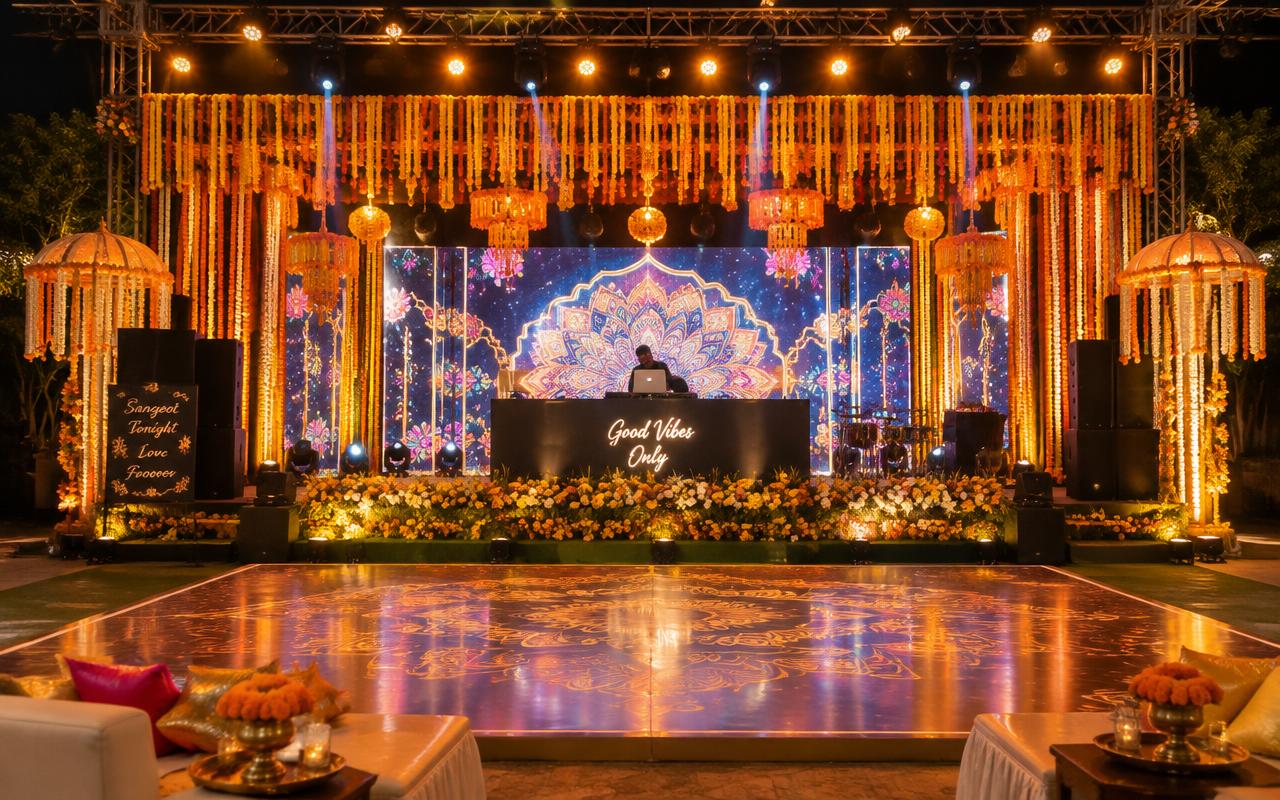
A wedding is not one event; it is four or five productions sharing a site and a crew. Mehendi wants soft daytime coverage and a live dholak that will not feed back. Sangeet needs performance-grade sound, a dance-floor rig and a cue stack that follows rehearsed choreography. The pheras demand near-silence from the system beyond gentle reinforcement of the mantras, and the reception needs speech intelligibility at conversational volume plus a band or DJ afterwards. We design each function as its own zone plan, then sequence the changeovers so the crew is never rebuilding a system while guests are in the room.
Palace courtyards, hotel lawns and banquet halls each impose different speaker positions and rigging options, and the decorator's drape plan usually gets first claim on the good ones. In Delhi that plays out at venues like Bharat Mandapam, Yashobhoomi, JLN Stadium, and across Connaught Place, Aerocity, Chattarpur, Vasant Kunj.
Speech is the part most often lost. Vows, speeches and the pandit's recitation sit at 65 to 75 dBA and compete with open-air ambience, clattering service and a decor team that hates visible speakers. The answer is distribution rather than volume: small cabinets on slim stands or hidden in decor every 10 to 15 metres, delayed to the source so the sound arrives coherently, with lavalier and headset microphones on separate coordinated frequencies and a technician holding a spare handheld within arm's reach of the mandap. Low frequency is deliberately restrained during ceremony so the system never muddies consonants.
What’s included
- Separate setups per function with fast changeovers
- Pixel-mapped decor lighting
- Wireless mics for vows & speeches
- LED walls for visuals & live feed
Equipment we carry
Why Delhi chooses Prime AV
- Crews and trucks positioned for fast load-in at Siri Fort Auditorium and venues in Kirti Nagar and Mehrauli.
- One white point per function agreed with the photographer and videographer, and all fixtures colour-calibrated to it at focus.
- Order-of-events cue sheet shared with the planner and the family
- Working knowledge of Delhi NCR venue rules, power sanctions and permission timelines.
Local conditions
Producing wedding sound & lighting in Delhi
Weather & the rig
Wedding rigs live outdoors across multiple functions and multiple days, so battery fixtures, covered racks and a canopy decision taken on the forecast matter more here than on any other kind of show. Two distinct problems bracket the season. From mid-December through January, radiation fog drops visibility under 100m and turns projection milky at any useful throw, while 3–5°C call times slow LCD response on monitors and stress LED driver boards before the first cue. Then from late October the post-harvest smoke layer pushes AQI past 400, which hazes beams attractively to the eye and reads as dirty grey on camera, so broadcast-led shows have to light for the haze rather than through it. May and June bring 45°C and loo winds that load filters within a session. Jul–Sep monsoon, where the real hazard is not rainfall volume but the short violent pre-rain squall that arrives in ten minutes and takes down an untethered outdoor structure; mid-Dec to late Jan if the design depends on projection throw.
Power & redundancy
Hotel lawns and heritage properties rarely offer the clean three-phase a multi-function build needs, so the generator and distribution plan is sized for the whole weekend rather than for one evening. NDMC, BSES and Tata Power supply in Lutyens, Aerocity and Dwarka is strong enough to run a conference on house power. The farmhouse belt is the opposite: Chattarpur and Mehrauli events are DG-primary, typically a synchronised pair of 250 kVA silent sets with auto-changeover. The complication unique to Delhi is GRAP — once the Commission for Air Quality Management escalates to the higher stages in winter, diesel generator use is curtailed unless the set is retrofitted or dual-fuel, so a December outdoor show needs its power strategy approved before the stage design is signed.
Permits & noise rules
Weddings run late and loud in residential surroundings, which makes the local noise curfew and any open-flame or fireworks restriction a design constraint on the sangeet and the after-party. Amplified sound and temporary-structure NOCs route through the Delhi Police Licensing Branch, with ground permission from MCD, NDMC or DDA depending on whose land it is, and a Delhi Fire Service NOC for any pandal or raised structure. DPCC applies the noise rules and the 10pm loudspeaker cut-off. Drone operation is close to impossible on a normal timeline: most of the city falls inside the IGI red zone or a VVIP restriction, and anything beyond that needs clearance that goes well past a Digital Sky permission.
Load-in & access
Multi-function builds mean repeated load-ins around guests, decor teams and caterers, so dock access and the hours when trucks can move decide the changeover plan. Goods-vehicle restrictions keep trucks out of much of the city through the day, so inventory moves from Okhla, Noida or Gurugram warehousing after 11pm. Pragati Maidan is easier since the tunnel opened, but ITPO gate passes have to be lodged days ahead. Yashobhoomi has purpose-built docks. The genuine trap is the farmhouse circuit, where a single narrow gate is shared with guest arrival, so load-in must be finished and the gate cleared before the first car turns in.
Season & booking
India International Trade Fair at Pragati Maidan through the second half of November absorbs every truss section, rigger and forklift in the NCR. Republic Day locks central Delhi for most of January with rehearsal closures from early in the month, state visits close roads without notice, Diwali week empties the labour pool, and the November-December and February muhurat clusters book out the farmhouse belt a year ahead. Peak demand runs Oct–Mar.
Crew & dispatch
Own NCR base with warehousing across Okhla, Noida and Gurugram, which also makes Delhi the dispatch origin for Jaipur, Agra, Lucknow, Gwalior, Ludhiana and Amritsar. Load-in support covers Kirti Nagar, Mehrauli and the rest of the city.
What it costs here
The deepest supplier pool in the country sits here, which makes Delhi the cheapest place in India to hire kit — a comparable conference rig quotes well below its Mumbai equivalent — and clients negotiate accordingly. The margin lives in engineering, crew quality and compliance paperwork, not in equipment day rates.
Local expectations
Protocol is the deliverable at government and diplomatic events: dais seating order, the lamp-lighting sequence, anthem cues, correct honorifics in the script and a VIP arrival time that will move by forty minutes without warning. Bilingual Hindi and English scripting is assumed, as is a clean press feed. Punjabi weddings here expect high SPL and a finish past the curfew, which is why experienced producers push those clients towards acoustically contained indoor venues rather than fighting the enforcement.
Specification
Wedding Sound & Lighting: technical specification
| Specification | Detail |
|---|---|
| Function zones | Separate designs for mehendi, sangeet, pheras, reception and after-party |
| Speech target level | 65 – 75 dBA at the guest position, distributed not centralised |
| Distributed fill spacing | One cabinet every 10 – 15 m, time-aligned to the primary source |
| Dance-floor SPL | 95 – 100 dBA for sangeet, 100 – 105 dBA for the after-party |
| Uplighter spacing | 3 m centres along drapes and perimeter walls |
| Colour reference | Single white point per function, typically 2,700 – 3,200 K for warm looks |
| Microphones | Lavalier, headset and handheld on coordinated UHF frequencies plus a held spare |
| Changeover window | 90 – 180 minutes between functions on a shared site |
| LED backdrop | P2.6 – P3.9 indoor, P4.8 outdoor, with live camera feed input |
Lighting on a wedding is architectural before it is theatrical. Battery or cabled uplighters on 3-metre centres wash drapes and walls in the palette the decorator has chosen; pixel-mapped tape and tubes carry the sangeet's beat; warm-white pin spots pick out the mandap, the cake and the entrance walkway so that photography and video have something to work with. Everything is colour-matched to one reference white point, typically around 3,000 K for warm functions, because a stage lit at 3,200 K beside decor lit at 5,600 K looks wrong in every photograph regardless of how good either looks alone.
Sizing
What size rig does your event actually need?
| Scale | Guests | Recommended setup |
|---|---|---|
| Intimate lawn | 100 – 250 | Two compact tops per side, one sub, two distributed fills, 16 uplighters, four pin spots |
| Banquet hall | 250 – 600 | Four tops per side, two subs, four delayed fills, 32 uplighters, 12 moving heads, 3 m LED backdrop |
| Hotel lawn | 600 – 1,200 | Compact array per side, four subs, six distributed fills, 60 uplighters, 24 fixtures, 6 m LED wall |
| Palace or fort | 800 – 1,500 | Zoned systems per courtyard, façade wash, battery fixtures where cabling is restricted, generator-fed |
| Multi-venue resort | 1,000 – 2,000+ | Duplicate rigs per venue, central control, 100+ uplighters, two LED walls, full travelling crew |
Scope
Wedding Sound & Lighting scope tiers in Delhi
Single Function
One evening — sangeet or reception — for 200 to 500 guests
- Compact PA with distributed fills and four wireless microphones
- Twenty-four uplighters colour-matched to the decor palette
- Eight moving heads over the stage and dance floor
- A 3 m x 2 m LED backdrop with content playback
- Sound engineer, lighting operator and one technician
Full Wedding Weekend
Three to four functions across two or three days, 400 – 1,000 guests
- Separate zone designs per function with rehearsed changeovers
- Pixel-mapped decor lighting plus pin spots on mandap, cake and entry
- Sangeet performance rig with monitors and IEM channels
- LED wall with live IMAG feed from two cameras
- Full-time crew across all functions including a show caller
Destination Production
Palace, resort and overseas weddings, 600 – 2,000 guests
- Multi-venue design across lawn, ballroom and poolside builds
- Duplicate systems so no function waits for a de-rig
- Architectural façade lighting and perimeter landscape wash
- Weatherised outdoor rig with covered racks and tented FOH
- Travelling crew, local labour coordination and spares inventory
The deepest supplier pool in the country sits here, which makes Delhi the cheapest place in India to hire kit — a comparable conference rig quotes well below its Mumbai equivalent — and clients negotiate accordingly. The margin lives in engineering, crew quality and compliance paperwork, not in equipment day rates.
Venues
Where we work in Delhi
| Venue | Capacity | Production note |
|---|---|---|
| Bharat Mandapam | Around 7,000 in the plenary hall with multiple halls across the ITPO complex | Everything goes through the ITPO process — gate passes, approved-vendor paperwork and security screening of every case — so the build calendar has to start 72 hours before a build that would take one night anywhere else. |
| Yashobhoomi | Around 11,000 in the main auditorium plus very large convention and exhibition halls | The sheer footprint is the constraint: control positions end up a long way from stage, so fibre and signal distribution rather than copper multicore decides whether the design works. |
| JLN Stadium | Around 60,000 in the bowl, with the infield used for staged events | SAI holds the approvals, the athletics track and infield need full protection boarding, and the roof carries no event rigging at all, so even a modest stage needs ground-support towers with ballast calculations. |
| Siri Fort Auditorium | Around 1,200 seated | A fixed proscenium house with house rigging and a locked projection throw, so any design that wants a different screen position has to solve it with ground support in the wings. |
| Chattarpur farmhouse venues | Typically 1,000–5,000 across lawns and covered structures | Driveways are gravel or kutcha and will not take a loaded trailer without ground-protection boards, and almost every one of them is generated end to end with no usable house feed. |
Crew
Who turns up on show day
- Show caller
Runs the order of events against the family's timeline, cues entries and keeps sound, lighting and video in step.
- Sound engineer
Mixes speech, live musicians and performances, and holds the ceremony level low enough to stay transparent.
- Lighting programmer
Builds and runs the cue stack for entries, performances and the first dance, and colour-matches to decor samples.
- Microphone technician
Fits and checks lavaliers and headsets, stays within reach of the mandap, and swaps a failing pack silently.
- Changeover crew lead
Owns the clock between functions — strike, rebuild, test and clear before guests return.
What you receive
- Zone plan and speaker placement drawing per function
- Lighting plot with colour references matched to decor samples
- Microphone allocation chart naming who wears which pack
- Order-of-events cue sheet shared with the planner and the family
- LED content playlist and backup on two drives
- Power requirement schedule and generator load sheet
- Rehearsal notes and the final running order as actually run
Timeline
From enquiry to load-out
- T-8 weeks
Design and decor alignment
We take the decorator's palette, drape plan and mandap design and build the lighting and speaker placement around them.
- T-4 weeks
Function-by-function plan
Zone plans, microphone counts, changeover sequence and power requirement issued per function.
- T-2 weeks
Content and cue build
LED content, entry tracks, performance audio and the lighting cue stack are assembled and reviewed with the family.
- Show day −1
Rehearsal
Performers rehearse with full sound and lighting, entries are walked, and every microphone is checked on the actual stage.
- Day 1 to Day 3
Function days
Crew works each function live, with changeovers timed against the published guest schedule.
- Final function +4 hours
Strike
De-rig in venue-mandated order, with decor-integrated fixtures removed carefully alongside the decor team.
Risk control
What goes wrong, and how we stop it
What can go wrong
How we prevent it
- What can go wrong
Stage lighting at 3,200 K beside decor lighting at 5,600 K ruins every photograph.
How we prevent itOne white point per function agreed with the photographer and videographer, and all fixtures colour-calibrated to it at focus.
- What can go wrong
The changeover between pheras and reception overruns and guests walk into a half-built room.
How we prevent itChangeovers are rehearsed as a timed drill, and anything that cannot be struck in the window is duplicated rather than moved.
- What can go wrong
An evening shower on a lawn build takes out uplighters and a stage-left amplifier rack.
How we prevent itIP-rated battery fixtures on decor positions, racks on raised deck under hard cover, and a canopy plan that goes up on a forecast rather than on a drop.
- What can go wrong
Dance-floor volume at the sangeet drives older guests out of the room entirely.
How we prevent itZoned levels with the dance floor hot and the dining area 12 to 15 dB quieter, achieved with directional boxes rather than a single master fader.
Honest comparison
Is this the right choice for your event?
- Decorator-supplied lighting instead of a lighting designerOur verdict
Decorators do beautiful static looks and often include uplighting in their package. If nothing needs to change on a cue, take it. The moment there are entries, performances and a first dance, you need a programmer and a cue stack.
- Reusing one rig across all functions instead of duplicatingOur verdict
Reuse is the right call when functions are a day apart. When two functions are six hours apart in different parts of the property, duplication costs less than the overtime, the risk and the guests watching a de-rig.
- One large central PA instead of distributed fillsOur verdict
A central system is cheaper and simpler, and fine for a compact hall. On a long lawn it forces you to make the front painfully loud to reach the back, which is precisely the complaint most wedding guests have.
Demand
What Delhi books most
Delhi event mix
- Government, ministry and multilateral summits
- Trade exhibitions and industry association conventions
- Large farmhouse and hotel weddings
- Corporate conferences, dealer meets and award nights
- Product launches and auto reveals
- Political rallies and public functions
Ideal for
Events we power with wedding sound & lighting in Delhi
Process
From brief to standing ovation
01
Brief & recce
We visit the venue, map power and rigging, and understand your show flow.
02
Design & quote
CAD plans, 3D previews and an itemised quote within 24 hours.
03
Build & rehearse
Load-in, system tuning, content checks and full technical rehearsal.
04
Show & strike
Show-caller-led execution, then a quick, clean load-out.
FAQ
Wedding Sound & Lighting in Delhi: FAQs
More services in Delhi
Wedding Sound & Lighting in nearby cities
Areas we cover in Delhi
Events in Delhi