Lighting & Stage
Intelligent Moving Head Lights across India
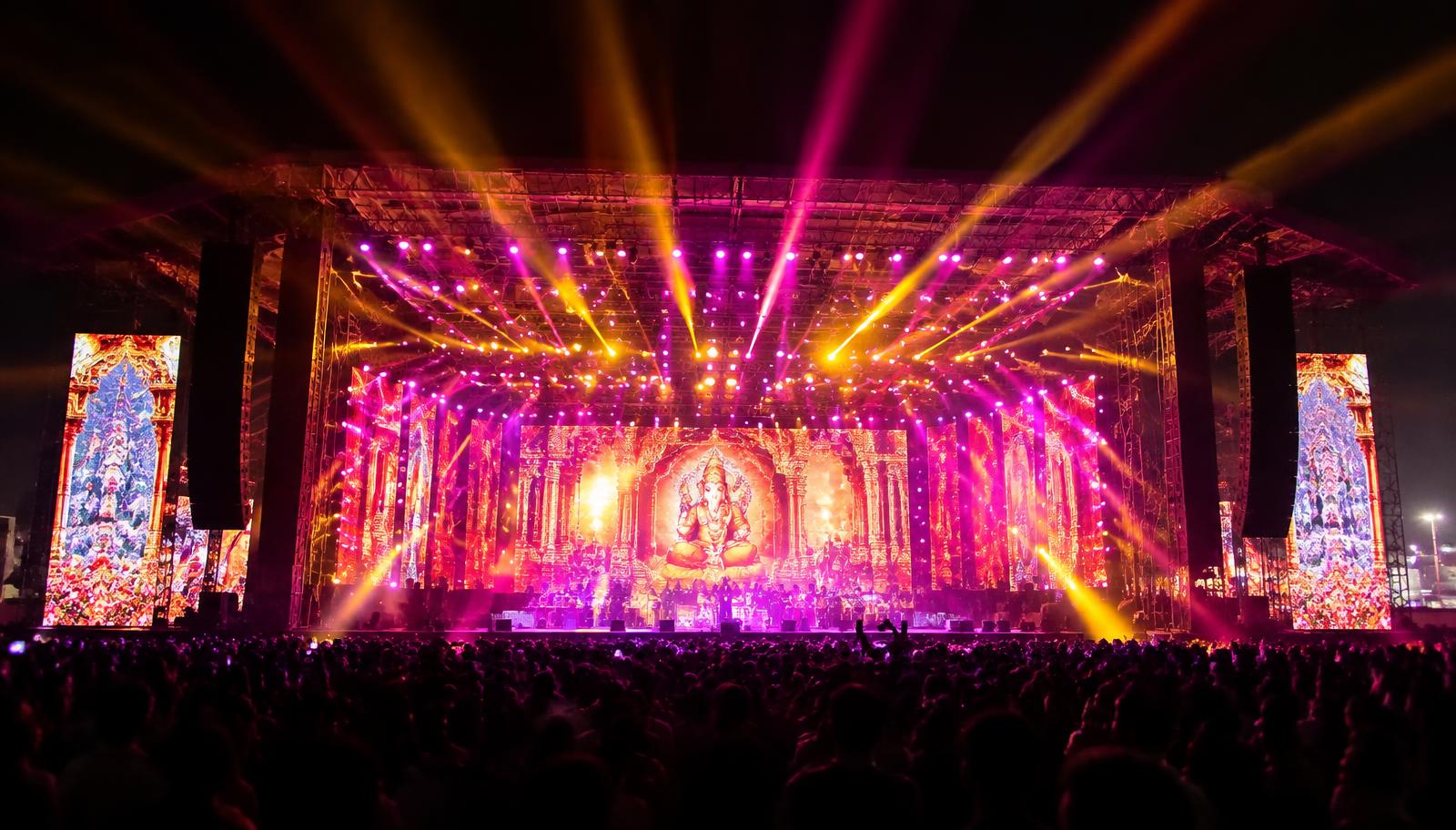
Beams, spots, washes and hybrids from Robe, Clay Paky and Martin — deployed in rigs of 24 to 300 fixtures with programmers on site.
- Lead time
- T-4 weeks
- Category
- Lighting & Stage
- Coverage
- 90+ Indian cities
Key takeaway
How we deliver intelligent moving head lights
This is the fixture rig itself: the hardware, the trussing it hangs on, the power and data that feed it, and the technicians who keep every unit alive. A moving head rig is specified by fixture type against the job each one does. Beam fixtures like the Clay Paky Sharpy class throw a tight, dense column that reads as a solid shaft in haze. Spots carry gobos, prisms, animation wheels and a sharp focus for mid-air and surface texture. Washes flood the stage and the audience with colour. Hybrids such as the Robe MegaPointe and Clay Paky Mythos do all three at the cost of being a compromise at each — frequently the right compromise when truss space and budget are both finite.
Source matters as much as fixture category. Discharge lamps still produce the hardest, brightest beams and remain the choice for aerial work, while LED engines have taken over wash and profile duties with better colour mixing, instant strike and far less heat and power. A 1,700 W discharge profile on a 16 A circuit is a very different proposition from four 500 W LED washes on the same circuit, and the circuit schedule for a mixed rig has to be worked out fixture by fixture. For outdoor and monsoon-exposed positions we specify IP65-rated fixtures rather than building rain hats, because a rain hat changes the beam and never quite works.
The rig is only as good as its data and its maintenance. Fixtures are addressed and recorded on a patch sheet, data runs in short DMX chains off multiple sACN nodes rather than one long daisy chain, and every chain is terminated. A dedicated fixture technician pre-builds and burns in every unit in the warehouse, checks pan and tilt calibration, cleans optics and verifies gobo and colour wheel alignment, because a misaligned gobo wheel on a unit at the back of a 60-fixture rig is invisible at focus and obvious in a photograph. Spares travel as complete fixtures, not as parts.
What you get
- Robe, Clay Paky, Martin fixtures
- Beam, spot, wash & hybrid
- Laser & strobe effects
- Followspots with operators
Equipment we carry
Ideal for
Specification
Intelligent Moving Head Lights: technical specification
| Specification | Detail |
|---|---|
| Beam fixtures | Clay Paky Sharpy class, approximately 189 W discharge, very narrow dense beam |
| Hybrid fixtures | Robe MegaPointe and Clay Paky Mythos class, beam, spot and wash in one body |
| Large profiles | Robe BMFL and Esprite class, up to 1,700 W discharge or high-output LED engine |
| Wash fixtures | LED wash and zoom units with RGBW or additive multi-emitter colour mixing |
| Rig sizes | 24 – 300 fixtures across front truss, mid trusses, uprights and floor positions |
| Outdoor rating | IP65 fixtures for exposed positions rather than improvised rain covers |
| Data topology | Multiple sACN nodes feeding short terminated DMX chains, never one long daisy chain |
| Power per circuit | Load calculated fixture by fixture; a single 1,700 W profile can occupy most of a 16 A way |
| Followspots | Long-throw profiles on operated positions with comms and iris control |
| Spares policy | Five to ten per cent complete spare fixtures rather than component-level spares |
Sizing
What size rig does your event actually need?
| Scale | Guests | Recommended setup |
|---|---|---|
| Conference stage | 200 – 600 | 24 fixtures: 12 wash, 8 beam, 4 profile, two universes, single truss |
| Sangeet or launch | 400 – 1,000 | 40 – 60 fixtures across front truss and four uprights, plus a floor package |
| Award night | 1,000 – 3,000 | 80 – 120 fixtures on three truss levels, two followspots, audience wash |
| Concert stage | 5,000 – 15,000 | 150 – 200 fixtures over roof and side trusses, floor beams, IP65 on exposed positions |
| Festival main stage | 20,000+ | 250 – 300 fixtures, maintenance bench on site, ten per cent complete spares |
Scope
Moving Head Light Rental scope tiers
Compact Rig
24 – 40 fixtures for sangeets, launches and conference stages
- Twelve washes, twelve beams and four profiles on front and mid truss
- sACN nodes with terminated data chains and a printed patch sheet
- One hazer and a load-balanced power schedule
- Five per cent complete spare fixtures on site
- Fixture technician and an operator
Performance Rig
60 – 120 fixtures for concerts, award nights and large sangeets
- Mixed beam, hybrid, profile and wash rig across multiple truss levels
- Floor package with uplights and audience wash positions
- Two followspot positions with operators and comms
- Redundant data distribution with node-level failover
- Fixture technicians, dimmer tech and a crew chief
Arena Rig
150 – 300 fixtures for arena concerts and festival main stages
- Full fixture inventory across roof, side and floor positions
- IP65 fixtures on every exposed outdoor position
- Warehouse pre-build and burn-in of the complete rig before despatch
- Ten per cent complete spares travelling with the show
- Full lighting crew with fixture techs, riggers and a maintenance bench on site
Crew
Who turns up on show day
- Fixture technician
Pre-builds and burns in every unit, checks pan and tilt calibration and gobo alignment, and swaps a failing fixture mid-run.
- Dimmer and power technician
Builds the distribution, balances load across phases and monitors current draw as the rig comes up.
- Data technician
Places sACN nodes, keeps DMX chains short and terminated, and traces a flickering fixture back to its cable rather than its body.
- Rigger
Hangs fixtures to the plot, checks clamp and safety-bond discipline on every unit and manages truss trim.
- Followspot operator
Works a long-throw profile on cue, holding a performer in frame through movement and changes of level.
What you receive
- Fixture inventory listing make, model and quantity by position
- Printed and digital patch sheet with every DMX address
- Power schedule with circuit-level loads and phase balance
- Data topology drawing showing node placement and chain lengths
- Pre-build and burn-in test record for the rig as despatched
- Focus notes recording each fixture's assigned purpose
- Fault log recording any unit swapped during the run
Timeline
From enquiry to load-out
- T-4 weeks
Fixture specification
Fixture types matched to their jobs — beam, spot, wash, hybrid — against the plot and the available truss space.
- T-3 weeks
Power and data schedule
Circuit-by-circuit load calculation, phase balance, node placement and the addressing plan issued.
- T-4 days
Warehouse pre-build
Every fixture burned in, calibrated, optics cleaned, addressed and tested as a complete rig before it is cased.
- Show day −1
Hang and address
Fixtures hung to plot with safety bonds, data chains terminated, addresses verified unit by unit against the patch sheet.
- Show day −1 evening
Focus
Each fixture focused to its purpose with the set in place, and any mechanical fault found and swapped before programming.
- Show day to +4 hours
Show and strike
Technicians hold positions during the show to catch a failure, then the rig is struck and cased in hang order.
Risk control
What goes wrong, and how we stop it
What can go wrong
How we prevent it
- What can go wrong
One long DMX daisy chain across sixty fixtures produces intermittent flicker nobody can locate.
How we prevent itData is distributed from multiple sACN nodes into short terminated chains, so a fault is isolated to a handful of fixtures and found in minutes.
- What can go wrong
A mixed rig of discharge profiles and LED washes trips a circuit because load was estimated by fixture count.
How we prevent itLoad is calculated fixture by fixture from actual draw, not averaged, with phases balanced and the schedule checked against measured current at power-up.
- What can go wrong
A gobo wheel is a few degrees out on a rear fixture — invisible at focus, obvious in every photograph.
How we prevent itCalibration and wheel alignment are verified during warehouse burn-in, and the focus pass includes a gobo and prism check on every unit rather than a spot sample.
- What can go wrong
Rain reaches non-rated fixtures on an outdoor upright and three units fail during the show.
How we prevent itExposed positions are specified with IP65 fixtures from the outset, because improvised rain hats alter the beam and still let water in from below.
- What can go wrong
Fixtures are hung with clamps but no safety bonds under time pressure.
How we prevent itBonding is a non-negotiable item on the rigging checklist, signed off position by position before the truss goes to trim.
- What can go wrong
A fixture fails mid-show and there is no way to replace it without dropping the truss.
How we prevent itComplete spare fixtures travel with the rig, critical positions are doubled where the plot allows, and the stack is built so a dead unit's job can be reassigned live.
Honest comparison
Is this the right choice for your event?
- Hybrid fixtures instead of separate beams, spots and washesOur verdict
Hybrids are the efficient answer when truss space, power or budget is tight — one body, three jobs. They are measurably weaker than a dedicated beam in haze and than a dedicated wash on skin tone, so a large design still wants purpose-built fixtures.
- LED fixtures instead of discharge lampsOur verdict
LED wins on power, heat, colour mixing and instant strike, and is now the default for wash and profile work. Discharge still produces the hardest, brightest aerial beam, so a rig that needs mid-air shafts in a big room usually keeps discharge units.
- Fewer high-output fixtures instead of many small onesOur verdict
Fewer large units give cleaner beams, less truss clutter and fewer things to fail. Many small units give you density, symmetry and the layered look that reads on camera. The right answer depends on whether the rig is seen as an object or used as a tool.
- Static LED pars and blinders instead of moving headsOur verdict
Genuinely the better buy for a gala or a dinner where the look never changes, and far cheaper per fixture. Moving heads justify themselves the moment the show needs different states for different segments.
Process
How we deliver
01
Brief & recce
We visit the venue, map power and rigging, and understand your show flow.
02
Design & quote
CAD plans, 3D previews and an itemised quote within 24 hours.
03
Build & rehearse
Load-in, system tuning, content checks and full technical rehearsal.
04
Show & strike
Show-caller-led execution, then a quick, clean load-out.
Locations
Moving Head Light Rental by city
Tier 1 metros
Tier 2 cities
FAQ