Lighting & Stage · Udaipur, Rajasthan
Moving Head Light Rental in Udaipur
In Udaipur, multi-day destination weddings at palace and lake properties set the standard everything else is measured against. Our intelligent moving head lights is specified to clear that bar at Oberoi Udaivilas and anywhere else in the city.
- Lead time
- From 4 weeks
- Peak season
- Oct–Mar
- Coverage
- Udaipur & Rajasthan
Key takeaway
Intelligent Moving Head Lights for Udaipur’s biggest events
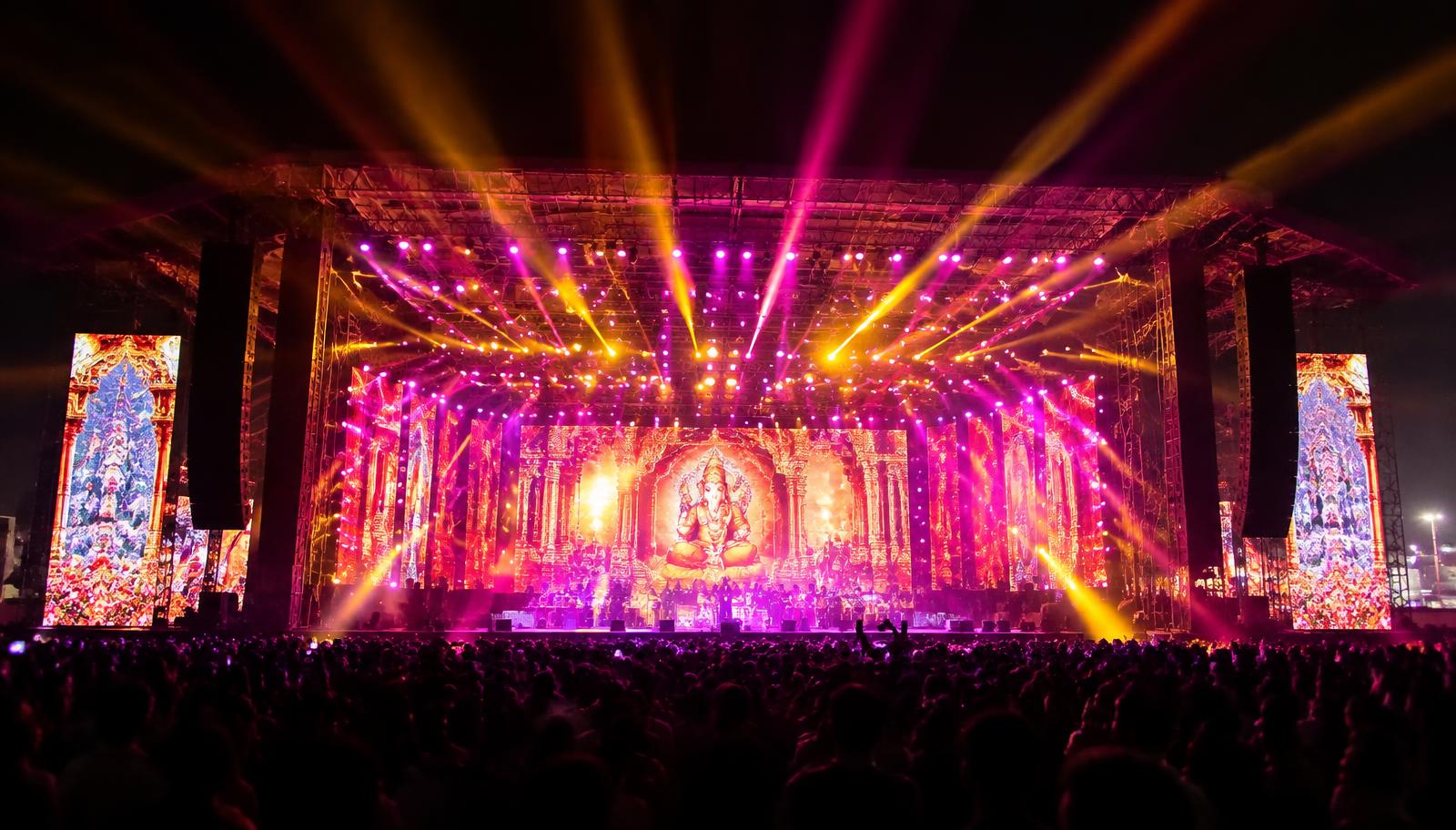
This is the fixture rig itself: the hardware, the trussing it hangs on, the power and data that feed it, and the technicians who keep every unit alive. A moving head rig is specified by fixture type against the job each one does. Beam fixtures like the Clay Paky Sharpy class throw a tight, dense column that reads as a solid shaft in haze. Spots carry gobos, prisms, animation wheels and a sharp focus for mid-air and surface texture. Washes flood the stage and the audience with colour. Hybrids such as the Robe MegaPointe and Clay Paky Mythos do all three at the cost of being a compromise at each — frequently the right compromise when truss space and budget are both finite.
Truss positions, trim height and what the ceiling will carry determine the fixture count directly, because a rig that cannot be hung where it was drawn is a different rig. In Udaipur that plays out at venues like Oberoi Udaivilas, Taj Lake Palace, The Leela Palace Udaipur, and across Lake Pichola, Fateh Sagar, Sukher, Hiran Magri.
Source matters as much as fixture category. Discharge lamps still produce the hardest, brightest beams and remain the choice for aerial work, while LED engines have taken over wash and profile duties with better colour mixing, instant strike and far less heat and power. A 1,700 W discharge profile on a 16 A circuit is a very different proposition from four 500 W LED washes on the same circuit, and the circuit schedule for a mixed rig has to be worked out fixture by fixture. For outdoor and monsoon-exposed positions we specify IP65-rated fixtures rather than building rain hats, because a rain hat changes the beam and never quite works.
What’s included
- Robe, Clay Paky, Martin fixtures
- Beam, spot, wash & hybrid
- Laser & strobe effects
- Followspots with operators
Equipment we carry
Why Udaipur chooses Prime AV
- Crews and trucks positioned for fast load-in at The Leela Palace Udaipur and venues in Sukher and Hiran Magri.
- Data is distributed from multiple sACN nodes into short terminated chains, so a fault is isolated to a handful of fixtures and found in minutes.
- Fault log recording any unit swapped during the run
- Working knowledge of Rajasthan venue rules, power sanctions and permission timelines.
Local conditions
Producing moving head light rental in Udaipur
Weather & the rig
Fixtures are the hardware most exposed to the elements — heat shortens lamp and LED life, dust clogs optics and fans, and only IP65 units belong on an exposed upright. The Aravalli setting moderates the heat compared with the rest of Rajasthan, but April to June still reaches 40–42°C and the pre-monsoon dust arrives on the wind. The decisive local factors are the lakes: evening breeze off Pichola and Fateh Sagar loads any tall outdoor structure and makes the barge crossing a weather call rather than a formality, overnight humidity near the water is high enough to leave real dew on an open rig, and the July to September monsoon — heavier here than in western Rajasthan — both raises the lake level and makes island work genuinely hazardous. December and January nights fall to 6–8°C, which matters for outdoor dinners and for battery life in wireless packs. April to June heat and dust make daytime outdoor work unviable, and July to September monsoon makes island and barge operations unsafe while filling the lakes. The season is October to March, and the peak dates within it are held by planners a year or more ahead. Late December nights are cold enough to need heating designed into the guest experience.
Power & redundancy
A mixed rig of discharge profiles and LED washes has wildly uneven per-fixture draw, so the circuit schedule and phase balance are calculated unit by unit against the supply available. Palace and luxury properties protect their own supply and release nothing meaningful for event load, so every serious job here is fully generator-fed. Two local constraints make this harder than elsewhere: silent canopies are not negotiable because the DG compound will sit within earshot of suites that cost what they cost, and island venues mean the generator itself is barged across and positioned where fuel can be replenished without a boat run mid-show. Full redundancy with automatic changeover is standard, and a stabilised feed for the control and media world is sensible given the long cable runs.
Permits & noise rules
Moving beams reach a long way after dark, so aiming restrictions and light-spill conditions near residences and roads shape where the aerial looks can point. The Udaipur Municipal Corporation handles ground and public-space permissions and the district administration and police license assembly, with the Rajasthan noise rules and the 10 pm outdoor amplified-sound limit applying — and lake-area restrictions that are tighter in practice, because sound carries across open water far better than planners expect. Palace and island venues require the City Palace trust or the respective property's heritage approvals, with conservation conditions on fixings, structure proximity and lighting heat. Boat and barge movement on Pichola needs the lake and tourism authority's consent. Maharana Pratap airport at Dabok is 22 km out, but drone work over the lakes and palaces needs DGCA clearance plus the palace administration's permission and is often refused on privacy grounds for private events.
Load-in & access
Fixture cases are numerous and heavy and must arrive in hang order, so dock access and the number of available hands decide how much rig can be up before focus. Everything about Udaipur's logistics is harder than its glamour suggests. Trucks from Jaipur, 400 km and about seven hours on NH-48, or Ahmedabad, 260 km and four and a half, reach the city easily and then stop at the old city boundary — the lanes around Jagdish Chowk and Gangaur Ghat take nothing wider than a tempo and the final stretch is porterage. Island venues add a boat or barge transfer with weight limits, a weather call and a lake-level constraint on draft. A build that would take one day in a city ballroom takes three or four here, and the crew accommodation that makes that possible is itself scarce and expensive during season.
Season & booking
The wedding grid from late October to March is the city's economy, with the auspicious dates held a year or more in advance and every palace room, boat, crane and crew member committed. The Mewar Festival at Gangaur in March or April, Shilpgram Utsav in the last ten days of December, and the lakeside music festival in February take their own dates and absorb local crew. Holi's Mewar Festival procession from the City Palace is a fixed civic event, and the monsoon months are when properties close for refurbishment. Peak demand runs Oct–Mar.
Crew & dispatch
Local crew, consumables and boat contractors retained in Udaipur year-round because the market demands it, with the heavy rig trucked from our Jaipur depot — 400 km on NH-48, about seven hours loaded — or from Ahmedabad when Jaipur is at its own peak; specialist control, camera and automation packages fly in from Mumbai or Delhi for international briefs. Load-in support covers Sukher, Hiran Magri and the rest of the city.
What it costs here
The highest-paying market in this entire set and the only one where international riders are routine. Buyers are Delhi, Mumbai and overseas planners working to a specification sheet, and they expect — and accept — a premium that reflects barge transfer, porterage, multi-day builds, heritage handling and scarce peak-season crew accommodation. The corollary is that scrutiny is high, named-brand equipment is specified rather than requested, and a vague quote loses the job. Pricing this market honestly means showing the logistics lines rather than burying them.
Local expectations
Mewar palace weddings are the most produced private events in India and the brief is always the same contradiction: enormous scale with no visible machinery. Clients want the lake, the sandstone and the marble to be the subject, so warm 2700 K washes on architecture, concealed truss, cable buried or dressed out of every camera angle, and a lighting look that reads at dusk across water. Sequences run over three or four days — mehendi, sangeet, pheras, reception — each with its own look, and the pheras are frequently timed to a pre-dawn muhurat. Manganiyar and Langa folk ensembles and classical Kathak are expected and need gentle acoustic support; the sangeet, by contrast, runs at full concert level until the curfew forces it indoors or onto a boat.
Specification
Intelligent Moving Head Lights: technical specification
| Specification | Detail |
|---|---|
| Beam fixtures | Clay Paky Sharpy class, approximately 189 W discharge, very narrow dense beam |
| Hybrid fixtures | Robe MegaPointe and Clay Paky Mythos class, beam, spot and wash in one body |
| Large profiles | Robe BMFL and Esprite class, up to 1,700 W discharge or high-output LED engine |
| Wash fixtures | LED wash and zoom units with RGBW or additive multi-emitter colour mixing |
| Rig sizes | 24 – 300 fixtures across front truss, mid trusses, uprights and floor positions |
| Outdoor rating | IP65 fixtures for exposed positions rather than improvised rain covers |
| Data topology | Multiple sACN nodes feeding short terminated DMX chains, never one long daisy chain |
| Power per circuit | Load calculated fixture by fixture; a single 1,700 W profile can occupy most of a 16 A way |
| Followspots | Long-throw profiles on operated positions with comms and iris control |
| Spares policy | Five to ten per cent complete spare fixtures rather than component-level spares |
The rig is only as good as its data and its maintenance. Fixtures are addressed and recorded on a patch sheet, data runs in short DMX chains off multiple sACN nodes rather than one long daisy chain, and every chain is terminated. A dedicated fixture technician pre-builds and burns in every unit in the warehouse, checks pan and tilt calibration, cleans optics and verifies gobo and colour wheel alignment, because a misaligned gobo wheel on a unit at the back of a 60-fixture rig is invisible at focus and obvious in a photograph. Spares travel as complete fixtures, not as parts.
Sizing
What size rig does your event actually need?
| Scale | Guests | Recommended setup |
|---|---|---|
| Conference stage | 200 – 600 | 24 fixtures: 12 wash, 8 beam, 4 profile, two universes, single truss |
| Sangeet or launch | 400 – 1,000 | 40 – 60 fixtures across front truss and four uprights, plus a floor package |
| Award night | 1,000 – 3,000 | 80 – 120 fixtures on three truss levels, two followspots, audience wash |
| Concert stage | 5,000 – 15,000 | 150 – 200 fixtures over roof and side trusses, floor beams, IP65 on exposed positions |
| Festival main stage | 20,000+ | 250 – 300 fixtures, maintenance bench on site, ten per cent complete spares |
Scope
Moving Head Light Rental scope tiers in Udaipur
Compact Rig
24 – 40 fixtures for sangeets, launches and conference stages
- Twelve washes, twelve beams and four profiles on front and mid truss
- sACN nodes with terminated data chains and a printed patch sheet
- One hazer and a load-balanced power schedule
- Five per cent complete spare fixtures on site
- Fixture technician and an operator
Performance Rig
60 – 120 fixtures for concerts, award nights and large sangeets
- Mixed beam, hybrid, profile and wash rig across multiple truss levels
- Floor package with uplights and audience wash positions
- Two followspot positions with operators and comms
- Redundant data distribution with node-level failover
- Fixture technicians, dimmer tech and a crew chief
Arena Rig
150 – 300 fixtures for arena concerts and festival main stages
- Full fixture inventory across roof, side and floor positions
- IP65 fixtures on every exposed outdoor position
- Warehouse pre-build and burn-in of the complete rig before despatch
- Ten per cent complete spares travelling with the show
- Full lighting crew with fixture techs, riggers and a maintenance bench on site
The highest-paying market in this entire set and the only one where international riders are routine. Buyers are Delhi, Mumbai and overseas planners working to a specification sheet, and they expect — and accept — a premium that reflects barge transfer, porterage, multi-day builds, heritage handling and scarce peak-season crew accommodation. The corollary is that scrutiny is high, named-brand equipment is specified rather than requested, and a vague quote loses the job. Pricing this market honestly means showing the logistics lines rather than burying them.
Venues
Where we work in Udaipur
| Venue | Capacity | Production note |
|---|---|---|
| Oberoi Udaivilas | 400–800 across the courtyards, lawns and domed pavilions | Built to a deliberate architectural symmetry the property protects absolutely — structures must not break a sightline or a reflection in the water channels, no fixings into any surface, and the generator compound sits far enough out that cable runs are long and must be fully concealed. |
| Taj Lake Palace | 200–500 across the courtyards and terraces of the island palace | The hardest venue in the country to build in: the entire island is reached only by boat from the City Palace jetty, every case, truss section and generator goes across on a launch with a weight limit and a weather call, and the marble courtyards take no ground penetration and very limited point load. Budget twice the load-in time of any mainland venue and a contingency boat window. |
| The Leela Palace Udaipur | 300–700 across the lawns, terraces and ballroom | Lakefront property on the eastern shore with a road approach, which makes it the most practical of the premium venues, though the terraced level changes mean long hand-carry stretches and the lake-facing lawn is exposed to an evening breeze that loads any tall structure. |
| Jagmandir Island Palace | 500–1,200 across the Gul Mahal courtyard and garden terraces | Another boat-only island, under the City Palace trust, where the barge schedule governs the build entirely; lake water level determines the draft and therefore what a barge can carry, and the heritage conditions prohibit fixings and restrict lighting heat near the stonework. |
| City Palace complex and the Manek Chowk courtyards | 800–3,000 across the courtyards and the Zenana precinct | A living museum and trust property where approvals run through the palace administration with genuine conservation conditions, lead times measured in weeks, vehicle access limited to the lower gates, and a hand-carry route up through the ramped entrance for everything. |
Crew
Who turns up on show day
- Fixture technician
Pre-builds and burns in every unit, checks pan and tilt calibration and gobo alignment, and swaps a failing fixture mid-run.
- Dimmer and power technician
Builds the distribution, balances load across phases and monitors current draw as the rig comes up.
- Data technician
Places sACN nodes, keeps DMX chains short and terminated, and traces a flickering fixture back to its cable rather than its body.
- Rigger
Hangs fixtures to the plot, checks clamp and safety-bond discipline on every unit and manages truss trim.
- Followspot operator
Works a long-throw profile on cue, holding a performer in frame through movement and changes of level.
What you receive
- Fixture inventory listing make, model and quantity by position
- Printed and digital patch sheet with every DMX address
- Power schedule with circuit-level loads and phase balance
- Data topology drawing showing node placement and chain lengths
- Pre-build and burn-in test record for the rig as despatched
- Focus notes recording each fixture's assigned purpose
- Fault log recording any unit swapped during the run
Timeline
From enquiry to load-out
- T-4 weeks
Fixture specification
Fixture types matched to their jobs — beam, spot, wash, hybrid — against the plot and the available truss space.
- T-3 weeks
Power and data schedule
Circuit-by-circuit load calculation, phase balance, node placement and the addressing plan issued.
- T-4 days
Warehouse pre-build
Every fixture burned in, calibrated, optics cleaned, addressed and tested as a complete rig before it is cased.
- Show day −1
Hang and address
Fixtures hung to plot with safety bonds, data chains terminated, addresses verified unit by unit against the patch sheet.
- Show day −1 evening
Focus
Each fixture focused to its purpose with the set in place, and any mechanical fault found and swapped before programming.
- Show day to +4 hours
Show and strike
Technicians hold positions during the show to catch a failure, then the rig is struck and cased in hang order.
Risk control
What goes wrong, and how we stop it
What can go wrong
How we prevent it
- What can go wrong
One long DMX daisy chain across sixty fixtures produces intermittent flicker nobody can locate.
How we prevent itData is distributed from multiple sACN nodes into short terminated chains, so a fault is isolated to a handful of fixtures and found in minutes.
- What can go wrong
A mixed rig of discharge profiles and LED washes trips a circuit because load was estimated by fixture count.
How we prevent itLoad is calculated fixture by fixture from actual draw, not averaged, with phases balanced and the schedule checked against measured current at power-up.
- What can go wrong
A gobo wheel is a few degrees out on a rear fixture — invisible at focus, obvious in every photograph.
How we prevent itCalibration and wheel alignment are verified during warehouse burn-in, and the focus pass includes a gobo and prism check on every unit rather than a spot sample.
- What can go wrong
Rain reaches non-rated fixtures on an outdoor upright and three units fail during the show.
How we prevent itExposed positions are specified with IP65 fixtures from the outset, because improvised rain hats alter the beam and still let water in from below.
Honest comparison
Is this the right choice for your event?
- Hybrid fixtures instead of separate beams, spots and washesOur verdict
Hybrids are the efficient answer when truss space, power or budget is tight — one body, three jobs. They are measurably weaker than a dedicated beam in haze and than a dedicated wash on skin tone, so a large design still wants purpose-built fixtures.
- LED fixtures instead of discharge lampsOur verdict
LED wins on power, heat, colour mixing and instant strike, and is now the default for wash and profile work. Discharge still produces the hardest, brightest aerial beam, so a rig that needs mid-air shafts in a big room usually keeps discharge units.
- Fewer high-output fixtures instead of many small onesOur verdict
Fewer large units give cleaner beams, less truss clutter and fewer things to fail. Many small units give you density, symmetry and the layered look that reads on camera. The right answer depends on whether the rig is seen as an object or used as a tool.
Demand
What Udaipur books most
Udaipur event mix
- Multi-day destination weddings at palace and lake properties
- High-value private celebrations, anniversaries and milestone events
- Luxury corporate incentive groups and leadership offsites
- Mewar cultural festivals and heritage programming
- Fashion, jewellery and luxury brand shoots and launches
- Film and content production using the lake and palace settings
Ideal for
Events we power with intelligent moving head lights in Udaipur
Process
From brief to standing ovation
01
Brief & recce
We visit the venue, map power and rigging, and understand your show flow.
02
Design & quote
CAD plans, 3D previews and an itemised quote within 24 hours.
03
Build & rehearse
Load-in, system tuning, content checks and full technical rehearsal.
04
Show & strike
Show-caller-led execution, then a quick, clean load-out.
FAQ
Moving Head Light Rental in Udaipur: FAQs
More services in Udaipur
Moving Head Light Rental in nearby cities
Areas we cover in Udaipur
Events in Udaipur