Conference & Broadcast · Udaipur, Rajasthan
Interpretation Equipment in Udaipur
Udaipur is the destination-wedding capital of India and almost nothing else about the local AV market matters as much. Lake Pichola's palace properties, the City Palace complex and the Aravalli hill resorts draw the country's largest private budgets and a steady stream of international couples, with a luxury MICE and incentive trade and the Mewar cultural calendar filling the gaps between wedding weeks. Prime AV Solutions supplies the simultaneous interpretation systems behind those events — designed on paper, proven in rehearsal and run by our own crew.
- Lead time
- From 8 weeks
- Peak season
- Oct–Mar
- Coverage
- Udaipur & Rajasthan
Key takeaway
Simultaneous Interpretation Systems for Udaipur’s biggest events
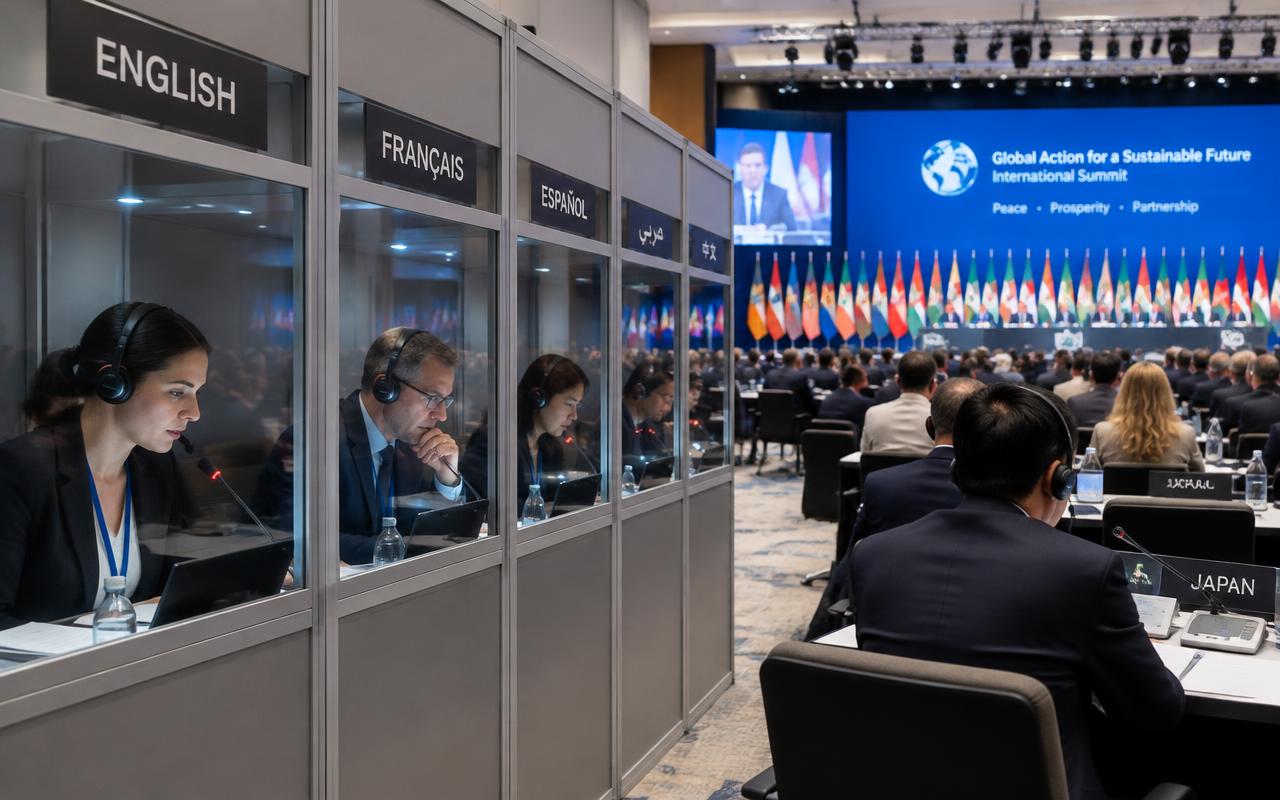
Interpretation is a standards-driven discipline, and the standards exist because interpreters working in bad conditions make mistakes. Mobile booths are built to ISO 4043, which specifies a working space of roughly 1.6 by 1.6 by 2.0 metres for two interpreters, sound insulation from the floor and from adjacent booths, forced ventilation with a defined air change rate that is quiet enough not to intrude on the microphone, and a full-width front window with unobstructed sight of the speaker, the screen and the delegates. Permanently installed booths follow ISO 2603, and the equipment itself — consoles, headphones, microphones — follows ISO 20109. Where a client asks us to put interpreters in a curtained corner, we decline, because sightline and sound isolation are not optional extras.
Booth siting is the whole design problem: interpreters need direct sight of speaker and screen, while infrared radiators need line of sight to every seat around pillars and balconies. In Udaipur that plays out at venues like Oberoi Udaivilas, Taj Lake Palace, The Leela Palace Udaipur, and across Lake Pichola, Fateh Sagar, Sukher, Hiran Magri.
Distribution to delegates is almost always infrared on a Bosch Integrus or equivalent system, for one reason that matters more than audio quality: infrared does not pass through walls, so a confidential session cannot be received from the corridor. Radiators are placed to cover the seating area with line of sight to every receiver, and coverage is calculated from radiator power against the room area, with careful attention to shadowing behind pillars, under balconies and in deep seating. Channel planning allocates one channel per target language plus the floor language, and the carrier frequencies are chosen to avoid interference from certain LED and plasma lighting that radiates in the infrared band.
What’s included
- ISO 4043 booths
- Bosch Integrus IR systems
- Up to 16 language channels
- Interpreter sourcing on request
Equipment we carry
Why Udaipur chooses Prime AV
- Crews and trucks positioned for fast load-in at Oberoi Udaivilas and venues in Lake Pichola and Fateh Sagar.
- We quote two interpreters per booth per language as standard and explain why — sustained simultaneous interpretation beyond roughly thirty minutes is not reliably accurate.
- Channel test and booth isolation verification record
- Working knowledge of Rajasthan venue rules, power sanctions and permission timelines.
Local conditions
Producing interpretation equipment in Udaipur
Weather & the rig
Interpretation booths are sealed, ventilated boxes holding two people for hours, so ambient heat and the venue's cooling capacity directly affect whether the ISO ventilation requirement can actually be met. The Aravalli setting moderates the heat compared with the rest of Rajasthan, but April to June still reaches 40–42°C and the pre-monsoon dust arrives on the wind. The decisive local factors are the lakes: evening breeze off Pichola and Fateh Sagar loads any tall outdoor structure and makes the barge crossing a weather call rather than a formality, overnight humidity near the water is high enough to leave real dew on an open rig, and the July to September monsoon — heavier here than in western Rajasthan — both raises the lake level and makes island work genuinely hazardous. December and January nights fall to 6–8°C, which matters for outdoor dinners and for battery life in wireless packs. April to June heat and dust make daytime outdoor work unviable, and July to September monsoon makes island and barge operations unsafe while filling the lakes. The season is October to March, and the peak dates within it are held by planners a year or more ahead. Late December nights are cold enough to need heating designed into the guest experience.
Power & redundancy
Booths, consoles, radiators and a receiver charging operation all need clean uninterrupted supply, and the charging bank is a surprisingly large overnight load on a thousand-delegate event. Palace and luxury properties protect their own supply and release nothing meaningful for event load, so every serious job here is fully generator-fed. Two local constraints make this harder than elsewhere: silent canopies are not negotiable because the DG compound will sit within earshot of suites that cost what they cost, and island venues mean the generator itself is barged across and positioned where fuel can be replenished without a boat run mid-show. Full redundancy with automatic changeover is standard, and a stabilised feed for the control and media world is sensible given the long cable runs.
Permits & noise rules
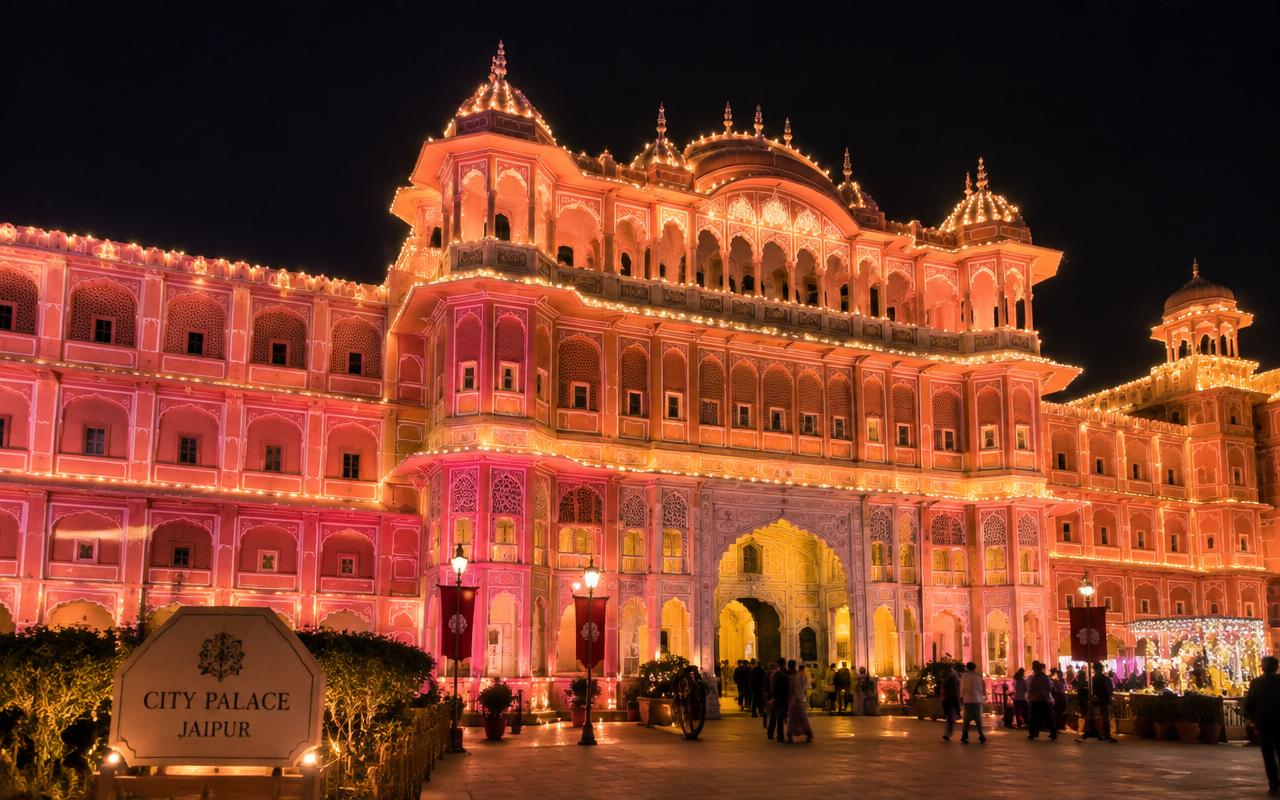
Multilateral and government sessions bring security clearance for crew, controlled access to the booths and recording consent requirements rather than conventional event permissions. The Udaipur Municipal Corporation handles ground and public-space permissions and the district administration and police license assembly, with the Rajasthan noise rules and the 10 pm outdoor amplified-sound limit applying — and lake-area restrictions that are tighter in practice, because sound carries across open water far better than planners expect. Palace and island venues require the City Palace trust or the respective property's heritage approvals, with conservation conditions on fixings, structure proximity and lighting heat. Boat and barge movement on Pichola needs the lake and tourism authority's consent. Maharana Pratap airport at Dabok is 22 km out, but drone work over the lakes and palaces needs DGCA clearance plus the palace administration's permission and is often refused on privacy grounds for private events.
Load-in & access
Flight-cased booth panels are bulky and need a clear path to a position with sightline to the stage, and receiver distribution has to happen at the entry point before delegates disperse. Everything about Udaipur's logistics is harder than its glamour suggests. Trucks from Jaipur, 400 km and about seven hours on NH-48, or Ahmedabad, 260 km and four and a half, reach the city easily and then stop at the old city boundary — the lanes around Jagdish Chowk and Gangaur Ghat take nothing wider than a tempo and the final stretch is porterage. Island venues add a boat or barge transfer with weight limits, a weather call and a lake-level constraint on draft. A build that would take one day in a city ballroom takes three or four here, and the crew accommodation that makes that possible is itself scarce and expensive during season.
Season & booking
The wedding grid from late October to March is the city's economy, with the auspicious dates held a year or more in advance and every palace room, boat, crane and crew member committed. The Mewar Festival at Gangaur in March or April, Shilpgram Utsav in the last ten days of December, and the lakeside music festival in February take their own dates and absorb local crew. Holi's Mewar Festival procession from the City Palace is a fixed civic event, and the monsoon months are when properties close for refurbishment. Peak demand runs Oct–Mar.
Crew & dispatch
Local crew, consumables and boat contractors retained in Udaipur year-round because the market demands it, with the heavy rig trucked from our Jaipur depot — 400 km on NH-48, about seven hours loaded — or from Ahmedabad when Jaipur is at its own peak; specialist control, camera and automation packages fly in from Mumbai or Delhi for international briefs. Load-in support covers Lake Pichola, Fateh Sagar and the rest of the city.
What it costs here
The highest-paying market in this entire set and the only one where international riders are routine. Buyers are Delhi, Mumbai and overseas planners working to a specification sheet, and they expect — and accept — a premium that reflects barge transfer, porterage, multi-day builds, heritage handling and scarce peak-season crew accommodation. The corollary is that scrutiny is high, named-brand equipment is specified rather than requested, and a vague quote loses the job. Pricing this market honestly means showing the logistics lines rather than burying them.
Local expectations
Mewar palace weddings are the most produced private events in India and the brief is always the same contradiction: enormous scale with no visible machinery. Clients want the lake, the sandstone and the marble to be the subject, so warm 2700 K washes on architecture, concealed truss, cable buried or dressed out of every camera angle, and a lighting look that reads at dusk across water. Sequences run over three or four days — mehendi, sangeet, pheras, reception — each with its own look, and the pheras are frequently timed to a pre-dawn muhurat. Manganiyar and Langa folk ensembles and classical Kathak are expected and need gentle acoustic support; the sangeet, by contrast, runs at full concert level until the curfew forces it indoors or onto a boat.
Specification
Simultaneous Interpretation Systems: technical specification
| Specification | Detail |
|---|---|
| Mobile booth standard | ISO 4043: approximately 1.6 x 1.6 x 2.0 m for two interpreters, insulated and ventilated |
| Built-in booth standard | ISO 2603 for permanently installed booths |
| Equipment standard | ISO 20109 for interpreter consoles, microphones and headphones |
| Distribution | Bosch Integrus infrared, confidential because it does not pass through walls |
| Channel capacity | Up to 16 language channels plus the floor channel on a typical deployment |
| Radiator coverage | Calculated from radiator power against floor area with line of sight to every seat |
| Interpreter staffing | Two interpreters per booth per language, swapping every 20 – 30 minutes |
| Audio feed | Clean direct feed from the console to each booth, never a room microphone |
| Relay interpretation | Pivot language routing where no direct language pair is available |
| Receiver logistics | Issued against delegate ID, counted back, charged overnight and sanitised between sessions |
The operational layer is the part clients underestimate. Interpreters work in pairs per booth and swap roughly every twenty to thirty minutes, because sustained simultaneous interpretation is cognitively unsustainable beyond that — a single interpreter per language is a false economy that degrades the session. They need the speaker's slides and script in advance, a clean direct audio feed from the console rather than a room microphone, and a technician who can patch relay interpretation when a language pair has no direct interpreter. Receivers are issued against delegate identification, counted back, charged overnight and sanitised between sessions, which is a logistics job in its own right at scale.
Sizing
What size rig does your event actually need?
| Scale | Guests | Recommended setup |
|---|---|---|
| Bilateral meeting | 20 – 80 | One booth, two channels, 80 receivers, one radiator, single technician |
| Seminar | 100 – 300 | Two booths, three channels, 300 receivers, two to three radiators, receiver desk |
| Conference hall | 300 – 800 | Four booths, five channels, 800 receivers, four to six radiators with shadow mapping |
| Summit plenary | 800 – 1,500 | Six to eight booths, eight channels, 1,500 receivers, radiator grid plus balcony coverage |
| Multilateral meeting | 1,500+ | Up to sixteen channels, multi-room booths, shared interpreter pool, per-channel recording |
Scope
Interpretation Equipment scope tiers in Udaipur
Two-Language Session
Single-day bilateral meetings and pharma sessions up to 200 delegates
- One ISO 4043 booth with two interpreter consoles
- Two language channels plus floor on infrared distribution
- Two hundred receivers with issue, return and overnight charging
- Clean console feed to the booth and a technician throughout
- Radiator coverage check across the full seating area
Multilingual Summit
International summits and conferences, 300 – 1,000 delegates, four to eight languages
- Four to eight ISO 4043 booths with full isolation and sightline positioning
- Eight-channel infrared with shadow-free radiator placement
- Relay routing configured for language pairs without direct interpreters
- Interpreter briefing pack: agenda, slides, scripts and glossary
- Receiver desk crew plus a dedicated interpretation technician
Delegation Conference
Government and multilateral meetings, 1,000+ delegates, up to 16 languages
- Up to sixteen channels across multiple rooms with a shared interpreter pool
- Booth sound-isolation verification and ventilation noise measurement
- Multi-room receiver logistics with per-session reconciliation
- Per-channel recording of every language output for the record
- Interpreter sourcing coordination and on-site interpretation manager
The highest-paying market in this entire set and the only one where international riders are routine. Buyers are Delhi, Mumbai and overseas planners working to a specification sheet, and they expect — and accept — a premium that reflects barge transfer, porterage, multi-day builds, heritage handling and scarce peak-season crew accommodation. The corollary is that scrutiny is high, named-brand equipment is specified rather than requested, and a vague quote loses the job. Pricing this market honestly means showing the logistics lines rather than burying them.
Venues
Where we work in Udaipur
| Venue | Capacity | Production note |
|---|---|---|
| Oberoi Udaivilas | 400–800 across the courtyards, lawns and domed pavilions | Built to a deliberate architectural symmetry the property protects absolutely — structures must not break a sightline or a reflection in the water channels, no fixings into any surface, and the generator compound sits far enough out that cable runs are long and must be fully concealed. |
| Taj Lake Palace | 200–500 across the courtyards and terraces of the island palace | The hardest venue in the country to build in: the entire island is reached only by boat from the City Palace jetty, every case, truss section and generator goes across on a launch with a weight limit and a weather call, and the marble courtyards take no ground penetration and very limited point load. Budget twice the load-in time of any mainland venue and a contingency boat window. |
| The Leela Palace Udaipur | 300–700 across the lawns, terraces and ballroom | Lakefront property on the eastern shore with a road approach, which makes it the most practical of the premium venues, though the terraced level changes mean long hand-carry stretches and the lake-facing lawn is exposed to an evening breeze that loads any tall structure. |
| Jagmandir Island Palace | 500–1,200 across the Gul Mahal courtyard and garden terraces | Another boat-only island, under the City Palace trust, where the barge schedule governs the build entirely; lake water level determines the draft and therefore what a barge can carry, and the heritage conditions prohibit fixings and restrict lighting heat near the stonework. |
| City Palace complex and the Manek Chowk courtyards | 800–3,000 across the courtyards and the Zenana precinct | A living museum and trust property where approvals run through the palace administration with genuine conservation conditions, lead times measured in weeks, vehicle access limited to the lower gates, and a hand-carry route up through the ramped entrance for everything. |
Crew
Who turns up on show day
- Interpretation technician
Builds and tests booths, consoles and radiators, verifies every channel and relay path, and sits within reach of the booths all session.
- Audio engineer
Provides the clean direct feed to every booth and keeps floor audio free of the room reverberation that makes interpreting exhausting.
- Receiver desk crew
Issues receivers against delegate identification, reconciles the count at every break and manages charging and sanitisation.
- Interpretation manager
Coordinates interpreter rotation, distributes briefing packs and handles the on-the-day language changes that always arrive.
- Booth builder
Assembles and positions booths for sightline to speaker and screen, and verifies isolation and ventilation noise before interpreters arrive.
What you receive
- Booth layout drawing showing sightlines to speaker and screen
- Radiator coverage plan with shadowed areas identified and resolved
- Channel allocation map including every relay routing path
- Interpreter briefing pack as distributed, with the technical glossary
- Receiver issue and reconciliation log per session
- Per-channel recording of each language output where required
- Channel test and booth isolation verification record
Timeline
From enquiry to load-out
- T-8 weeks
Language and format confirmation
Target languages, session formats, relay requirements and whether interpreters are client-supplied or sourced by us.
- T-5 weeks
Room and booth planning
Booth positions set for sightline and isolation, radiator coverage calculated against the seating plan.
- T-2 weeks
Interpreter briefing pack
Agenda, speaker slides, scripts, acronym list and technical glossary compiled and sent to every interpreter.
- Show day −1
Build and channel test
Booths built, isolation and ventilation noise checked, every channel and relay path tested, radiator shadows walked.
- Show day, T-2 hours
Interpreter check-in
Interpreters test their consoles, confirm sightlines and audio quality, and agree rotation with their booth partner.
- Session days to +3 hours
Sessions and strike
Receivers issued and reconciled per session, channels monitored and recorded, then booths struck and receivers counted back.
Risk control
What goes wrong, and how we stop it
What can go wrong
How we prevent it
- What can go wrong
A single interpreter is booked per language to save cost and quality collapses after half an hour.
How we prevent itWe quote two interpreters per booth per language as standard and explain why — sustained simultaneous interpretation beyond roughly thirty minutes is not reliably accurate.
- What can go wrong
Interpreters receive a room microphone feed full of reverberation and struggle to hear the speaker.
How we prevent itEvery booth takes a clean direct feed from the audio console, and the engineer monitors that feed on headphones rather than assuming it is right.
- What can go wrong
A speaker reads from a prepared script at full speed and interpretation falls behind.
How we prevent itScripts and slides go to interpreters at T-2 weeks, and the chair is briefed to remind speakers that they are being interpreted, which is the single most effective intervention available.
- What can go wrong
Certain LED and plasma lighting radiates in the infrared band and corrupts channel reception.
How we prevent itCarrier frequencies are selected to avoid the interference band and a reception test is run with the full event lighting rig live, not with house lights only.
Honest comparison
Is this the right choice for your event?
- Consecutive interpretation instead of simultaneousOur verdict
Consecutive needs no booths, no receivers and no equipment — the interpreter speaks after the speaker pauses. It roughly doubles the length of every session, which is acceptable for a bilateral meeting and impossible for a full-day agenda.
- Radio or Wi-Fi distribution instead of infraredOur verdict
Radio and app-based distribution cover more area and need no line of sight, which solves the shadowing problem. They also pass through walls, so a confidential session can be received outside the room — which is exactly why government and multilateral work stays on infrared.
- A curtained corner instead of an ISO 4043 boothOur verdict
There is no honest case for it on a session that matters. The booth exists to isolate the interpreter's own voice from the floor audio and to give them sight of the speaker; without both, accuracy falls and the delegates hear the result.
Demand
What Udaipur books most
Udaipur event mix
- Multi-day destination weddings at palace and lake properties
- High-value private celebrations, anniversaries and milestone events
- Luxury corporate incentive groups and leadership offsites
- Mewar cultural festivals and heritage programming
- Fashion, jewellery and luxury brand shoots and launches
- Film and content production using the lake and palace settings
Ideal for
Events we power with simultaneous interpretation systems in Udaipur
Process
From brief to standing ovation
01
Brief & recce
We visit the venue, map power and rigging, and understand your show flow.
02
Design & quote
CAD plans, 3D previews and an itemised quote within 24 hours.
03
Build & rehearse
Load-in, system tuning, content checks and full technical rehearsal.
04
Show & strike
Show-caller-led execution, then a quick, clean load-out.
FAQ
Interpretation Equipment in Udaipur: FAQs
More services in Udaipur
Interpretation Equipment in nearby cities
Areas we cover in Udaipur
Events in Udaipur