Conference & Broadcast · Pune, Maharashtra
Interpretation Equipment in Pune
The gap between adequate and excellent interpretation equipment in Pune is usually preparation: msedcl supply in the city is stable and fails predictably rather than randomly, with scheduled maintenance outages that can be planned around, and the hinjewadi it park feeders are robust. moshi, the farm venues and the mulshi belt are dg-primary. maharashtra's acoustic-enclosure requirement and the 10pm cut apply exactly as in mumbai, with the state's notified festival nights the only exception, and a recce that finds the venue's real constraints before quote stage.
- Lead time
- From 8 weeks
- Peak season
- Oct–Mar
- Coverage
- Pune & Maharashtra
Key takeaway
Simultaneous Interpretation Systems for Pune’s biggest events
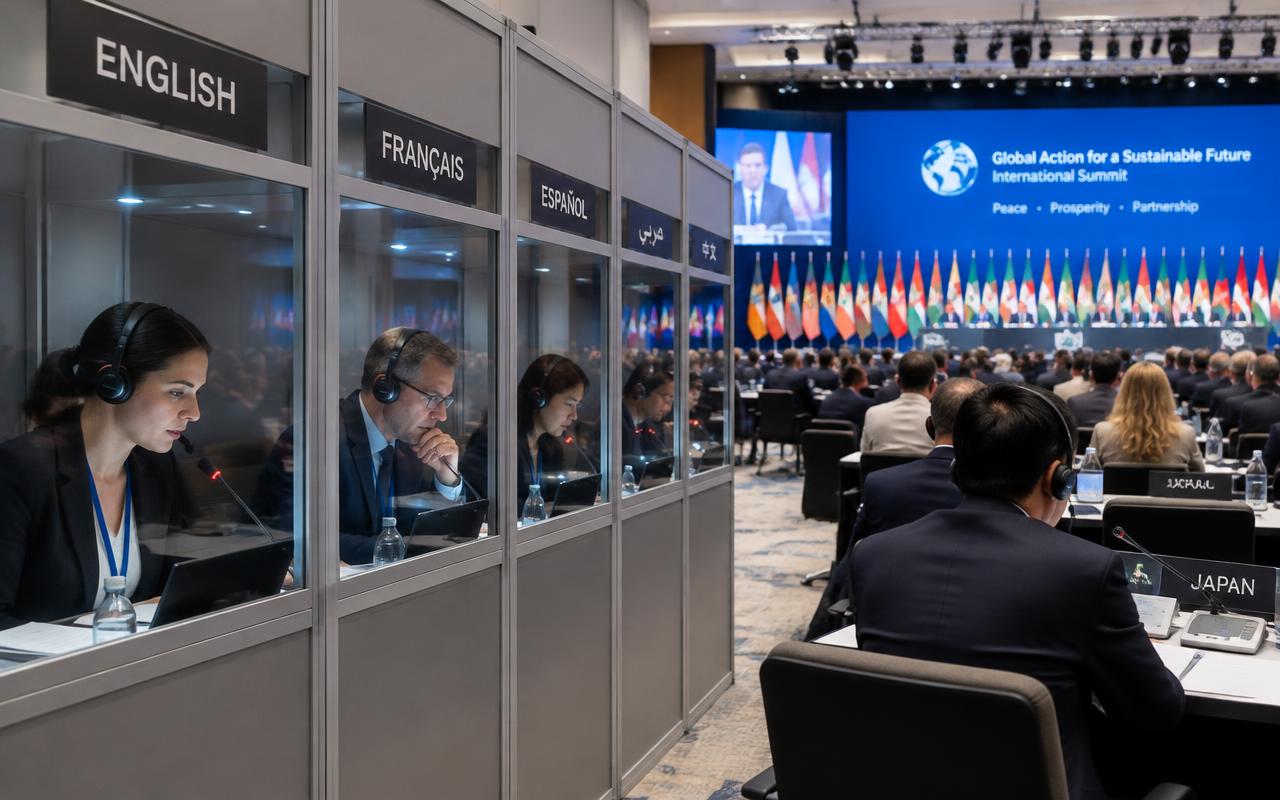
Interpretation is a standards-driven discipline, and the standards exist because interpreters working in bad conditions make mistakes. Mobile booths are built to ISO 4043, which specifies a working space of roughly 1.6 by 1.6 by 2.0 metres for two interpreters, sound insulation from the floor and from adjacent booths, forced ventilation with a defined air change rate that is quiet enough not to intrude on the microphone, and a full-width front window with unobstructed sight of the speaker, the screen and the delegates. Permanently installed booths follow ISO 2603, and the equipment itself — consoles, headphones, microphones — follows ISO 20109. Where a client asks us to put interpreters in a curtained corner, we decline, because sightline and sound isolation are not optional extras.
Booth siting is the whole design problem: interpreters need direct sight of speaker and screen, while infrared radiators need line of sight to every seat around pillars and balconies. In Pune that plays out at venues like Pune International Exhibition Centre, JW Marriott Pune, Balewadi Stadium, and across Hinjewadi, Koregaon Park, Baner, Kharadi.
Distribution to delegates is almost always infrared on a Bosch Integrus or equivalent system, for one reason that matters more than audio quality: infrared does not pass through walls, so a confidential session cannot be received from the corridor. Radiators are placed to cover the seating area with line of sight to every receiver, and coverage is calculated from radiator power against the room area, with careful attention to shadowing behind pillars, under balconies and in deep seating. Channel planning allocates one channel per target language plus the floor language, and the carrier frequencies are chosen to avoid interference from certain LED and plasma lighting that radiates in the infrared band.
What’s included
- ISO 4043 booths
- Bosch Integrus IR systems
- Up to 16 language channels
- Interpreter sourcing on request
Equipment we carry
Why Pune chooses Prime AV
- Crews and trucks positioned for fast load-in at Sheraton Grand Pune and venues in Hadapsar and Hinjewadi.
- We quote two interpreters per booth per language as standard and explain why — sustained simultaneous interpretation beyond roughly thirty minutes is not reliably accurate.
- Receiver issue and reconciliation log per session
- Working knowledge of Maharashtra venue rules, power sanctions and permission timelines.
Local conditions
Producing interpretation equipment in Pune
Weather & the rig
Interpretation booths are sealed, ventilated boxes holding two people for hours, so ambient heat and the venue's cooling capacity directly affect whether the ISO ventilation requirement can actually be met. Sitting at 560m in the Deccan rain shadow, Pune has the most benign winter working conditions in Maharashtra — 8–12°C December nights that are dry and still, which is why outdoor builds here need less weather contingency than Mumbai's. The exception is anything west of the city: Mulshi, Lavasa and the Lonavala-side destination venues catch Western Ghats weather, with July and August rainfall and wind well beyond what the city forecast shows. March to May afternoons reach 40°C and the construction dust along the Hinjewadi and Katraj corridors loads fixture filters quickly. Jun–Sep monsoon, with the caveat that the Ghats-side venues are unusable a good fortnight either side of what the city's own rainfall suggests; and Aug–Sep Ganpati, when nothing is available at any price.
Power & redundancy
Booths, consoles, radiators and a receiver charging operation all need clean uninterrupted supply, and the charging bank is a surprisingly large overnight load on a thousand-delegate event. MSEDCL supply in the city is stable and fails predictably rather than randomly, with scheduled maintenance outages that can be planned around, and the Hinjewadi IT park feeders are robust. Moshi, the farm venues and the Mulshi belt are DG-primary. Maharashtra's acoustic-enclosure requirement and the 10pm cut apply exactly as in Mumbai, with the state's notified festival nights the only exception.
Permits & noise rules
Multilateral and government sessions bring security clearance for crew, controlled access to the booths and recording consent requirements rather than conventional event permissions. Which body you approach depends on which side of the Mula-Mutha the venue sits: PMC for the city, PCMC for Pimpri-Chinchwad and Moshi, and the Collector or Gram Panchayat route for the Mulshi and Lavasa venues outside both. The Pune Police Commissionerate licenses amplified sound and gatherings, and MPCB's standards apply. Pune Cantonment and Khadki have their own boards with separate approvals. Drone work is harder than the city's profile suggests because Lohegaon is an Air Force station, which puts a firm restriction over the eastern half of the city.
Load-in & access
Flight-cased booth panels are bulky and need a clear path to a position with sightline to the stage, and receiver distribution has to happen at the entry point before delegates disperse. Moshi is the easy one, straight off the highway. The real bottlenecks are the Expressway descent into Katraj and the Chandni Chowk junction, which can add two hours to a Mumbai run without warning, and the Peth quarter — Sadashiv Peth, Laxmi Road, Shaniwar Peth — where lanes are around three metres wide and a tempo is the largest vehicle that will physically pass. Daytime heavy-vehicle restrictions apply on city roads.
Season & booking
Ganesh Chaturthi's ten days make Pune the heaviest AV-consuming city in the state after Mumbai, with the major mandals commissioning trussing, line arrays, lighting and generators city-wide and the immersion procession closing the central roads entirely. The Sawai Gandharva Bhimsen Mahotsav in December takes the best audio crews in the city, Pune Festival runs alongside Ganpati, and the college festival season from January to February books concert inventory. Peak demand runs Oct–Mar.
Crew & dispatch
Served from the Pune base with the Mumbai depot three hours away on the Expressway as a working backup, which makes a mid-show spares run genuinely feasible. Load-in support covers Hadapsar, Hinjewadi and the rest of the city.
What it costs here
Pune draws on the same western-India supplier pool as Mumbai with lower crew and cartage costs, which makes it the best value in the region for a metro-grade rig. Hinjewadi corporate buyers expect Bengaluru-standard documentation at Pune rates and will say so.
Local expectations
Marathi-first compering is expected for public, mandal and institutional events, and the city's classical music audience is informed enough that an uncoloured PA and a low-noise stage matter more than any visual treatment. Mandal work has its own politics — the committee decides, not the event manager — and the corporate side in Hinjewadi mirrors Bengaluru's formality on process while running tighter on budget.
Specification
Simultaneous Interpretation Systems: technical specification
| Specification | Detail |
|---|---|
| Mobile booth standard | ISO 4043: approximately 1.6 x 1.6 x 2.0 m for two interpreters, insulated and ventilated |
| Built-in booth standard | ISO 2603 for permanently installed booths |
| Equipment standard | ISO 20109 for interpreter consoles, microphones and headphones |
| Distribution | Bosch Integrus infrared, confidential because it does not pass through walls |
| Channel capacity | Up to 16 language channels plus the floor channel on a typical deployment |
| Radiator coverage | Calculated from radiator power against floor area with line of sight to every seat |
| Interpreter staffing | Two interpreters per booth per language, swapping every 20 – 30 minutes |
| Audio feed | Clean direct feed from the console to each booth, never a room microphone |
| Relay interpretation | Pivot language routing where no direct language pair is available |
| Receiver logistics | Issued against delegate ID, counted back, charged overnight and sanitised between sessions |
The operational layer is the part clients underestimate. Interpreters work in pairs per booth and swap roughly every twenty to thirty minutes, because sustained simultaneous interpretation is cognitively unsustainable beyond that — a single interpreter per language is a false economy that degrades the session. They need the speaker's slides and script in advance, a clean direct audio feed from the console rather than a room microphone, and a technician who can patch relay interpretation when a language pair has no direct interpreter. Receivers are issued against delegate identification, counted back, charged overnight and sanitised between sessions, which is a logistics job in its own right at scale.
Sizing
What size rig does your event actually need?
| Scale | Guests | Recommended setup |
|---|---|---|
| Bilateral meeting | 20 – 80 | One booth, two channels, 80 receivers, one radiator, single technician |
| Seminar | 100 – 300 | Two booths, three channels, 300 receivers, two to three radiators, receiver desk |
| Conference hall | 300 – 800 | Four booths, five channels, 800 receivers, four to six radiators with shadow mapping |
| Summit plenary | 800 – 1,500 | Six to eight booths, eight channels, 1,500 receivers, radiator grid plus balcony coverage |
| Multilateral meeting | 1,500+ | Up to sixteen channels, multi-room booths, shared interpreter pool, per-channel recording |
Scope
Interpretation Equipment scope tiers in Pune
Two-Language Session
Single-day bilateral meetings and pharma sessions up to 200 delegates
- One ISO 4043 booth with two interpreter consoles
- Two language channels plus floor on infrared distribution
- Two hundred receivers with issue, return and overnight charging
- Clean console feed to the booth and a technician throughout
- Radiator coverage check across the full seating area
Multilingual Summit
International summits and conferences, 300 – 1,000 delegates, four to eight languages
- Four to eight ISO 4043 booths with full isolation and sightline positioning
- Eight-channel infrared with shadow-free radiator placement
- Relay routing configured for language pairs without direct interpreters
- Interpreter briefing pack: agenda, slides, scripts and glossary
- Receiver desk crew plus a dedicated interpretation technician
Delegation Conference
Government and multilateral meetings, 1,000+ delegates, up to 16 languages
- Up to sixteen channels across multiple rooms with a shared interpreter pool
- Booth sound-isolation verification and ventilation noise measurement
- Multi-room receiver logistics with per-session reconciliation
- Per-channel recording of every language output for the record
- Interpreter sourcing coordination and on-site interpretation manager
Pune draws on the same western-India supplier pool as Mumbai with lower crew and cartage costs, which makes it the best value in the region for a metro-grade rig. Hinjewadi corporate buyers expect Bengaluru-standard documentation at Pune rates and will say so.
Venues
Where we work in Pune
| Venue | Capacity | Production note |
|---|---|---|
| Pune International Exhibition Centre | Several thousand per hall across the Moshi complex | Drive-in halls straight off the Nashik highway make the build simple, but the site is 20km north of the city, so crew accommodation and shuttle logistics sit in Pimpri-Chinchwad and the day starts earlier than the call sheet suggests. |
| JW Marriott Pune | Around 1,200 banquet in the grand ballroom | Proper rigging points and a working dock make it the strongest hotel build in the city, but Senapati Bapat Road's traffic means the trucks come in overnight and the dock is shared with hotel operations. |
| Balewadi Stadium | Around 20,000 in the athletics bowl with indoor halls alongside | Sports Authority approval runs on its own timeline, the track and field need complete protection boarding, there is no roof rigging, and the entire site is generated. |
| Ganesh Kala Krida Manch | Around 5,000 under cover at Swargate | A large covered amphitheatre with limited structural rigging capacity, so the design is tower-based and the open sides mean wind and rain ingress have to be accounted for even though it reads as an indoor venue. |
| Sheraton Grand Pune | Around 800 banquet across the ballroom | Bund Garden location with a constrained service approach, so cases are broken down to lift dimensions before they leave the warehouse. |
Crew
Who turns up on show day
- Interpretation technician
Builds and tests booths, consoles and radiators, verifies every channel and relay path, and sits within reach of the booths all session.
- Audio engineer
Provides the clean direct feed to every booth and keeps floor audio free of the room reverberation that makes interpreting exhausting.
- Receiver desk crew
Issues receivers against delegate identification, reconciles the count at every break and manages charging and sanitisation.
- Interpretation manager
Coordinates interpreter rotation, distributes briefing packs and handles the on-the-day language changes that always arrive.
- Booth builder
Assembles and positions booths for sightline to speaker and screen, and verifies isolation and ventilation noise before interpreters arrive.
What you receive
- Booth layout drawing showing sightlines to speaker and screen
- Radiator coverage plan with shadowed areas identified and resolved
- Channel allocation map including every relay routing path
- Interpreter briefing pack as distributed, with the technical glossary
- Receiver issue and reconciliation log per session
- Per-channel recording of each language output where required
- Channel test and booth isolation verification record
Timeline
From enquiry to load-out
- T-8 weeks
Language and format confirmation
Target languages, session formats, relay requirements and whether interpreters are client-supplied or sourced by us.
- T-5 weeks
Room and booth planning
Booth positions set for sightline and isolation, radiator coverage calculated against the seating plan.
- T-2 weeks
Interpreter briefing pack
Agenda, speaker slides, scripts, acronym list and technical glossary compiled and sent to every interpreter.
- Show day −1
Build and channel test
Booths built, isolation and ventilation noise checked, every channel and relay path tested, radiator shadows walked.
- Show day, T-2 hours
Interpreter check-in
Interpreters test their consoles, confirm sightlines and audio quality, and agree rotation with their booth partner.
- Session days to +3 hours
Sessions and strike
Receivers issued and reconciled per session, channels monitored and recorded, then booths struck and receivers counted back.
Risk control
What goes wrong, and how we stop it
What can go wrong
How we prevent it
- What can go wrong
A single interpreter is booked per language to save cost and quality collapses after half an hour.
How we prevent itWe quote two interpreters per booth per language as standard and explain why — sustained simultaneous interpretation beyond roughly thirty minutes is not reliably accurate.
- What can go wrong
Interpreters receive a room microphone feed full of reverberation and struggle to hear the speaker.
How we prevent itEvery booth takes a clean direct feed from the audio console, and the engineer monitors that feed on headphones rather than assuming it is right.
- What can go wrong
A speaker reads from a prepared script at full speed and interpretation falls behind.
How we prevent itScripts and slides go to interpreters at T-2 weeks, and the chair is briefed to remind speakers that they are being interpreted, which is the single most effective intervention available.
- What can go wrong
Certain LED and plasma lighting radiates in the infrared band and corrupts channel reception.
How we prevent itCarrier frequencies are selected to avoid the interference band and a reception test is run with the full event lighting rig live, not with house lights only.
Honest comparison
Is this the right choice for your event?
- Consecutive interpretation instead of simultaneousOur verdict
Consecutive needs no booths, no receivers and no equipment — the interpreter speaks after the speaker pauses. It roughly doubles the length of every session, which is acceptable for a bilateral meeting and impossible for a full-day agenda.
- Radio or Wi-Fi distribution instead of infraredOur verdict
Radio and app-based distribution cover more area and need no line of sight, which solves the shadowing problem. They also pass through walls, so a confidential session can be received outside the room — which is exactly why government and multilateral work stays on infrared.
- A curtained corner instead of an ISO 4043 boothOur verdict
There is no honest case for it on a session that matters. The booth exists to isolate the interpreter's own voice from the floor audio and to give them sight of the speaker; without both, accuracy falls and the delegates hear the result.
Demand
What Pune books most
Pune event mix
- IT and engineering corporate conferences in the Hinjewadi corridor
- Automotive and industrial dealer meets and plant events
- Weddings and receptions across the city and the Mulshi belt
- College and cultural festivals with concert-scale requirements
- Trade exhibitions at PIEC
- Ganpati mandal sound and lighting
Ideal for
Events we power with simultaneous interpretation systems in Pune
Process
From brief to standing ovation
01
Brief & recce
We visit the venue, map power and rigging, and understand your show flow.
02
Design & quote
CAD plans, 3D previews and an itemised quote within 24 hours.
03
Build & rehearse
Load-in, system tuning, content checks and full technical rehearsal.
04
Show & strike
Show-caller-led execution, then a quick, clean load-out.
FAQ
Interpretation Equipment in Pune: FAQs
More services in Pune
Interpretation Equipment in nearby cities
Areas we cover in Pune
Events in Pune