Lighting & Stage · Bhilai, Chhattisgarh
Moving Head Light Rental in Bhilai
Prime AV Solutions runs intelligent moving head lights across Bhilai and the rest of Chhattisgarh. Served from our Nagpur depot at 320 km with Raipur, 30 km away, acting as the real forward base — crew, structures and plant can be across in under an hour, which is what makes short-notice township work viable at all. Every project is specified and quoted to its own brief.
- Lead time
- From 4 weeks
- Peak season
- Oct–Feb
- Coverage
- Bhilai & Chhattisgarh
Key takeaway
Intelligent Moving Head Lights for Bhilai’s biggest events
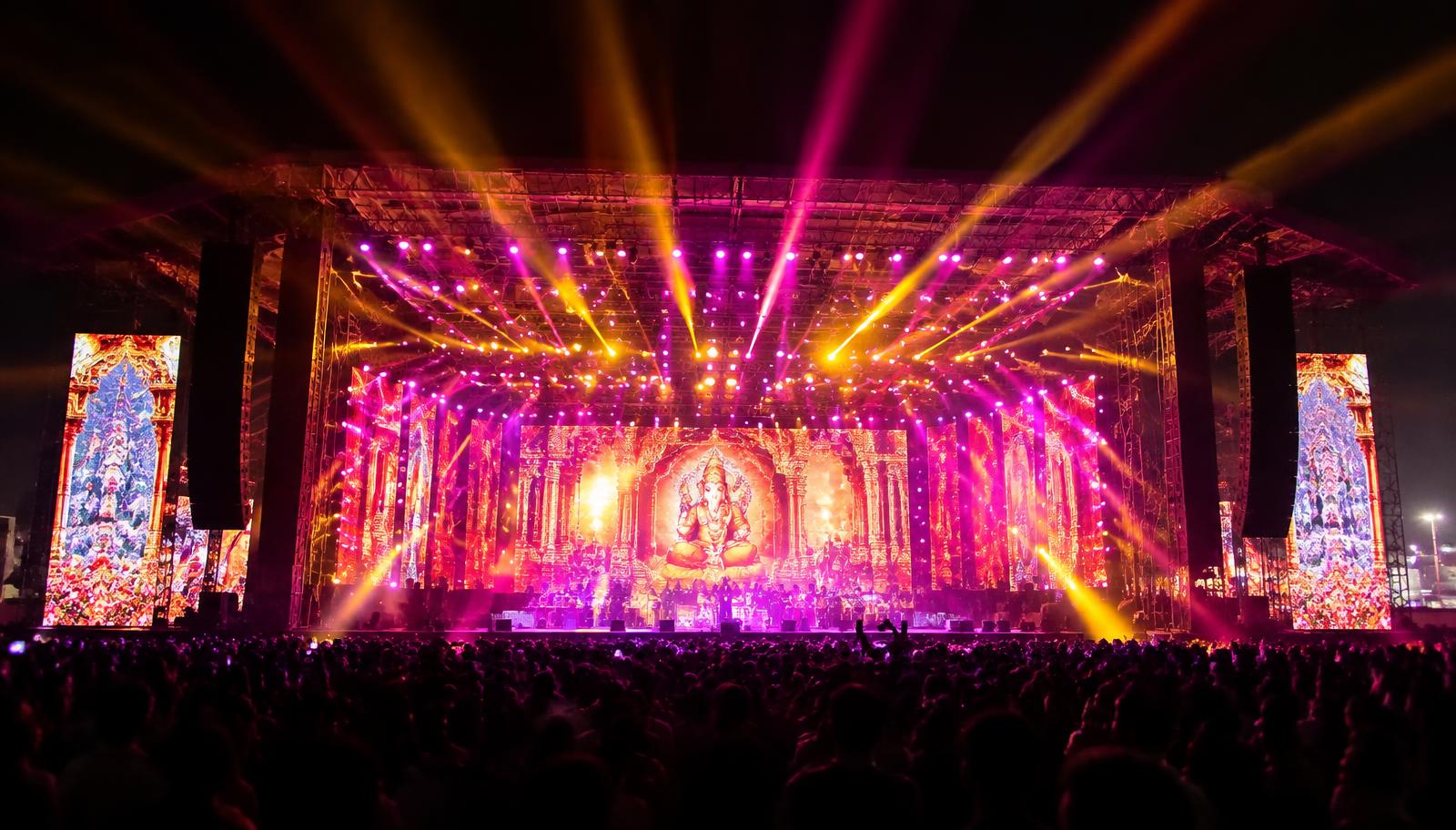
This is the fixture rig itself: the hardware, the trussing it hangs on, the power and data that feed it, and the technicians who keep every unit alive. A moving head rig is specified by fixture type against the job each one does. Beam fixtures like the Clay Paky Sharpy class throw a tight, dense column that reads as a solid shaft in haze. Spots carry gobos, prisms, animation wheels and a sharp focus for mid-air and surface texture. Washes flood the stage and the audience with colour. Hybrids such as the Robe MegaPointe and Clay Paky Mythos do all three at the cost of being a compromise at each — frequently the right compromise when truss space and budget are both finite.
Truss positions, trim height and what the ceiling will carry determine the fixture count directly, because a rig that cannot be hung where it was drawn is a different rig. In Bhilai that plays out at venues like Bhilai Niwas, Civic Centre, Jayanti Stadium, and across Civic Centre, Nehru Nagar, Supela, Sector 9.
Source matters as much as fixture category. Discharge lamps still produce the hardest, brightest beams and remain the choice for aerial work, while LED engines have taken over wash and profile duties with better colour mixing, instant strike and far less heat and power. A 1,700 W discharge profile on a 16 A circuit is a very different proposition from four 500 W LED washes on the same circuit, and the circuit schedule for a mixed rig has to be worked out fixture by fixture. For outdoor and monsoon-exposed positions we specify IP65-rated fixtures rather than building rain hats, because a rain hat changes the beam and never quite works.
What’s included
- Robe, Clay Paky, Martin fixtures
- Beam, spot, wash & hybrid
- Laser & strobe effects
- Followspots with operators
Equipment we carry
Why Bhilai chooses Prime AV
- Crews and trucks positioned for fast load-in at Sector community halls and Ispat club spaces and venues in Sector 9 and Durg.
- Complete spare fixtures travel with the rig, critical positions are doubled where the plot allows, and the stack is built so a dead unit's job can be reassigned live.
- Fault log recording any unit swapped during the run
- Working knowledge of Chhattisgarh venue rules, power sanctions and permission timelines.
Local conditions
Producing moving head light rental in Bhilai
Weather & the rig
Fixtures are the hardware most exposed to the elements — heat shortens lamp and LED life, dust clogs optics and fans, and only IP65 units belong on an exposed upright. Bhilai shares Raipur's central Indian continental climate but the plant's own thermal environment is the local twist — working inside or adjacent to plant areas in May and June, when ambient is already 44–46°C, means fixtures and crew face radiant heat on top of air temperature, which genuinely shortens equipment life and requires crew rotation. The June to September monsoon is reliable and heavy, and winter mornings bring ground fog across the township's open sectors. April to mid-June is too hot for outdoor or plant-adjacent work, and June to September monsoon rules out the open grounds. October to February is the window; the plant's own annual maintenance shutdown periods also restrict access and are worth checking before committing to a date.
Power & redundancy
A mixed rig of discharge profiles and LED washes has wildly uneven per-fixture draw, so the circuit schedule and phase balance are calculated unit by unit against the supply available. Uniquely in this set, the township is served off the steel plant's captive generation, which makes supply inside Bhilai's sectors genuinely excellent — stable voltage, few interruptions and decent sanctioned loads at the plant venues. Cross the boundary into Durg and ordinary CSPDCL conditions resume, so generators return. Where DG is needed, the plant's own engineering ecosystem means good sets, competent operators and proper earthing are easy to source locally.
Permits & noise rules
Moving beams reach a long way after dark, so aiming restrictions and light-spill conditions near residences and roads shape where the aerial looks can point. Permissions inside the township go through the Bhilai Steel Plant's estate department rather than a municipal body, which is a slower and more documented process than a corporation file — equipment lists, contractor safety compliance, and in plant-adjacent areas a safety department sign-off. Outside the township the Bhilai-Charoda and Durg municipal corporations and the district administration apply, with Chhattisgarh noise rules and the 10 pm outdoor amplified-sound limit. Drone work over or near plant premises is effectively prohibited on industrial security grounds regardless of DGCA status, and Raipur airport's zone covers the eastern approach.
Load-in & access
Fixture cases are numerous and heavy and must arrive in hang order, so dock access and the number of available hands decide how much rig can be up before focus. The township was planned with wide roads and the industrial corridor handles heavy transport daily, so freight movement is easy up to the gates — and then stops. Plant and township venue access runs entirely on approved gate passes with named crew and listed equipment, and an unlisted item or an unnamed technician will be turned back at the gate. Allow a week for the paperwork. Raipur airport is 40 km east, about an hour, which makes crew movement straightforward.
Season & booking
The plant's own observances set the diary: safety week, foundation and steel day programming, union election and anniversary functions, and sector-level cultural competitions. Chhattisgarh Rajyotsava on 1 November and Durga Puja in September–October bring township and community programming, Ganeshotsav draws the Maharashtrian and migrant communities, and the Nov–Feb wedding run concentrates in the Durg commercial belt. Peak demand runs Oct–Feb.
Crew & dispatch
Served from our Nagpur depot at 320 km with Raipur, 30 km away, acting as the real forward base — crew, structures and plant can be across in under an hour, which is what makes short-notice township work viable at all. Load-in support covers Sector 9, Durg and the rest of the city.
What it costs here
A public-sector pricing environment: formal tendering, rate contracts, GST-clean documentation and payment on institutional cycles, with ceilings that do not move. Margins are thin and the paperwork burden is real, but the work is predictable, repeats annually and the operating conditions inside the township are benign. Private wedding work in Durg prices against Raipur and is negotiated hard.
Local expectations
Steel township formality governs everything: a fixed dais order with union and management seating protocol observed precisely, Hindi-first scripting with legible name boards, long felicitation sequences that need many roving mics, and a sound design built for speech. The township's population is a genuine mix of Hindi-belt, Odia, Bengali, Telugu and Maharashtrian families brought in over decades, so sector cultural programmes move between several musical traditions in a single evening and the rig has to switch between them cleanly.
Specification
Intelligent Moving Head Lights: technical specification
| Specification | Detail |
|---|---|
| Beam fixtures | Clay Paky Sharpy class, approximately 189 W discharge, very narrow dense beam |
| Hybrid fixtures | Robe MegaPointe and Clay Paky Mythos class, beam, spot and wash in one body |
| Large profiles | Robe BMFL and Esprite class, up to 1,700 W discharge or high-output LED engine |
| Wash fixtures | LED wash and zoom units with RGBW or additive multi-emitter colour mixing |
| Rig sizes | 24 – 300 fixtures across front truss, mid trusses, uprights and floor positions |
| Outdoor rating | IP65 fixtures for exposed positions rather than improvised rain covers |
| Data topology | Multiple sACN nodes feeding short terminated DMX chains, never one long daisy chain |
| Power per circuit | Load calculated fixture by fixture; a single 1,700 W profile can occupy most of a 16 A way |
| Followspots | Long-throw profiles on operated positions with comms and iris control |
| Spares policy | Five to ten per cent complete spare fixtures rather than component-level spares |
The rig is only as good as its data and its maintenance. Fixtures are addressed and recorded on a patch sheet, data runs in short DMX chains off multiple sACN nodes rather than one long daisy chain, and every chain is terminated. A dedicated fixture technician pre-builds and burns in every unit in the warehouse, checks pan and tilt calibration, cleans optics and verifies gobo and colour wheel alignment, because a misaligned gobo wheel on a unit at the back of a 60-fixture rig is invisible at focus and obvious in a photograph. Spares travel as complete fixtures, not as parts.
Sizing
What size rig does your event actually need?
| Scale | Guests | Recommended setup |
|---|---|---|
| Conference stage | 200 – 600 | 24 fixtures: 12 wash, 8 beam, 4 profile, two universes, single truss |
| Sangeet or launch | 400 – 1,000 | 40 – 60 fixtures across front truss and four uprights, plus a floor package |
| Award night | 1,000 – 3,000 | 80 – 120 fixtures on three truss levels, two followspots, audience wash |
| Concert stage | 5,000 – 15,000 | 150 – 200 fixtures over roof and side trusses, floor beams, IP65 on exposed positions |
| Festival main stage | 20,000+ | 250 – 300 fixtures, maintenance bench on site, ten per cent complete spares |
Scope
Moving Head Light Rental scope tiers in Bhilai
Compact Rig
24 – 40 fixtures for sangeets, launches and conference stages
- Twelve washes, twelve beams and four profiles on front and mid truss
- sACN nodes with terminated data chains and a printed patch sheet
- One hazer and a load-balanced power schedule
- Five per cent complete spare fixtures on site
- Fixture technician and an operator
Performance Rig
60 – 120 fixtures for concerts, award nights and large sangeets
- Mixed beam, hybrid, profile and wash rig across multiple truss levels
- Floor package with uplights and audience wash positions
- Two followspot positions with operators and comms
- Redundant data distribution with node-level failover
- Fixture technicians, dimmer tech and a crew chief
Arena Rig
150 – 300 fixtures for arena concerts and festival main stages
- Full fixture inventory across roof, side and floor positions
- IP65 fixtures on every exposed outdoor position
- Warehouse pre-build and burn-in of the complete rig before despatch
- Ten per cent complete spares travelling with the show
- Full lighting crew with fixture techs, riggers and a maintenance bench on site
A public-sector pricing environment: formal tendering, rate contracts, GST-clean documentation and payment on institutional cycles, with ceilings that do not move. Margins are thin and the paperwork burden is real, but the work is predictable, repeats annually and the operating conditions inside the township are benign. Private wedding work in Durg prices against Raipur and is negotiated hard.
Venues
Where we work in Bhilai
| Venue | Capacity | Production note |
|---|---|---|
| Bhilai Niwas | 300–700 across the halls and lawn | The plant's own guest and function property, which means impeccable power and a controlled setting but full industrial protocol on access — gate passes, equipment lists and a load-in window that will not move. |
| Civic Centre | 1,500–4,000 across the hall and the surrounding plaza | The township's central civic venue, designed for public and cultural programming; the hall is acoustically hard and the plaza has limited power points, so a show of any scale brings its own distribution. |
| Jayanti Stadium | 20,000-plus in an open layout | The township's main sports ground, used for large public and union gatherings, with good vehicle access but no show-grade power on site and strict turf and track protection conditions from the estate department. |
| Sector community halls and Ispat club spaces | 200–800 each | A network of small township halls with reliable supply but low ceilings, narrow doorways and modest sanctioned loads — these are jobs for compact, distributed systems rather than scaled-down big rigs. |
| Supela and Durg commercial banquet belt | 600–2,000 across halls and lawns | Outside the township boundary, which changes both the permitting authority and the power situation — CSPDCL supply here is ordinary, so generators come back into the plan. |
Crew
Who turns up on show day
- Fixture technician
Pre-builds and burns in every unit, checks pan and tilt calibration and gobo alignment, and swaps a failing fixture mid-run.
- Dimmer and power technician
Builds the distribution, balances load across phases and monitors current draw as the rig comes up.
- Data technician
Places sACN nodes, keeps DMX chains short and terminated, and traces a flickering fixture back to its cable rather than its body.
- Rigger
Hangs fixtures to the plot, checks clamp and safety-bond discipline on every unit and manages truss trim.
- Followspot operator
Works a long-throw profile on cue, holding a performer in frame through movement and changes of level.
What you receive
- Fixture inventory listing make, model and quantity by position
- Printed and digital patch sheet with every DMX address
- Power schedule with circuit-level loads and phase balance
- Data topology drawing showing node placement and chain lengths
- Pre-build and burn-in test record for the rig as despatched
- Focus notes recording each fixture's assigned purpose
- Fault log recording any unit swapped during the run
Timeline
From enquiry to load-out
- T-4 weeks
Fixture specification
Fixture types matched to their jobs — beam, spot, wash, hybrid — against the plot and the available truss space.
- T-3 weeks
Power and data schedule
Circuit-by-circuit load calculation, phase balance, node placement and the addressing plan issued.
- T-4 days
Warehouse pre-build
Every fixture burned in, calibrated, optics cleaned, addressed and tested as a complete rig before it is cased.
- Show day −1
Hang and address
Fixtures hung to plot with safety bonds, data chains terminated, addresses verified unit by unit against the patch sheet.
- Show day −1 evening
Focus
Each fixture focused to its purpose with the set in place, and any mechanical fault found and swapped before programming.
- Show day to +4 hours
Show and strike
Technicians hold positions during the show to catch a failure, then the rig is struck and cased in hang order.
Risk control
What goes wrong, and how we stop it
What can go wrong
How we prevent it
- What can go wrong
A fixture fails mid-show and there is no way to replace it without dropping the truss.
How we prevent itComplete spare fixtures travel with the rig, critical positions are doubled where the plot allows, and the stack is built so a dead unit's job can be reassigned live.
- What can go wrong
One long DMX daisy chain across sixty fixtures produces intermittent flicker nobody can locate.
How we prevent itData is distributed from multiple sACN nodes into short terminated chains, so a fault is isolated to a handful of fixtures and found in minutes.
- What can go wrong
A mixed rig of discharge profiles and LED washes trips a circuit because load was estimated by fixture count.
How we prevent itLoad is calculated fixture by fixture from actual draw, not averaged, with phases balanced and the schedule checked against measured current at power-up.
- What can go wrong
A gobo wheel is a few degrees out on a rear fixture — invisible at focus, obvious in every photograph.
How we prevent itCalibration and wheel alignment are verified during warehouse burn-in, and the focus pass includes a gobo and prism check on every unit rather than a spot sample.
Honest comparison
Is this the right choice for your event?
- LED fixtures instead of discharge lampsOur verdict
LED wins on power, heat, colour mixing and instant strike, and is now the default for wash and profile work. Discharge still produces the hardest, brightest aerial beam, so a rig that needs mid-air shafts in a big room usually keeps discharge units.
- Fewer high-output fixtures instead of many small onesOur verdict
Fewer large units give cleaner beams, less truss clutter and fewer things to fail. Many small units give you density, symmetry and the layered look that reads on camera. The right answer depends on whether the rig is seen as an object or used as a tool.
- Static LED pars and blinders instead of moving headsOur verdict
Genuinely the better buy for a gala or a dinner where the look never changes, and far cheaper per fixture. Moving heads justify themselves the moment the show needs different states for different segments.
Demand
What Bhilai books most
Bhilai event mix
- Steel plant union, safety and long-service functions
- Township sector cultural programmes and sports events
- IIT Bhilai and engineering college festivals and convocations
- Vendor, ancillary and contractor industrial meets
- Weddings and receptions in the Durg and Supela commercial belt
- District administration and civic functions
Ideal for
Events we power with intelligent moving head lights in Bhilai
Process
From brief to standing ovation
01
Brief & recce
We visit the venue, map power and rigging, and understand your show flow.
02
Design & quote
CAD plans, 3D previews and an itemised quote within 24 hours.
03
Build & rehearse
Load-in, system tuning, content checks and full technical rehearsal.
04
Show & strike
Show-caller-led execution, then a quick, clean load-out.
FAQ
Moving Head Light Rental in Bhilai: FAQs
More services in Bhilai
Moving Head Light Rental in nearby cities
Areas we cover in Bhilai
Events in Bhilai