Sound · Bhilai, Chhattisgarh
Concert Sound System Rental in Bhilai
Booking concert sound system rental in Bhilai means solving Bhilai's particular problems: april to mid-june is too hot for outdoor or plant-adjacent work, and june to september monsoon rules out the open grounds. october to february is the window; the plant's own annual maintenance shutdown periods also restrict access and are worth checking before committing to a date, venue load-in windows, and dates that disappear once the season turns.
- Lead time
- From 6 weeks
- Peak season
- Oct–Feb
- Coverage
- Bhilai & Chhattisgarh
Key takeaway
Concert Sound Systems for Bhilai’s biggest events
A concert sound package begins with the artist's technical rider, not with a speaker count. We read the input list, the monitor spec and the backline requirements, then build a patch document that maps every source to a channel on both the front-of-house and monitor consoles. A digital stage box carrying 48 to 96 inputs over a redundant fibre or Cat5e loop feeds both desks, so a failure at one end never silences the other. Where a touring engineer is flying in, we match the console family in the rider — DiGiCo SD or Quantum, Yamaha Rivage PM, Allen & Heath dLive — so their show file loads without a rebuild.
Concert sound is written by the room: reflective rear walls, low trims and unhelpful balcony overhangs decide the box count and the fill strategy long before the guest list does. In Bhilai that plays out at venues like Bhilai Niwas, Civic Centre, Jayanti Stadium, and across Civic Centre, Nehru Nagar, Supela, Sector 9.
Monitor world is the half of concert audio that clients rarely budget for and artists always judge. We run a dedicated monitor engineer on a separate console with its own splits, a mix of wedges and sidefills for the band and in-ear sends for vocalists and drummers who need isolation from stage wash. Drum fills, bass rigs and guitar cabinets are placed and oriented to keep stage spill out of vocal microphones, because every decibel of bleed we remove on stage is a decibel of clarity we gain at the mix position. Talkback, shout circuits and a wired intercom tie the monitor position, FOH and the stage manager together.
What’s included
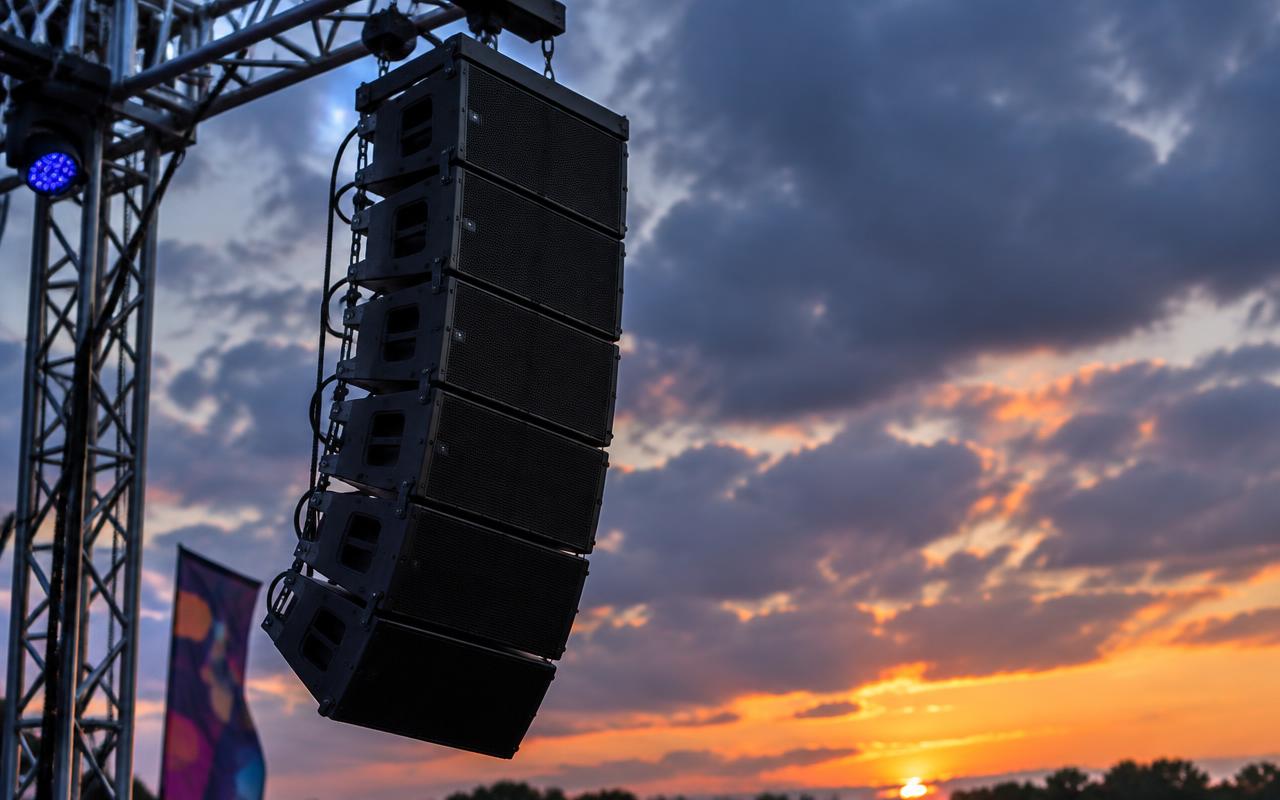
- Line arrays with flown and ground-stacked subwoofers
- Digital consoles: DiGiCo, Yamaha Rivage, Allen & Heath dLive
- Monitor world with IEMs and wedges
- Smaart-tuned system alignment
Equipment we carry
Why Bhilai chooses Prime AV
- Crews and trucks positioned for fast load-in at Civic Centre and venues in Nehru Nagar and Supela.
- We confirm the exact desk model and firmware version in writing at T-3 weeks and keep a compatible rental option on standby.
- Post-show incident and equipment report
- Working knowledge of Chhattisgarh venue rules, power sanctions and permission timelines.
Local conditions
Producing concert sound system rental in Bhilai
Weather & the rig
Concert audio is the most exposed department on an open-air build — stage boxes, amplifier racks, wedges and backline all sit in whatever the sky does, and heat alone will push an amplifier rack into thermal protection mid-set. Bhilai shares Raipur's central Indian continental climate but the plant's own thermal environment is the local twist — working inside or adjacent to plant areas in May and June, when ambient is already 44–46°C, means fixtures and crew face radiant heat on top of air temperature, which genuinely shortens equipment life and requires crew rotation. The June to September monsoon is reliable and heavy, and winter mornings bring ground fog across the township's open sectors. April to mid-June is too hot for outdoor or plant-adjacent work, and June to September monsoon rules out the open grounds. October to February is the window; the plant's own annual maintenance shutdown periods also restrict access and are worth checking before committing to a date.
Power & redundancy
A concert rig draws hard and draws unevenly, with amplifier inrush and bass transients hitting the supply together, so audio always gets its own phase and its own earth reference rather than sharing with dimmers. Uniquely in this set, the township is served off the steel plant's captive generation, which makes supply inside Bhilai's sectors genuinely excellent — stable voltage, few interruptions and decent sanctioned loads at the plant venues. Cross the boundary into Durg and ordinary CSPDCL conditions resume, so generators return. Where DG is needed, the plant's own engineering ecosystem means good sets, competent operators and proper earthing are easy to source locally.
Permits & noise rules
Concerts are judged on decibels at the site boundary rather than at the mix position, so the noise condition and the curfew drive the system design before a single box is hung. Permissions inside the township go through the Bhilai Steel Plant's estate department rather than a municipal body, which is a slower and more documented process than a corporation file — equipment lists, contractor safety compliance, and in plant-adjacent areas a safety department sign-off. Outside the township the Bhilai-Charoda and Durg municipal corporations and the district administration apply, with Chhattisgarh noise rules and the 10 pm outdoor amplified-sound limit. Drone work over or near plant premises is effectively prohibited on industrial security grounds regardless of DGCA status, and Raipur airport's zone covers the eastern approach.
Load-in & access
A headline audio package fills one to two trucks of arrays, subs, consoles, splits and backline, and it has to be first in and last out around the lighting and video departments. The township was planned with wide roads and the industrial corridor handles heavy transport daily, so freight movement is easy up to the gates — and then stops. Plant and township venue access runs entirely on approved gate passes with named crew and listed equipment, and an unlisted item or an unnamed technician will be turned back at the gate. Allow a week for the paperwork. Raipur airport is 40 km east, about an hour, which makes crew movement straightforward.
Season & booking
The plant's own observances set the diary: safety week, foundation and steel day programming, union election and anniversary functions, and sector-level cultural competitions. Chhattisgarh Rajyotsava on 1 November and Durga Puja in September–October bring township and community programming, Ganeshotsav draws the Maharashtrian and migrant communities, and the Nov–Feb wedding run concentrates in the Durg commercial belt. Peak demand runs Oct–Feb.
Crew & dispatch
Served from our Nagpur depot at 320 km with Raipur, 30 km away, acting as the real forward base — crew, structures and plant can be across in under an hour, which is what makes short-notice township work viable at all. Load-in support covers Nehru Nagar, Supela and the rest of the city.
What it costs here
A public-sector pricing environment: formal tendering, rate contracts, GST-clean documentation and payment on institutional cycles, with ceilings that do not move. Margins are thin and the paperwork burden is real, but the work is predictable, repeats annually and the operating conditions inside the township are benign. Private wedding work in Durg prices against Raipur and is negotiated hard.
Local expectations
Steel township formality governs everything: a fixed dais order with union and management seating protocol observed precisely, Hindi-first scripting with legible name boards, long felicitation sequences that need many roving mics, and a sound design built for speech. The township's population is a genuine mix of Hindi-belt, Odia, Bengali, Telugu and Maharashtrian families brought in over decades, so sector cultural programmes move between several musical traditions in a single evening and the rig has to switch between them cleanly.
Specification
Concert Sound Systems: technical specification
| Specification | Detail |
|---|---|
| Input capacity | 48 – 96 channels on redundant digital stage boxes |
| FOH consoles | DiGiCo SD10 / Quantum 338, Yamaha Rivage PM5, Allen & Heath dLive S7000 |
| Target SPL at mix position | 100 – 105 dBA for rock and EDM, 95 – 100 dBA for acoustic sets |
| Monitor world | Separate console, 16 – 24 mixes, wedges plus IEM sends |
| Sample rate / latency | 96 kHz, under 2 ms stage-box to amplifier |
| Measurement | Rational Acoustics Smaart with calibrated measurement microphones |
| Redundancy | Mirrored console or engine, dual PSU racks, ring-topology snake |
| Backline | Drum kits, bass and guitar amplification, keyboard stands, risers on request |
| Virtual soundcheck | Multitrack capture at 96 kHz for offline mixing and recall |
Show day runs on a disciplined sequence: power and earth checks, system time-alignment and tuning, line check channel by channel, then soundcheck with the band and a virtual soundcheck recording captured for later reference. We log SPL at the mix position and at the nearest residential boundary so the show stays inside the venue's noise condition while still delivering the impact the music needs. Spare microphones, spare wireless channels, a spare amplifier rack and a redundant console mirror sit ready throughout, and the engineer keeps a printed patch sheet because tablets fail at the worst moment.
Sizing
What size rig does your event actually need?
| Scale | Guests | Recommended setup |
|---|---|---|
| Club stage | 500 – 1,500 | Six to eight compact boxes per side, four subs, two front fills, 32-channel desk |
| Open ground | 2,000 – 5,000 | Twelve-box arrays per side, twelve subs in cardioid blocks, one delay position |
| Arena floor | 5,000 – 12,000 | Main hangs plus outhangs, flown sub hangs, six front fills, two monitor worlds |
| Stadium bowl | 15,000 – 40,000 | Main and side hangs with two to four delay towers, 400 kW+ amplification |
| Festival main stage | 40,000+ | Dual console worlds, rolling risers, four delay rings, full RF coordination desk |
Scope
Concert Sound System Rental scope tiers in Bhilai
Club & Festival Stage
Single-artist sets, college fest side stages, 1,000 – 3,000 guests
- Compact line array, 8 – 10 boxes per side with ground-stacked subs
- 32-channel FOH console and 12-mix monitor position
- Six wedges, two sidefills and four IEM channels
- Standard backline: drum kit, bass rig, two guitar amps
- System engineer plus two audio technicians
Headline Production
Touring artists with riders, arena shows, 5,000 – 15,000 guests
- Large-format array with flown cardioid sub hangs and front fills
- Rider-matched FOH and monitor consoles with mirrored engines
- 96-channel redundant split to both desks plus broadcast tie-off
- Twelve IEM channels with on-site RF coordination
- Four-person audio crew including dedicated monitor engineer
Stadium & Multi-Artist
Stadium concerts and multi-day festivals, 20,000 – 50,000+ guests
- Main hangs, outhangs, delay positions and distributed front fill
- Rolling-riser changeover system with duplicate monitor packages
- Two complete console worlds for back-to-back artist swaps
- Full-time RF coordinator and documented frequency plan
- Crew chief, system engineers, stage patch techs and runners
A public-sector pricing environment: formal tendering, rate contracts, GST-clean documentation and payment on institutional cycles, with ceilings that do not move. Margins are thin and the paperwork burden is real, but the work is predictable, repeats annually and the operating conditions inside the township are benign. Private wedding work in Durg prices against Raipur and is negotiated hard.
Venues
Where we work in Bhilai
| Venue | Capacity | Production note |
|---|---|---|
| Bhilai Niwas | 300–700 across the halls and lawn | The plant's own guest and function property, which means impeccable power and a controlled setting but full industrial protocol on access — gate passes, equipment lists and a load-in window that will not move. |
| Civic Centre | 1,500–4,000 across the hall and the surrounding plaza | The township's central civic venue, designed for public and cultural programming; the hall is acoustically hard and the plaza has limited power points, so a show of any scale brings its own distribution. |
| Jayanti Stadium | 20,000-plus in an open layout | The township's main sports ground, used for large public and union gatherings, with good vehicle access but no show-grade power on site and strict turf and track protection conditions from the estate department. |
| Sector community halls and Ispat club spaces | 200–800 each | A network of small township halls with reliable supply but low ceilings, narrow doorways and modest sanctioned loads — these are jobs for compact, distributed systems rather than scaled-down big rigs. |
| Supela and Durg commercial banquet belt | 600–2,000 across halls and lawns | Outside the township boundary, which changes both the permitting authority and the power situation — CSPDCL supply here is ordinary, so generators come back into the plan. |
Crew
Who turns up on show day
- Crew chief
Owns the load-in order, truck sequence, rigging sign-off and the clock against the venue's curfew.
- FOH engineer
Mixes the show, or hosts the visiting engineer and runs the house system while they drive the desk.
- Monitor engineer
Builds and mixes every wedge and IEM send, and manages talkback and artist cues from stage left.
- System engineer
Aligns the PA, measures coverage, sets delay times and keeps amplification and network health on screen.
- Stage patch technician
Patches the input list, labels every line, swaps microphones mid-show and handles changeovers.
- RF technician
Scans spectrum, coordinates microphone and IEM frequencies and watches for dropouts during the show.
What you receive
- Approved input list and FOH/monitor patch sheet
- Stage plot with backline positions and monitor send map
- SPL log at mix position and nearest noise-sensitive boundary
- Console show file backup on two drives, handed over after strike
- RF frequency plan with coordinated and reserve channels
- Multitrack virtual soundcheck recording of the performance
- Post-show incident and equipment report
Timeline
From enquiry to load-out
- T-6 weeks
Rider review
We parse the artist rider line by line and flag every item that needs substitution, approval or import.
- T-3 weeks
Patch and plot issue
Input list, patch sheet, stage plot and monitor send map go to the artist's team for sign-off.
- T-5 days
Prep and pre-build
Consoles are loaded with the show file, racks are tested, and the whole system is powered up in the warehouse.
- Show day −1
Load-in and tuning
Rigging, array flying, power distribution, system alignment and a full line check before the venue closes.
- Show day, T-5 hours
Soundcheck
Band soundcheck, virtual soundcheck capture, SPL logging at mix and boundary positions.
- Show day to +6 hours
Show and strike
Doors to curfew, then de-rig in reverse truck order with rigging signed off before motors move.
Risk control
What goes wrong, and how we stop it
What can go wrong
How we prevent it
- What can go wrong
A visiting touring engineer arrives with a show file for a console family nobody booked.
How we prevent itWe confirm the exact desk model and firmware version in writing at T-3 weeks and keep a compatible rental option on standby.
- What can go wrong
Stage wash from guitar cabinets and drum fills bleeds into vocal microphones and kills intelligibility.
How we prevent itBackline is angled off-axis from vocal positions, drum fills are replaced with IEMs for the vocalist, and we hold a perspex drum screen in the truck.
- What can go wrong
Changeover between artists overruns and the headline set is cut short by curfew.
How we prevent itRolling risers with pre-patched looms and a duplicate monitor package, rehearsed as a timed drill at load-in.
- What can go wrong
Power sag when lighting and LED load up mid-show causes amplifier protection trips.
How we prevent itAudio sits on its own phase and its own distribution with a separate earth reference, never shared with dimmer or LED feeds.
Honest comparison
Is this the right choice for your event?
- Hiring a local house system instead of a dedicated concert rigOur verdict
If the venue system is a current-generation array with a maintained amplifier rack, use it and spend the saving on monitors. Many house systems are a decade old with failed drivers, which no amount of tuning fixes.
- Skipping the virtual soundcheck captureOur verdict
Genuinely optional for a one-off private show. For a tour, a broadcast or anything you will mix again later, the multitrack is the cheapest insurance on the invoice.
- Point-source stacks instead of a line arrayOur verdict
Below about 800 guests in a low-ceilinged room, well-placed point source boxes are cheaper, faster to rig and sound more natural. Past that, the array wins on even coverage and on keeping energy off walls.
Demand
What Bhilai books most
Bhilai event mix
- Steel plant union, safety and long-service functions
- Township sector cultural programmes and sports events
- IIT Bhilai and engineering college festivals and convocations
- Vendor, ancillary and contractor industrial meets
- Weddings and receptions in the Durg and Supela commercial belt
- District administration and civic functions
Ideal for
Events we power with concert sound systems in Bhilai
Process
From brief to standing ovation
01
Brief & recce
We visit the venue, map power and rigging, and understand your show flow.
02
Design & quote
CAD plans, 3D previews and an itemised quote within 24 hours.
03
Build & rehearse
Load-in, system tuning, content checks and full technical rehearsal.
04
Show & strike
Show-caller-led execution, then a quick, clean load-out.
FAQ
Concert Sound System Rental in Bhilai: FAQs
More services in Bhilai
Concert Sound System Rental in nearby cities
Areas we cover in Bhilai
Events in Bhilai