Event production · Bhilai, Chhattisgarh
Government & Public Events AV in Bhilai
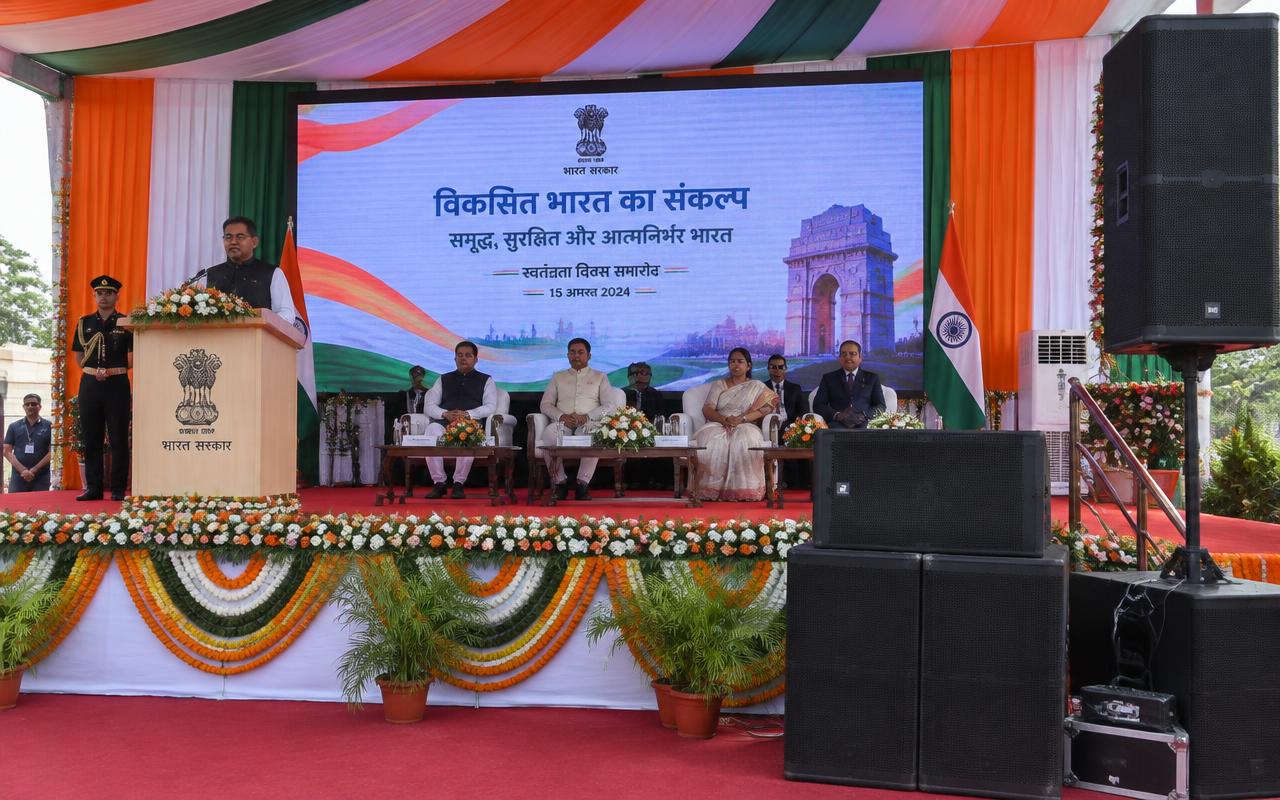
Bhilai exists because of the steel plant, and the AV market follows that logic exactly: SAIL's Bhilai Steel Plant and its township run an internal calendar of union functions, safety observances, long-service felicitations and sector-level cultural programmes, with IIT Bhilai and the Durg district establishment adding institutional work. Private spend sits in the Durg and Supela commercial belt rather than inside the township. Prime AV Solutions produces the government & public events end of that calendar — protocol-aware crew, redundant PA & power, large public screens — with one crew owning the whole stack.
- Lead time
- 6 weeks out
- Peak season
- Oct–Feb
- Coverage
- Bhilai & Chhattisgarh
Key takeaway
Complete AV for government & public events in Bhilai
A government function is a protocol exercise before it is a production. The order of the dais, who is addressed and in what sequence, where the national flag stands, when the anthem is played and how the arrival is received are all decided by the protocol office, and the production has to serve that order precisely rather than propose its own. Everything freezes earlier than on a commercial show: seating charts, speaker sequence, scripts and the anthem cue are confirmed days ahead, and the crew works from a cue sheet countersigned by the nodal officer.
Maidans, civic auditoriums and government grounds come with protocol seating, security sightlines and screening gates that shape the entire layout before AV is drawn. In Bhilai we work at Bhilai Niwas, Civic Centre, Jayanti Stadium and venues across Civic Centre, Nehru Nagar, Supela, Sector 9, Durg.
Redundancy is the second principle, and it is not a precaution here but the baseline. A function in front of a dais does not get a second attempt, so the design carries a duplicate signal chain from microphone to loudspeaker, a hot-spare podium microphone open and mixed at all times, mirrored playback for the anthem and any film, and two generators on automatic changeover with the venue supply as a third leg. Every redundant path is tested under load at rehearsal, not merely connected and assumed.
What your event needs
- Protocol-aware crew
- Redundant PA & power
- Large public screens
- Interpretation for delegations
Why Bhilai organisers choose Prime AV
- Crews and trucks positioned for fast load-in at Jayanti Stadium and venues in Supela and Sector 9.
- Design coverage with an overflow zone, pre-plan one additional delay position and screen that can be added in a day, and agree with the administration how the overflow area is served and marshalled.
- A standing Bhilai client base across steel plant union, safety and long-service functions and township sector cultural programmes and sports events, so the rig is specified from experience rather than a catalogue.
- Working knowledge of Chhattisgarh venue rules, power sanctions and permission timelines.
What you will be judged on afterwards
- The arrival and the national anthem ran exactly to the protocol office's order, with no music or cue out of place.
- Every dignitary was clearly audible from the podium and on the press feed, with no dropout in front of the dais.
- The public seated beyond the enclosures could both hear the addresses and see them on screen.
- Press and broadcast received a usable clean feed and left without needing to re-record anything.
- Delegations followed the proceedings on their own language channel, and accessible seating had a clear screen sightline.
Local conditions
Producing government & public events in Bhilai
Weather & the rig
Public functions are fixed to a date of significance and usually held in the open under a shamiana, so the dais, the screens and a seated public meet the season head-on. Bhilai shares Raipur's central Indian continental climate but the plant's own thermal environment is the local twist — working inside or adjacent to plant areas in May and June, when ambient is already 44–46°C, means fixtures and crew face radiant heat on top of air temperature, which genuinely shortens equipment life and requires crew rotation. The June to September monsoon is reliable and heavy, and winter mornings bring ground fog across the township's open sectors. April to mid-June is too hot for outdoor or plant-adjacent work, and June to September monsoon rules out the open grounds. October to February is the window; the plant's own annual maintenance shutdown periods also restrict access and are worth checking before committing to a date.
Power & redundancy
A function in front of a dais is designed for zero visible failure, which makes dual generators on automatic changeover the baseline rather than a contingency. Uniquely in this set, the township is served off the steel plant's captive generation, which makes supply inside Bhilai's sectors genuinely excellent — stable voltage, few interruptions and decent sanctioned loads at the plant venues. Cross the boundary into Durg and ordinary CSPDCL conditions resume, so generators return. Where DG is needed, the plant's own engineering ecosystem means good sets, competent operators and proper earthing are easy to source locally.
Permits & noise rules
Clearances run through the district administration, the police and the venue's nodal officer together, and nothing loads in until all three are aligned on the same plan. Permissions inside the township go through the Bhilai Steel Plant's estate department rather than a municipal body, which is a slower and more documented process than a corporation file — equipment lists, contractor safety compliance, and in plant-adjacent areas a safety department sign-off. Outside the township the Bhilai-Charoda and Durg municipal corporations and the district administration apply, with Chhattisgarh noise rules and the 10 pm outdoor amplified-sound limit. Drone work over or near plant premises is effectively prohibited on industrial security grounds regardless of DGCA status, and Raipur airport's zone covers the eastern approach.
Load-in & access
Vehicles and crew need prior clearance and must be inside the cordon well before a lockdown hour that is not negotiable for any reason. The township was planned with wide roads and the industrial corridor handles heavy transport daily, so freight movement is easy up to the gates — and then stops. Plant and township venue access runs entirely on approved gate passes with named crew and listed equipment, and an unlisted item or an unnamed technician will be turned back at the gate. Allow a week for the paperwork. Raipur airport is 40 km east, about an hour, which makes crew movement straightforward.
Season & booking
The plant's own observances set the diary: safety week, foundation and steel day programming, union election and anniversary functions, and sector-level cultural competitions. Chhattisgarh Rajyotsava on 1 November and Durga Puja in September–October bring township and community programming, Ganeshotsav draws the Maharashtrian and migrant communities, and the Nov–Feb wedding run concentrates in the Durg commercial belt. Peak demand runs Oct–Feb.
Crew & dispatch
Served from our Nagpur depot at 320 km with Raipur, 30 km away, acting as the real forward base — crew, structures and plant can be across in under an hour, which is what makes short-notice township work viable at all.
What it costs here
A public-sector pricing environment: formal tendering, rate contracts, GST-clean documentation and payment on institutional cycles, with ceilings that do not move. Margins are thin and the paperwork burden is real, but the work is predictable, repeats annually and the operating conditions inside the township are benign. Private wedding work in Durg prices against Raipur and is negotiated hard.
Local expectations
Steel township formality governs everything: a fixed dais order with union and management seating protocol observed precisely, Hindi-first scripting with legible name boards, long felicitation sequences that need many roving mics, and a sound design built for speech. The township's population is a genuine mix of Hindi-belt, Odia, Bengali, Telugu and Maharashtrian families brought in over decades, so sector cultural programmes move between several musical traditions in a single evening and the rig has to switch between them cleanly.
Run of show
A typical government & public events schedule
| Time | Moment | What AV is doing |
|---|---|---|
| T−4 days | Site build | Stage, dais, shamiana, screen supports and delay positions erected; generators placed, earthed and tested; cable routes kept clear of all access and evacuation paths. |
| T−2 days | Crew clearance and access | Final crew list and vehicle details submitted; passes issued; equipment inventory logged with the security detail at the gate. |
| T−1 day | Full rehearsal with protocol | Complete run with the protocol team including arrival, anthem, speaker sequence and departure; every redundant path tested under load; cue sheet countersigned. |
| T−6 hrs | Anti-sabotage check and lockdown | Venue swept and sealed; nothing enters afterwards, so all testing, spares placement and crew positioning is completed before this hour. |
| T−90 min | Crew in position | Operators at consoles inside the cordon, comms checked on a closed channel, podium and dais microphones verified with the hot spare live. |
| 10:00 | Guest seating | Instrumental bed at a restrained level, screens on the event frame, announcement channel ready for seating and protocol instructions. |
| 10:30 | Arrival and national anthem | Music stopped cleanly, anthem played from the primary machine with the mirror armed, cameras framed wide on the dais, no cuts during the anthem. |
| 11:30 | Addresses and inauguration | Podium microphone with hot spare, interpretation channels live, screens on the speaker and the plaque or inauguration point, clean feed to the press enclosure. |
Reach and inclusion complete the brief. A public function may seat a few hundred under a shamiana and gather several thousand beyond it, so large screens and delay positions carry the event to people who cannot see the dais. Visiting delegations need interpretation booths and receivers; accessible seating needs a direct screen sightline; announcements and screen text often need a regional language alongside English and Hindi; and the press and broadcast enclosure needs a clean programme feed delivered to an agreed standard rather than a microphone pointed at a speaker.
Scope
Government & Public Events scope levels in Bhilai
A hall or small ground function: redundant speech PA with a hot-spare podium microphone, a screen, dais lighting, playback for the anthem and a generator on changeover.
A public function for several thousand: line-array mains with a delay position, two large screens with camera feed, duplicated signal chain, dual generators and a press feed.
A large maidan event: multiple hangs and delay rings, screen clusters, full duplicate chain and power, interpretation for delegations, three or four cameras and a broadcast-standard clean feed.
A major ceremony or multi-day summit: zoned coverage across a very large ground, multi-language interpretation, a drone or ceremonial finale where permitted, and complete end-to-end redundancy with a multi-day build.
A public-sector pricing environment: formal tendering, rate contracts, GST-clean documentation and payment on institutional cycles, with ceilings that do not move. Margins are thin and the paperwork burden is real, but the work is predictable, repeats annually and the operating conditions inside the township are benign. Private wedding work in Durg prices against Raipur and is negotiated hard.
Venues
Where government & public events happen in Bhilai
| Venue | Capacity | Production note |
|---|---|---|
| Bhilai Niwas | 300–700 across the halls and lawn | The plant's own guest and function property, which means impeccable power and a controlled setting but full industrial protocol on access — gate passes, equipment lists and a load-in window that will not move. |
| Civic Centre | 1,500–4,000 across the hall and the surrounding plaza | The township's central civic venue, designed for public and cultural programming; the hall is acoustically hard and the plaza has limited power points, so a show of any scale brings its own distribution. |
| Jayanti Stadium | 20,000-plus in an open layout | The township's main sports ground, used for large public and union gatherings, with good vehicle access but no show-grade power on site and strict turf and track protection conditions from the estate department. |
| Sector community halls and Ispat club spaces | 200–800 each | A network of small township halls with reliable supply but low ceilings, narrow doorways and modest sanctioned loads — these are jobs for compact, distributed systems rather than scaled-down big rigs. |
| Supela and Durg commercial banquet belt | 600–2,000 across halls and lawns | Outside the township boundary, which changes both the permitting authority and the power situation — CSPDCL supply here is ordinary, so generators come back into the plan. |
Demand
What Bhilai books most
Bhilai event mix
- Steel plant union, safety and long-service functions
- Township sector cultural programmes and sports events
- IIT Bhilai and engineering college festivals and convocations
- Vendor, ancillary and contractor industrial meets
- Weddings and receptions in the Durg and Supela commercial belt
- District administration and civic functions
Services
Recommended production stack
Line Array Systems
Flown line array systems designed in prediction software for outdoor grounds, convention halls and arenas of 1,000 to 50,000 guests.
LED Screen Rental
Large-format LED screens and IMAG side screens with switching, so every guest sees speakers, performers and content in crisp detail.
Simultaneous Interpretation Systems
ISO-standard interpretation booths, infrared receivers and multi-language channels for international summits and government delegations.
Drone Light Shows
Choreographed drone light shows with 100 to 1,000+ drones that paint logos, names and stories across the night sky — with all permissions handled.
Timeline
Planning milestones
- 6 weeks out
Site survey with the nodal officer
Ground layout, enclosure plan, security sightlines, power availability and permitted structure positions walked and recorded in writing.
- 4 weeks out
Protocol and seating plan
Dais order, speaker sequence, anthem and arrival choreography, flag position and enclosure allocations received from the protocol office.
- 3 weeks out
Crew list for security clearance
Names, identity documents and vehicle details submitted; cleared deputies nominated for every critical operating position.
- 2 weeks out
Redundancy design sign-off
Duplicate signal chain, hot-spare microphone scheme, mirrored playback and dual-generator changeover approved by the client's technical officer.
- T−1 day
Rehearsal and lockdown preparation
Full protocol rehearsal, every redundant path tested under load, spares placed inside the cordon and the cue sheet countersigned.
- T+1 day
Strike and site handover
Derig after the cordon lifts, inventory reconciled with the security detail, and the ground handed back in its surveyed condition.
Risk control
What goes wrong, and how we stop it
What can go wrong
How we prevent it
- What can go wrong
The public crowd substantially exceeds the enclosure estimate.
How we prevent itDesign coverage with an overflow zone, pre-plan one additional delay position and screen that can be added in a day, and agree with the administration how the overflow area is served and marshalled.
- What can go wrong
Interpretation channels or receivers are unallocated on the day.
How we prevent itConfirm delegation languages and head counts in advance, number receivers against a distribution and collection register at the entry point, and brief the protocol team on which channel carries which language.
- What can go wrong
The speaker sequence changes after the dignitaries have arrived.
How we prevent itBuild the cue sheet so segments are independent and reorderable, keep the show-caller beside the protocol officer throughout, and have the graphics and screen operator working from live text fields rather than baked video.
- What can go wrong
Crew passes are not cleared in time and technicians cannot enter.
How we prevent itSubmit the crew list, identity documents and vehicle details well before the deadline, nominate a cleared deputy for every critical position, and keep the list short and fixed rather than adding names late.
Process
From brief to standing ovation
01
Brief & recce
We visit the venue, map power and rigging, and understand your show flow.
02
Design & quote
CAD plans, 3D previews and an itemised quote within 24 hours.
03
Build & rehearse
Load-in, system tuning, content checks and full technical rehearsal.
04
Show & strike
Show-caller-led execution, then a quick, clean load-out.
FAQ
Government & Public Events AV in Bhilai: FAQs
Other events in Bhilai
Government & Public Events AV in nearby cities
Services in Bhilai
Areas we cover in Bhilai