Event production · Delhi, Delhi NCR
College Fests AV in Delhi
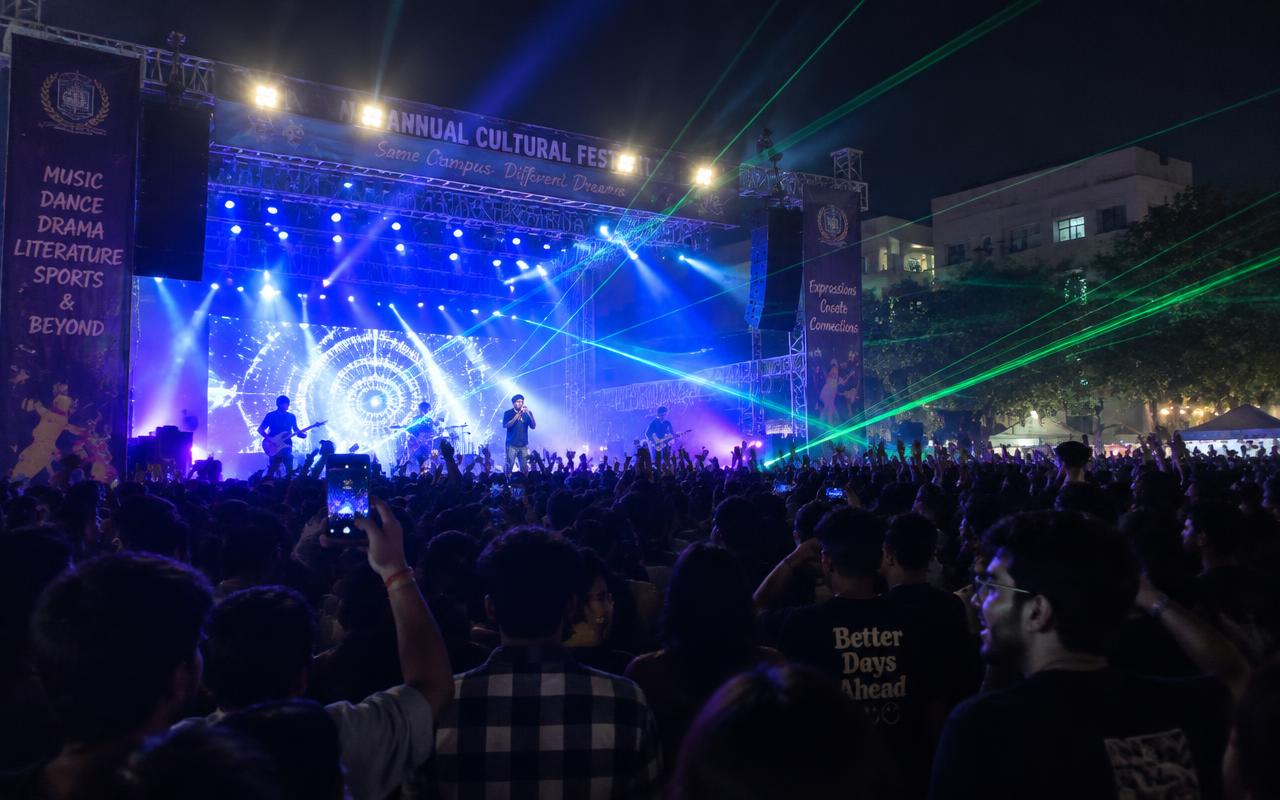
Delhi's event economy runs on policy and procurement: ministries, PSUs, embassies, industry bodies like CII and FICCI, and the exhibition calendar at Pragati Maidan and Dwarka. Alongside that sits the farmhouse wedding belt from Chattarpur to Mehrauli, where single families commission production budgets that rival a mid-size corporate conference. Prime AV Solutions produces the college fests end of that calendar — artist rider fulfilment, concert PA for 10,000+, beam & laser shows — with one crew owning the whole stack.
- Lead time
- 8 weeks out
- Peak season
- Oct–Mar
- Coverage
- Delhi & Delhi NCR
Key takeaway
Complete AV for college fests in Delhi
A college fest runs on a budget that was raised, not allocated, and is decided by a committee that changes every year. The way to protect both the show and the students is a written scope with named quantities, a single student point of contact with authority, and clear payment milestones tied to build stages. Scope the rig to the ground and the realistic crowd rather than to the poster, and be explicit about what is not included, because the gap between what a sponsorship deck promised and what the budget buys is where fests get into trouble two days before the pro-show.
College grounds and auditoriums offer no rigging, no loading dock and usually a cricket pitch or turf nobody is allowed to drive over. In Delhi we work at Bharat Mandapam, Yashobhoomi, JLN Stadium and venues across Connaught Place, Aerocity, Chattarpur, Vasant Kunj, Dwarka.
Crowd safety is the part that actually matters. A campus ground holding eight to fifteen thousand students needs a barricade line with a working front-of-stage pit, delay towers so the back of the field hears the set rather than an echo, a crowd-lighting state the security team can call for in one button, clear exit routes that cables do not cross, and an agreed stop-show protocol. Sound-pressure limits near hostels, examination blocks and residential neighbours are real and enforced, so they belong in the system design rather than in a conversation at eleven at night.
What your event needs
- Artist rider fulfilment
- Concert PA for 10,000+
- Beam & laser shows
- Stage and barricades
Why Delhi organisers choose Prime AV
- Crews and trucks positioned for fast load-in at Chattarpur farmhouse venues and venues in Mehrauli and Connaught Place.
- Cover the stage surface, keep the pro-show backline and consoles off the deck until the afternoon reset, and schedule a hard changeover with the committee rather than letting events run late into it.
- A standing Delhi client base across government, ministry and multilateral summits and trade exhibitions and industry association conventions, so the rig is specified from experience rather than a catalogue.
- Working knowledge of Delhi NCR venue rules, power sanctions and permission timelines.
What you will be judged on afterwards
- The headline set started and finished on the permitted time, so the college kept its clearance for next year.
- Nobody was injured at the barricade and security had light on the crowd whenever they asked for it.
- Students at the back of the ground heard a real mix rather than a distant echo.
- The committee stayed inside the budget they raised, with no surprise additions on show day.
- The phone footage that circulated afterwards made the fest look bigger than it cost.
Local conditions
Producing college fests in Delhi
Weather & the rig
Fests sit on open grounds in fest season, and an unseasonal shower on a student budget has nowhere to retreat to, so the roof and covers are the whole contingency. Two distinct problems bracket the season. From mid-December through January, radiation fog drops visibility under 100m and turns projection milky at any useful throw, while 3–5°C call times slow LCD response on monitors and stress LED driver boards before the first cue. Then from late October the post-harvest smoke layer pushes AQI past 400, which hazes beams attractively to the eye and reads as dirty grey on camera, so broadcast-led shows have to light for the haze rather than through it. May and June bring 45°C and loo winds that load filters within a session. Jul–Sep monsoon, where the real hazard is not rainfall volume but the short violent pre-rain squall that arrives in ten minutes and takes down an untethered outdoor structure; mid-Dec to late Jan if the design depends on projection throw.
Power & redundancy
Campus supply was built for classrooms and laboratories, so a pro-show rig almost always runs on hired generators parked at the edge of the ground. NDMC, BSES and Tata Power supply in Lutyens, Aerocity and Dwarka is strong enough to run a conference on house power. The farmhouse belt is the opposite: Chattarpur and Mehrauli events are DG-primary, typically a synchronised pair of 250 kVA silent sets with auto-changeover. The complication unique to Delhi is GRAP — once the Commission for Air Quality Management escalates to the higher stages in winter, diesel generator use is curtailed unless the set is retrofitted or dual-fuel, so a December outdoor show needs its power strategy approved before the stage design is signed.
Permits & noise rules
A campus event still needs police intimation, crowd clearance and a loudspeaker permission with a hard end time, and the administration layers its own conditions on top. Amplified sound and temporary-structure NOCs route through the Delhi Police Licensing Branch, with ground permission from MCD, NDMC or DDA depending on whose land it is, and a Delhi Fire Service NOC for any pandal or raised structure. DPCC applies the noise rules and the 10pm loudspeaker cut-off. Drone operation is close to impossible on a normal timeline: most of the city falls inside the IGI red zone or a VVIP restriction, and anything beyond that needs clearance that goes well past a Digital Sky permission.
Load-in & access
Trucks have to reach a campus built for two-wheelers, through narrow gates, across paver blocks and between academic buildings during term time. Goods-vehicle restrictions keep trucks out of much of the city through the day, so inventory moves from Okhla, Noida or Gurugram warehousing after 11pm. Pragati Maidan is easier since the tunnel opened, but ITPO gate passes have to be lodged days ahead. Yashobhoomi has purpose-built docks. The genuine trap is the farmhouse circuit, where a single narrow gate is shared with guest arrival, so load-in must be finished and the gate cleared before the first car turns in.
Season & booking
India International Trade Fair at Pragati Maidan through the second half of November absorbs every truss section, rigger and forklift in the NCR. Republic Day locks central Delhi for most of January with rehearsal closures from early in the month, state visits close roads without notice, Diwali week empties the labour pool, and the November-December and February muhurat clusters book out the farmhouse belt a year ahead. Peak demand runs Oct–Mar.
Crew & dispatch
Own NCR base with warehousing across Okhla, Noida and Gurugram, which also makes Delhi the dispatch origin for Jaipur, Agra, Lucknow, Gwalior, Ludhiana and Amritsar.
What it costs here
The deepest supplier pool in the country sits here, which makes Delhi the cheapest place in India to hire kit — a comparable conference rig quotes well below its Mumbai equivalent — and clients negotiate accordingly. The margin lives in engineering, crew quality and compliance paperwork, not in equipment day rates.
Local expectations
Protocol is the deliverable at government and diplomatic events: dais seating order, the lamp-lighting sequence, anthem cues, correct honorifics in the script and a VIP arrival time that will move by forty minutes without warning. Bilingual Hindi and English scripting is assumed, as is a clean press feed. Punjabi weddings here expect high SPL and a finish past the curfew, which is why experienced producers push those clients towards acoustically contained indoor venues rather than fighting the enforcement.
Run of show
A typical college fests schedule
| Time | Moment | What AV is doing |
|---|---|---|
| T−2 days | Ground build | Stage, roof and ground support up with load calculations, barricade line set with security, delay tower positions pegged and power routed. |
| T−1 day | Rig and programme | Arrays flown and tuned, lighting rig focused and the show programmed, LED built and content loaded, campus boundary levels measured. |
| 08:00 | Day events on the main stage | Speech-level audio and basic wash for competitions, with the pro-show rig protected and the stage surface covered. |
| 16:00 | Stage reset for pro-show | Day-event kit struck, backline placed on rolling risers and pre-wired, stage plot checked against the rider. |
| 17:30 | Line check | Full input list verified with each act, monitor scenes stored per act, radio and in-ear frequencies coordinated across all users. |
| 19:00 | Doors and opening acts | Crowd lighting live for security, walk-in level controlled, first acts run from stored scenes with a drilled changeover between them. |
| 21:30 | Headline changeover | Risers rolled, pre-wired backline connected, monitor world recalled, five-minute line check behind a drape with the clock visible to all. |
| 22:00 | Headline set to hard stop | Full programmed show, SPL logged, lighting and LED cues run, set ends on the permitted time without negotiation from the stage. |
Pro-show night is a turnaround exercise. Three or four student and opening acts feeding into one headliner, with a hard campus stop, means changeovers of twenty to thirty minutes with no room to lose any. Rolling risers with pre-wired backline, stored console scenes per act, a split monitor position and a stage manager running the move as a drill are what hold it together. The headline artist's rider frequently lands seventy-two hours out, so build the advance process early and treat the rider as a document to be negotiated rather than received.
Scope
College Fests scope levels in Delhi
Day events plus a modest evening show: compact PA for up to 2,000, four radio mics, a basic moving-light rig, a decked stage and a small LED backdrop.
A 5,000-capacity ground: line-array PA with subs, separate monitor position, roofed stage with certified rigging, barricade, a programmed light show and an LED wall.
10,000-plus crowd: full hangs with a delay ring, rider-grade consoles and backline, large LED with IMAG, a 100-plus fixture rig with beams and lasers, and generator redundancy.
Multi-day, multi-stage fest with an arena-scale pro-show night, rider compliance for a touring act, full crowd-safety infrastructure and a crew on rotating shifts.
The deepest supplier pool in the country sits here, which makes Delhi the cheapest place in India to hire kit — a comparable conference rig quotes well below its Mumbai equivalent — and clients negotiate accordingly. The margin lives in engineering, crew quality and compliance paperwork, not in equipment day rates.
Venues
Where college fests happen in Delhi
| Venue | Capacity | Production note |
|---|---|---|
| Bharat Mandapam | Around 7,000 in the plenary hall with multiple halls across the ITPO complex | Everything goes through the ITPO process — gate passes, approved-vendor paperwork and security screening of every case — so the build calendar has to start 72 hours before a build that would take one night anywhere else. |
| Yashobhoomi | Around 11,000 in the main auditorium plus very large convention and exhibition halls | The sheer footprint is the constraint: control positions end up a long way from stage, so fibre and signal distribution rather than copper multicore decides whether the design works. |
| JLN Stadium | Around 60,000 in the bowl, with the infield used for staged events | SAI holds the approvals, the athletics track and infield need full protection boarding, and the roof carries no event rigging at all, so even a modest stage needs ground-support towers with ballast calculations. |
| Siri Fort Auditorium | Around 1,200 seated | A fixed proscenium house with house rigging and a locked projection throw, so any design that wants a different screen position has to solve it with ground support in the wings. |
| Chattarpur farmhouse venues | Typically 1,000–5,000 across lawns and covered structures | Driveways are gravel or kutcha and will not take a loaded trailer without ground-protection boards, and almost every one of them is generated end to end with no usable house feed. |
Demand
What Delhi books most
Delhi event mix
- Government, ministry and multilateral summits
- Trade exhibitions and industry association conventions
- Large farmhouse and hotel weddings
- Corporate conferences, dealer meets and award nights
- Product launches and auto reveals
- Political rallies and public functions
Services
Recommended production stack
Concert Sound Systems
Concert-grade PA built around L-Acoustics, d&b and JBL VTX class line arrays, tuned by system engineers for even coverage from front row to last.
Intelligent Moving Head Lights
Beams, spots, washes and hybrids from Robe, Clay Paky and Martin — deployed in rigs of 24 to 300 fixtures with programmers on site.
Stage & Truss Fabrication
Modular stages, ground support, roof systems and custom truss structures engineered with load calculations and certified rigging crews.
LED Wall Rental
Indoor P2.6/P3.9 and outdoor P4.8 LED walls in any size or shape — curved, cubes, floor LED and kinetic panels — powered by Novastar processing.
Timeline
Planning milestones
- 8 weeks out
Scope and budget agreed
Ground, crowd estimate, stage size and quantities written down with inclusions, exclusions and payment milestones signed by the committee.
- 6 weeks out
Campus permissions
Police intimation, crowd and capacity clearance, loudspeaker permission with its end time, and the administration's own conditions obtained.
- 4 weeks out
Artist advance
Rider reviewed, substitutions proposed and accepted in writing, stage plot and input list issued to the ground design.
- 3 weeks out
Site design and safety plan
Array prediction on the actual ground, barricade and exit layout, generator placement, cable routes clear of crowd paths.
- T−2 to T−1 day
Build and programme
Structure, arrays, lighting and LED complete; show programmed, boundary levels measured, changeover drill rehearsed.
- T+1 day
Strike and ground handover
Overnight or next-morning derig, ground returned to the condition the college signed for, with turf and surfaces inspected together.
Risk control
What goes wrong, and how we stop it
What can go wrong
How we prevent it
- What can go wrong
Day competitions damage or disorganise the pro-show stage.
How we prevent itCover the stage surface, keep the pro-show backline and consoles off the deck until the afternoon reset, and schedule a hard changeover with the committee rather than letting events run late into it.
- What can go wrong
The campus hard stop arrives mid-set and nobody on stage respects it.
How we prevent itGet the permitted end time in writing, print it on the cue sheet, brief the artist management in the advance, and give the stage manager authority to run a play-off at the agreed minute.
- What can go wrong
Crowd surge builds at the front-of-stage barricade.
How we prevent itSpecify a pit with real working width, staff it with a barrier crew carrying water and an extraction route, keep a one-button crowd-lighting state, and agree a stop-show protocol with campus security beforehand.
- What can go wrong
Campus electrical supply cannot carry a concert rig.
How we prevent itMeasure what is actually available at the recce, hire sized silent generators parked at the ground's edge with a changeover panel, and keep audio on separate clean distribution from the lighting feed.
Process
From brief to standing ovation
01
Brief & recce
We visit the venue, map power and rigging, and understand your show flow.
02
Design & quote
CAD plans, 3D previews and an itemised quote within 24 hours.
03
Build & rehearse
Load-in, system tuning, content checks and full technical rehearsal.
04
Show & strike
Show-caller-led execution, then a quick, clean load-out.
FAQ
College Fests AV in Delhi: FAQs
Other events in Delhi
College Fests AV in nearby cities
Services in Delhi