Spectacle · Amravati, Maharashtra
3D Projection Mapping in Amravati
Prime AV Solutions runs 3D projection mapping across Amravati and the rest of Maharashtra. Run from our Nagpur depot, 155 km on NH-53 at about three hours, which keeps same-day movement practical; labour, mandap structure and barricading are hired locally in Amravati and Akola, with Nagpur supplying anything specialised. Every project is specified and quoted to its own brief.
- Lead time
- From 10 weeks
- Peak season
- Oct–Feb
- Coverage
- Amravati & Maharashtra
Key takeaway
3D Projection Mapping for Amravati’s biggest events
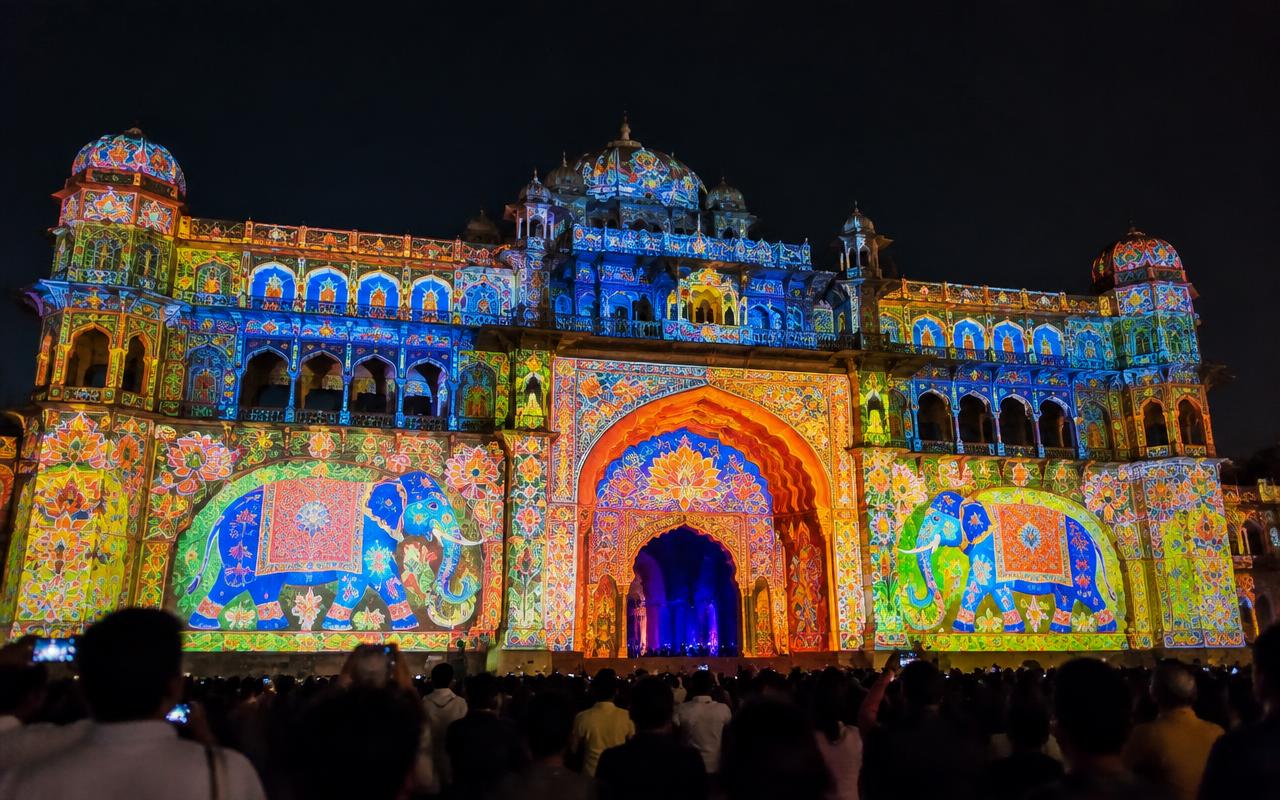
Projection mapping starts with a survey, not a storyboard. We photogrammetry-scan or LiDAR-measure the surface — a façade, a stage set, a car, a cake — and build a 3D model that matches the real object within a few centimetres. The projectors are then positioned virtually against that model to check throw ratio, keystone, shadowing from balconies or trees, and whether any part of the surface falls outside the beam. Only once the projector positions are fixed does content production begin, because a mapped animation is authored against a specific camera position and cannot simply be moved later.
The surface is the instrument here — its material, reflectance, depth and the audience's viewing axis decide projector count, angles and whether the illusion reads at all. In Amravati that plays out at venues like Hotel Mahfil, Sant Gadge Baba grounds, Camp Area lawns, and across Camp Area, Rajapeth, Badnera Road, Shegaon Naka.
Brightness is the engineering constraint that decides the budget. Perceived image brightness depends on lumens, surface area, the reflectance of the material and the ambient light falling on it. Stone and painted plaster reflect perhaps 20 to 35 per cent of what hits them; dark stone far less. A heritage façade of 400 square metres with street lighting nearby can need 100,000 lumens or more in total, which is three or four stacked 30K-class laser projectors per angle. Laser phosphor sources are the standard now because they hold brightness and colour across a run, start instantly and tolerate the dust and heat of an outdoor build far better than lamps.
What’s included
- 20K–40K lumen laser projectors
- Custom 3D content & storyboards
- Edge blending & warping (Pixera, Disguise)
- Heritage façades, cars, cakes & stages
Equipment we carry
Why Amravati chooses Prime AV
- Crews and trucks positioned for fast load-in at Ambadevi temple precinct and adjoining grounds and venues in Shegaon Naka and Gadge Nagar.
- The calculation includes measured surface reflectance, not an assumed figure, and a test projection on the actual material is done at survey wherever access allows.
- Master render of the show content at delivery resolution
- Working knowledge of Maharashtra venue rules, power sanctions and permission timelines.
Local conditions
Producing 3D projection mapping in Amravati
Weather & the rig
Mapping is defeated by air as much as by rain — haze, dust and humidity scatter the beam and soften a blend, so brightness headroom is specified against local conditions. Western Vidarbha is among the hottest regions in Maharashtra and May routinely reaches 45–47°C with a dry searing wind that makes any daytime outdoor rehearsal unsafe without shade and crew rotation. The region is also drought-prone, which makes water for dust suppression scarce and expensive in the pre-monsoon months. The south-west monsoon from June to September delivers the year's rain in heavy spells, and the local black cotton soil becomes a slick, load-bearing nightmare when wet — the single most underestimated ground condition in this belt. March to mid-June is too hot for daytime outdoor work and crew heat stress becomes the limiting constraint. June–September monsoon makes black-soil ground unusable for vehicles and structures alike. October to February is the season, and farmer-facing events track the post-harvest months when there is money in the belt.
Power & redundancy
Stacked 30K-class projectors each draw several kilowatts continuously for the whole run, so projection needs a dedicated, stable, uninterrupted supply rather than a share of the event distribution. MSEDCL supply into the city centre is adequate but the district's feeders carry heavy irrigation load and managed interruption is routine, worse in the surrounding talukas than in the city itself. Venue sanctioned loads are small, so diesel generation covers show load on almost every job; the local hire fleet is agriculture and construction oriented with a lot of older open sets, so specify silent canopies and verify the actual condition of the plant before it arrives.
Permits & noise rules
Mapping a building means permission to light it, towers on public or heritage ground, and usually a negotiated blackout of nearby street lighting for the show window. The Amravati Municipal Corporation allots grounds and issues pandal permissions, the district police handle assembly and traffic, and the Maharashtra Noise Pollution Rules apply with the state's characteristic seriousness — silence-zone provisions near hospitals and schools, the 10 pm outdoor amplified-sound limit, and Bombay High Court directions on festival loudspeaker use that are applied rather than ignored. Amravati has no scheduled commercial airport, which simplifies drone clearance to DGCA registration plus police intimation, and Melghat tiger reserve conditions apply to anything on that side of the district.
Load-in & access
Projector towers, ballast and enclosures have to be placed on a precise viewing axis that is often a road or a public plaza, so access and closures drive the build plan. NH-53 runs through, putting Nagpur about three hours east, and freight into the campus and industrial venues is uncomplicated. The friction is the old city — Rajkamal Chowk, Itwara Bazaar and the lanes around the temple are congested and take nothing larger than a tempo in daylight, and day-time truck entry is restricted. Monsoon-season movement onto black-soil ground needs matted access roads laid before the first vehicle, not after.
Season & booking
Ganeshotsav in August–September commits mandal-grade sound and lighting across the city for ten days and is the busiest community production period of the year. The Ambadevi Navaratri fair draws large crowds, Gudi Padwa and Akshaya Tritiya open wedding seasons, and the post-harvest window from November to February is when agri trade bodies and farmer conventions actually meet. Marathi college festival season takes January and February dates. Peak demand runs Oct–Feb.
Crew & dispatch
Run from our Nagpur depot, 155 km on NH-53 at about three hours, which keeps same-day movement practical; labour, mandap structure and barricading are hired locally in Amravati and Akola, with Nagpur supplying anything specialised. Load-in support covers Shegaon Naka, Gadge Nagar and the rest of the city.
What it costs here
Genuinely tied to the agricultural cycle — a poor cotton season visibly shrinks wedding and trade budgets across the district, and clients will say so openly. Committee-run trade bodies and cooperative institutions negotiate hard against local suppliers who work cheaply. The segments that hold up are branded agri-input and automotive dealer meets, where a national marketing standard sets the specification, and the university sector, which books predictably if modestly.
Local expectations
Vidarbha Marathi convention shapes the social and civic work: a shubharambha and lamp-lighting sequence with its own lighting state, long satkar and felicitation segments needing several roving mics, and bhajan or kirtan ensembles that want warm natural reinforcement. Farmer conventions are judged entirely on whether the speaker was intelligible at the back of a wide, open, noisy ground. Wedding work is expressive but spends on decor before AV, so the proposition is usually sound quality and a video deliverable the family will keep.
Specification
3D Projection Mapping: technical specification
| Specification | Detail |
|---|---|
| Projector class | 20,000 – 40,000 ANSI lumens, laser phosphor or RGB laser, 3-chip DLP |
| Surface reflectance assumption | 20 – 35 per cent for stone and painted plaster, lower for dark granite |
| Typical façade budget | Approximately 250 – 400 lumens per square metre of lit surface, ambient dependent |
| Blend overlap | 10 – 20 per cent soft-edge between adjacent projectors |
| Media servers | disguise gx/vx, AV Stumpfl Pixera, Dataton Watchout |
| Survey method | Photogrammetry or LiDAR scan to a 3D model accurate within a few centimetres |
| Alignment window | Night-time only, four to eight hours for a multi-projector façade |
| Content pipeline | Cinema 4D or Blender to UV-mapped render, delivered as image sequence |
| Show length | 3 – 12 minutes, usually looped with timecoded audio |
| Weather protection | IP-rated projector enclosures with filtered forced-air cooling for outdoor runs |
On site, the work is warping, blending and masking. Each projector's output is warped onto the surface geometry using a media server — disguise, Pixera or Watchout — with overlap regions of 10 to 20 per cent soft-edge blended so no seam is visible. Masks cut the beam off windows, balconies and anything that must stay dark. Alignment is done at night with the actual content and takes hours, not minutes, and it must be re-checked if a projector is bumped or a tower settles. We lock projector positions with ballasted towers and mark every position so a knocked unit can be returned to alignment rather than re-mapped.
Sizing
What size rig does your event actually need?
| Scale | Guests | Recommended setup |
|---|---|---|
| Single object | 50 – 300 | One object, 2 x 20K projectors, 10 – 30 sq m, 60 – 90 seconds of content |
| Stage set | 300 – 1,500 | Set faces plus floor, 4 x 20K, 50 – 120 sq m, blended and masked to scenic edges |
| Hotel façade | 500 – 2,000 | 6 x 30K from two angles, 250 – 400 sq m, three-minute show, ballasted towers |
| Palace or fort wall | 2,000 – 10,000 | 10 – 14 x 30K from three angles, 500 – 800 sq m, five-minute narrative, multi-night |
| Monument spectacle | 10,000+ | 20+ projectors, 1,000 sq m+, redundant servers, nightly alignment, licensed site |
Scope
3D Projection Mapping scope tiers in Amravati
Object & Stage Mapping
Product reveals, car launches, cakes and set pieces up to 60 sq m
- 3D scan of the object and a matched virtual projector study
- Two to four 20K-class projectors with blending and masking
- 60 to 120 seconds of bespoke animation to the reveal beat
- Pixera or Watchout playback with timecoded audio
- Mapping technician, media server operator and a content artist
Façade Show
Heritage buildings, hotel and palace façades, 200 – 600 sq m
- Photogrammetry survey and full geometry model of the building
- Six to twelve 30K-class laser projectors on ballasted towers
- Three to six minutes of custom 3D content with sound design
- Night alignment across multiple sessions with masking of windows
- Projection crew, riggers, server operator and content studio time
Large-Scale Spectacle
City festivals, monuments and multi-surface installations, 800 sq m and above
- Multi-angle design covering several surfaces as one canvas
- Twenty-plus projectors with redundant servers and hot spares
- Full narrative content production with score and voiceover
- Weather-rated enclosures and a multi-night run with nightly re-alignment
- Full crew across survey, build, alignment, show run and strike
Genuinely tied to the agricultural cycle — a poor cotton season visibly shrinks wedding and trade budgets across the district, and clients will say so openly. Committee-run trade bodies and cooperative institutions negotiate hard against local suppliers who work cheaply. The segments that hold up are branded agri-input and automotive dealer meets, where a national marketing standard sets the specification, and the university sector, which books predictably if modestly.
Venues
Where we work in Amravati
| Venue | Capacity | Production note |
|---|---|---|
| Hotel Mahfil | 400–800 across the banquet hall and lawn | The city's most dependable commercial venue, with a modest sanctioned load and a narrow service approach, so stage and LED arrive on tempos in sequence rather than in a single delivery. |
| Sant Gadge Baba grounds | 5,000–20,000 across the university and adjoining open ground | Large bare campus ground with easy vehicle access and ample room for a generator compound, but no rigging, a dusty black-soil surface that turns greasy after rain, and availability governed entirely by the academic calendar. |
| Camp Area lawns | 800–2,500 across the lawn and hall circuit | The established wedding and function belt, running on lighting-grade connections with no spare capacity and no drainage, with residential neighbours close enough that array rear-rejection matters more than output. |
| Ambadevi temple precinct and adjoining grounds | 3,000–10,000 for devotional programming | Temple-trust controlled with continuous darshan queues that cannot be obstructed, so the structure footprint is tightly constrained and every cable run has to be ramped or trenched. |
| Nandgaon Peth industrial area function spaces | 1,000–4,000 in industrial and exhibition layouts | Developing industrial estate with genuine three-phase capacity close by and unrestricted truck access, but an unsurfaced, exposed site with no wind break, so structures need engineered ballast and walkways need matting. |
Crew
Who turns up on show day
- Mapping technician
Builds the geometry model, warps each projector to the surface and maintains alignment across the run.
- Media server operator
Runs disguise, Pixera or Watchout, holds the show timeline to timecode and keeps a mirrored backup server.
- Content artist
Authors the animation against the UV-mapped geometry so it reads correctly from the audience viewing position.
- Projector technician
Rigs, powers, focuses and cools each unit, monitors lamp or laser hours and swaps a failed unit without losing alignment.
- Rigger
Builds and ballasts the projector towers, secures positions against wind and marks them for repeatable realignment.
What you receive
- 3D geometry model of the mapped surface with the UV layout
- Projector placement study with throw, brightness and coverage calculations
- Master render of the show content at delivery resolution
- Media server show file with timecode cues and a mirrored backup
- Masking map showing every excluded window, balcony and dark zone
- Audio stem and mixed show track used for synchronisation
- Full-length video capture of the show as performed from the audience position
Timeline
From enquiry to load-out
- T-10 weeks
Site survey and scan
Photogrammetry or LiDAR capture of the surface, plus ambient light readings taken at the intended show hour.
- T-8 weeks
Projector study and sign-off
Virtual projector placement, brightness calculation and tower positions agreed with the venue and the authority.
- T-7 to T-2 weeks
Content production
Storyboard, animatic review, then full 3D render against the UV map with sound design and score.
- Show day −3 to −2
Build and first alignment
Towers built and ballasted, projectors rigged, first night of warping, blending and masking.
- Show day −1
Technical rehearsal
Full show run at the actual hour, content reviewed from the audience position, and corrections rendered overnight.
- Show day to +2 days
Show run and strike
Nightly runs with a pre-show alignment check, then strike with projectors cased and towers de-ballasted.
Risk control
What goes wrong, and how we stop it
What can go wrong
How we prevent it
- What can go wrong
Brightness is calculated from lumens alone and the dark stone façade swallows the image.
How we prevent itThe calculation includes measured surface reflectance, not an assumed figure, and a test projection on the actual material is done at survey wherever access allows.
- What can go wrong
The audience ends up standing off the designed viewing axis and the 3D illusion collapses.
How we prevent itThe viewing position is part of the design and is barricaded or seated on site, with content checked from the extreme left and right of the intended crowd area.
- What can go wrong
Street lighting or a neighbouring building's floodlights wash the façade and the show looks grey.
How we prevent itAmbient readings are taken at the show hour during the survey, and the blackout of specific street and site lights is negotiated and written into the permission before content is budgeted.
- What can go wrong
Content is authored before projector positions are fixed, so the animation does not sit on the geometry.
How we prevent itContent production does not begin until the projector study is signed off, because the mapping is authored against those exact camera positions.
Honest comparison
Is this the right choice for your event?
- Fewer, brighter projectors instead of more unitsOur verdict
Fewer angles means fewer blends and a faster alignment, which is the right trade on a flat surface. Any building with depth, recesses or wings needs multiple angles regardless of total lumens, or the recesses stay dark.
- Architectural lighting instead of mappingOur verdict
For a façade that only needs to look beautiful, uplighting and colour washes cost a fraction, go up in a day and work in light rain. Mapping is for when the building has to perform rather than just glow.
- LED wall instead of projection mappingOur verdict
LED beats projection on brightness, on reliability and in any lit environment. But it cannot map onto an existing building, a car or a cake, and at 400 square metres of heritage façade it is simply unaffordable. If the surface is the story, map it; if you need a rectangle that works in daylight, use LED.
Demand
What Amravati books most
Amravati event mix
- Cotton, soybean and agri-input trade and farmer conventions
- University and college festivals, convocations and annual days
- Marathi community weddings and receptions
- Devotional programming on the Ambadevi and temple calendar
- Cooperative bank, sugar and textile industry functions
- Political rallies and public outreach events
Ideal for
Events we power with 3D projection mapping in Amravati
Process
From brief to standing ovation
01
Brief & recce
We visit the venue, map power and rigging, and understand your show flow.
02
Design & quote
CAD plans, 3D previews and an itemised quote within 24 hours.
03
Build & rehearse
Load-in, system tuning, content checks and full technical rehearsal.
04
Show & strike
Show-caller-led execution, then a quick, clean load-out.
FAQ
3D Projection Mapping in Amravati: FAQs
More services in Amravati
3D Projection Mapping in nearby cities
Areas we cover in Amravati
Events in Amravati