Conference & Broadcast · Jammu, Jammu & Kashmir
Multi-Camera Broadcast in Jammu
Booking multi-camera broadcast in Jammu means solving Jammu's particular problems: may–Jun plains heat; Jul–Sep monsoon and tawi flooding; and dense-fog january for anything depending on air freight, projection or drone work, venue load-in windows, and dates that disappear once the season turns.
- Lead time
- From 5 weeks
- Peak season
- Oct–Mar
- Coverage
- Jammu & Jammu & Kashmir
Key takeaway
Broadcast & Multi-Camera for Jammu’s biggest events
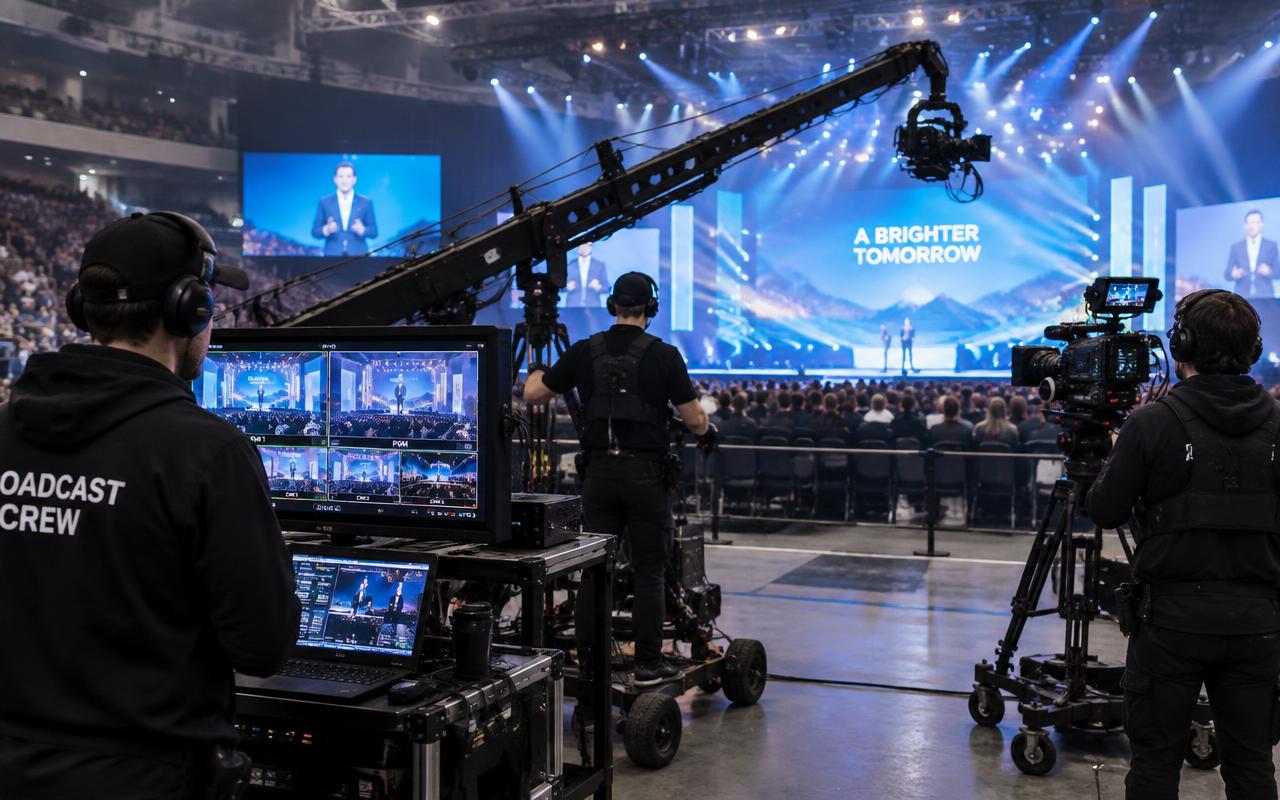
Multi-camera production is a disciplined signal chain before it is a creative one. Cameras are genlocked to a common reference — tri-level sync for HD and UHD — so that every source is on the same clock and a cut between them is clean rather than a frame of glitch. Signals run on 12G-SDI over coax for short distances and on SMPTE fibre or triax for long camera positions, with camera control units allowing a vision engineer to shade iris, black level and colour matrix remotely from a rack position. That shading is what makes six cameras look like one camera from six angles, which is the difference between a multi-camera production and six separate recordings.
The room sets the camera plan: riser positions for long lenses, pit space for handhelds, jib clearance and whether the lighting rig will allow a usable exposure. In Jammu that plays out at venues like Radisson Blu Jammu, Abhinav Theatre, Maulana Azad Stadium, and across Gandhi Nagar, Trikuta Nagar, Bahu Plaza, Channi Himmat.
Camera positions are planned against the show, not the room. A typical award night runs a wide lock-off, two long-lens cameras on a riser at the back for presenter close-ups, a handheld or Steadicam in the pit for the walk-up, a jib for movement and reveals, and PTZ units in positions no operator can occupy. Everything is cut live by a director on a switcher — Ross, Blackmagic ATEM Constellation or a Sony — with the camera operators on intercom receiving frame instructions. A talkback system from Riedel or Clear-Com is non-negotiable: a multi-camera production without reliable comms is just hopeful.
What’s included
- Sony & Blackmagic broadcast cameras
- Jib cranes, sliders & PTZ
- OB-style production control
- Same-day highlight edits
Equipment we carry
Why Jammu chooses Prime AV
- Crews and trucks positioned for fast load-in at Abhinav Theatre and venues in Trikuta Nagar and Bahu Plaza.
- A proper intercom system with per-position talkback and a tested backup channel, plus wired comms on fixed positions rather than relying on wireless packs throughout.
- Camera plan drawing with every position and lens package
- Working knowledge of Jammu & Kashmir venue rules, power sanctions and permission timelines.
Local conditions
Producing multi-camera broadcast in Jammu
Weather & the rig
Cameras, lenses and fibre connectors are the equipment least tolerant of moisture and dust, and condensation on a lens moving between a cold control room and a humid outdoor pit costs minutes of show time. Jammu is the hot anomaly of a cold Union Territory — the plains here reach 44°C in May and June, hotter than anywhere in the Kashmir valley, and the Jul–Sep monsoon brings the Tawi up fast with flash-flood risk on riverside ground. Winter is the operational problem: January fog closes Jammu airport for hours at a stretch, slows the NH-44 run to a crawl and makes projection and any aerial plan unworkable, while 4–20°C days require heating for every outdoor function. May–Jun plains heat; Jul–Sep monsoon and Tawi flooding; and dense-fog January for anything depending on air freight, projection or drone work.
Power & redundancy
A broadcast chain needs clean, continuous power on its own distribution, because a momentary dip takes down cameras, CCUs, the switcher and the recording all at once. Among the more demanding power environments in north India. JPDCL operates scheduled curtailment in both the winter heating peak and the summer cooling peak, so a show here is planned DG-primary with the mains treated as a bonus, and N+1 redundancy with automatic changeover is standard rather than premium. Fuel storage and a bowser plan matter because a long outage is normal, not exceptional.
Permits & noise rules
Filming brings its own requirements — venue filming rights, audience consent notices, and clearances for any aerial or drone-mounted camera position. Jammu Municipal Corporation for the licence and temporary structures, the SSP Jammu and the district magistrate for assembly and loudspeaker permission, and the J&K noise rules with the 10 pm outdoor limit. Two constraints are specific to this city: Jammu's airfield is a shared civil-military field effectively inside the urban area, which closes drone operations in practice, and any event near an Army or paramilitary installation needs security clearance with crew lists submitted for verification well in advance. Everything within Katra and on the track is governed by the Shri Mata Vaishno Devi Shrine Board, whose rules on content, catering and structures supersede the municipal file.
Load-in & access
Camera positions need cable routes that cross audience areas and a control room position with sightline and comms, so the cabling plan has to be agreed before seating is set. Delhi is 600 km and a realistic 10–11 hours on NH-44, with the Lakhanpur toll and security checks adding unpredictable hours. Pathankot at 100 km is the useful staging point, and rail parcel into Jammu Tawi is reliable. Northbound movement towards the valley is regularly halted for highway closures, so never plan a Jammu show on gear still sitting past Udhampur. In the city, Residency Road and the old town bar heavy vehicles through the day; 10 pm–6 am is the window.
Season & booking
Both Navratris — Chaitra in spring and Sharad in autumn — bring peak Vaishno Devi footfall and absorb the region's hospitality, transport and police capacity. The Jhiri Mela in Oct–Nov, Lohri and Baisakhi, the Bahu Mela, and the Army Day and Republic Day ceremonial calendar all lock dates. The Dogra wedding grid runs Oct–Mar around the auspicious tithis, with the pre-winter weeks busiest. Peak demand runs Oct–Mar.
Crew & dispatch
Local crew based in Jammu with working stock held in the city, because the Delhi run is too long and too interruptible to rely on for a tight call time; Delhi supplies large-format LED and specialist inventory with at least 48 hours in hand, and Pathankot serves as the staging point. Load-in support covers Trikuta Nagar, Bahu Plaza and the rest of the city.
What it costs here
Government and defence work is tendered, documented and reliable but slow to settle, and the paperwork load is heavier here than in most states. Dogra weddings spend confidently on stage, lighting and entry production. Honest pricing has to carry the real cost of redundancy — DG sizing, fuel and a spare-stock position that this grid and this highway demand — rather than pretending to a plains cost base.
Local expectations
Dogra weddings carry their own ritual sequence, with the baraat, dhol and Dogri wedding songs needing acoustic space before the sangeet takes over at full level. A large share of functions have serving or retired defence families in the room, which sets a formal tone: punctual starts, clear protocol order, accurate rank and title on every name board. Hindi and Dogri scripting with English for official events, and a visible preference for dignified formality over spectacle in institutional work.
Specification
Broadcast & Multi-Camera: technical specification
| Specification | Detail |
|---|---|
| Camera classes | Sony HDC and HXC system cameras, Blackmagic URSA Broadcast, large-sensor cinema bodies |
| Genlock | Tri-level sync distributed to every source so cuts are frame-clean |
| Signal transport | 12G-SDI on coax for short runs, SMPTE fibre or triax for long camera positions |
| Camera control | CCU and RCP shading of iris, black level and matrix from the rack position |
| Switchers | Ross Carbonite, Blackmagic ATEM Constellation, Sony production switchers |
| Specialist positions | Jib, Steadicam, dolly, slider and PTZ for inaccessible angles |
| Intercom | Riedel or Clear-Com party-line or digital matrix to every operator and the director |
| Recording | Programme cut plus isolated camera ISOs for post-event editing |
| Delivery formats | 1080p50 standard, UHD on request, broadcaster spec for frame rate, colour and loudness |
| On-site edit | Shuttle drive to an edit position for same-day highlight delivery |
What happens to the signal afterwards shapes the whole build. If the show feeds IMAG screens, the programme cut must be clean and the switcher has to supply separate outputs for the screens, the stream and the record. If it feeds a broadcaster, their delivery specification governs frame rate, colour space, loudness and the clean feed they require without graphics. If the output is a post-event film, we record isolated camera feeds — ISOs — alongside the programme cut, because an editor with six ISOs can build something the live cut never could. Same-day highlight edits run off a shuttle drive to an on-site edit position while the show is still in progress.
Sizing
What size rig does your event actually need?
| Scale | Guests | Recommended setup |
|---|---|---|
| Panel session | 100 – 400 | Three cameras: wide lock-off plus two long lenses, single switcher, programme and ISOs |
| Conference plenary | 500 – 1,500 | Four to five cameras with a slider, IMAG programme output, camera shading, ISOs |
| Award night | 1,500 – 4,000 | Six to seven cameras including jib and pit handheld, separate IMAG and stream feeds |
| Concert | 5,000 – 20,000 | Eight to ten cameras with long lenses, jib, pit and on-stage positions, replay |
| Televised production | 20,000+ | Twelve to sixteen cameras, broadcaster spec delivery, EVS replay, matrix intercom |
Scope
Multi-Camera Broadcast scope tiers in Jammu
Three-Camera Record
Conferences, panels and single-session events needing a record and basic IMAG
- Three genlocked cameras with a wide lock-off and two operated positions
- Switcher with a clean programme output for screens and record
- Camera shading from a rack position for a matched look
- Intercom to every operator and the director
- Programme cut plus isolated camera recordings
Multi-Camera Show
Award nights, concerts and launches with IMAG and a post-event film
- Five to seven cameras including a jib and a Steadicam or handheld in the pit
- Full OB-style control position with vision engineer and director
- Independent outputs for IMAG screens, stream and record
- ISO recording of every camera for post-event editing
- Same-day highlight edit from an on-site edit position
Broadcast Production
Televised shows, sports events and broadcaster-delivered productions
- Eight to sixteen cameras including specialist and PTZ positions
- Broadcaster-specification delivery with a clean feed and a graphics feed
- Replay and slow-motion positions with a dedicated operator
- Digital matrix intercom with per-position talkback routing
- Full production department including director, vision engineer and EVS operator
Government and defence work is tendered, documented and reliable but slow to settle, and the paperwork load is heavier here than in most states. Dogra weddings spend confidently on stage, lighting and entry production. Honest pricing has to carry the real cost of redundancy — DG sizing, fuel and a spare-stock position that this grid and this highway demand — rather than pretending to a plains cost base.
Venues
Where we work in Jammu
| Venue | Capacity | Production note |
|---|---|---|
| Radisson Blu Jammu | Up to 1,000 across ballroom and lawns | The city's most capable conference property, bypass-side with a usable service approach; ballroom rigging provision is conservative, and winter load-ins have to be planned around the dense January fog that slows every vehicle movement into the city. |
| Abhinav Theatre | Roughly 700 fixed seats | The J&K Academy's proscenium house at Kachi Chawni — a real theatre with a house grid and wings, but the electrical infrastructure is dated and sized for house lighting, so a substantial rig needs a parallel temporary supply, and the stage door restricts case dimensions. |
| Maulana Azad Stadium | 15,000-plus with the field in use | City-centre stadium near Residency Road with no permanent rigging and turf that needs full boarding before any vehicle or tower goes on; one service gate and a congested surrounding block mean a staged, shuttled load-in across two nights rather than one. |
| General Zorawar Singh Auditorium | Roughly 1,000 fixed seats | Jammu University's main auditorium for convocations and cultural programmes; campus security logs every vehicle, academic-calendar blackouts are firm, and the in-house technical team's processes have to be worked with rather than around. |
| KC Residency | Up to 600 seated across halls | Established Residency Road hotel where the load-in is from a busy commercial street with no dock at all — a hand-carry and goods-lift operation that has to run overnight. |
Crew
Who turns up on show day
- Director
Calls the cut live from the running order, gives frame instructions to operators and decides what the audience sees at every moment.
- Vision engineer
Shades every camera from the rack so six sources match, and owns genlock, colour and signal integrity across the chain.
- Camera operators
Hold and move shots to the director's call, anticipate the action rather than chase it, and protect the frame through a cut.
- Jib and specialist operators
Deliver the movement and reveal shots — jib, Steadicam, dolly — that give a production its production value.
- Replay operator
Marks and plays back moments for IMAG or broadcast, working a few seconds behind live with the director.
- On-site editor
Pulls selects off shuttle drives during the show and delivers a highlight cut the same night.
What you receive
- Camera plan drawing with every position and lens package
- Signal flow and output map including genlock distribution
- Programme cut recording at full quality
- Isolated camera recordings for every position
- Clean feed without graphics where a broadcaster requires it
- Same-day highlight edit where contracted
- Verified media offload report with checksums before any card is reused
Timeline
From enquiry to load-out
- T-5 weeks
Camera plan
Running order and stage design reviewed to place camera positions against the moments that must be captured.
- T-3 weeks
Signal and comms design
Cable routes, fibre runs, genlock distribution, output map and the intercom topology drawn and agreed.
- T-2 weeks
Delivery spec confirmation
Frame rate, colour space, loudness, clean feed and file delivery requirements confirmed with the broadcaster or the post team.
- Show day −1
Rig and camera match
Cameras rigged, genlocked and shaded to match under the actual stage lighting, with every signal path proved.
- Show day, T-4 hours
Camera rehearsal
Operators walk the running order, the director rehearses the cut, and comms is tested from every position.
- Show day to +12 hours
Show, offload and strike
Show cut live with ISOs recording, media offloaded and verified before any card is cleared, then de-rig.
Risk control
What goes wrong, and how we stop it
What can go wrong
How we prevent it
- What can go wrong
The director loses contact with a camera operator at the critical moment.
How we prevent itA proper intercom system with per-position talkback and a tested backup channel, plus wired comms on fixed positions rather than relying on wireless packs throughout.
- What can go wrong
The post team receives only the programme cut and cannot build the film the client expected.
How we prevent itEvery camera records an isolated feed as standard, and the delivery specification — including ISOs, clean feed and audio stems — is confirmed in writing at T-2 weeks.
- What can go wrong
Media cards are cleared before the offload is verified and footage is lost irrecoverably.
How we prevent itOffload is checksummed and verified against the source before any card is reformatted, with a second copy on separate media before the trucks leave.
- What can go wrong
Stage lighting is designed for the room and leaves presenters too contrasty to shade usably.
How we prevent itKey levels and colour temperature are agreed with the lighting designer during design and verified under camera at rehearsal, with the rig balanced for camera.
Honest comparison
Is this the right choice for your event?
- Cinema cameras instead of broadcast system camerasOur verdict
Large-sensor cinema bodies give a shallower, more filmic look that clients increasingly want. Broadcast system cameras give remote shading, genlock, long cable runs and reliability over a six-hour show. For a live cut to screens, system cameras remain the right tool.
- Hiring an OB van instead of a flypack control positionOur verdict
An OB van is faster to deploy and purpose-built, and right for sport and large televised productions. A flypack built into a control room is cheaper, fits venues a van cannot park at, and is more than adequate up to eight or ten cameras.
- A single-camera record instead of a multi-camera productionOur verdict
A well-operated single camera with good audio is a perfectly respectable record of a conference and costs a fraction. It cannot serve IMAG, cannot cut to a reaction, and gives an editor nothing to work with — so it is a record, not a production.
Demand
What Jammu books most
Jammu event mix
- Dogra community weddings and multi-day functions
- Government, administrative and UT-level conferences
- Defence and paramilitary ceremonial functions
- Vaishno Devi pilgrim-season and Shrine Board events
- Trade exhibitions and regional dealer meets
- University convocations and cultural programmes
Ideal for
Events we power with broadcast & multi-camera in Jammu
Process
From brief to standing ovation
01
Brief & recce
We visit the venue, map power and rigging, and understand your show flow.
02
Design & quote
CAD plans, 3D previews and an itemised quote within 24 hours.
03
Build & rehearse
Load-in, system tuning, content checks and full technical rehearsal.
04
Show & strike
Show-caller-led execution, then a quick, clean load-out.
FAQ
Multi-Camera Broadcast in Jammu: FAQs
More services in Jammu
Multi-Camera Broadcast in nearby cities
Areas we cover in Jammu
Events in Jammu