Conference & Broadcast · Kolkata, West Bengal
Multi-Camera Broadcast in Kolkata
Booking multi-camera broadcast in Kolkata means solving Kolkata's particular problems: Jun–Sep monsoon, when the low-lying southern and central wards waterlog within an hour of a heavy cell; and Sep–Oct if you need any inventory at all for something other than puja, venue load-in windows, and dates that disappear once the season turns.
- Lead time
- From 5 weeks
- Peak season
- Oct–Feb
- Coverage
- Kolkata & West Bengal
Key takeaway
Broadcast & Multi-Camera for Kolkata’s biggest events
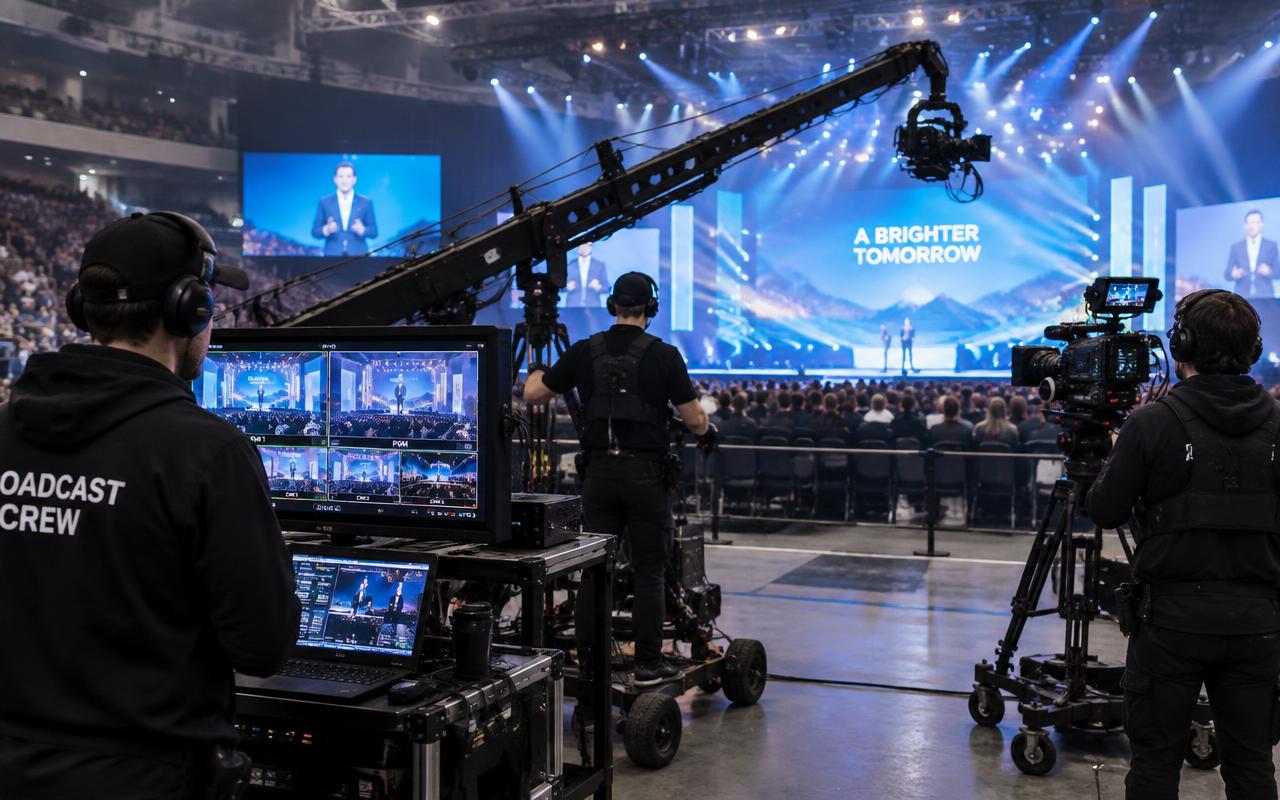
Multi-camera production is a disciplined signal chain before it is a creative one. Cameras are genlocked to a common reference — tri-level sync for HD and UHD — so that every source is on the same clock and a cut between them is clean rather than a frame of glitch. Signals run on 12G-SDI over coax for short distances and on SMPTE fibre or triax for long camera positions, with camera control units allowing a vision engineer to shade iris, black level and colour matrix remotely from a rack position. That shading is what makes six cameras look like one camera from six angles, which is the difference between a multi-camera production and six separate recordings.
The room sets the camera plan: riser positions for long lenses, pit space for handhelds, jib clearance and whether the lighting rig will allow a usable exposure. In Kolkata that plays out at venues like Biswa Bangla Convention Centre, Science City, Netaji Indoor Stadium, and across Salt Lake, New Town, Park Street, Ballygunge.
Camera positions are planned against the show, not the room. A typical award night runs a wide lock-off, two long-lens cameras on a riser at the back for presenter close-ups, a handheld or Steadicam in the pit for the walk-up, a jib for movement and reveals, and PTZ units in positions no operator can occupy. Everything is cut live by a director on a switcher — Ross, Blackmagic ATEM Constellation or a Sony — with the camera operators on intercom receiving frame instructions. A talkback system from Riedel or Clear-Com is non-negotiable: a multi-camera production without reliable comms is just hopeful.
What’s included
- Sony & Blackmagic broadcast cameras
- Jib cranes, sliders & PTZ
- OB-style production control
- Same-day highlight edits
Equipment we carry
Why Kolkata chooses Prime AV
- Crews and trucks positioned for fast load-in at Science City and venues in New Town and Park Street.
- Key levels and colour temperature are agreed with the lighting designer during design and verified under camera at rehearsal, with the rig balanced for camera.
- Camera plan drawing with every position and lens package
- Working knowledge of West Bengal venue rules, power sanctions and permission timelines.
Local conditions
Producing multi-camera broadcast in Kolkata
Weather & the rig
Cameras, lenses and fibre connectors are the equipment least tolerant of moisture and dust, and condensation on a lens moving between a cold control room and a humid outdoor pit costs minutes of show time. The Kalbaisakhi nor'westers in April and May are the design case here: they arrive in minutes with 70–90 km/h gusts, which means outdoor truss in Kolkata is ballasted and signed off for wind loading rather than merely sheeted against rain. Humidity sits near 80% from April to October and the Hooghly keeps overnight dew heavy enough that an outdoor projection surface will fog by 4am and a lectern mic capsule picks up moisture if left uncovered. Jun–Sep monsoon, when the low-lying southern and central wards waterlog within an hour of a heavy cell; and Sep–Oct if you need any inventory at all for something other than Puja.
Power & redundancy
A broadcast chain needs clean, continuous power on its own distribution, because a momentary dip takes down cameras, CCUs, the switcher and the recording all at once. CESC's city network is genuinely one of the better urban utilities in India, so indoor venues run on house power confidently. Puja pandals are a different exercise: temporary sanctioned connections are applied for formally through CESC or WBSEDCL well in advance, and the load per pandal is capped at what the application granted. Maidan and open-ground events are DG-fed with acoustic enclosures under WBPCB norms.
Permits & noise rules
Filming brings its own requirements — venue filming rights, audience consent notices, and clearances for any aerial or drone-mounted camera position. Kolkata Municipal Corporation handles structures, the Kolkata Police Commissioner's office with the local police station licenses pandals and loudspeaker use, and WBPCB applies the noise rules with a 10pm to 6am silence period and a time-boxed festival relaxation. The Maidan is Army land, so an event there needs Eastern Command's NOC as a genuine step in the critical path rather than a formality. Drone operation is limited by the Dum Dum airport zone and by Fort William's restrictions over central Kolkata.
Load-in & access
Camera positions need cable routes that cross audience areas and a control room position with sightline and comms, so the cabling plan has to be agreed before seating is set. Larger goods vehicles are barred from central Kolkata through the day, and arrival timing is dictated by which Hooghly crossing the truck uses. The Puja constraint is unlike anything else in India: pandals in the north Kolkata lanes around Shyambazar, Kumartuli and Bagbazar are reached only by handcart for the final 200m, the bamboo structure is complete before any kit arrives, and the hang points are the structure the decorator built, so the rigging design has to be agreed with the pandal fabricator weeks earlier.
Season & booking
From Mahalaya through Lakshmi Puja and on to Kali Puja, roughly late September to early November, every scaffolder, generator, line array and lighting rig in eastern India is committed and rates reflect it. The Kolkata International Film Festival in November and the Boi Mela in late January take the auditoria, and Poila Boishakh in mid-April brings its own cluster of cultural programming. Peak demand runs Oct–Feb.
Crew & dispatch
Own Kolkata base, which is also the practical origin for Patna, Ranchi, Bhubaneswar and Guwahati work. Load-in support covers New Town, Park Street and the rest of the city.
What it costs here
Outside Puja this is a value market with strong, experienced local technical labour at reasonable day rates, so a two-day conference costs appreciably less here than the same build in Mumbai or Delhi. Inside the Puja window the same inventory prices at a multiple and has to be committed months ahead, which is a conversation to have in June rather than in September.
Local expectations
A Bengali audience for live music will notice a coloured PA and say so — Rabindra Sangeet, band and classical programming here want natural tonality and a low noise floor rather than brute level, and the vocal chain is judged more closely than the lighting. Puja committees expect continuous operation across five days, which means shift rotation, a crew rest plan and spares on site rather than in the warehouse. Bengali-language compering is the default and the committee's own hierarchy governs stage access.
Specification
Broadcast & Multi-Camera: technical specification
| Specification | Detail |
|---|---|
| Camera classes | Sony HDC and HXC system cameras, Blackmagic URSA Broadcast, large-sensor cinema bodies |
| Genlock | Tri-level sync distributed to every source so cuts are frame-clean |
| Signal transport | 12G-SDI on coax for short runs, SMPTE fibre or triax for long camera positions |
| Camera control | CCU and RCP shading of iris, black level and matrix from the rack position |
| Switchers | Ross Carbonite, Blackmagic ATEM Constellation, Sony production switchers |
| Specialist positions | Jib, Steadicam, dolly, slider and PTZ for inaccessible angles |
| Intercom | Riedel or Clear-Com party-line or digital matrix to every operator and the director |
| Recording | Programme cut plus isolated camera ISOs for post-event editing |
| Delivery formats | 1080p50 standard, UHD on request, broadcaster spec for frame rate, colour and loudness |
| On-site edit | Shuttle drive to an edit position for same-day highlight delivery |
What happens to the signal afterwards shapes the whole build. If the show feeds IMAG screens, the programme cut must be clean and the switcher has to supply separate outputs for the screens, the stream and the record. If it feeds a broadcaster, their delivery specification governs frame rate, colour space, loudness and the clean feed they require without graphics. If the output is a post-event film, we record isolated camera feeds — ISOs — alongside the programme cut, because an editor with six ISOs can build something the live cut never could. Same-day highlight edits run off a shuttle drive to an on-site edit position while the show is still in progress.
Sizing
What size rig does your event actually need?
| Scale | Guests | Recommended setup |
|---|---|---|
| Panel session | 100 – 400 | Three cameras: wide lock-off plus two long lenses, single switcher, programme and ISOs |
| Conference plenary | 500 – 1,500 | Four to five cameras with a slider, IMAG programme output, camera shading, ISOs |
| Award night | 1,500 – 4,000 | Six to seven cameras including jib and pit handheld, separate IMAG and stream feeds |
| Concert | 5,000 – 20,000 | Eight to ten cameras with long lenses, jib, pit and on-stage positions, replay |
| Televised production | 20,000+ | Twelve to sixteen cameras, broadcaster spec delivery, EVS replay, matrix intercom |
Scope
Multi-Camera Broadcast scope tiers in Kolkata
Three-Camera Record
Conferences, panels and single-session events needing a record and basic IMAG
- Three genlocked cameras with a wide lock-off and two operated positions
- Switcher with a clean programme output for screens and record
- Camera shading from a rack position for a matched look
- Intercom to every operator and the director
- Programme cut plus isolated camera recordings
Multi-Camera Show
Award nights, concerts and launches with IMAG and a post-event film
- Five to seven cameras including a jib and a Steadicam or handheld in the pit
- Full OB-style control position with vision engineer and director
- Independent outputs for IMAG screens, stream and record
- ISO recording of every camera for post-event editing
- Same-day highlight edit from an on-site edit position
Broadcast Production
Televised shows, sports events and broadcaster-delivered productions
- Eight to sixteen cameras including specialist and PTZ positions
- Broadcaster-specification delivery with a clean feed and a graphics feed
- Replay and slow-motion positions with a dedicated operator
- Digital matrix intercom with per-position talkback routing
- Full production department including director, vision engineer and EVS operator
Outside Puja this is a value market with strong, experienced local technical labour at reasonable day rates, so a two-day conference costs appreciably less here than the same build in Mumbai or Delhi. Inside the Puja window the same inventory prices at a multiple and has to be committed months ahead, which is a conversation to have in June rather than in September.
Venues
Where we work in Kolkata
| Venue | Capacity | Production note |
|---|---|---|
| Biswa Bangla Convention Centre | Around 2,500 in the main hall plus a large grand ballroom at New Town | The city's only purpose-built modern convention venue, with generous clear height and working docks, which makes it the default whenever a design needs hung loads rather than towers. |
| Science City | Around 2,200 in the Main Auditorium with a smaller Mini Auditorium alongside | A fixed-seat theatre with house rigging positions and a fixed projection throw, so screen geometry is decided by the building and additional loads need the venue's engineering sign-off. |
| Netaji Indoor Stadium | Around 12,000 in concert configuration | Roof rigging is effectively unavailable, so the entire package is ground-supported, and the only vehicle approach runs through the congested Maidan roads under police bandobast on event days. |
| Rabindra Sadan | Around 1,000 seated | A cultural-complex auditorium with house infrastructure and a protective attitude to it, so visiting rigs work within the existing hang points and the build window is tight between programmes. |
| ITC Royal Bengal | Around 1,500 banquet across the ballroom and pre-function | Modern hotel with a usable service dock, but New Town traffic and the venue's own guest-movement rules push load-in to overnight slots. |
Crew
Who turns up on show day
- Director
Calls the cut live from the running order, gives frame instructions to operators and decides what the audience sees at every moment.
- Vision engineer
Shades every camera from the rack so six sources match, and owns genlock, colour and signal integrity across the chain.
- Camera operators
Hold and move shots to the director's call, anticipate the action rather than chase it, and protect the frame through a cut.
- Jib and specialist operators
Deliver the movement and reveal shots — jib, Steadicam, dolly — that give a production its production value.
- Replay operator
Marks and plays back moments for IMAG or broadcast, working a few seconds behind live with the director.
- On-site editor
Pulls selects off shuttle drives during the show and delivers a highlight cut the same night.
What you receive
- Camera plan drawing with every position and lens package
- Signal flow and output map including genlock distribution
- Programme cut recording at full quality
- Isolated camera recordings for every position
- Clean feed without graphics where a broadcaster requires it
- Same-day highlight edit where contracted
- Verified media offload report with checksums before any card is reused
Timeline
From enquiry to load-out
- T-5 weeks
Camera plan
Running order and stage design reviewed to place camera positions against the moments that must be captured.
- T-3 weeks
Signal and comms design
Cable routes, fibre runs, genlock distribution, output map and the intercom topology drawn and agreed.
- T-2 weeks
Delivery spec confirmation
Frame rate, colour space, loudness, clean feed and file delivery requirements confirmed with the broadcaster or the post team.
- Show day −1
Rig and camera match
Cameras rigged, genlocked and shaded to match under the actual stage lighting, with every signal path proved.
- Show day, T-4 hours
Camera rehearsal
Operators walk the running order, the director rehearses the cut, and comms is tested from every position.
- Show day to +12 hours
Show, offload and strike
Show cut live with ISOs recording, media offloaded and verified before any card is cleared, then de-rig.
Risk control
What goes wrong, and how we stop it
What can go wrong
How we prevent it
- What can go wrong
Stage lighting is designed for the room and leaves presenters too contrasty to shade usably.
How we prevent itKey levels and colour temperature are agreed with the lighting designer during design and verified under camera at rehearsal, with the rig balanced for camera.
- What can go wrong
Cameras are not genlocked and every cut shows a frame of tearing on the IMAG screens.
How we prevent itTri-level sync is distributed to every source and verified at the switcher during the build, because the fault is invisible on a single camera and obvious on every cut.
- What can go wrong
Six cameras each have a different colour balance and the cut looks like six different events.
How we prevent itEvery camera is shaded from the rack by a vision engineer under the actual stage lighting, and the match is re-checked after any significant lighting change.
- What can go wrong
The director loses contact with a camera operator at the critical moment.
How we prevent itA proper intercom system with per-position talkback and a tested backup channel, plus wired comms on fixed positions rather than relying on wireless packs throughout.
Honest comparison
Is this the right choice for your event?
- Hiring an OB van instead of a flypack control positionOur verdict
An OB van is faster to deploy and purpose-built, and right for sport and large televised productions. A flypack built into a control room is cheaper, fits venues a van cannot park at, and is more than adequate up to eight or ten cameras.
- A single-camera record instead of a multi-camera productionOur verdict
A well-operated single camera with good audio is a perfectly respectable record of a conference and costs a fraction. It cannot serve IMAG, cannot cut to a reaction, and gives an editor nothing to work with — so it is a record, not a production.
- PTZ cameras instead of manned positionsOur verdict
PTZ units are excellent in positions no operator can occupy and have become genuinely good. They still cannot anticipate action the way an operator does, and a show cut entirely from PTZs looks subtly late throughout. Mix them in; do not build on them alone.
Demand
What Kolkata books most
Kolkata event mix
- Durga Puja pandal sound, lighting and AV
- Corporate conferences and dealer meets at Biswa Bangla and city hotels
- Live music, theatre and cultural programming
- Trade exhibitions and industry expos
- Weddings through the December to February window
- Government, PSU and academic conferences
Ideal for
Events we power with broadcast & multi-camera in Kolkata
Process
From brief to standing ovation
01
Brief & recce
We visit the venue, map power and rigging, and understand your show flow.
02
Design & quote
CAD plans, 3D previews and an itemised quote within 24 hours.
03
Build & rehearse
Load-in, system tuning, content checks and full technical rehearsal.
04
Show & strike
Show-caller-led execution, then a quick, clean load-out.
FAQ
Multi-Camera Broadcast in Kolkata: FAQs
More services in Kolkata
Multi-Camera Broadcast in nearby cities
Areas we cover in Kolkata
Events in Kolkata