Lighting & Stage · Kolkata, West Bengal
Wedding Lighting Design in Kolkata
Booking wedding lighting design in Kolkata means solving Kolkata's particular problems: Jun–Sep monsoon, when the low-lying southern and central wards waterlog within an hour of a heavy cell; and Sep–Oct if you need any inventory at all for something other than puja, venue load-in windows, and dates that disappear once the season turns.
- Lead time
- From 8 weeks
- Peak season
- Oct–Feb
- Coverage
- Kolkata & West Bengal
Key takeaway
Wedding Lighting Design for Kolkata’s biggest events
The artefact that survives a wedding is the film. Guests remember an evening; the family watches the edit for the next thirty years, which is why wedding lighting is designed to the camera's requirements first and the room's second. In practice that means high colour rendering — Ra above 90, with the R9 deep-red value that inexpensive LED fixtures quietly fail — so skin, gold and mehendi render as themselves rather than as sallow approximations. It means enough key on faces that the cinematographer can stop the lens down and keep depth of field, and one colour temperature across every fixture pointed at a person.
Lawns, banquet halls, forts and resort courtyards each give a different answer to the only question decor lighting really asks — where can a fixture stand, and can it be cabled. In Kolkata that plays out at venues like Biswa Bangla Convention Centre, Science City, Netaji Indoor Stadium, and across Salt Lake, New Town, Park Street, Ballygunge.
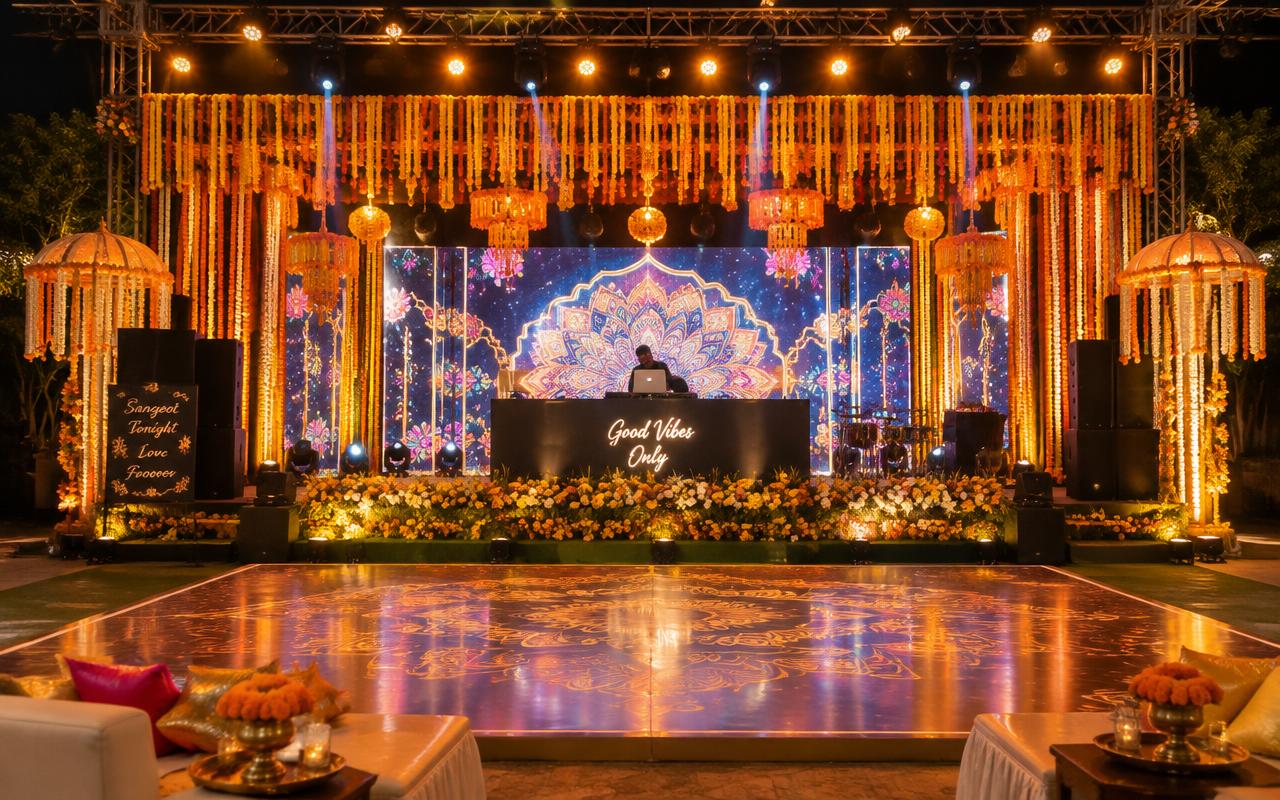
The second discipline is working inside somebody else's design. The decorator owns the palette, the drape plan and the mandap, and lighting either flatters that work or fights it. Palette decisions are therefore made against physical material — a swatch of the drape, a stem from the floral mock-up, held under the actual fixture — because additive LED mixing lands somewhere other than where a monitor promised. Drapes and structures are pixel-mapped where the look needs movement, grazed from shallow angles where it needs texture, and pin-spotted where one floral centrepiece or the mandap canopy should carry the eye.
What’s included
- High-CRI key lighting tuned for skin tone on camera
- Pixel-mapped decor, drapes and mandap washes
- Battery uplighters for lawns and heritage venues with no cabling
- Programmed cue list per function with a dedicated operator
Equipment we carry
Why Kolkata chooses Prime AV
- Crews and trucks positioned for fast load-in at Science City and venues in New Town and Park Street.
- Focus is scheduled as a named slot after decor dressing rather than before it, and the plot marks which positions must stay accessible for the re-focus pass.
- Console show file backed up to two drives and handed over
- Working knowledge of West Bengal venue rules, power sanctions and permission timelines.
Local conditions
Producing wedding lighting design in Kolkata
Weather & the rig
Wedding lighting lives in gardens, courtyards and open lawns across several consecutive nights, so IP ratings, covered distribution and a pre-programmed wet-weather look are specified against the season rather than added when a forecast turns. The Kalbaisakhi nor'westers in April and May are the design case here: they arrive in minutes with 70–90 km/h gusts, which means outdoor truss in Kolkata is ballasted and signed off for wind loading rather than merely sheeted against rain. Humidity sits near 80% from April to October and the Hooghly keeps overnight dew heavy enough that an outdoor projection surface will fog by 4am and a lectern mic capsule picks up moisture if left uncovered. Jun–Sep monsoon, when the low-lying southern and central wards waterlog within an hour of a heavy cell; and Sep–Oct if you need any inventory at all for something other than Puja.
Power & redundancy
A decor lighting rig draws modestly but spreads across an entire property in dozens of small positions, so the real question is not total load but how many clean, stable circuits reach the far corners of the site. CESC's city network is genuinely one of the better urban utilities in India, so indoor venues run on house power confidently. Puja pandals are a different exercise: temporary sanctioned connections are applied for formally through CESC or WBSEDCL well in advance, and the load per pandal is capped at what the application granted. Maidan and open-ground events are DG-fed with acoustic enclosures under WBPCB norms.
Permits & noise rules
Façade and landscape washes at heritage and civic properties are governed by what may be fixed, aimed or illuminated after dark, and that is the venue's or the authority's call rather than the designer's. Kolkata Municipal Corporation handles structures, the Kolkata Police Commissioner's office with the local police station licenses pandals and loudspeaker use, and WBPCB applies the noise rules with a 10pm to 6am silence period and a time-boxed festival relaxation. The Maidan is Army land, so an event there needs Eastern Command's NOC as a genuine step in the critical path rather than a formality. Drone operation is limited by the Dum Dum airport zone and by Fort William's restrictions over central Kolkata.
Load-in & access
Fixtures go in after the decor has dressed and come out alongside it, which puts the lighting crew at the back of every load-in queue and makes the focus slot the most fragile hour in the whole schedule. Larger goods vehicles are barred from central Kolkata through the day, and arrival timing is dictated by which Hooghly crossing the truck uses. The Puja constraint is unlike anything else in India: pandals in the north Kolkata lanes around Shyambazar, Kumartuli and Bagbazar are reached only by handcart for the final 200m, the bamboo structure is complete before any kit arrives, and the hang points are the structure the decorator built, so the rigging design has to be agreed with the pandal fabricator weeks earlier.
Season & booking
From Mahalaya through Lakshmi Puja and on to Kali Puja, roughly late September to early November, every scaffolder, generator, line array and lighting rig in eastern India is committed and rates reflect it. The Kolkata International Film Festival in November and the Boi Mela in late January take the auditoria, and Poila Boishakh in mid-April brings its own cluster of cultural programming. Peak demand runs Oct–Feb.
Crew & dispatch
Own Kolkata base, which is also the practical origin for Patna, Ranchi, Bhubaneswar and Guwahati work. Load-in support covers New Town, Park Street and the rest of the city.
What it costs here
Outside Puja this is a value market with strong, experienced local technical labour at reasonable day rates, so a two-day conference costs appreciably less here than the same build in Mumbai or Delhi. Inside the Puja window the same inventory prices at a multiple and has to be committed months ahead, which is a conversation to have in June rather than in September.
Local expectations
A Bengali audience for live music will notice a coloured PA and say so — Rabindra Sangeet, band and classical programming here want natural tonality and a low noise floor rather than brute level, and the vocal chain is judged more closely than the lighting. Puja committees expect continuous operation across five days, which means shift rotation, a crew rest plan and spares on site rather than in the warehouse. Bengali-language compering is the default and the committee's own hierarchy governs stage access.
Specification
Wedding Lighting Design: technical specification
| Specification | Detail |
|---|---|
| Colour rendering | Ra above 90 with R9 deep-red verified on every fixture that lights a face |
| Colour temperature | One white point per function, typically 2,700 – 3,200 K for pheras and reception |
| Key light for camera | Faces keyed so the cinematographer can stop down rather than shoot wide open |
| Decor matching | Fixtures set against physical fabric and floral samples at focus, never against hex values |
| Battery fixtures | Wireless-DMX uplighters and tubes with runtime measured at the programmed output |
| Weather rating | IP65 or better on lawn, poolside and courtyard positions, with data and power under cover |
| Uplighter spacing | Roughly 3 m centres on drape and wall runs, tightened on textured stone to avoid scalloping |
| Pixel mapping | Pixel tape, tubes and mapped drape runs driven from the console or a small media server |
| Control | sACN or Art-Net to nodes, DMX512-A to fixtures, wireless DMX for untethered positions |
| Cue list | A programmed cue per beat of each function, run live by a dedicated operator |
Heritage and lawn venues dictate much of the method. A fort courtyard will not permit cable across stone, a lawn cannot have mains cable under a guest walkway in dew, and neither offers useful rigging positions. Battery uplighters on wireless DMX solve positions that cabling cannot reach, provided runtime is measured at the output actually programmed rather than read off a brochure. Open-air positions carry IP65-rated housings as a minimum, with data and distribution under hard cover. Everything still answers to one console, so a battery fixture inside a floral structure takes the same cue as a moving head on the stage truss.
Sizing
What size rig does your event actually need?
| Scale | Guests | Recommended setup |
|---|---|---|
| Intimate lawn | 100 – 250 | Sixteen battery uplighters, four pin spots, two high-CRI key fixtures on the couple, one operator |
| Banquet hall | 250 – 600 | Thirty-two uplighters, twelve pin spots, eight profiles keying the stage, two universes, cue list per function |
| Hotel lawn | 600 – 1,200 | Sixty uplighters, a pixel-mapped backdrop run, twenty-four moving heads for sangeet, generator-fed distribution |
| Palace courtyard | 800 – 1,500 | Fully wireless decor rig with daily charge rotation, façade wash from free-standing ground positions, no fixings to stone |
| Multi-venue resort | 1,000 – 2,000+ | Independent rigs per venue on one network, over a hundred fixtures, designer plus two operators |
Scope
Wedding Lighting Design scope tiers in Kolkata
Single Function Design
One function — sangeet or reception — in a hall or on a lawn for 200 to 500 guests
- Lighting plot drawn over the decorator's drape and mandap layout
- High-CRI key on the stage and the couple's positions, set against the camera
- Twenty-four to thirty-two uplighters colour-matched to physical samples
- Programmed cue list for entries, performances and the first dance
- One operator on console for the whole function
Wedding Weekend Design
Mehendi through reception across two or three days, 400 – 1,000 guests
- A separate design and cue list per function, from daylight-balanced mehendi to low warm pheras
- Pixel-mapped drapes and backdrops cued to the sangeet choreography
- Battery uplighters and tubes for decor positions that cannot be cabled
- Pin spots on mandap, cake, entry walkway and floral focal points
- Lighting designer plus operator and a focus crew across every function
Heritage & Destination Design
Palaces, forts, resorts and overseas venues with multiple courtyards, 600 – 2,000 guests
- Façade and landscape lighting designed alongside the function stages
- Fully wireless rig where cabling is prohibited, with a daily charge rotation planned
- Weatherised fixtures and covered control positions for open-air builds
- Previsualised look renders approved with the family and the decorator before travel
- Travelling design and programming crew with a spares inventory held on site
Outside Puja this is a value market with strong, experienced local technical labour at reasonable day rates, so a two-day conference costs appreciably less here than the same build in Mumbai or Delhi. Inside the Puja window the same inventory prices at a multiple and has to be committed months ahead, which is a conversation to have in June rather than in September.
Venues
Where we work in Kolkata
| Venue | Capacity | Production note |
|---|---|---|
| Biswa Bangla Convention Centre | Around 2,500 in the main hall plus a large grand ballroom at New Town | The city's only purpose-built modern convention venue, with generous clear height and working docks, which makes it the default whenever a design needs hung loads rather than towers. |
| Science City | Around 2,200 in the Main Auditorium with a smaller Mini Auditorium alongside | A fixed-seat theatre with house rigging positions and a fixed projection throw, so screen geometry is decided by the building and additional loads need the venue's engineering sign-off. |
| Netaji Indoor Stadium | Around 12,000 in concert configuration | Roof rigging is effectively unavailable, so the entire package is ground-supported, and the only vehicle approach runs through the congested Maidan roads under police bandobast on event days. |
| Rabindra Sadan | Around 1,000 seated | A cultural-complex auditorium with house infrastructure and a protective attitude to it, so visiting rigs work within the existing hang points and the build window is tight between programmes. |
| ITC Royal Bengal | Around 1,500 banquet across the ballroom and pre-function | Modern hotel with a usable service dock, but New Town traffic and the venue's own guest-movement rules push load-in to overnight slots. |
Crew
Who turns up on show day
- Lighting designer
Translates the decorator's palette and the family's running order into a plot and a look for each function, and answers for how the night photographs.
- Programmer and operator
Builds the cue list per function and runs it live, holding entries, performances and the first dance on timed fades rather than on static colour.
- Focus and colour technician
Sets each fixture's angle, intensity and colour against the physical samples, then re-checks the rig once decor has dressed the room.
- Battery fixture technician
Owns the wireless rig — placement inside decor, link margin checks on every unit, and a charge rotation that keeps each fixture alive to the end of the night.
- Camera-side gaffer
Agrees key level and white point with the wedding film team, coordinates their practicals with the house rig and checks skin tone on their monitor at rehearsal.
- Rigging and cable crew
Hangs truss and floor positions, dresses cable clear of guest routes and photography lines, and removes fixtures alongside the decor team at strike.
What you receive
- Lighting plot per function, drawn over the decorator's layout
- Colour reference sheet naming the fixture setting matched to each fabric and floral sample
- Previsualisation renders of the key looks for every function
- Cue list per function mapped to the running order with fade times
- Battery fixture placement plan with its charge rotation schedule
- Console show file backed up to two drives and handed over
- Agreed key level and white point note shared with the photography and film team
Timeline
From enquiry to load-out
- T-8 weeks
Decor and film alignment
We take the decorator's palette, drape plan and mandap drawings together with the film team's camera plan, and design to both rather than to a fixture count.
- T-5 weeks
Function-by-function design
A plot and a look direction per function: daylight-balanced mehendi, bright informal haldi, show-lit sangeet, low warm pheras, keyed reception receiving line.
- T-3 weeks
Sample matching and previs
Physical fabric and floral samples tested under the actual fixtures, settings recorded, and the key looks previsualised and shared as renders.
- T-1 week
Cue build
Entries, performance tracks, the first dance and the pheras sequence turned into a timed cue list per function with fade times set.
- Show day −1
Focus and rehearsal
Rig focused after decor has dressed, colours re-checked against samples in the finished room, and looks reviewed on the film team's monitor.
- Day 1 to final function +4 hours
Functions and strike
Each function operated live from its own cue list, then fixtures inside decor removed carefully alongside the decorator at strike.
Risk control
What goes wrong, and how we stop it
What can go wrong
How we prevent it
- What can go wrong
Decor dresses the room after the rig has been focused and half the fixtures now point at a drape.
How we prevent itFocus is scheduled as a named slot after decor dressing rather than before it, and the plot marks which positions must stay accessible for the re-focus pass.
- What can go wrong
The room looks beautiful to the eye and the wedding film comes back with grey, sallow skin tones.
How we prevent itFixtures lighting faces are specified above Ra 90 with the R9 value verified, one white point is locked per function, and the look is reviewed on the film team's own monitor at rehearsal rather than trusted to the eye.
- What can go wrong
A saturated decor colour is matched from a hex code and the uplighters render it as a visibly different shade on the night.
How we prevent itPhysical fabric and floral samples are requested weeks ahead, tested under the actual fixtures, and the resulting setting is recorded on a colour reference sheet so focus is repeatable across every function.
- What can go wrong
Battery uplighters buried inside floral structures die partway through the reception.
How we prevent itRuntime is measured at the output level actually programmed rather than taken from the datasheet, a charge rotation is planned per day, and decor positions are built so a unit can be swapped without dismantling the arrangement.
Honest comparison
Is this the right choice for your event?
- A concert-style moving-head rig across the whole weddingOur verdict
Moving heads earn their place over the sangeet stage and the dance floor, where looks must change and energy matters. Aimed at a mandap or a dining area they are too hard, too cool and too mobile, and they photograph badly. Most of a wedding wants soft, warm, high-CRI light from fixed positions, with movement reserved for the functions that want it.
- Static colour all evening instead of a programmed cue listOur verdict
Static colour is simple, safe and perfectly right at a mehendi or any daytime function where light is not doing dramatic work. Across a sangeet and a reception it flattens the whole evening: the entry, the performances, the first dance and the cake all look identical, and the edit has nothing to cut between.
- Letting the film crew bring all the lightingOur verdict
Film crews carry excellent key lighting and should use it for portraits and couple shoots. What they cannot do from a camera position is light a room, so a rig built only for the lens leaves guests sitting in an unlit hall. The two jobs are complementary, which is exactly why key level and white point get agreed between us rather than discovered on the night.
Demand
What Kolkata books most
Kolkata event mix
- Durga Puja pandal sound, lighting and AV
- Corporate conferences and dealer meets at Biswa Bangla and city hotels
- Live music, theatre and cultural programming
- Trade exhibitions and industry expos
- Weddings through the December to February window
- Government, PSU and academic conferences
Ideal for
Events we power with wedding lighting design in Kolkata
Process
From brief to standing ovation
01
Brief & recce
We visit the venue, map power and rigging, and understand your show flow.
02
Design & quote
CAD plans, 3D previews and an itemised quote within 24 hours.
03
Build & rehearse
Load-in, system tuning, content checks and full technical rehearsal.
04
Show & strike
Show-caller-led execution, then a quick, clean load-out.
FAQ
Wedding Lighting Design in Kolkata: FAQs
More services in Kolkata
Wedding Lighting Design in nearby cities
Areas we cover in Kolkata
Events in Kolkata