Event production · Jammu, Jammu & Kashmir
Government & Public Events AV in Jammu
Jammu's event economy runs on the pilgrim corridor to Vaishno Devi at Katra, the administrative and defence establishment of a Union Territory that hosts Northern Command, and a Dogra wedding market with its own customs. It is a city where security clearance is as much a part of the production schedule as the load-in. Prime AV Solutions produces the government & public events end of that calendar — protocol-aware crew, redundant PA & power, large public screens — with one crew owning the whole stack.
- Lead time
- 6 weeks out
- Peak season
- Oct–Mar
- Coverage
- Jammu & Jammu & Kashmir
Key takeaway
Complete AV for government & public events in Jammu
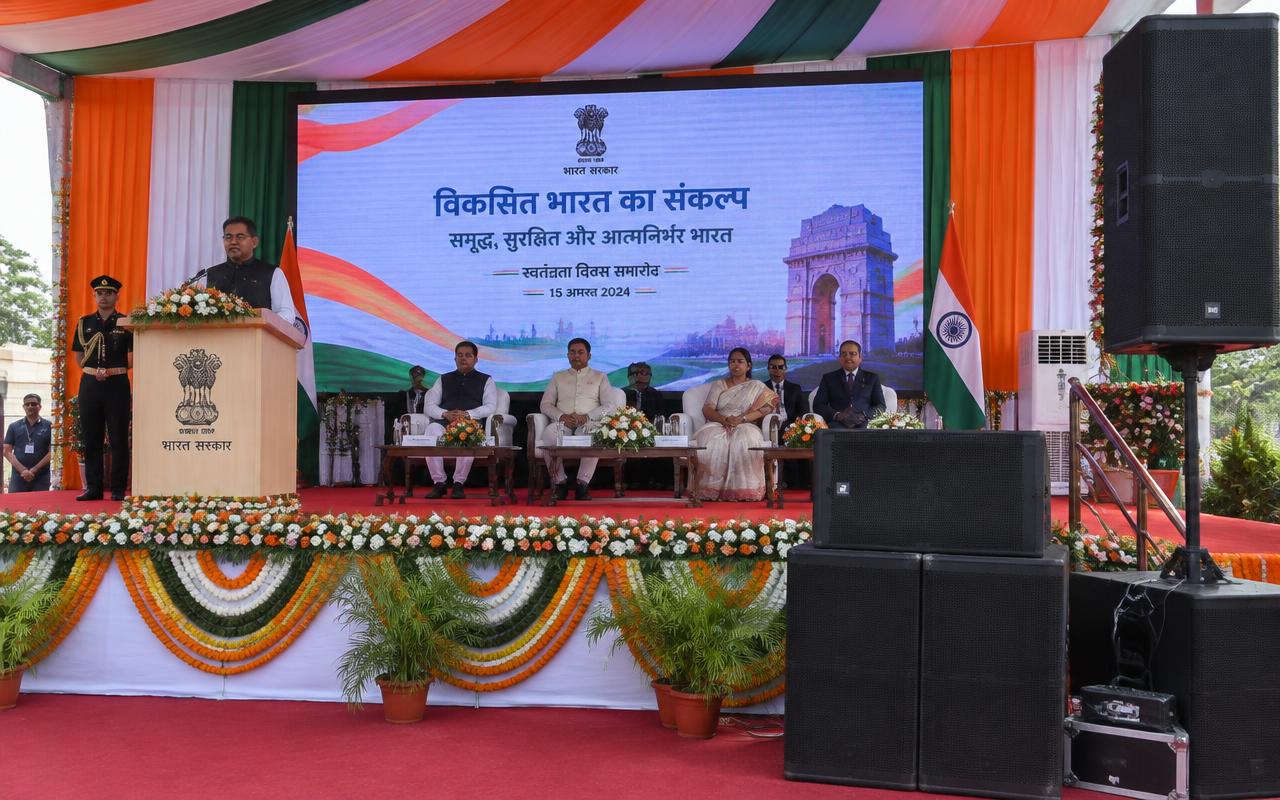
A government function is a protocol exercise before it is a production. The order of the dais, who is addressed and in what sequence, where the national flag stands, when the anthem is played and how the arrival is received are all decided by the protocol office, and the production has to serve that order precisely rather than propose its own. Everything freezes earlier than on a commercial show: seating charts, speaker sequence, scripts and the anthem cue are confirmed days ahead, and the crew works from a cue sheet countersigned by the nodal officer.
Maidans, civic auditoriums and government grounds come with protocol seating, security sightlines and screening gates that shape the entire layout before AV is drawn. In Jammu we work at Radisson Blu Jammu, Abhinav Theatre, Maulana Azad Stadium and venues across Gandhi Nagar, Trikuta Nagar, Bahu Plaza, Channi Himmat, Nanak Nagar.
Redundancy is the second principle, and it is not a precaution here but the baseline. A function in front of a dais does not get a second attempt, so the design carries a duplicate signal chain from microphone to loudspeaker, a hot-spare podium microphone open and mixed at all times, mirrored playback for the anthem and any film, and two generators on automatic changeover with the venue supply as a third leg. Every redundant path is tested under load at rehearsal, not merely connected and assumed.
What your event needs
- Protocol-aware crew
- Redundant PA & power
- Large public screens
- Interpretation for delegations
Why Jammu organisers choose Prime AV
- Crews and trucks positioned for fast load-in at KC Residency and venues in Nanak Nagar and Gandhi Nagar.
- Submit the crew list, identity documents and vehicle details well before the deadline, nominate a cleared deputy for every critical position, and keep the list short and fixed rather than adding names late.
- A standing Jammu client base across dogra community weddings and multi-day functions and government, administrative and ut-level conferences, so the rig is specified from experience rather than a catalogue.
- Working knowledge of Jammu & Kashmir venue rules, power sanctions and permission timelines.
What you will be judged on afterwards
- The arrival and the national anthem ran exactly to the protocol office's order, with no music or cue out of place.
- Every dignitary was clearly audible from the podium and on the press feed, with no dropout in front of the dais.
- The public seated beyond the enclosures could both hear the addresses and see them on screen.
- Press and broadcast received a usable clean feed and left without needing to re-record anything.
- Delegations followed the proceedings on their own language channel, and accessible seating had a clear screen sightline.
Local conditions
Producing government & public events in Jammu
Weather & the rig
Public functions are fixed to a date of significance and usually held in the open under a shamiana, so the dais, the screens and a seated public meet the season head-on. Jammu is the hot anomaly of a cold Union Territory — the plains here reach 44°C in May and June, hotter than anywhere in the Kashmir valley, and the Jul–Sep monsoon brings the Tawi up fast with flash-flood risk on riverside ground. Winter is the operational problem: January fog closes Jammu airport for hours at a stretch, slows the NH-44 run to a crawl and makes projection and any aerial plan unworkable, while 4–20°C days require heating for every outdoor function. May–Jun plains heat; Jul–Sep monsoon and Tawi flooding; and dense-fog January for anything depending on air freight, projection or drone work.
Power & redundancy
A function in front of a dais is designed for zero visible failure, which makes dual generators on automatic changeover the baseline rather than a contingency. Among the more demanding power environments in north India. JPDCL operates scheduled curtailment in both the winter heating peak and the summer cooling peak, so a show here is planned DG-primary with the mains treated as a bonus, and N+1 redundancy with automatic changeover is standard rather than premium. Fuel storage and a bowser plan matter because a long outage is normal, not exceptional.
Permits & noise rules
Clearances run through the district administration, the police and the venue's nodal officer together, and nothing loads in until all three are aligned on the same plan. Jammu Municipal Corporation for the licence and temporary structures, the SSP Jammu and the district magistrate for assembly and loudspeaker permission, and the J&K noise rules with the 10 pm outdoor limit. Two constraints are specific to this city: Jammu's airfield is a shared civil-military field effectively inside the urban area, which closes drone operations in practice, and any event near an Army or paramilitary installation needs security clearance with crew lists submitted for verification well in advance. Everything within Katra and on the track is governed by the Shri Mata Vaishno Devi Shrine Board, whose rules on content, catering and structures supersede the municipal file.
Load-in & access
Vehicles and crew need prior clearance and must be inside the cordon well before a lockdown hour that is not negotiable for any reason. Delhi is 600 km and a realistic 10–11 hours on NH-44, with the Lakhanpur toll and security checks adding unpredictable hours. Pathankot at 100 km is the useful staging point, and rail parcel into Jammu Tawi is reliable. Northbound movement towards the valley is regularly halted for highway closures, so never plan a Jammu show on gear still sitting past Udhampur. In the city, Residency Road and the old town bar heavy vehicles through the day; 10 pm–6 am is the window.
Season & booking
Both Navratris — Chaitra in spring and Sharad in autumn — bring peak Vaishno Devi footfall and absorb the region's hospitality, transport and police capacity. The Jhiri Mela in Oct–Nov, Lohri and Baisakhi, the Bahu Mela, and the Army Day and Republic Day ceremonial calendar all lock dates. The Dogra wedding grid runs Oct–Mar around the auspicious tithis, with the pre-winter weeks busiest. Peak demand runs Oct–Mar.
Crew & dispatch
Local crew based in Jammu with working stock held in the city, because the Delhi run is too long and too interruptible to rely on for a tight call time; Delhi supplies large-format LED and specialist inventory with at least 48 hours in hand, and Pathankot serves as the staging point.
What it costs here
Government and defence work is tendered, documented and reliable but slow to settle, and the paperwork load is heavier here than in most states. Dogra weddings spend confidently on stage, lighting and entry production. Honest pricing has to carry the real cost of redundancy — DG sizing, fuel and a spare-stock position that this grid and this highway demand — rather than pretending to a plains cost base.
Local expectations
Dogra weddings carry their own ritual sequence, with the baraat, dhol and Dogri wedding songs needing acoustic space before the sangeet takes over at full level. A large share of functions have serving or retired defence families in the room, which sets a formal tone: punctual starts, clear protocol order, accurate rank and title on every name board. Hindi and Dogri scripting with English for official events, and a visible preference for dignified formality over spectacle in institutional work.
Run of show
A typical government & public events schedule
| Time | Moment | What AV is doing |
|---|---|---|
| T−4 days | Site build | Stage, dais, shamiana, screen supports and delay positions erected; generators placed, earthed and tested; cable routes kept clear of all access and evacuation paths. |
| T−2 days | Crew clearance and access | Final crew list and vehicle details submitted; passes issued; equipment inventory logged with the security detail at the gate. |
| T−1 day | Full rehearsal with protocol | Complete run with the protocol team including arrival, anthem, speaker sequence and departure; every redundant path tested under load; cue sheet countersigned. |
| T−6 hrs | Anti-sabotage check and lockdown | Venue swept and sealed; nothing enters afterwards, so all testing, spares placement and crew positioning is completed before this hour. |
| T−90 min | Crew in position | Operators at consoles inside the cordon, comms checked on a closed channel, podium and dais microphones verified with the hot spare live. |
| 10:00 | Guest seating | Instrumental bed at a restrained level, screens on the event frame, announcement channel ready for seating and protocol instructions. |
| 10:30 | Arrival and national anthem | Music stopped cleanly, anthem played from the primary machine with the mirror armed, cameras framed wide on the dais, no cuts during the anthem. |
| 11:30 | Addresses and inauguration | Podium microphone with hot spare, interpretation channels live, screens on the speaker and the plaque or inauguration point, clean feed to the press enclosure. |
Reach and inclusion complete the brief. A public function may seat a few hundred under a shamiana and gather several thousand beyond it, so large screens and delay positions carry the event to people who cannot see the dais. Visiting delegations need interpretation booths and receivers; accessible seating needs a direct screen sightline; announcements and screen text often need a regional language alongside English and Hindi; and the press and broadcast enclosure needs a clean programme feed delivered to an agreed standard rather than a microphone pointed at a speaker.
Scope
Government & Public Events scope levels in Jammu
A hall or small ground function: redundant speech PA with a hot-spare podium microphone, a screen, dais lighting, playback for the anthem and a generator on changeover.
A public function for several thousand: line-array mains with a delay position, two large screens with camera feed, duplicated signal chain, dual generators and a press feed.
A large maidan event: multiple hangs and delay rings, screen clusters, full duplicate chain and power, interpretation for delegations, three or four cameras and a broadcast-standard clean feed.
A major ceremony or multi-day summit: zoned coverage across a very large ground, multi-language interpretation, a drone or ceremonial finale where permitted, and complete end-to-end redundancy with a multi-day build.
Government and defence work is tendered, documented and reliable but slow to settle, and the paperwork load is heavier here than in most states. Dogra weddings spend confidently on stage, lighting and entry production. Honest pricing has to carry the real cost of redundancy — DG sizing, fuel and a spare-stock position that this grid and this highway demand — rather than pretending to a plains cost base.
Venues
Where government & public events happen in Jammu
| Venue | Capacity | Production note |
|---|---|---|
| Radisson Blu Jammu | Up to 1,000 across ballroom and lawns | The city's most capable conference property, bypass-side with a usable service approach; ballroom rigging provision is conservative, and winter load-ins have to be planned around the dense January fog that slows every vehicle movement into the city. |
| Abhinav Theatre | Roughly 700 fixed seats | The J&K Academy's proscenium house at Kachi Chawni — a real theatre with a house grid and wings, but the electrical infrastructure is dated and sized for house lighting, so a substantial rig needs a parallel temporary supply, and the stage door restricts case dimensions. |
| Maulana Azad Stadium | 15,000-plus with the field in use | City-centre stadium near Residency Road with no permanent rigging and turf that needs full boarding before any vehicle or tower goes on; one service gate and a congested surrounding block mean a staged, shuttled load-in across two nights rather than one. |
| General Zorawar Singh Auditorium | Roughly 1,000 fixed seats | Jammu University's main auditorium for convocations and cultural programmes; campus security logs every vehicle, academic-calendar blackouts are firm, and the in-house technical team's processes have to be worked with rather than around. |
| KC Residency | Up to 600 seated across halls | Established Residency Road hotel where the load-in is from a busy commercial street with no dock at all — a hand-carry and goods-lift operation that has to run overnight. |
Demand
What Jammu books most
Jammu event mix
- Dogra community weddings and multi-day functions
- Government, administrative and UT-level conferences
- Defence and paramilitary ceremonial functions
- Vaishno Devi pilgrim-season and Shrine Board events
- Trade exhibitions and regional dealer meets
- University convocations and cultural programmes
Services
Recommended production stack
Line Array Systems
Flown line array systems designed in prediction software for outdoor grounds, convention halls and arenas of 1,000 to 50,000 guests.
LED Screen Rental
Large-format LED screens and IMAG side screens with switching, so every guest sees speakers, performers and content in crisp detail.
Simultaneous Interpretation Systems
ISO-standard interpretation booths, infrared receivers and multi-language channels for international summits and government delegations.
Drone Light Shows
Choreographed drone light shows with 100 to 1,000+ drones that paint logos, names and stories across the night sky — with all permissions handled.
Timeline
Planning milestones
- 6 weeks out
Site survey with the nodal officer
Ground layout, enclosure plan, security sightlines, power availability and permitted structure positions walked and recorded in writing.
- 4 weeks out
Protocol and seating plan
Dais order, speaker sequence, anthem and arrival choreography, flag position and enclosure allocations received from the protocol office.
- 3 weeks out
Crew list for security clearance
Names, identity documents and vehicle details submitted; cleared deputies nominated for every critical operating position.
- 2 weeks out
Redundancy design sign-off
Duplicate signal chain, hot-spare microphone scheme, mirrored playback and dual-generator changeover approved by the client's technical officer.
- T−1 day
Rehearsal and lockdown preparation
Full protocol rehearsal, every redundant path tested under load, spares placed inside the cordon and the cue sheet countersigned.
- T+1 day
Strike and site handover
Derig after the cordon lifts, inventory reconciled with the security detail, and the ground handed back in its surveyed condition.
Risk control
What goes wrong, and how we stop it
What can go wrong
How we prevent it
- What can go wrong
Crew passes are not cleared in time and technicians cannot enter.
How we prevent itSubmit the crew list, identity documents and vehicle details well before the deadline, nominate a cleared deputy for every critical position, and keep the list short and fixed rather than adding names late.
- What can go wrong
The venue locks down hours before the function and nothing further can be brought in.
How we prevent itTreat the lockdown hour as the real deadline: complete all testing, place every spare inside the cordon, and station crew at each position before the sweep rather than planning to walk back out.
- What can go wrong
The podium microphone becomes a single point of failure.
How we prevent itRun a second microphone on the podium, permanently open and mixed low on a separate wireless system and separate receiver, so a failure is inaudible to the audience rather than a visible pause.
- What can go wrong
The public crowd substantially exceeds the enclosure estimate.
How we prevent itDesign coverage with an overflow zone, pre-plan one additional delay position and screen that can be added in a day, and agree with the administration how the overflow area is served and marshalled.
Process
From brief to standing ovation
01
Brief & recce
We visit the venue, map power and rigging, and understand your show flow.
02
Design & quote
CAD plans, 3D previews and an itemised quote within 24 hours.
03
Build & rehearse
Load-in, system tuning, content checks and full technical rehearsal.
04
Show & strike
Show-caller-led execution, then a quick, clean load-out.
FAQ
Government & Public Events AV in Jammu: FAQs
Other events in Jammu
Government & Public Events AV in nearby cities
Services in Jammu
Areas we cover in Jammu