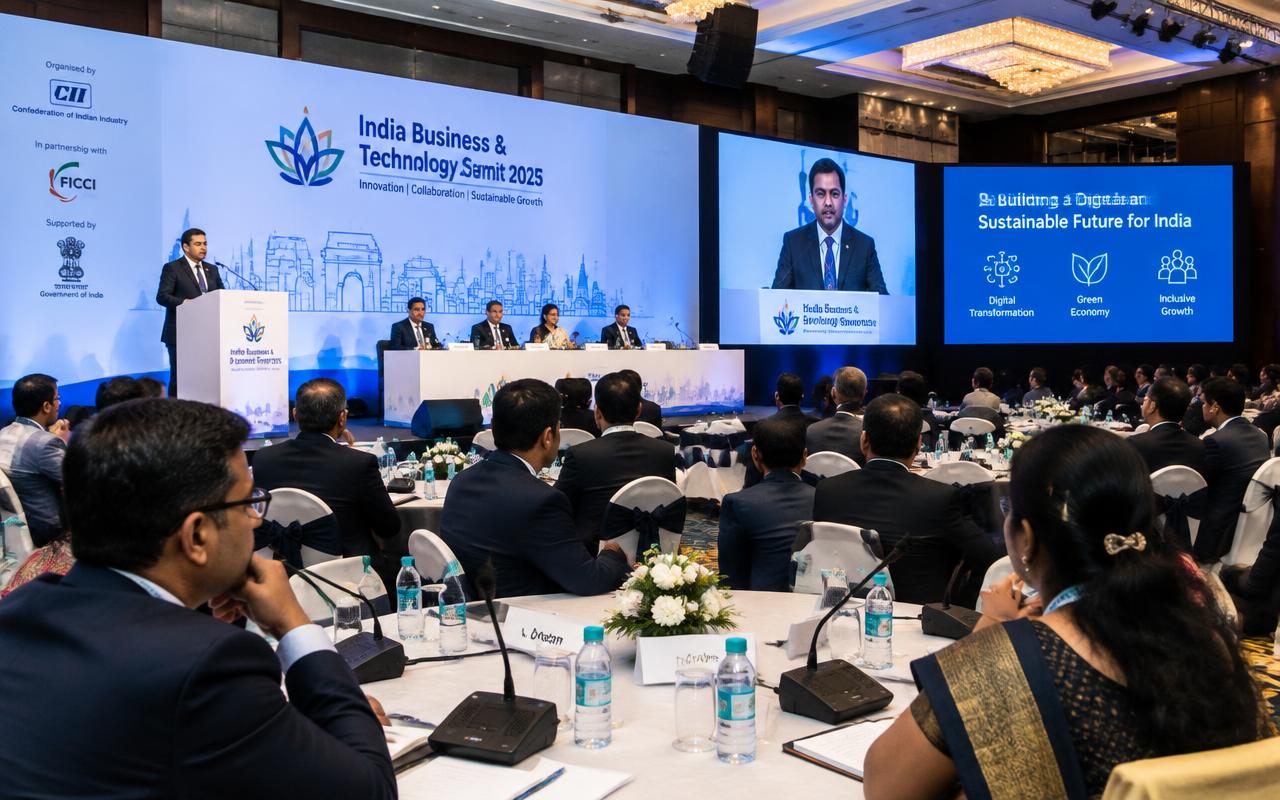
Event production · Jammu, Jammu & Kashmir
Corporate Conferences AV in Jammu
Jammu's event economy runs on the pilgrim corridor to Vaishno Devi at Katra, the administrative and defence establishment of a Union Territory that hosts Northern Command, and a Dogra wedding market with its own customs. It is a city where security clearance is as much a part of the production schedule as the load-in. Prime AV Solutions produces the corporate conferences end of that calendar — delegate mics & confidence monitors, LED walls with presentation switching, live streaming for remote teams — with one crew owning the whole stack.
- Lead time
- 8 weeks out
- Peak season
- Oct–Mar
- Coverage
- Jammu & Jammu & Kashmir
Key takeaway
Complete AV for corporate conferences in Jammu
A corporate conference is won or lost in the week before it opens. Every deck has to arrive on a published deadline, be converted to a single house template at the correct aspect ratio, and live on one presentation machine with a mirrored backup, never on fifteen visiting laptops. Build a master content order that matches the run of show exactly, name every file by session and speaker, and rehearse embedded videos separately because that is where audio routing quietly fails. A show-caller working from a printed cue sheet then drives the room rather than reacting to it.
Conference rooms are designed for banquets rather than sightlines, so ceiling height, pillar positions and the ballroom's width-to-depth ratio dictate the screen design. In Jammu we work at Radisson Blu Jammu, Abhinav Theatre, Maulana Azad Stadium and venues across Gandhi Nagar, Trikuta Nagar, Bahu Plaza, Channi Himmat, Nanak Nagar.
Changeover time is the other half of the discipline. A keynote becoming a five-person panel means new furniture, five lapel mics checked and labelled, a different lighting state and a video source change, and the audience watches all of it unless you cover the move with a stinger and a rehearsed stage-management routine. Allow ninety seconds, run it twice at rehearsal, and keep a second set of mics pre-fitted backstage. Breakout sessions multiply the problem, so every room gets its own technician, its own RF block and its own copy of the content.
What your event needs
- Delegate mics & confidence monitors
- LED walls with presentation switching
- Live streaming for remote teams
- Show-caller and stage manager
Why Jammu organisers choose Prime AV
- Crews and trucks positioned for fast load-in at General Zorawar Singh Auditorium and venues in Channi Himmat and Nanak Nagar.
- Brief two runners with assigned aisles, gate the roving channels at the desk, and have the show-caller put the camera and a light on the questioner before the microphone is opened.
- A standing Jammu client base across dogra community weddings and multi-day functions and government, administrative and ut-level conferences, so the rig is specified from experience rather than a catalogue.
- Working knowledge of Jammu & Kashmir venue rules, power sanctions and permission timelines.
What you will be judged on afterwards
- Every speaker finished inside their allotted slot and the day ended at the time printed on the invitation.
- No slide, video or logo appeared on screen in the wrong order, the wrong version or the wrong aspect ratio.
- Delegates in the last row heard the panel without straining, and audience questions were audible to the whole hall.
- The recording is clean enough that the marketing and training teams actually reuse the sessions afterwards.
- No member of leadership had to hunt for a microphone, a clicker or a technician while standing on stage.
Local conditions
Producing corporate conferences in Jammu
Weather & the rig
A conference is an indoor event with an outdoor arrival, so heat, humidity and rain decide how long delegates queue at registration and how hard the hall's cooling has to fight a full lighting rig. Jammu is the hot anomaly of a cold Union Territory — the plains here reach 44°C in May and June, hotter than anywhere in the Kashmir valley, and the Jul–Sep monsoon brings the Tawi up fast with flash-flood risk on riverside ground. Winter is the operational problem: January fog closes Jammu airport for hours at a stretch, slows the NH-44 run to a crawl and makes projection and any aerial plan unworkable, while 4–20°C days require heating for every outdoor function. May–Jun plains heat; Jul–Sep monsoon and Tawi flooding; and dense-fog January for anything depending on air freight, projection or drone work.
Power & redundancy
Conference AV draws modestly but tolerates nothing, because a two-second dip reboots a media server mid-keynote, which makes clean switched redundancy the requirement rather than raw capacity. Among the more demanding power environments in north India. JPDCL operates scheduled curtailment in both the winter heating peak and the summer cooling peak, so a show here is planned DG-primary with the mains treated as a bonus, and N+1 redundancy with automatic changeover is standard rather than premium. Fuel storage and a bowser plan matter because a long outage is normal, not exceptional.
Permits & noise rules
Conferences seldom need public-event clearance, but hotel rigging approvals, fire-load sign-off and the noise rules governing any evening reception still apply locally. Jammu Municipal Corporation for the licence and temporary structures, the SSP Jammu and the district magistrate for assembly and loudspeaker permission, and the J&K noise rules with the 10 pm outdoor limit. Two constraints are specific to this city: Jammu's airfield is a shared civil-military field effectively inside the urban area, which closes drone operations in practice, and any event near an Army or paramilitary installation needs security clearance with crew lists submitted for verification well in advance. Everything within Katra and on the track is governed by the Shri Mata Vaishno Devi Shrine Board, whose rules on content, catering and structures supersede the municipal file.
Load-in & access
Conference kit usually arrives in one or two trucks, and the entire build plan depends on reaching a working hotel's loading bay in the gap between banquets. Delhi is 600 km and a realistic 10–11 hours on NH-44, with the Lakhanpur toll and security checks adding unpredictable hours. Pathankot at 100 km is the useful staging point, and rail parcel into Jammu Tawi is reliable. Northbound movement towards the valley is regularly halted for highway closures, so never plan a Jammu show on gear still sitting past Udhampur. In the city, Residency Road and the old town bar heavy vehicles through the day; 10 pm–6 am is the window.
Season & booking
Both Navratris — Chaitra in spring and Sharad in autumn — bring peak Vaishno Devi footfall and absorb the region's hospitality, transport and police capacity. The Jhiri Mela in Oct–Nov, Lohri and Baisakhi, the Bahu Mela, and the Army Day and Republic Day ceremonial calendar all lock dates. The Dogra wedding grid runs Oct–Mar around the auspicious tithis, with the pre-winter weeks busiest. Peak demand runs Oct–Mar.
Crew & dispatch
Local crew based in Jammu with working stock held in the city, because the Delhi run is too long and too interruptible to rely on for a tight call time; Delhi supplies large-format LED and specialist inventory with at least 48 hours in hand, and Pathankot serves as the staging point.
What it costs here
Government and defence work is tendered, documented and reliable but slow to settle, and the paperwork load is heavier here than in most states. Dogra weddings spend confidently on stage, lighting and entry production. Honest pricing has to carry the real cost of redundancy — DG sizing, fuel and a spare-stock position that this grid and this highway demand — rather than pretending to a plains cost base.
Local expectations
Dogra weddings carry their own ritual sequence, with the baraat, dhol and Dogri wedding songs needing acoustic space before the sangeet takes over at full level. A large share of functions have serving or retired defence families in the room, which sets a formal tone: punctual starts, clear protocol order, accurate rank and title on every name board. Hindi and Dogri scripting with English for official events, and a visible preference for dignified formality over spectacle in institutional work.
Run of show
A typical corporate conferences schedule
| Time | Moment | What AV is doing |
|---|---|---|
| T−1 day | Technical rehearsal | Full system check, all received content ingested, speaker walk-throughs and a timed run of the opening block. |
| T−4 hrs | Content lock and comms check | Final deck versions loaded, playback and backup machines matched file for file, show-caller comms tested to every position. |
| T−90 min | Speaker ready room | Lapel mics fitted and labelled by name, RF scan reconfirmed, confidence monitor and countdown timer repeated backstage. |
| 09:00 | Registration and doors | Ambient bed and holding loop on the main screen, foyer displays live with the agenda and wayfinding. |
| 09:30 | Opening and keynote | Opening film, house-light cue, IMAG cut to the speaker, timer running, stream opened on a thirty-second pre-roll. |
| 11:15 | Panel changeover | Stinger covers the stage reset, five pre-fitted mics brought live, lighting state changes to a flat panel wash. |
| 14:00 | Breakout sessions | Each room technician takes local content, local recording and a return comms feed to main control. |
| 17:30 | Plenary close | Closing film and announcement cue, stream ended cleanly, recordings copied and handed over the same evening. |
Audio comes third in most briefs and first in every post-event complaint. Hotel ballrooms are wide, low and carpeted, with pillars and audible air handling, so coverage needs distributed fills rather than one loud pair at the proscenium. Delegate microphones for a dealer meet, roving mics for Q&A with a disciplined operator, and a stream mix that is not simply the room mix are three separate line items, not one. If sessions are being recorded for internal reuse, the recording mix deserves its own engineer and its own monitoring position.
Scope
Corporate Conferences scope levels in Jammu
One hall up to 300 delegates: compact line-array PA, four wireless mics, a 16:9 LED wall or large-format projection, a simple stage wash, presentation switching, one technician and a show-caller.
A 500 – 800 delegate hall: wider LED with IMAG side screens, full panel and delegate mic complement, designed stage lighting, two-camera IMAG, a recorded stream and a dedicated content operator.
Custom-shaped LED set with previsualised lighting design, four-camera IMAG and broadcast-grade streaming, two-language interpretation, confidence and timer systems, and a full show-management team.
Two or three days with a plenary plus four to six independently crewed breakout rooms, exhibition foyer AV, a hybrid studio for remote speakers and same-day highlight edits.
Government and defence work is tendered, documented and reliable but slow to settle, and the paperwork load is heavier here than in most states. Dogra weddings spend confidently on stage, lighting and entry production. Honest pricing has to carry the real cost of redundancy — DG sizing, fuel and a spare-stock position that this grid and this highway demand — rather than pretending to a plains cost base.
Venues
Where corporate conferences happen in Jammu
| Venue | Capacity | Production note |
|---|---|---|
| Radisson Blu Jammu | Up to 1,000 across ballroom and lawns | The city's most capable conference property, bypass-side with a usable service approach; ballroom rigging provision is conservative, and winter load-ins have to be planned around the dense January fog that slows every vehicle movement into the city. |
| Abhinav Theatre | Roughly 700 fixed seats | The J&K Academy's proscenium house at Kachi Chawni — a real theatre with a house grid and wings, but the electrical infrastructure is dated and sized for house lighting, so a substantial rig needs a parallel temporary supply, and the stage door restricts case dimensions. |
| Maulana Azad Stadium | 15,000-plus with the field in use | City-centre stadium near Residency Road with no permanent rigging and turf that needs full boarding before any vehicle or tower goes on; one service gate and a congested surrounding block mean a staged, shuttled load-in across two nights rather than one. |
| General Zorawar Singh Auditorium | Roughly 1,000 fixed seats | Jammu University's main auditorium for convocations and cultural programmes; campus security logs every vehicle, academic-calendar blackouts are firm, and the in-house technical team's processes have to be worked with rather than around. |
| KC Residency | Up to 600 seated across halls | Established Residency Road hotel where the load-in is from a busy commercial street with no dock at all — a hand-carry and goods-lift operation that has to run overnight. |
Demand
What Jammu books most
Jammu event mix
- Dogra community weddings and multi-day functions
- Government, administrative and UT-level conferences
- Defence and paramilitary ceremonial functions
- Vaishno Devi pilgrim-season and Shrine Board events
- Trade exhibitions and regional dealer meets
- University convocations and cultural programmes
Services
Recommended production stack
Conference AV Setup
End-to-end conference AV: delegate mic systems, confidence monitors, presentation switching, speaker timers and a show-caller who keeps it on time.
LED Wall Rental
Indoor P2.6/P3.9 and outdoor P4.8 LED walls in any size or shape — curved, cubes, floor LED and kinetic panels — powered by Novastar processing.
Live Streaming & Webcasting
Multi-camera live streaming to YouTube, LinkedIn, Zoom or private portals with graphics, bonded internet and a backup encoder on every show.
Simultaneous Interpretation Systems
ISO-standard interpretation booths, infrared receivers and multi-language channels for international summits and government delegations.
Wireless Microphones & IEMs
Shure Axient and Sennheiser Digital 6000 microphones with RF coordination, so speeches and performances never drop — even in RF-crowded venues.
Timeline
Planning milestones
- 8 weeks out
Run of show lock
Session order, speaker list, durations and the house slide template agreed so the AV design has something fixed to solve.
- 6 weeks out
Recce and technical design
Rigging points, ceiling height, power, sightlines and dock access surveyed; screen and audio design issued as drawings.
- 3 weeks out
Content pipeline opens
Template circulated to every speaker with a hard submission date plus aspect-ratio, font and video-codec guidance.
- 1 week out
Deck freeze and dry run
Everything received is ingested and run end to end; missing decks escalated to the organising committee by speaker name.
- T−1 day
Technical rehearsal
Build complete, speakers walked through, cue sheet printed and distributed to every crew position.
- T+2 days
Handover
Session recordings, stream analytics and final content files delivered in the agreed format.
Risk control
What goes wrong, and how we stop it
What can go wrong
How we prevent it
- What can go wrong
Q&A collapses because two roving mics ring or nobody can find the questioner.
How we prevent itBrief two runners with assigned aisles, gate the roving channels at the desk, and have the show-caller put the camera and a light on the questioner before the microphone is opened.
- What can go wrong
The remote audience hears a muddy open room mic and drifts away.
How we prevent itBuild the stream mix from console direct outs with its own engineer, and monitor it on the actual platform rather than trusting the meters on the desk.
- What can go wrong
Hotel air handling or an adjacent banquet bleeds into the hall.
How we prevent itRaise it at the recce, get engineering settings and neighbouring banquet timings agreed in writing, and design coverage with distributed fills so you are not fighting noise with volume.
- What can go wrong
The chief executive rewrites their deck twenty minutes before walking on.
How we prevent itRun a watched hot-folder with a second operator whose only job is late versions: ingest, check fonts and embedded media, and play the new file once on the backup machine before it goes anywhere near the screen.
Process
From brief to standing ovation
01
Brief & recce
We visit the venue, map power and rigging, and understand your show flow.
02
Design & quote
CAD plans, 3D previews and an itemised quote within 24 hours.
03
Build & rehearse
Load-in, system tuning, content checks and full technical rehearsal.
04
Show & strike
Show-caller-led execution, then a quick, clean load-out.
FAQ
Corporate Conferences AV in Jammu: FAQs
Other events in Jammu
Corporate Conferences AV in nearby cities
Services in Jammu
Areas we cover in Jammu