Sound · Jammu, Jammu & Kashmir
Premium DJ Sound Setup in Jammu
Jammu's event economy runs on the pilgrim corridor to Vaishno Devi at Katra, the administrative and defence establishment of a Union Territory that hosts Northern Command, and a Dogra wedding market with its own customs. It is a city where security clearance is as much a part of the production schedule as the load-in. Prime AV Solutions supplies the DJ & premium party sound behind those events — designed on paper, proven in rehearsal and run by our own crew.
- Lead time
- From 3 weeks
- Peak season
- Oct–Mar
- Coverage
- Jammu & Jammu & Kashmir
Key takeaway
DJ & Premium Party Sound for Jammu’s biggest events
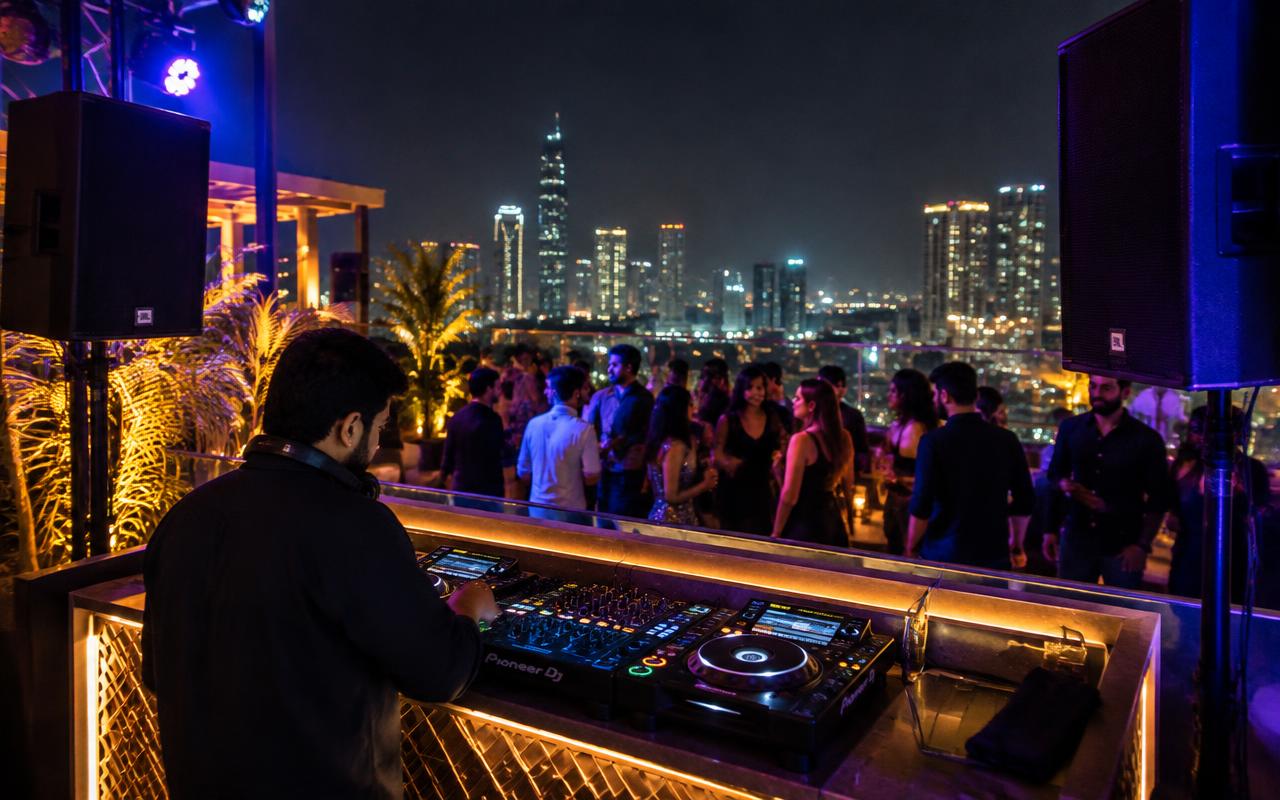
A premium DJ setup is judged on two things: what the DJ feels in the booth and what the dance floor feels in the chest. The booth is built around a Pioneer CDJ-3000 pair or quad with a DJM-A9 or V10 mixer, linked over Pro DJ Link so beat grids, quantise and track loading behave as the artist expects. Booth monitoring is a separate send on its own cabinets, angled at the DJ's ear height and level-matched so they are not mixing against a 20-metre delayed slap from the main system. We supply a laptop stand, a USB hub, RCA and XLR patching for every common controller, and a dedicated power circuit for the booth that nothing else shares.
Dance-floor shape dictates everything here: a long narrow floor needs delay fills, a square one needs a centre sub cluster, and low ceilings decide whether tops fly at all. In Jammu that plays out at venues like Radisson Blu Jammu, Abhinav Theatre, Maulana Azad Stadium, and across Gandhi Nagar, Trikuta Nagar, Bahu Plaza, Channi Himmat.
The dance floor is a low-frequency problem. Club-grade subs placed in a left-right pair produce a comb pattern across the floor, so we prefer a centre-clustered block or a four-box arc that gives the whole floor similar energy between 40 and 80 Hz. Tops are flown or pole-mounted above head height and aimed down into the floor rather than across it, which keeps level on the dancers and off the bar and the smoking terrace. Target is 100 to 105 dBA on the floor with the system still clean at that level, which comes from headroom and correct crossover points rather than from pushing limiters.
What’s included
- Pioneer CDJ-3000 & DJM-A9 booths
- Club subwoofers & tops
- Beam, wash and laser lighting
- LED DJ console facades
Equipment we carry
Why Jammu chooses Prime AV
- Crews and trucks positioned for fast load-in at Radisson Blu Jammu and venues in Gandhi Nagar and Trikuta Nagar.
- The booth spec is confirmed in writing at T-3 weeks and a second mixer travels in the truck on any headline night.
- Lighting plot with the busking layout and programmed look list
- Working knowledge of Jammu & Kashmir venue rules, power sanctions and permission timelines.
Local conditions
Producing premium DJ sound setup in Jammu
Weather & the rig
DJ booths and dance floors are frequently rooftop or poolside, which puts expensive decks, a mixer and a laptop in direct reach of dew, dust and sudden rain. Jammu is the hot anomaly of a cold Union Territory — the plains here reach 44°C in May and June, hotter than anywhere in the Kashmir valley, and the Jul–Sep monsoon brings the Tawi up fast with flash-flood risk on riverside ground. Winter is the operational problem: January fog closes Jammu airport for hours at a stretch, slows the NH-44 run to a crawl and makes projection and any aerial plan unworkable, while 4–20°C days require heating for every outdoor function. May–Jun plains heat; Jul–Sep monsoon and Tawi flooding; and dense-fog January for anything depending on air freight, projection or drone work.
Power & redundancy
A party rig is electrically noisy — lighting, lasers, CO2 solenoids and the booth all on one supply is how hum gets into a mix, so the booth takes its own clean circuit. Among the more demanding power environments in north India. JPDCL operates scheduled curtailment in both the winter heating peak and the summer cooling peak, so a show here is planned DG-primary with the mains treated as a bonus, and N+1 redundancy with automatic changeover is standard rather than premium. Fuel storage and a bowser plan matter because a long outage is normal, not exceptional.
Permits & noise rules
After-parties sit squarely against the local noise curfew, and late-night licensing is usually what decides whether the set ends at midnight or at two. Jammu Municipal Corporation for the licence and temporary structures, the SSP Jammu and the district magistrate for assembly and loudspeaker permission, and the J&K noise rules with the 10 pm outdoor limit. Two constraints are specific to this city: Jammu's airfield is a shared civil-military field effectively inside the urban area, which closes drone operations in practice, and any event near an Army or paramilitary installation needs security clearance with crew lists submitted for verification well in advance. Everything within Katra and on the track is governed by the Shri Mata Vaishno Devi Shrine Board, whose rules on content, catering and structures supersede the municipal file.
Load-in & access
Rooftop and poolside builds mean carrying subs up service lifts in a narrow window, so the sub count is often limited by the lift, not the budget. Delhi is 600 km and a realistic 10–11 hours on NH-44, with the Lakhanpur toll and security checks adding unpredictable hours. Pathankot at 100 km is the useful staging point, and rail parcel into Jammu Tawi is reliable. Northbound movement towards the valley is regularly halted for highway closures, so never plan a Jammu show on gear still sitting past Udhampur. In the city, Residency Road and the old town bar heavy vehicles through the day; 10 pm–6 am is the window.
Season & booking
Both Navratris — Chaitra in spring and Sharad in autumn — bring peak Vaishno Devi footfall and absorb the region's hospitality, transport and police capacity. The Jhiri Mela in Oct–Nov, Lohri and Baisakhi, the Bahu Mela, and the Army Day and Republic Day ceremonial calendar all lock dates. The Dogra wedding grid runs Oct–Mar around the auspicious tithis, with the pre-winter weeks busiest. Peak demand runs Oct–Mar.
Crew & dispatch
Local crew based in Jammu with working stock held in the city, because the Delhi run is too long and too interruptible to rely on for a tight call time; Delhi supplies large-format LED and specialist inventory with at least 48 hours in hand, and Pathankot serves as the staging point. Load-in support covers Gandhi Nagar, Trikuta Nagar and the rest of the city.
What it costs here
Government and defence work is tendered, documented and reliable but slow to settle, and the paperwork load is heavier here than in most states. Dogra weddings spend confidently on stage, lighting and entry production. Honest pricing has to carry the real cost of redundancy — DG sizing, fuel and a spare-stock position that this grid and this highway demand — rather than pretending to a plains cost base.
Local expectations
Dogra weddings carry their own ritual sequence, with the baraat, dhol and Dogri wedding songs needing acoustic space before the sangeet takes over at full level. A large share of functions have serving or retired defence families in the room, which sets a formal tone: punctual starts, clear protocol order, accurate rank and title on every name board. Hindi and Dogri scripting with English for official events, and a visible preference for dignified formality over spectacle in institutional work.
Specification
DJ & Premium Party Sound: technical specification
| Specification | Detail |
|---|---|
| Booth standard | 2 – 4 x Pioneer CDJ-3000 with DJM-A9 or DJM-V10, Pro DJ Link |
| Booth monitoring | Dedicated send, two coaxial or compact cabinets at ear height |
| Dance-floor SPL target | 100 – 105 dBA on the floor, clean with limiter headroom intact |
| Sub configuration | Centre cluster or four-box arc, never a bare left-right pair |
| Low-frequency band | Useful output to 35 – 40 Hz with crossover at 80 – 100 Hz |
| Top placement | Flown or pole-mounted above head height, aimed into the floor |
| Booth power | Dedicated circuit, isolated from lighting and effects phases |
| Effects | CO2 jets, low-fog, confetti and hazers on DMX with manual override |
| Laser safety | Beams masked above the audience plane; no audience scanning |
Lighting and effects are programmed to the music, not left on sound-active. Beams and washes are built as looks on a console with a busking layout so the operator can hit the drop, and strobes and CO2 jets are placed where they read on camera without blinding the DJ. Lasers, where used, are aimed and masked so no beam enters the audience plane at eye height — audience scanning is an avoidable risk and we simply do not take it. LED booth facades carry content or a live pixel-mapped feed, and the whole lighting world runs on a separate electrical phase from audio.
Sizing
What size rig does your event actually need?
| Scale | Guests | Recommended setup |
|---|---|---|
| Lounge floor | 80 – 200 | Two tops, one centre sub, booth monitor pair, eight washes, four beams |
| Rooftop | 200 – 500 | Four tops pole-mounted, two subs centre-clustered, 16 fixtures, hazer |
| Ballroom after-party | 500 – 1,000 | Flown tops, four-box sub arc, two delay fills, 24 fixtures, two CO2 jets |
| Warehouse or lawn | 1,000 – 2,500 | Compact array per side, eight to twelve subs in a block, 40+ fixtures, lasers |
| Festival dance stage | 3,000 – 5,000+ | Full array with outfills, 16 subs, timecoded lighting and effects, duplicate booth |
Scope
Premium DJ Sound Setup scope tiers in Jammu
Cocktail Booth
Cocktail hours and intimate parties, 100 – 300 guests
- CDJ-3000 pair with DJM-A9 and booth monitor send
- Four tops and two subs with a centre sub position
- Eight washes and four beams on a busking console layout
- LED booth facade with content playback
- Sound engineer and one lighting operator
Club Floor
After-parties, rooftop nights and corporate socials, 300 – 800 guests
- Quad CDJ booth with mixer redundancy and spare channel
- Flown tops with a four-box sub arc and dance-floor delay fills
- Twenty-four fixture lighting rig with hazer and two CO2 jets
- Pixel-mapped booth and bar-back LED
- Three-person crew with programmed looks and a busking layout
Headline Night
Touring DJ sets and large party productions, 1,000 – 5,000 guests
- Rider-matched booth with artist-specified mixer and spare deck
- Compact line array per side with a dedicated sub block
- Sixty-plus fixtures, lasers under masked aiming and timecoded looks
- Full LED stage-design surface with media server playback
- Crew chief, system engineer, monitor tech and lighting programmer
Government and defence work is tendered, documented and reliable but slow to settle, and the paperwork load is heavier here than in most states. Dogra weddings spend confidently on stage, lighting and entry production. Honest pricing has to carry the real cost of redundancy — DG sizing, fuel and a spare-stock position that this grid and this highway demand — rather than pretending to a plains cost base.
Venues
Where we work in Jammu
| Venue | Capacity | Production note |
|---|---|---|
| Radisson Blu Jammu | Up to 1,000 across ballroom and lawns | The city's most capable conference property, bypass-side with a usable service approach; ballroom rigging provision is conservative, and winter load-ins have to be planned around the dense January fog that slows every vehicle movement into the city. |
| Abhinav Theatre | Roughly 700 fixed seats | The J&K Academy's proscenium house at Kachi Chawni — a real theatre with a house grid and wings, but the electrical infrastructure is dated and sized for house lighting, so a substantial rig needs a parallel temporary supply, and the stage door restricts case dimensions. |
| Maulana Azad Stadium | 15,000-plus with the field in use | City-centre stadium near Residency Road with no permanent rigging and turf that needs full boarding before any vehicle or tower goes on; one service gate and a congested surrounding block mean a staged, shuttled load-in across two nights rather than one. |
| General Zorawar Singh Auditorium | Roughly 1,000 fixed seats | Jammu University's main auditorium for convocations and cultural programmes; campus security logs every vehicle, academic-calendar blackouts are firm, and the in-house technical team's processes have to be worked with rather than around. |
| KC Residency | Up to 600 seated across halls | Established Residency Road hotel where the load-in is from a busy commercial street with no dock at all — a hand-carry and goods-lift operation that has to run overnight. |
Crew
Who turns up on show day
- System engineer
Tunes the floor for even low-frequency coverage and keeps the system clean at target level rather than limiter-bound.
- Booth technician
Builds and tests the DJ booth, hosts each artist through changeover and handles their patching and monitoring.
- Lighting operator
Busks looks against the set, hits drops live, and runs hazer, CO2 and strobe cues to the music.
- Effects technician
Loads and arms CO2 and confetti, monitors gas levels, and keeps firing lines clear of guests and the booth.
- Laser operator
Aims and masks every beam above the audience plane and holds the kill switch for the duration of the set.
What you receive
- Booth layout drawing with patching and power detail
- Dance-floor coverage plan showing sub positions and top aiming
- Lighting plot with the busking layout and programmed look list
- Effects firing plan with safety exclusion zones marked
- Laser aiming and masking record with the operator's sign-off
- Recorded set audio on request, taken from a dedicated mixer output
Timeline
From enquiry to load-out
- T-3 weeks
Artist spec confirmation
Booth layout, mixer model, monitor preference and any lighting or timecode requirement confirmed with the DJ's team.
- T-2 weeks
Floor and rig plan
Sub positions, top aiming, fixture plot and effects firing positions drawn against the venue layout.
- T-1 week
Content and look build
Booth facade content, LED visuals and the programmed lighting looks are built and reviewed.
- Show day
Load-in and tune
Build, tune the floor for even low frequency, set booth monitoring and walk the laser masking.
- Show day, T-2 hours
Soundcheck and set
Each artist checks their booth, levels are agreed, then the set runs with an operator on lighting throughout.
- Set end +2 hours
Strike
Effects are made safe and gas isolated first, then lighting, then audio, with the booth packed under supervision.
Risk control
What goes wrong, and how we stop it
What can go wrong
How we prevent it
- What can go wrong
A visiting DJ arrives expecting a mixer model that was never confirmed.
How we prevent itThe booth spec is confirmed in writing at T-3 weeks and a second mixer travels in the truck on any headline night.
- What can go wrong
Laser beams drop into the audience plane as the crowd surges forward.
How we prevent itBeams are masked and aimed above head height at build, the exclusion zone is physically barricaded, and the operator holds a kill switch all set.
- What can go wrong
CO2 jets empty halfway through the set because the cylinder count was guessed.
How we prevent itGas is calculated from the number of programmed hits plus 40 per cent reserve, and cylinder pressure is checked between artists.
- What can go wrong
Shared power between lighting and audio produces audible buzz through the booth.
How we prevent itSeparate phases for audio and lighting with a single common earth reference, and balanced patching throughout the booth.
Honest comparison
Is this the right choice for your event?
- More subs instead of better sub placementOur verdict
Doubling the sub count buys about 6 dB and makes the comb pattern worse. Moving the same boxes into a centre cluster usually improves what the floor actually feels, for no extra rental.
- Lasers instead of beams and CO2Our verdict
Lasers look spectacular in haze and photograph brilliantly, but they add an operator, a safety plan and masking time. On a tight load-in, beams plus two CO2 jets deliver most of the impact with far less risk.
- A controller-and-laptop setup instead of a CDJ boothOur verdict
For a resident DJ who owns their workflow, a controller is lighter and perfectly capable. Guest and touring artists expect CDJ-3000s and Pro DJ Link, and asking them to adapt on the night is where sets go wrong.
Demand
What Jammu books most
Jammu event mix
- Dogra community weddings and multi-day functions
- Government, administrative and UT-level conferences
- Defence and paramilitary ceremonial functions
- Vaishno Devi pilgrim-season and Shrine Board events
- Trade exhibitions and regional dealer meets
- University convocations and cultural programmes
Ideal for
Events we power with DJ & premium party sound in Jammu
Process
From brief to standing ovation
01
Brief & recce
We visit the venue, map power and rigging, and understand your show flow.
02
Design & quote
CAD plans, 3D previews and an itemised quote within 24 hours.
03
Build & rehearse
Load-in, system tuning, content checks and full technical rehearsal.
04
Show & strike
Show-caller-led execution, then a quick, clean load-out.
FAQ
Premium DJ Sound Setup in Jammu: FAQs
More services in Jammu
Premium DJ Sound Setup in nearby cities
Areas we cover in Jammu
Events in Jammu