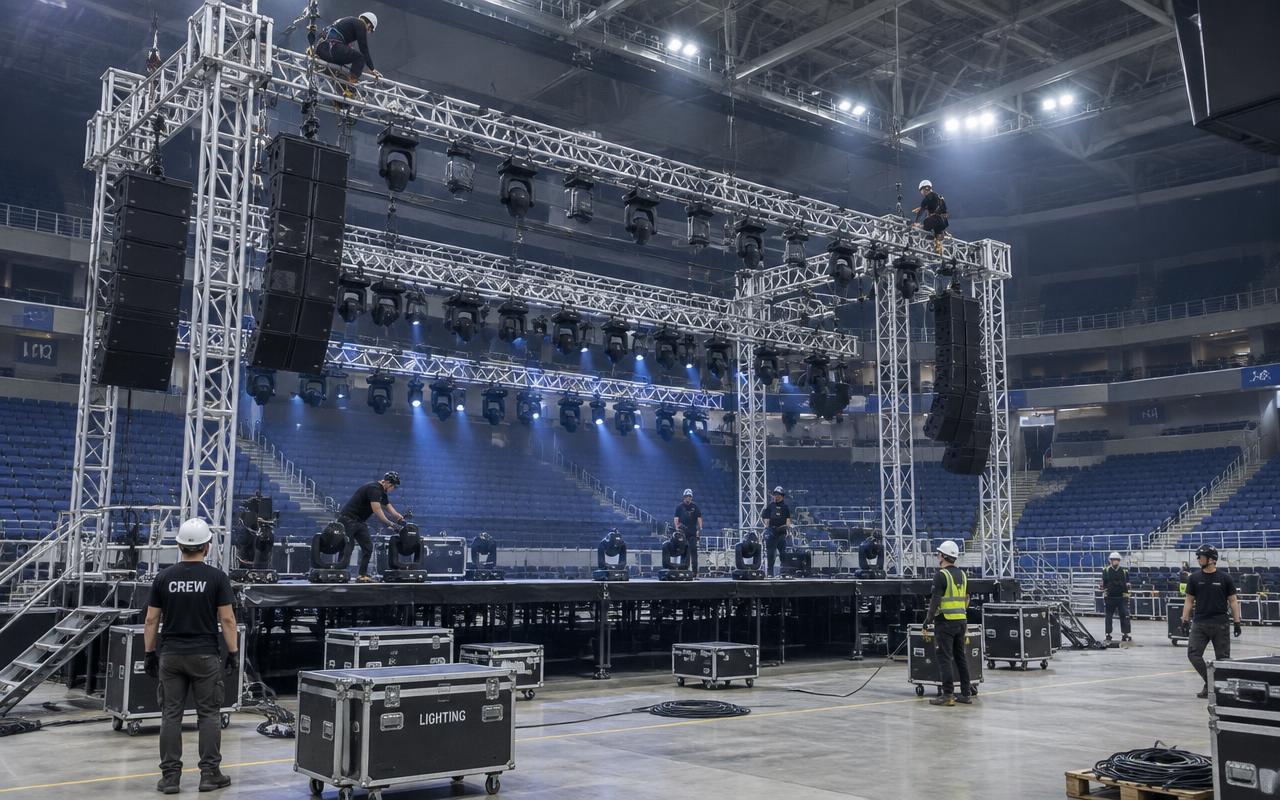
Key takeaway
Key takeaways
- Exact models, not categories, on the equipment list
- Spares for anything that would stop the show
- Power sanction plus generator changeover confirmed
- One named show-caller holding the cue sheet
Stage & Truss Fabrication: pre-show checklist
Equipment & specification
- Deck systems confirmed: Layher Allround and aluminium-framed modular decks with published load ratings
- Live load design confirmed: Typically 500 kg per square metre distributed for performance stages
- Truss types confirmed: 300 – 600 mm box and triangular truss, specified from manufacturer span and load tables
- Chain hoists confirmed: Electric hoists in 500 kg – 2 t capacities, rated well above working load, inspected per build
- Rigging safety factor confirmed: Hardware used within rated capacity with the factor appropriate to lifting over people
- Itemised list naming exact models, not categories
- Spares for mics, cables, processors and any single point of failure
Power & safety
- Venue sanctioned load confirmed in writing against the rig's draw
- Silent generator sized with automatic changeover
- Earthing check completed and logged
- Rigging certification and load calculations signed off
- Cable covers on every walkway and crowd line
People
- Structural designer named and briefed
- Crew chief named and briefed
- Lead rigger named and briefed
- Stage carpenter named and briefed
- Competent person on site named and briefed
Timings
- Load-in slot agreed with the venue in writing
- Sound check and line check scheduled
- Full technical rehearsal booked with real presenters and real content
- Venue curfew and strike window confirmed
Content & handover
- Structural load calculations covering dead, live, suspended and wind cases
- Point-load report per leg issued to the venue or structural engineer
- Stage and truss CAD drawing with dimensions, heights and trim
- Hoist and rigging hardware inspection records for the build
- All video, audio and slides delivered 72 hours ahead in the agreed format
What this checklist is protecting you from
What can go wrong
How we prevent it
- What can go wrong
Departments add lighting, LED and audio beyond the load the grid was designed for.
How we prevent itA single suspended-load budget is published at T-4 weeks and every department's weight is booked against it; anything added later triggers a recalculation before it is hung.
- What can go wrong
A banner-clad roof becomes a sail and the structure approaches its overturning limit in a squall.
How we prevent itThe wind management plan sets a numeric speed at which banners come off and a higher one at which the roof is lowered, with an anemometer on site and a named person empowered to act.
- What can go wrong
Ballast is placed on soft or wet ground and begins to sink, taking the structure out of plumb.
How we prevent itGround bearing capacity is assessed before the build, load-spreading plates are specified for soft surfaces, and plumb is re-checked after the first night.
- What can go wrong
The venue quotes a rigging capacity that turns out to be an assumption rather than a calculation.
How we prevent itWe require written sign-off on point loads and, where it is not forthcoming, quote a ground support system that carries its own load to the floor.
- What can go wrong
Stage gaps and unprotected edges become an injury risk once performers and guests are moving fast.
How we prevent itDeck gaps are closed and taped, edge protection and handrails are fitted to code, and the carpenter walks the whole deck surface before anyone is allowed on it.
- What can go wrong
Lifting continues while other crew work underneath because the build is behind schedule.
How we prevent itAll lifting is controlled from a single position with the area cleared, and the crew chief has explicit authority to stop a build that is being rushed.
Want this tailored to your event?
Get an itemised quote from Prime AV Solutions within 24 hours — call +91 93093 80958 or WhatsApp our producers.
Published 3 May 2026 by the Prime AV Solutions production team.