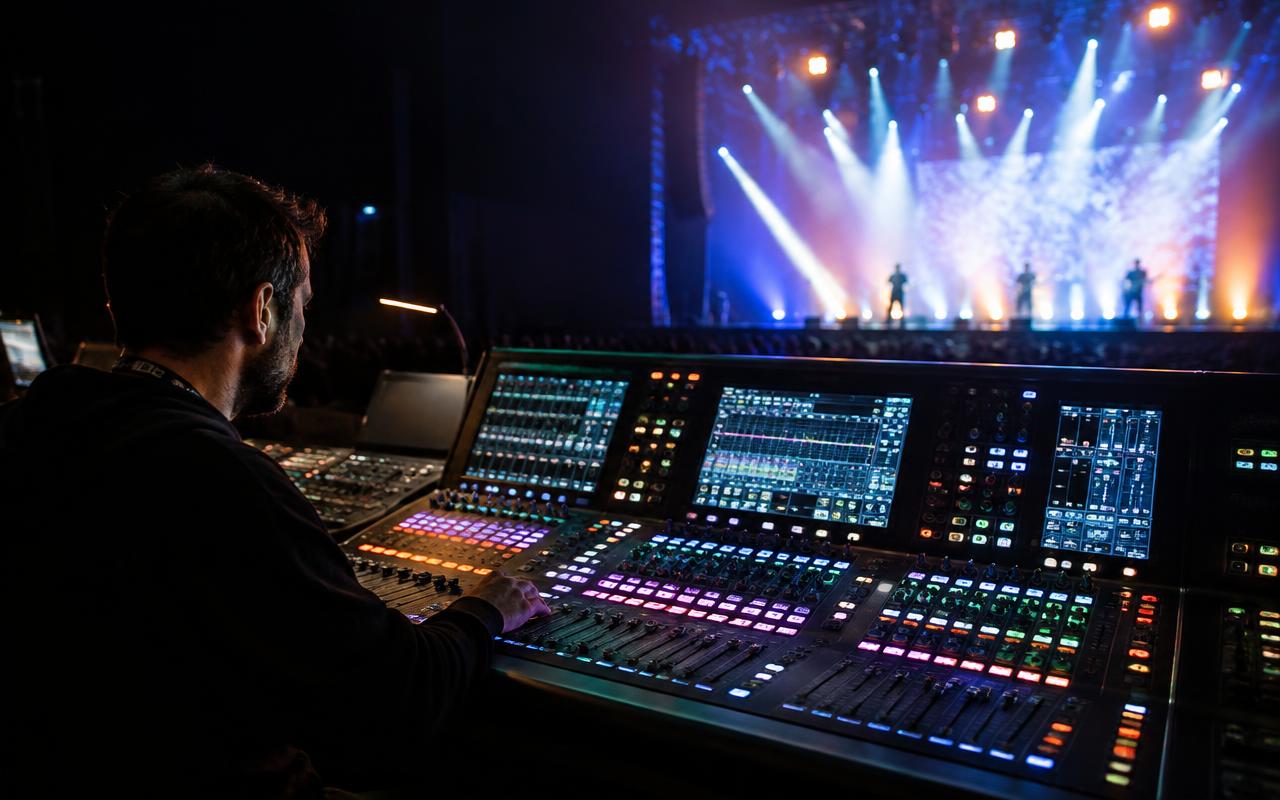
Key takeaway
Key takeaways
- Exact models, not categories, on the equipment list
- Spares for anything that would stop the show
- Power sanction plus generator changeover confirmed
- One named show-caller holding the cue sheet
Line Array Systems: pre-show checklist
Equipment & specification
- Prediction software confirmed: L-Acoustics Soundvision, d&b ArrayCalc, Meyer MAPP
- Coverage tolerance target confirmed: ±3 dB across the defined audience area
- Array sizes confirmed: 6 – 24 boxes per hang, single or double hangs plus outfills
- Delay timing constant confirmed: ≈2.9 ms per metre, temperature-corrected on the day
- Delay position spacing confirmed: Every 50 – 70 m of audience depth beyond the main hang
- Itemised list naming exact models, not categories
- Spares for mics, cables, processors and any single point of failure
Power & safety
- Venue sanctioned load confirmed in writing against the rig's draw
- Silent generator sized with automatic changeover
- Earthing check completed and logged
- Rigging certification and load calculations signed off
- Cable covers on every walkway and crowd line
People
- System designer named and briefed
- System engineer named and briefed
- Lead rigger named and briefed
- Amplification technician named and briefed
- Delay position technician named and briefed
Timings
- Load-in slot agreed with the venue in writing
- Sound check and line check scheduled
- Full technical rehearsal booked with real presenters and real content
- Venue curfew and strike window confirmed
Content & handover
- Soundvision or ArrayCalc coverage model with SPL prediction map
- Box-by-box splay angle schedule for every hang
- Rigging plot with point loads and bridle calculations
- Measured Smaart traces from the audience positions used for alignment
- All video, audio and slides delivered 72 hours ahead in the agreed format
What this checklist is protecting you from
What can go wrong
How we prevent it
- What can go wrong
The venue's published rigging capacity turns out to be theoretical and will not take the hang.
How we prevent itWe require a point-load sign-off from the venue or a structural engineer at T-2 weeks, and keep a ground-support tower design as the fallback.
- What can go wrong
Delay towers are timed at noon and sound wrong at 9 pm as the air cools and the speed of sound drops.
How we prevent itDelays are computed with the forecast show-time temperature and re-measured just before doors, which typically moves each tower a fraction of a millisecond.
- What can go wrong
Low frequency from ground-stacked subs rolls straight into the nearest housing and triggers a complaint.
How we prevent itA cardioid or end-fire sub array cuts rearward output by 15 dB or more in the problem direction, measured at the boundary before the show.
- What can go wrong
Coverage is modelled for the drawn seating plan, then the client adds 1,500 chairs on the flanks the day before.
How we prevent itWe design the hang with outfill capacity in reserve and keep the splay schedule adjustable, so flank coverage is a change of angle rather than a change of system.
- What can go wrong
The array is flown too low, so the front rows are loud and the back rows are thin.
How we prevent itTrim height is derived from the prediction model and non-negotiable; where sightlines force a low trim, box count and splay are re-modelled rather than fudged on site.
- What can go wrong
A single amplifier network cable is damaged by a forklift and takes a whole hang silent.
How we prevent itRing-topology networking with redundant paths, armoured or trenched cable runs, and a documented failover test performed before doors.
Want this tailored to your event?
Get an itemised quote from Prime AV Solutions within 24 hours — call +91 93093 80958 or WhatsApp our producers.
Published 19 August 2026 by the Prime AV Solutions production team.