Lighting & Stage · Jalandhar, Punjab
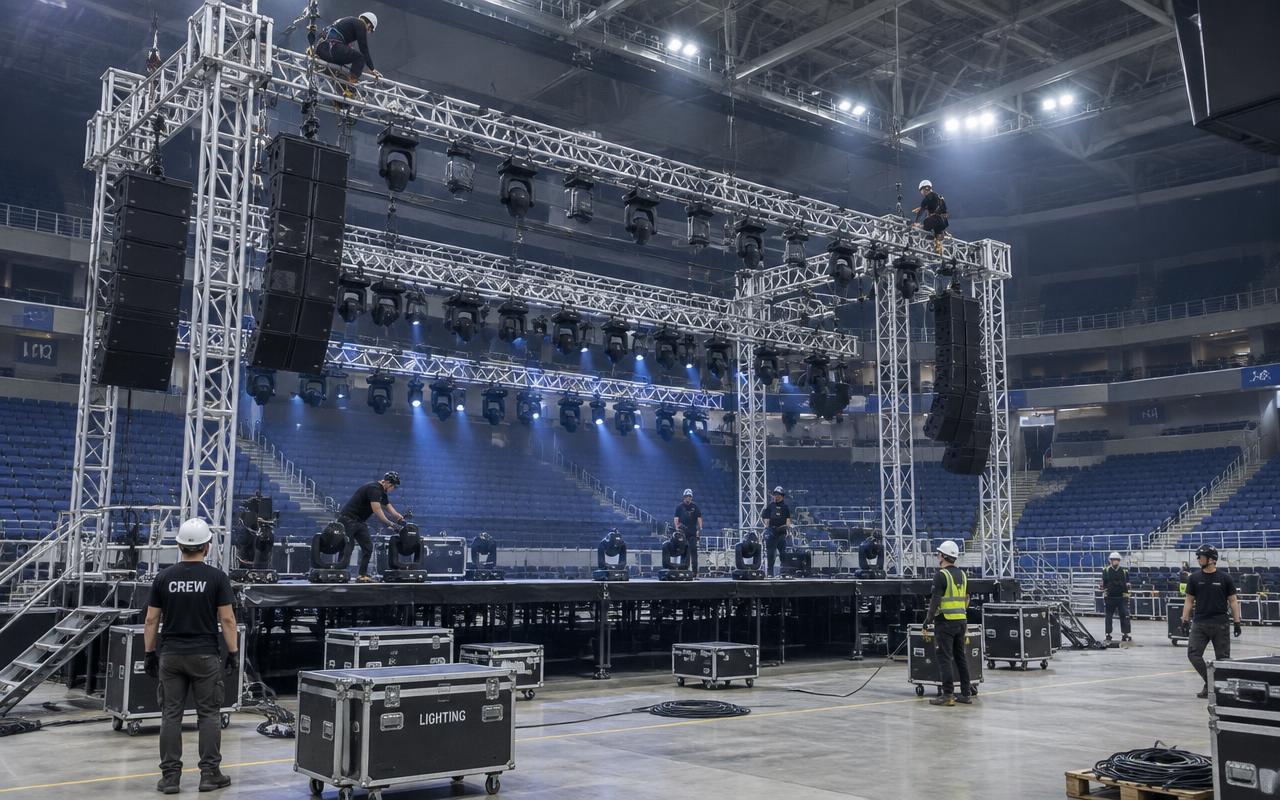
Stage & Truss Setup in Jalandhar
In Jalandhar, nri-funded weddings and multi-day sangeet productions set the standard everything else is measured against. Our stage & truss fabrication is specified to clear that bar at Radisson Jalandhar and anywhere else in the city.
- Lead time
- From 6 weeks
- Peak season
- Oct–Mar
- Coverage
- Jalandhar & Punjab
Key takeaway
Stage & Truss Fabrication for Jalandhar’s biggest events
Structure is the one department where getting it wrong is not an aesthetic problem. Every stage and truss build starts from a load case: the dead load of the structure itself, the live load of performers and crew, the suspended loads of lighting, audio and LED, and — outdoors — wind load on any banner, roof or solid surface. We specify from manufacturer load tables for the exact truss type and span, with chain hoists rated well above the working load and point loads calculated per leg. Decks are Layher or aluminium framed systems with a published uniform load rating, and a performance stage is typically designed for 500 kg per square metre of distributed live load.
Everything here is set by the building and the ground: documented rigging capacity, floor loading, ceiling trim and whether there is room for towers to carry load to the floor. In Jalandhar that plays out at venues like Radisson Jalandhar, Ramada Jalandhar, PAP Ground, and across Model Town, GT Road, Civil Lines, Urban Estate.
Ground support and roof systems are where wind becomes the governing factor. A solid or banner-clad roof is a sail, and the force on it rises with the square of wind speed, so every roof design comes with a wind management plan: a speed at which banners are removed, a higher speed at which the roof is lowered or the show stops, and a ballast or ground-anchor scheme calculated for the site's surface. Ballast is not a number we guess — concrete blocks or water ballast are specified against the structure's overturning calculation, and soft ground needs load-spreading plates or a different anchoring approach entirely.
What’s included
- Layher & aluminium deck stages
- Ground support & roof systems
- Motorised chain hoists
- Structural load calculations
Equipment we carry
Why Jalandhar chooses Prime AV
- Crews and trucks positioned for fast load-in at PAP Ground and venues in Civil Lines and Urban Estate.
- Deck gaps are closed and taped, edge protection and handrails are fitted to code, and the carpenter walks the whole deck surface before anyone is allowed on it.
- Hoist and rigging hardware inspection records for the build
- Working knowledge of Punjab venue rules, power sanctions and permission timelines.

Local conditions
Producing stage & truss setup in Jalandhar
Weather & the rig
Structure is the department wind and rain act on directly — a clad roof behaves as a sail, ballast sinks into saturated ground, and the wind plan is written against the site's actual conditions. Punjab's winter fog rolls into the Doaba plain from late December through January, cutting visibility sharply and disrupting the very flights that bring NRI families in for the wedding season, so the run of show has to tolerate late arrivals. Summer peaks at 44–45°C in June with a dry dusty wind, the monsoon from late June to September brings heavy spells and the Sutlej and Beas catchments can flood low ground, and February onwards is the pleasant working weather. Late December to January fog creates genuine travel risk for overseas guests, May–June is too hot for daytime outdoor work, and July–September monsoon with occasional catchment flooding rules out open ground. October–November and February–March are the best windows; the NRI wedding peak sits in December and January regardless.
Power & redundancy
Motorised hoists and the loading sequence need a reliable supply early in the build, well before the event distribution is energised, so structure usually works off its own temporary feed. PSPCL supply is better than the Uttar Pradesh comparison but agricultural load management means the surrounding belt still sees interruption, and the marriage palaces, despite their size, sanction loads sized for decorative lighting rather than a concert rig. Every serious job here is generator-backed, and since these are multi-day functions running late, fuel planning and a relief operator for the DG compound matter as much as the set itself.
Permits & noise rules
Stages, roofs and ground support frequently need structural sign-off and local authority approval in their own right, separate from the event permission itself. The Jalandhar Municipal Corporation and the district administration handle ground use, the police commissionerate licenses assembly and manages traffic for rallies and congregations, and the Punjab noise rules with the Supreme Court 10 pm limit apply. Enforcement here has a specific local history: the courts and police have acted against marriage-palace noise after midnight, so the practical approach is enclosed venues with sealed openings for the late hours. Drone work needs DGCA clearance and, given the proximity of the international border region, additional police coordination that should not be left late.
Load-in & access
Truss, decks and ballast are the heaviest and bulkiest loads on the job and must arrive first, which makes gate width, ground bearing and crane or forklift access the controlling constraints. NH-44 runs through the city, so freight from Delhi or Ludhiana is uncomplicated and the GT Road venues take full container trucks. The constraint is the city core — Model Town, Lajpat Nagar and the old bazaars are congested all day with no truck access, and PAP Ground operations run entirely on police-allotted windows with vehicle manifests submitted in advance. Multi-day wedding builds need a secure on-site compound because the rig stays up for three or four nights.
Season & booking
December and January are the NRI homecoming peak and every decent banquet venue, sound system and lighting rig in Doaba is committed — bookings for these weeks are made six months to a year out. The Harballabh classical sangeet sammelan at Devi Talab takes its December dates, Baisakhi in April and Lohri in January are major, Gurpurab dates bring large kirtan darbars, and the Jalandhar sports goods trade travels to its own fairs in spring. Peak demand runs Oct–Mar.
Crew & dispatch
Trucked from our Delhi depot, 380 km up NH-44 at about six and a half hours, with Ludhiana 60 km away as the practical forward base for crew, structures and barricading during the December peak. Load-in support covers Civil Lines, Urban Estate and the rest of the city.
What it costs here
The least price-sensitive wedding market in north India outside the Delhi and Rajasthan destination circuit — a Doaba family funding a daughter's wedding from Canada or the UK will spend on sound, lighting and a filmed deliverable without much argument, and will compare against what relatives booked last season. Industrial and expo work, by contrast, is negotiated tightly on local benchmarks.
Local expectations
Punjabi production expectations are unambiguous: the sound must be loud, the low end must be felt, dhol and live percussion will join the DJ, and the client genuinely expects the floor to be full at two in the morning. Design for high sustained SPL with headroom rather than a system running at its limit, plan a sangeet and a jaggo across separate nights, and treat the entry sequences as the hero moments. Where the programme is religious, the opposite discipline applies — kirtan needs restraint, clarity and no theatre at all.
Specification
Stage & Truss Fabrication: technical specification
| Specification | Detail |
|---|---|
| Deck systems | Layher Allround and aluminium-framed modular decks with published load ratings |
| Live load design | Typically 500 kg per square metre distributed for performance stages |
| Truss types | 300 – 600 mm box and triangular truss, specified from manufacturer span and load tables |
| Chain hoists | Electric hoists in 500 kg – 2 t capacities, rated well above working load, inspected per build |
| Rigging safety factor | Hardware used within rated capacity with the factor appropriate to lifting over people |
| Roof systems | Ground support and mother-grid roofs with a documented wind management plan |
| Wind thresholds | Staged limits for banner removal, roof lowering and show stop, set per structure and site |
| Ballast | Concrete or water ballast calculated against the overturning case, with load-spreading on soft ground |
| Stage heights | 0.6 m to 2.4 m with code-compliant stairs, handrails and edge protection |
| Documentation | Load calculations, point-load report, hoist inspection records and a build sign-off |
The rigging discipline on site is what turns a design into a safe build. Hoists are inspected, chains checked for wear, steels and shackles used within rated capacity with a safety factor appropriate to lifting over people. Every hang point is bonded, every hoist is controlled from a single position, and nothing moves while people are underneath. We run a pre-show structural check after the full rig is loaded and again before doors, because a structure that was correct when empty can reveal a problem once 2 tonnes of lighting and LED is on it. The build sequence, the bolt torque, the hoist inspection and the final sign-off are all documented.
Sizing
What size rig does your event actually need?
| Scale | Guests | Recommended setup |
|---|---|---|
| Conference stage | 200 – 600 | 10 m x 6 m deck at 0.6 m, front truss on two uprights, 1 t suspended load |
| Wedding stage | 400 – 1,200 | 12 m x 8 m deck at 0.9 m with ramps, four uprights and a decor-integrated grid |
| Launch stage | 1,000 – 3,000 | 16 m x 10 m deck at 1.2 m, ground support grid, 3 – 5 t suspended load |
| Concert stage | 5,000 – 15,000 | 18 m x 12 m deck at 1.8 m, roof system, PA wings, 10 – 15 t suspended load |
| Festival main stage | 20,000+ | 24 m x 16 m with 2.4 m deck, engineered roof, mother grid, ballast and wind plan |
Scope
Stage & Truss Setup scope tiers in Jalandhar
Modular Stage
Conference and wedding stages up to 100 sq m with a front truss
- Modular deck stage with skirting, stairs and edge protection
- Front and side truss on uprights with load calculations
- Point-load report issued to the venue
- Certified rigging crew and hoist inspection records
- Build and strike within the venue's load-in window
Ground Support System
Concert and launch stages, 150 – 400 sq m with a flown grid
- Ground support towers and a mother grid rated for the full rig load
- Motorised chain hoists with a single controlled lifting position
- Structural calculations covering dead, live and suspended loads
- Ballast scheme calculated against the overturning case
- Crew chief, certified riggers and a documented build sequence
Roof & Custom Structure
Festival stages, outdoor concerts and bespoke scenic structures
- Engineered roof system with a site-specific wind management plan
- Staged wind thresholds for banner removal, lowering and show stop
- Ground anchoring or ballast designed for the actual surface
- Pre-show structural checks after loading and again before doors
- Full rigging department with a nominated competent person on site
The least price-sensitive wedding market in north India outside the Delhi and Rajasthan destination circuit — a Doaba family funding a daughter's wedding from Canada or the UK will spend on sound, lighting and a filmed deliverable without much argument, and will compare against what relatives booked last season. Industrial and expo work, by contrast, is negotiated tightly on local benchmarks.
Venues
Where we work in Jalandhar
| Venue | Capacity | Production note |
|---|---|---|
| Radisson Jalandhar | Around 800 in the ballroom, 1,500 with lawn | Solid hotel infrastructure on the GT Road side with a usable dock, but the ballroom is conference-rated for rigging and the lawn sits close enough to guest rooms that late-night sound becomes a management conversation. |
| Ramada Jalandhar | 600–1,200 across banquet and lawn | Convenient for travelling guests, though the service lift and corridor dimensions dictate the maximum LED cabinet and sub size — check before designing the wall. |
| PAP Ground | Tens of thousands in an open congregation or rally layout | Punjab Armed Police land used for very large religious gatherings and rallies, which means security-force control over access, timing and vehicle movement, no permanent power for show load, and a distributed delay-tower design over a vast standing crowd. |
| GT Road and Nakodar Road palace banquet belt | 1,500–4,000 across the larger marriage palaces | Purpose-built for Punjabi weddings with high roofs and decent three-phase, but they are designed for decor rather than acoustics — vast hard volumes with long reverberation that punish an over-powered system. |
| Devi Talab Mandir precinct | 1,000–3,000 for the classical sammelan and festival programming | A temple precinct hosting one of north India's oldest classical music conferences, where night-long recitals need a genuinely musical, low-noise system and discreet structure that respects the religious setting. |
Crew
Who turns up on show day
- Structural designer
Produces the load case and the calculations, specifies truss and hoist capacities and signs the point-load report.
- Crew chief
Owns the build sequence and the clock, and holds the authority to stop the build if anything departs from the drawing.
- Lead rigger
Inspects hoists and hardware, controls all lifting from a single position and signs off before anything goes to trim.
- Stage carpenter
Builds decks to level, fits stairs, handrails and edge protection, and closes every gap a heel or a cable could find.
- Competent person on site
Performs the structural checks after loading and before doors, and owns the wind management decisions on an outdoor roof.
What you receive
- Structural load calculations covering dead, live, suspended and wind cases
- Point-load report per leg issued to the venue or structural engineer
- Stage and truss CAD drawing with dimensions, heights and trim
- Hoist and rigging hardware inspection records for the build
- Ballast or ground-anchoring scheme with the overturning calculation
- Wind management plan with staged thresholds for outdoor roof systems
- Signed build completion and pre-doors structural check record
Timeline
From enquiry to load-out
- T-6 weeks
Load case and design
Dead, live, suspended and wind loads established from every department's requirements, then truss and hoist capacities specified.
- T-4 weeks
Calculations issued
Structural calculations, point-load report and ballast scheme sent to the venue or the appointed structural engineer for sign-off.
- T-3 weeks
Site and ground assessment
Surface bearing capacity, levels, access routes and anchoring feasibility checked on site for outdoor builds.
- Show day −3 to −1
Build
Decks, towers, grid and roof built in documented sequence with bolt torque and hoist inspection recorded.
- Show day −1
Load and structural check
Departments load the grid, then a structural check is performed with the rig in place and again before doors.
- Show +4 to +24 hours
Strike
De-rig in reverse build order with lifting operations supervised and the area cleared of all other crew.
Risk control
What goes wrong, and how we stop it
What can go wrong
How we prevent it
- What can go wrong
Stage gaps and unprotected edges become an injury risk once performers and guests are moving fast.
How we prevent itDeck gaps are closed and taped, edge protection and handrails are fitted to code, and the carpenter walks the whole deck surface before anyone is allowed on it.
- What can go wrong
Lifting continues while other crew work underneath because the build is behind schedule.
How we prevent itAll lifting is controlled from a single position with the area cleared, and the crew chief has explicit authority to stop a build that is being rushed.
- What can go wrong
Departments add lighting, LED and audio beyond the load the grid was designed for.
How we prevent itA single suspended-load budget is published at T-4 weeks and every department's weight is booked against it; anything added later triggers a recalculation before it is hung.
- What can go wrong
A banner-clad roof becomes a sail and the structure approaches its overturning limit in a squall.
How we prevent itThe wind management plan sets a numeric speed at which banners come off and a higher one at which the roof is lowered, with an anemometer on site and a named person empowered to act.
Honest comparison
Is this the right choice for your event?
- A roof system instead of a tent or shamiana over the stageOur verdict
A fabric structure is cheaper and keeps rain off people, but it will not carry lighting or audio load and its own wind behaviour is usually undocumented. If anything needs to hang above the stage, it needs an engineered roof.
- Lower stage height to save cost and build timeOur verdict
Often a good call indoors where the audience is close. On a deep standing audience, a 0.6 m stage means the back two thirds see nothing, and IMAG screens become the only reason they stay — which costs far more than the deck did.
- Ground support towers instead of flying from the venue structureOur verdict
Ground support costs more and eats floor space, but it carries its own load to the floor and removes any dependence on a venue capacity you cannot verify. Where the venue has documented, engineered rigging points, flying is cheaper and cleaner.
Demand
What Jalandhar books most
Jalandhar event mix
- NRI-funded weddings and multi-day sangeet productions
- Punjabi music concerts, album launches and ticketed shows
- Sports goods and hand tool export and dealer meets
- Immigration, education and property expos for overseas buyers
- Religious congregations and kirtan darbars
- Classical music conferences and civic cultural programmes
Ideal for
Events we power with stage & truss fabrication in Jalandhar
Process
From brief to standing ovation
01
Brief & recce
We visit the venue, map power and rigging, and understand your show flow.
02
Design & quote
CAD plans, 3D previews and an itemised quote within 24 hours.
03
Build & rehearse
Load-in, system tuning, content checks and full technical rehearsal.
04
Show & strike
Show-caller-led execution, then a quick, clean load-out.
FAQ
Stage & Truss Setup in Jalandhar: FAQs
More services in Jalandhar
Stage & Truss Setup in nearby cities
Areas we cover in Jalandhar
Events in Jalandhar