Lighting & Stage · Ahmedabad, Gujarat
Stage & Truss Setup in Ahmedabad
Prime AV Solutions runs stage & truss fabrication across Ahmedabad and the rest of Gujarat. Own Ahmedabad base, feeding Gandhinagar, Vadodara, Surat and Rajkot by road within four hours. Every project is specified and quoted to its own brief.
- Lead time
- From 6 weeks
- Peak season
- Oct–Feb
- Coverage
- Ahmedabad & Gujarat
Key takeaway
Stage & Truss Fabrication for Ahmedabad’s biggest events
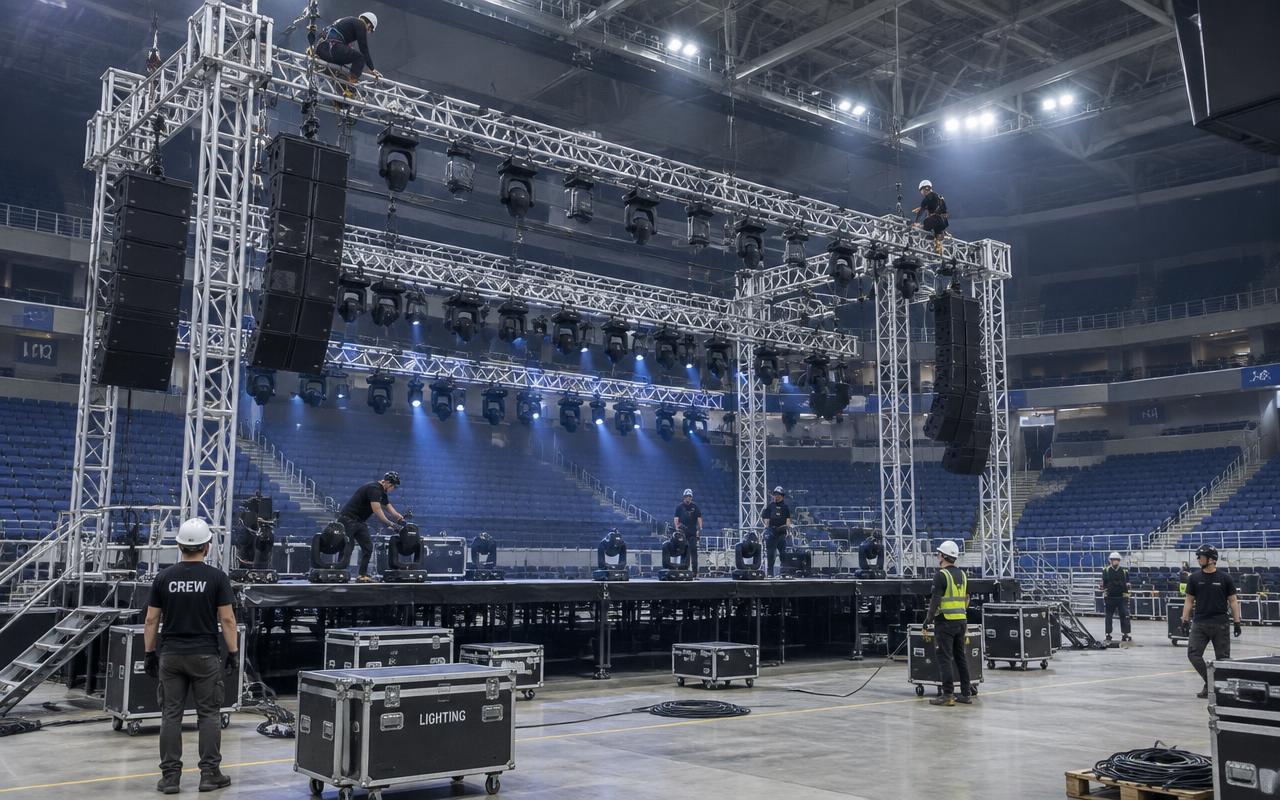
Structure is the one department where getting it wrong is not an aesthetic problem. Every stage and truss build starts from a load case: the dead load of the structure itself, the live load of performers and crew, the suspended loads of lighting, audio and LED, and — outdoors — wind load on any banner, roof or solid surface. We specify from manufacturer load tables for the exact truss type and span, with chain hoists rated well above the working load and point loads calculated per leg. Decks are Layher or aluminium framed systems with a published uniform load rating, and a performance stage is typically designed for 500 kg per square metre of distributed live load.
Everything here is set by the building and the ground: documented rigging capacity, floor loading, ceiling trim and whether there is room for towers to carry load to the floor. In Ahmedabad that plays out at venues like Narendra Modi Stadium, Mahatma Mandir, GMDC Ground, and across SG Highway, Prahlad Nagar, Satellite, Bodakdev.
Ground support and roof systems are where wind becomes the governing factor. A solid or banner-clad roof is a sail, and the force on it rises with the square of wind speed, so every roof design comes with a wind management plan: a speed at which banners are removed, a higher speed at which the roof is lowered or the show stops, and a ballast or ground-anchor scheme calculated for the site's surface. Ballast is not a number we guess — concrete blocks or water ballast are specified against the structure's overturning calculation, and soft ground needs load-spreading plates or a different anchoring approach entirely.
What’s included
- Layher & aluminium deck stages
- Ground support & roof systems
- Motorised chain hoists
- Structural load calculations
Equipment we carry
Why Ahmedabad chooses Prime AV
- Crews and trucks positioned for fast load-in at Karnavati Club and venues in Sabarmati Riverfront and Science City Road.
- A single suspended-load budget is published at T-4 weeks and every department's weight is booked against it; anything added later triggers a recalculation before it is hung.
- Hoist and rigging hardware inspection records for the build
- Working knowledge of Gujarat venue rules, power sanctions and permission timelines.
Local conditions
Producing stage & truss setup in Ahmedabad
Weather & the rig
Structure is the department wind and rain act on directly — a clad roof behaves as a sail, ballast sinks into saturated ground, and the wind plan is written against the site's actual conditions. Pre-monsoon heat is the single biggest reliability factor in Gujarat: April to mid-June routinely crosses 43–45°C, which costs real amplifier headroom, pushes LED modules past junction temperature in direct sun and ages wireless battery packs in days rather than months. Add the dry westerly dust off the Rann side and every moving fixture needs its filters cleared nightly. The compensation is November to February, when nights drop to 10–12°C and outdoor work becomes genuinely comfortable. Mid-Apr to mid-Jun, where daytime outdoor rigging is a crew-safety and equipment-reliability problem rather than a comfort one, and Jun–Sep monsoon.
Power & redundancy
Motorised hoists and the loading sequence need a reliable supply early in the build, well before the event distribution is energised, so structure usually works off its own temporary feed. Torrent Power's Ahmedabad licence area is among the most reliable urban supplies in the country, so indoor venues genuinely run on house power with a DG only backing the critical path. Garba grounds and wedding farms are a different scale of problem: synchronised sets from 250 to 500 kVA, running five hours a night for nine nights, with GPCB-compliant acoustic enclosures and a fuel and maintenance schedule built into the production programme.
Permits & noise rules
Stages, roofs and ground support frequently need structural sign-off and local authority approval in their own right, separate from the event permission itself. AMC handles ground booking, temporary-structure permission and the fire NOC, which is actively checked on garba grounds and large stages rather than filed. The Ahmedabad Police Commissionerate licenses public events, loudspeakers and any late-night extension. The operative rule for Navratri is the Gujarat government's annual time-relaxation notification — until it is issued, the Supreme Court's 10pm limit is the default and planning on a rumour is how grounds get shut down. Drone operation is restricted across the northern city by the SVPI airport zone, which covers Motera.
Load-in & access
Truss, decks and ballast are the heaviest and bulkiest loads on the job and must arrive first, which makes gate width, ground bearing and crane or forklift access the controlling constraints. The Sardar Patel Ring Road and the Ahmedabad-Gandhinagar corridor make this one of the easier truck cities in India, and Mahatma Mandir has purpose-built docks. The exception is the walled city, where the pols around Manek Chowk, Dariapur and Khadia are 2.5–3m lanes that take only a chhota hathi, with the last stretch hand-carried and the timing worked around market trading hours.
Season & booking
Navratri's nine nights are the largest sustained commercial AV deployment anywhere in India — line arrays, lighting, LED and generators are committed from around June, and crew work nine consecutive nights without a break. Uttarayan on 14–15 January effectively shuts the city for kite flying and makes any rooftop or overhead work genuinely hazardous with manja in the air. Vibrant Gujarat summit years take over Mahatma Mandir entirely, and Diwali through Labh Pancham closes the trade. Peak demand runs Oct–Feb.
Crew & dispatch
Own Ahmedabad base, feeding Gandhinagar, Vadodara, Surat and Rajkot by road within four hours. Load-in support covers Sabarmati Riverfront, Science City Road and the rest of the city.
What it costs here
Gujarat's garba economy has built a deep local inventory base, which keeps baseline rates competitive, but the Navratri and December wedding windows price at a real premium and require advance commitment with a deposit rather than an enquiry.
Local expectations
The garba pit is the entire brief. Coverage has to be even across a circular dancing ground with no hot spot at the centre and no shadow at the outer ring, sustained for four to five hours a night, and the singer's monitor mix matters more to the client's judgement of the night than any FOH spectacle. Weddings here are multi-day and run by a family committee rather than a planner, so cue lists change late and a floor manager with decision-making authority is worth more than an extra fixture.
Specification
Stage & Truss Fabrication: technical specification
| Specification | Detail |
|---|---|
| Deck systems | Layher Allround and aluminium-framed modular decks with published load ratings |
| Live load design | Typically 500 kg per square metre distributed for performance stages |
| Truss types | 300 – 600 mm box and triangular truss, specified from manufacturer span and load tables |
| Chain hoists | Electric hoists in 500 kg – 2 t capacities, rated well above working load, inspected per build |
| Rigging safety factor | Hardware used within rated capacity with the factor appropriate to lifting over people |
| Roof systems | Ground support and mother-grid roofs with a documented wind management plan |
| Wind thresholds | Staged limits for banner removal, roof lowering and show stop, set per structure and site |
| Ballast | Concrete or water ballast calculated against the overturning case, with load-spreading on soft ground |
| Stage heights | 0.6 m to 2.4 m with code-compliant stairs, handrails and edge protection |
| Documentation | Load calculations, point-load report, hoist inspection records and a build sign-off |
The rigging discipline on site is what turns a design into a safe build. Hoists are inspected, chains checked for wear, steels and shackles used within rated capacity with a safety factor appropriate to lifting over people. Every hang point is bonded, every hoist is controlled from a single position, and nothing moves while people are underneath. We run a pre-show structural check after the full rig is loaded and again before doors, because a structure that was correct when empty can reveal a problem once 2 tonnes of lighting and LED is on it. The build sequence, the bolt torque, the hoist inspection and the final sign-off are all documented.
Sizing
What size rig does your event actually need?
| Scale | Guests | Recommended setup |
|---|---|---|
| Conference stage | 200 – 600 | 10 m x 6 m deck at 0.6 m, front truss on two uprights, 1 t suspended load |
| Wedding stage | 400 – 1,200 | 12 m x 8 m deck at 0.9 m with ramps, four uprights and a decor-integrated grid |
| Launch stage | 1,000 – 3,000 | 16 m x 10 m deck at 1.2 m, ground support grid, 3 – 5 t suspended load |
| Concert stage | 5,000 – 15,000 | 18 m x 12 m deck at 1.8 m, roof system, PA wings, 10 – 15 t suspended load |
| Festival main stage | 20,000+ | 24 m x 16 m with 2.4 m deck, engineered roof, mother grid, ballast and wind plan |
Scope
Stage & Truss Setup scope tiers in Ahmedabad
Modular Stage
Conference and wedding stages up to 100 sq m with a front truss
- Modular deck stage with skirting, stairs and edge protection
- Front and side truss on uprights with load calculations
- Point-load report issued to the venue
- Certified rigging crew and hoist inspection records
- Build and strike within the venue's load-in window
Ground Support System
Concert and launch stages, 150 – 400 sq m with a flown grid
- Ground support towers and a mother grid rated for the full rig load
- Motorised chain hoists with a single controlled lifting position
- Structural calculations covering dead, live and suspended loads
- Ballast scheme calculated against the overturning case
- Crew chief, certified riggers and a documented build sequence
Roof & Custom Structure
Festival stages, outdoor concerts and bespoke scenic structures
- Engineered roof system with a site-specific wind management plan
- Staged wind thresholds for banner removal, lowering and show stop
- Ground anchoring or ballast designed for the actual surface
- Pre-show structural checks after loading and again before doors
- Full rigging department with a nominated competent person on site
Gujarat's garba economy has built a deep local inventory base, which keeps baseline rates competitive, but the Navratri and December wedding windows price at a real premium and require advance commitment with a deposit rather than an enquiry.
Venues
Where we work in Ahmedabad
| Venue | Capacity | Production note |
|---|---|---|
| Narendra Modi Stadium | Around 1,32,000 in the bowl, the largest cricket stadium in the world | A bowl this size reverberates badly, so a show here is a delay-tower design with time-aligned zones rather than a big PA pointed at the stands; the turf needs full protection, there is no event rigging on the roof, and GCA plus police clearance govern the schedule. |
| Mahatma Mandir | Over 5,000 in the main hall plus very large adjoining exhibition halls | Purpose-built for state summits, so power provision, dock access and circulation are all genuinely adequate — the catch is that it is in Gandhinagar, 25km from the city, so crew and accommodation planning shifts accordingly. |
| GMDC Ground | 20,000-plus on open ground at Helmet Circle | The city's principal commercial garba ground: unpaved surface that needs watering and matting, no house infrastructure at all, and nine nights of continuous operation that make generator servicing and fuel logistics part of the production plan. |
| Karnavati Club | A few thousand across lawns and halls | A members' club where the lawns are the usable space and the surrounding residential blocks mean a sound design that holds level on the dance floor without carrying over the boundary wall. |
| Hyatt Regency Ahmedabad | Around 1,000 banquet across the ballroom | Ashram Road location with a service-lift load-in, so large LED cabinets have to be substituted for a smaller pitch or built on ground support outside the lift's constraints. |
Crew
Who turns up on show day
- Structural designer
Produces the load case and the calculations, specifies truss and hoist capacities and signs the point-load report.
- Crew chief
Owns the build sequence and the clock, and holds the authority to stop the build if anything departs from the drawing.
- Lead rigger
Inspects hoists and hardware, controls all lifting from a single position and signs off before anything goes to trim.
- Stage carpenter
Builds decks to level, fits stairs, handrails and edge protection, and closes every gap a heel or a cable could find.
- Competent person on site
Performs the structural checks after loading and before doors, and owns the wind management decisions on an outdoor roof.
What you receive
- Structural load calculations covering dead, live, suspended and wind cases
- Point-load report per leg issued to the venue or structural engineer
- Stage and truss CAD drawing with dimensions, heights and trim
- Hoist and rigging hardware inspection records for the build
- Ballast or ground-anchoring scheme with the overturning calculation
- Wind management plan with staged thresholds for outdoor roof systems
- Signed build completion and pre-doors structural check record
Timeline
From enquiry to load-out
- T-6 weeks
Load case and design
Dead, live, suspended and wind loads established from every department's requirements, then truss and hoist capacities specified.
- T-4 weeks
Calculations issued
Structural calculations, point-load report and ballast scheme sent to the venue or the appointed structural engineer for sign-off.
- T-3 weeks
Site and ground assessment
Surface bearing capacity, levels, access routes and anchoring feasibility checked on site for outdoor builds.
- Show day −3 to −1
Build
Decks, towers, grid and roof built in documented sequence with bolt torque and hoist inspection recorded.
- Show day −1
Load and structural check
Departments load the grid, then a structural check is performed with the rig in place and again before doors.
- Show +4 to +24 hours
Strike
De-rig in reverse build order with lifting operations supervised and the area cleared of all other crew.
Risk control
What goes wrong, and how we stop it
What can go wrong
How we prevent it
- What can go wrong
Departments add lighting, LED and audio beyond the load the grid was designed for.
How we prevent itA single suspended-load budget is published at T-4 weeks and every department's weight is booked against it; anything added later triggers a recalculation before it is hung.
- What can go wrong
A banner-clad roof becomes a sail and the structure approaches its overturning limit in a squall.
How we prevent itThe wind management plan sets a numeric speed at which banners come off and a higher one at which the roof is lowered, with an anemometer on site and a named person empowered to act.
- What can go wrong
Ballast is placed on soft or wet ground and begins to sink, taking the structure out of plumb.
How we prevent itGround bearing capacity is assessed before the build, load-spreading plates are specified for soft surfaces, and plumb is re-checked after the first night.
- What can go wrong
The venue quotes a rigging capacity that turns out to be an assumption rather than a calculation.
How we prevent itWe require written sign-off on point loads and, where it is not forthcoming, quote a ground support system that carries its own load to the floor.
Honest comparison
Is this the right choice for your event?
- A roof system instead of a tent or shamiana over the stageOur verdict
A fabric structure is cheaper and keeps rain off people, but it will not carry lighting or audio load and its own wind behaviour is usually undocumented. If anything needs to hang above the stage, it needs an engineered roof.
- Lower stage height to save cost and build timeOur verdict
Often a good call indoors where the audience is close. On a deep standing audience, a 0.6 m stage means the back two thirds see nothing, and IMAG screens become the only reason they stay — which costs far more than the deck did.
- Ground support towers instead of flying from the venue structureOur verdict
Ground support costs more and eats floor space, but it carries its own load to the floor and removes any dependence on a venue capacity you cannot verify. Where the venue has documented, engineered rigging points, flying is cheaper and cleaner.
Demand
What Ahmedabad books most
Ahmedabad event mix
- Commercial Navratri garba grounds
- Large multi-day weddings and sangeets
- Trade exhibitions and industrial conferences
- Government and investment summits at Gandhinagar
- Corporate dealer meets and pharma events
- Stadium-scale concerts and sporting events
Ideal for
Events we power with stage & truss fabrication in Ahmedabad
Process
From brief to standing ovation
01
Brief & recce
We visit the venue, map power and rigging, and understand your show flow.
02
Design & quote
CAD plans, 3D previews and an itemised quote within 24 hours.
03
Build & rehearse
Load-in, system tuning, content checks and full technical rehearsal.
04
Show & strike
Show-caller-led execution, then a quick, clean load-out.
FAQ
Stage & Truss Setup in Ahmedabad: FAQs
More services in Ahmedabad
Stage & Truss Setup in nearby cities
Areas we cover in Ahmedabad
Events in Ahmedabad