Lighting & Stage · Ludhiana, Punjab
Stage & Truss Setup in Ludhiana
Booking stage & truss setup in Ludhiana means solving Ludhiana's particular problems: Jul–Sep monsoon; late Dec–Jan for projection-dependent designs and for any schedule that assumes a truck arrives on time; late Oct–Nov for any look that needs clean air on camera, venue load-in windows, and dates that disappear once the season turns.
- Lead time
- From 6 weeks
- Peak season
- Oct–Mar
- Coverage
- Ludhiana & Punjab
Key takeaway
Stage & Truss Fabrication for Ludhiana’s biggest events
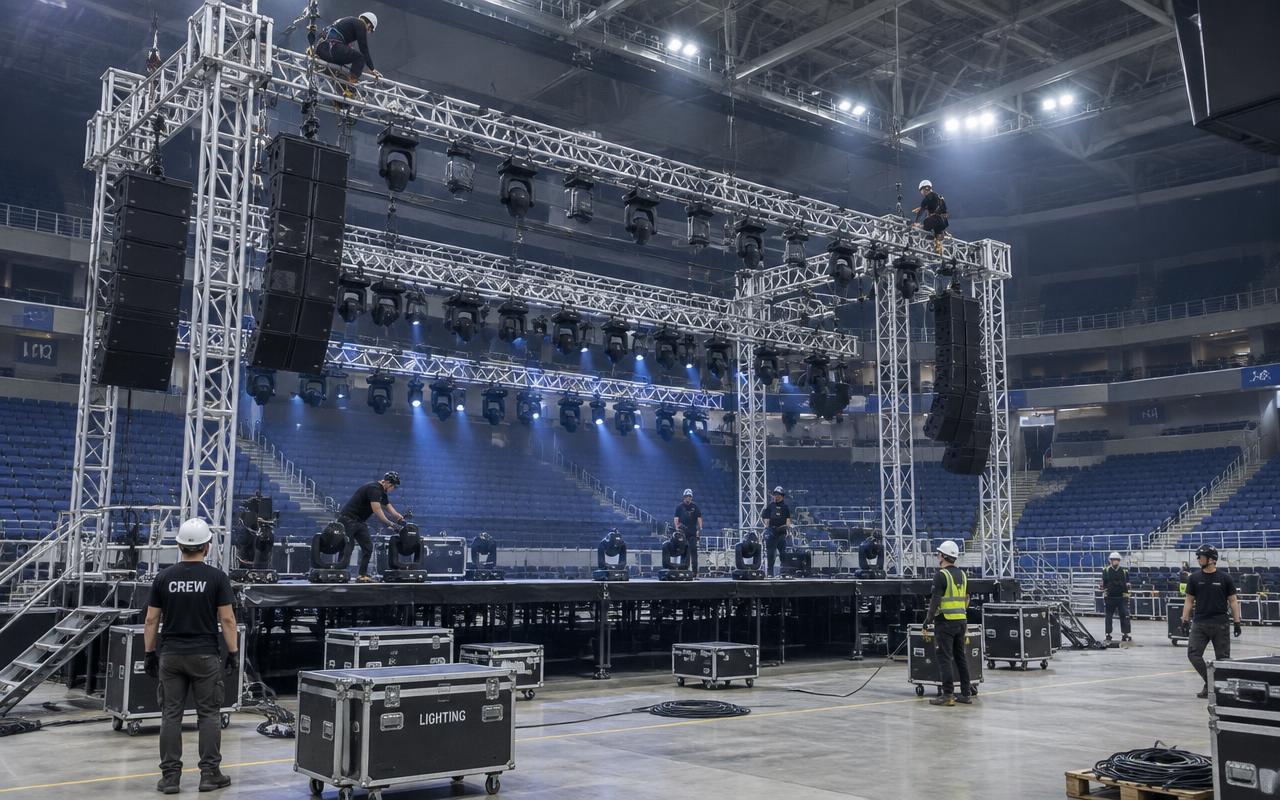
Structure is the one department where getting it wrong is not an aesthetic problem. Every stage and truss build starts from a load case: the dead load of the structure itself, the live load of performers and crew, the suspended loads of lighting, audio and LED, and — outdoors — wind load on any banner, roof or solid surface. We specify from manufacturer load tables for the exact truss type and span, with chain hoists rated well above the working load and point loads calculated per leg. Decks are Layher or aluminium framed systems with a published uniform load rating, and a performance stage is typically designed for 500 kg per square metre of distributed live load.
Everything here is set by the building and the ground: documented rigging capacity, floor loading, ceiling trim and whether there is room for towers to carry load to the floor. In Ludhiana that plays out at venues like Park Plaza Ludhiana, Hyatt Regency Ludhiana, PAU Grounds, and across Ferozepur Road, Model Town, Sarabha Nagar, Pakhowal Road.
Ground support and roof systems are where wind becomes the governing factor. A solid or banner-clad roof is a sail, and the force on it rises with the square of wind speed, so every roof design comes with a wind management plan: a speed at which banners are removed, a higher speed at which the roof is lowered or the show stops, and a ballast or ground-anchor scheme calculated for the site's surface. Ballast is not a number we guess — concrete blocks or water ballast are specified against the structure's overturning calculation, and soft ground needs load-spreading plates or a different anchoring approach entirely.
What’s included
- Layher & aluminium deck stages
- Ground support & roof systems
- Motorised chain hoists
- Structural load calculations
Equipment we carry
Why Ludhiana chooses Prime AV
- Crews and trucks positioned for fast load-in at Hyatt Regency Ludhiana and venues in Model Town and Sarabha Nagar.
- All lifting is controlled from a single position with the area cleared, and the crew chief has explicit authority to stop a build that is being rushed.
- Stage and truss CAD drawing with dimensions, heights and trim
- Working knowledge of Punjab venue rules, power sanctions and permission timelines.
Local conditions
Producing stage & truss setup in Ludhiana
Weather & the rig
Structure is the department wind and rain act on directly — a clad roof behaves as a sail, ballast sinks into saturated ground, and the wind plan is written against the site's actual conditions. Punjab gives extremes at both ends with a particular local problem in between. From late December through January, dense fog closes visibility on the GT Road to a few metres, which both ruins projection and makes overnight inbound trucking from Delhi genuinely unreliable. Then in late October and November the post-harvest stubble smoke settles over the city as a haze layer that photographs as grey murk and irritates crew throats through a long build. Summers reach 44–45°C with pre-monsoon dust storms. Jul–Sep monsoon; late Dec–Jan for projection-dependent designs and for any schedule that assumes a truck arrives on time; late Oct–Nov for any look that needs clean air on camera.
Power & redundancy
Motorised hoists and the loading sequence need a reliable supply early in the build, well before the event distribution is energised, so structure usually works off its own temporary feed. PSPCL's Ludhiana network is heavily loaded by the manufacturing belt and scheduled cuts are a normal part of the industrial calendar, so marriage palaces and industrial venues all carry their own DG as the working source rather than a standby. Sets and operators are plentiful and inexpensive locally, and PPCB's acoustic enclosure norms apply.
Permits & noise rules
Stages, roofs and ground support frequently need structural sign-off and local authority approval in their own right, separate from the event permission itself. Ludhiana Municipal Corporation issues ground and temporary-structure permission and the Ludhiana Police Commissionerate licenses loudspeakers and gatherings. The point that matters commercially is enforcement: the Punjab and Haryana High Court has pressed the state on noise compliance, so the 10pm cut is actively applied against marriage palaces, which run directly against a wedding tradition that expects the night to continue past midnight. Drone clearance is harder in Punjab than most states because of the airport zone and the proximity to the international border.
Load-in & access
Truss, decks and ballast are the heaviest and bulkiest loads on the job and must arrive first, which makes gate width, ground bearing and crane or forklift access the controlling constraints. Ludhiana sits on NH-44 with Delhi six to seven hours away, so metro-grade inventory trucks in without difficulty. Ferozepur Road and Chandigarh Road handle large vehicles; the old city around Chaura Bazar and the hosiery markets allows nothing larger than a tempo and only outside trading hours. The single-gate problem at the marriage palaces is the real constraint on the build programme.
Season & booking
The Christmas to New Year window is the most contested wedding inventory of the year because families settled overseas return then, and those specific dates sell out a year ahead. PAU's Kisan Mela runs in March and September and fills the university grounds for days, Lohri in January brings its own outdoor night production demand, and Baisakhi in April closes the season. Peak demand runs Oct–Mar.
Crew & dispatch
Trucked from the Delhi NCR base in six to seven hours up NH-44, with Punjabi rigging crew and generators hired locally and Ludhiana itself serving as the forward staging point for Amritsar and Jalandhar jobs. Load-in support covers Model Town, Sarabha Nagar and the rest of the city.
What it costs here
This market genuinely pays for wedding production and expects spectacle in return, while also negotiating hard and benchmarking against the marriage palace's own in-house package. The quotation has to separate what the palace supplies from what a production company adds, or the comparison is meaningless.
Local expectations
Punjabi wedding sound is a discipline of its own: sustained high SPL for dhol and a DJ set, visiting artists who arrive late and want an aggressive low end, and a family that expects the night to run well past the curfew regardless of what the licence says — which has to be managed with the venue and the police in advance rather than discovered at 10pm. The stage has to take a bhangra troupe's dynamic loading, and a jaggo or Lohri-style outdoor segment usually needs a second, mobile rig.
Specification
Stage & Truss Fabrication: technical specification
| Specification | Detail |
|---|---|
| Deck systems | Layher Allround and aluminium-framed modular decks with published load ratings |
| Live load design | Typically 500 kg per square metre distributed for performance stages |
| Truss types | 300 – 600 mm box and triangular truss, specified from manufacturer span and load tables |
| Chain hoists | Electric hoists in 500 kg – 2 t capacities, rated well above working load, inspected per build |
| Rigging safety factor | Hardware used within rated capacity with the factor appropriate to lifting over people |
| Roof systems | Ground support and mother-grid roofs with a documented wind management plan |
| Wind thresholds | Staged limits for banner removal, roof lowering and show stop, set per structure and site |
| Ballast | Concrete or water ballast calculated against the overturning case, with load-spreading on soft ground |
| Stage heights | 0.6 m to 2.4 m with code-compliant stairs, handrails and edge protection |
| Documentation | Load calculations, point-load report, hoist inspection records and a build sign-off |
The rigging discipline on site is what turns a design into a safe build. Hoists are inspected, chains checked for wear, steels and shackles used within rated capacity with a safety factor appropriate to lifting over people. Every hang point is bonded, every hoist is controlled from a single position, and nothing moves while people are underneath. We run a pre-show structural check after the full rig is loaded and again before doors, because a structure that was correct when empty can reveal a problem once 2 tonnes of lighting and LED is on it. The build sequence, the bolt torque, the hoist inspection and the final sign-off are all documented.
Sizing
What size rig does your event actually need?
| Scale | Guests | Recommended setup |
|---|---|---|
| Conference stage | 200 – 600 | 10 m x 6 m deck at 0.6 m, front truss on two uprights, 1 t suspended load |
| Wedding stage | 400 – 1,200 | 12 m x 8 m deck at 0.9 m with ramps, four uprights and a decor-integrated grid |
| Launch stage | 1,000 – 3,000 | 16 m x 10 m deck at 1.2 m, ground support grid, 3 – 5 t suspended load |
| Concert stage | 5,000 – 15,000 | 18 m x 12 m deck at 1.8 m, roof system, PA wings, 10 – 15 t suspended load |
| Festival main stage | 20,000+ | 24 m x 16 m with 2.4 m deck, engineered roof, mother grid, ballast and wind plan |
Scope
Stage & Truss Setup scope tiers in Ludhiana
Modular Stage
Conference and wedding stages up to 100 sq m with a front truss
- Modular deck stage with skirting, stairs and edge protection
- Front and side truss on uprights with load calculations
- Point-load report issued to the venue
- Certified rigging crew and hoist inspection records
- Build and strike within the venue's load-in window
Ground Support System
Concert and launch stages, 150 – 400 sq m with a flown grid
- Ground support towers and a mother grid rated for the full rig load
- Motorised chain hoists with a single controlled lifting position
- Structural calculations covering dead, live and suspended loads
- Ballast scheme calculated against the overturning case
- Crew chief, certified riggers and a documented build sequence
Roof & Custom Structure
Festival stages, outdoor concerts and bespoke scenic structures
- Engineered roof system with a site-specific wind management plan
- Staged wind thresholds for banner removal, lowering and show stop
- Ground anchoring or ballast designed for the actual surface
- Pre-show structural checks after loading and again before doors
- Full rigging department with a nominated competent person on site
This market genuinely pays for wedding production and expects spectacle in return, while also negotiating hard and benchmarking against the marriage palace's own in-house package. The quotation has to separate what the palace supplies from what a production company adds, or the comparison is meaningless.
Venues
Where we work in Ludhiana
| Venue | Capacity | Production note |
|---|---|---|
| Park Plaza Ludhiana | Several hundred across banquet halls on Ferozepur Road | Load-in runs through a shared commercial approach and a lift, so cabinet and truss sizes are set by the building and the delivery sequence has to be planned to the minute rather than staged on site. |
| Hyatt Regency Ludhiana | Up to around 1,000 banquet in the largest hall | The city's best dock access and most dependable house power, which makes it the default when a corporate conference here needs to run without a generator in the car park. |
| PAU Grounds | Tens of thousands across the university grounds | Punjab Agricultural University's own permission process governs access, vehicle movement across turf is restricted, and the Kisan Mela build means working alongside hundreds of exhibitor stalls on generated power. |
| Marriage palaces on the Chandigarh and Pakhowal roads | Typically 1,000–3,000 across halls and lawns | Almost all of them share a single gate between the load-in route and guest arrival, so the build must be complete and the gate cleared before the first car turns in — there is no second entrance to fall back on. |
| Rang Mahal | A few thousand across halls and lawns | A large banqueting complex running back-to-back functions, which means a tight changeover and an in-house sound system the client has to be shown the limits of before the brief gets written. |
Crew
Who turns up on show day
- Structural designer
Produces the load case and the calculations, specifies truss and hoist capacities and signs the point-load report.
- Crew chief
Owns the build sequence and the clock, and holds the authority to stop the build if anything departs from the drawing.
- Lead rigger
Inspects hoists and hardware, controls all lifting from a single position and signs off before anything goes to trim.
- Stage carpenter
Builds decks to level, fits stairs, handrails and edge protection, and closes every gap a heel or a cable could find.
- Competent person on site
Performs the structural checks after loading and before doors, and owns the wind management decisions on an outdoor roof.
What you receive
- Structural load calculations covering dead, live, suspended and wind cases
- Point-load report per leg issued to the venue or structural engineer
- Stage and truss CAD drawing with dimensions, heights and trim
- Hoist and rigging hardware inspection records for the build
- Ballast or ground-anchoring scheme with the overturning calculation
- Wind management plan with staged thresholds for outdoor roof systems
- Signed build completion and pre-doors structural check record
Timeline
From enquiry to load-out
- T-6 weeks
Load case and design
Dead, live, suspended and wind loads established from every department's requirements, then truss and hoist capacities specified.
- T-4 weeks
Calculations issued
Structural calculations, point-load report and ballast scheme sent to the venue or the appointed structural engineer for sign-off.
- T-3 weeks
Site and ground assessment
Surface bearing capacity, levels, access routes and anchoring feasibility checked on site for outdoor builds.
- Show day −3 to −1
Build
Decks, towers, grid and roof built in documented sequence with bolt torque and hoist inspection recorded.
- Show day −1
Load and structural check
Departments load the grid, then a structural check is performed with the rig in place and again before doors.
- Show +4 to +24 hours
Strike
De-rig in reverse build order with lifting operations supervised and the area cleared of all other crew.
Risk control
What goes wrong, and how we stop it
What can go wrong
How we prevent it
- What can go wrong
Lifting continues while other crew work underneath because the build is behind schedule.
How we prevent itAll lifting is controlled from a single position with the area cleared, and the crew chief has explicit authority to stop a build that is being rushed.
- What can go wrong
Departments add lighting, LED and audio beyond the load the grid was designed for.
How we prevent itA single suspended-load budget is published at T-4 weeks and every department's weight is booked against it; anything added later triggers a recalculation before it is hung.
- What can go wrong
A banner-clad roof becomes a sail and the structure approaches its overturning limit in a squall.
How we prevent itThe wind management plan sets a numeric speed at which banners come off and a higher one at which the roof is lowered, with an anemometer on site and a named person empowered to act.
- What can go wrong
Ballast is placed on soft or wet ground and begins to sink, taking the structure out of plumb.
How we prevent itGround bearing capacity is assessed before the build, load-spreading plates are specified for soft surfaces, and plumb is re-checked after the first night.
Honest comparison
Is this the right choice for your event?
- Lower stage height to save cost and build timeOur verdict
Often a good call indoors where the audience is close. On a deep standing audience, a 0.6 m stage means the back two thirds see nothing, and IMAG screens become the only reason they stay — which costs far more than the deck did.
- Ground support towers instead of flying from the venue structureOur verdict
Ground support costs more and eats floor space, but it carries its own load to the floor and removes any dependence on a venue capacity you cannot verify. Where the venue has documented, engineered rigging points, flying is cheaper and cleaner.
- Scaffold stage instead of a modular deck systemOur verdict
Scaffold is cheaper and infinitely adaptable, and for a long-run outdoor build on uneven ground it is often the sensible choice. Modular decks are faster, flatter, quieter underfoot and look finished without extra cladding.
Demand
What Ludhiana books most
Ludhiana event mix
- Big-budget Punjabi weddings and receptions
- Textile machinery and cycle-industry exhibitions
- Dealer and distributor conferences for the Punjab trade
- Punjabi music concerts and artist nights
- Agricultural fairs and farm-machinery exhibitions
- Industrial association and chamber events
Ideal for
Events we power with stage & truss fabrication in Ludhiana
Process
From brief to standing ovation
01
Brief & recce
We visit the venue, map power and rigging, and understand your show flow.
02
Design & quote
CAD plans, 3D previews and an itemised quote within 24 hours.
03
Build & rehearse
Load-in, system tuning, content checks and full technical rehearsal.
04
Show & strike
Show-caller-led execution, then a quick, clean load-out.
FAQ
Stage & Truss Setup in Ludhiana: FAQs
More services in Ludhiana
Stage & Truss Setup in nearby cities
Areas we cover in Ludhiana
Events in Ludhiana