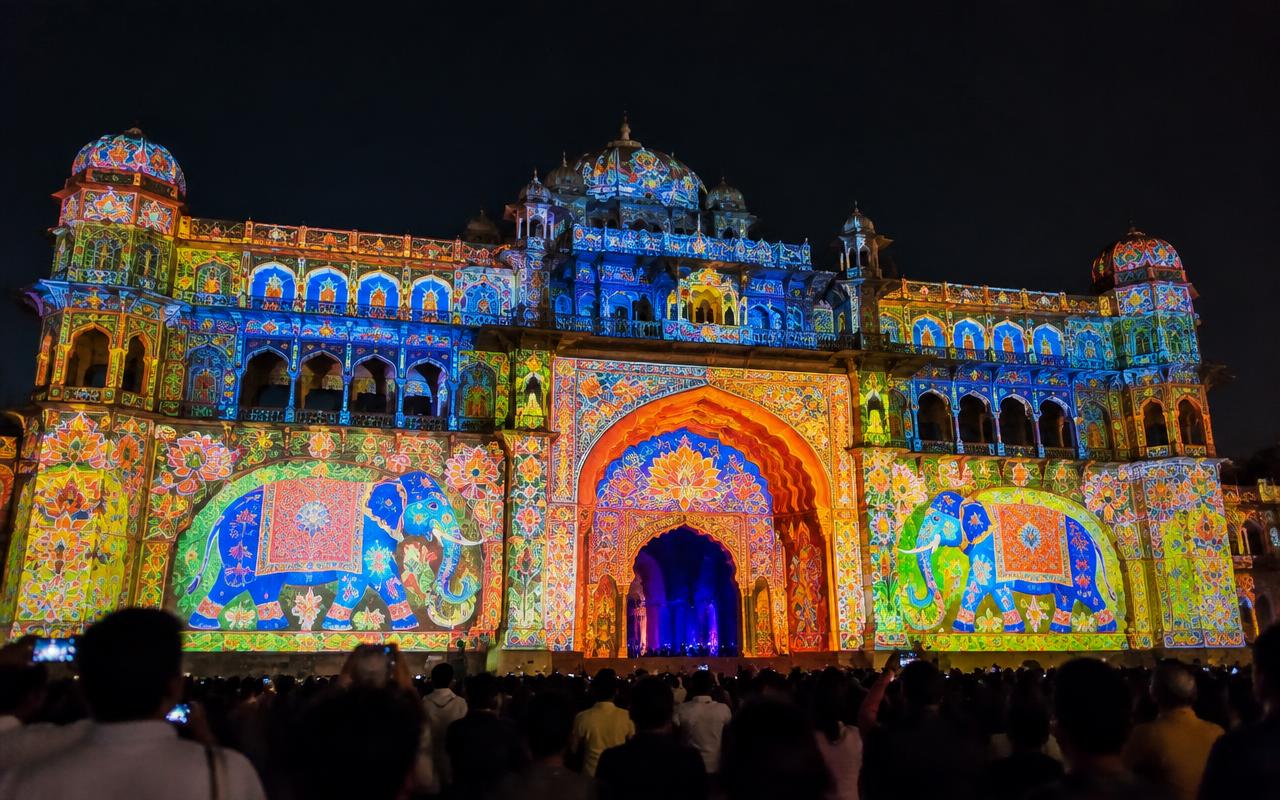
Spectacle · Ludhiana, Punjab
3D Projection Mapping in Ludhiana
In Ludhiana, big-budget punjabi weddings and receptions set the standard everything else is measured against. Our 3D projection mapping is specified to clear that bar at Park Plaza Ludhiana and anywhere else in the city.
- Lead time
- From 10 weeks
- Peak season
- Oct–Mar
- Coverage
- Ludhiana & Punjab
Key takeaway
3D Projection Mapping for Ludhiana’s biggest events
Projection mapping starts with a survey, not a storyboard. We photogrammetry-scan or LiDAR-measure the surface — a façade, a stage set, a car, a cake — and build a 3D model that matches the real object within a few centimetres. The projectors are then positioned virtually against that model to check throw ratio, keystone, shadowing from balconies or trees, and whether any part of the surface falls outside the beam. Only once the projector positions are fixed does content production begin, because a mapped animation is authored against a specific camera position and cannot simply be moved later.
The surface is the instrument here — its material, reflectance, depth and the audience's viewing axis decide projector count, angles and whether the illusion reads at all. In Ludhiana that plays out at venues like Park Plaza Ludhiana, Hyatt Regency Ludhiana, PAU Grounds, and across Ferozepur Road, Model Town, Sarabha Nagar, Pakhowal Road.
Brightness is the engineering constraint that decides the budget. Perceived image brightness depends on lumens, surface area, the reflectance of the material and the ambient light falling on it. Stone and painted plaster reflect perhaps 20 to 35 per cent of what hits them; dark stone far less. A heritage façade of 400 square metres with street lighting nearby can need 100,000 lumens or more in total, which is three or four stacked 30K-class laser projectors per angle. Laser phosphor sources are the standard now because they hold brightness and colour across a run, start instantly and tolerate the dust and heat of an outdoor build far better than lamps.
What’s included
- 20K–40K lumen laser projectors
- Custom 3D content & storyboards
- Edge blending & warping (Pixera, Disguise)
- Heritage façades, cars, cakes & stages
Equipment we carry
Why Ludhiana chooses Prime AV
- Crews and trucks positioned for fast load-in at PAU Grounds and venues in Sarabha Nagar and Pakhowal Road.
- The viewing position is part of the design and is barricaded or seated on site, with content checked from the extreme left and right of the intended crowd area.
- Projector placement study with throw, brightness and coverage calculations
- Working knowledge of Punjab venue rules, power sanctions and permission timelines.
Local conditions
Producing 3D projection mapping in Ludhiana
Weather & the rig
Mapping is defeated by air as much as by rain — haze, dust and humidity scatter the beam and soften a blend, so brightness headroom is specified against local conditions. Punjab gives extremes at both ends with a particular local problem in between. From late December through January, dense fog closes visibility on the GT Road to a few metres, which both ruins projection and makes overnight inbound trucking from Delhi genuinely unreliable. Then in late October and November the post-harvest stubble smoke settles over the city as a haze layer that photographs as grey murk and irritates crew throats through a long build. Summers reach 44–45°C with pre-monsoon dust storms. Jul–Sep monsoon; late Dec–Jan for projection-dependent designs and for any schedule that assumes a truck arrives on time; late Oct–Nov for any look that needs clean air on camera.
Power & redundancy
Stacked 30K-class projectors each draw several kilowatts continuously for the whole run, so projection needs a dedicated, stable, uninterrupted supply rather than a share of the event distribution. PSPCL's Ludhiana network is heavily loaded by the manufacturing belt and scheduled cuts are a normal part of the industrial calendar, so marriage palaces and industrial venues all carry their own DG as the working source rather than a standby. Sets and operators are plentiful and inexpensive locally, and PPCB's acoustic enclosure norms apply.
Permits & noise rules
Mapping a building means permission to light it, towers on public or heritage ground, and usually a negotiated blackout of nearby street lighting for the show window. Ludhiana Municipal Corporation issues ground and temporary-structure permission and the Ludhiana Police Commissionerate licenses loudspeakers and gatherings. The point that matters commercially is enforcement: the Punjab and Haryana High Court has pressed the state on noise compliance, so the 10pm cut is actively applied against marriage palaces, which run directly against a wedding tradition that expects the night to continue past midnight. Drone clearance is harder in Punjab than most states because of the airport zone and the proximity to the international border.
Load-in & access
Projector towers, ballast and enclosures have to be placed on a precise viewing axis that is often a road or a public plaza, so access and closures drive the build plan. Ludhiana sits on NH-44 with Delhi six to seven hours away, so metro-grade inventory trucks in without difficulty. Ferozepur Road and Chandigarh Road handle large vehicles; the old city around Chaura Bazar and the hosiery markets allows nothing larger than a tempo and only outside trading hours. The single-gate problem at the marriage palaces is the real constraint on the build programme.
Season & booking
The Christmas to New Year window is the most contested wedding inventory of the year because families settled overseas return then, and those specific dates sell out a year ahead. PAU's Kisan Mela runs in March and September and fills the university grounds for days, Lohri in January brings its own outdoor night production demand, and Baisakhi in April closes the season. Peak demand runs Oct–Mar.
Crew & dispatch
Trucked from the Delhi NCR base in six to seven hours up NH-44, with Punjabi rigging crew and generators hired locally and Ludhiana itself serving as the forward staging point for Amritsar and Jalandhar jobs. Load-in support covers Sarabha Nagar, Pakhowal Road and the rest of the city.
What it costs here
This market genuinely pays for wedding production and expects spectacle in return, while also negotiating hard and benchmarking against the marriage palace's own in-house package. The quotation has to separate what the palace supplies from what a production company adds, or the comparison is meaningless.
Local expectations
Punjabi wedding sound is a discipline of its own: sustained high SPL for dhol and a DJ set, visiting artists who arrive late and want an aggressive low end, and a family that expects the night to run well past the curfew regardless of what the licence says — which has to be managed with the venue and the police in advance rather than discovered at 10pm. The stage has to take a bhangra troupe's dynamic loading, and a jaggo or Lohri-style outdoor segment usually needs a second, mobile rig.
Specification
3D Projection Mapping: technical specification
| Specification | Detail |
|---|---|
| Projector class | 20,000 – 40,000 ANSI lumens, laser phosphor or RGB laser, 3-chip DLP |
| Surface reflectance assumption | 20 – 35 per cent for stone and painted plaster, lower for dark granite |
| Typical façade budget | Approximately 250 – 400 lumens per square metre of lit surface, ambient dependent |
| Blend overlap | 10 – 20 per cent soft-edge between adjacent projectors |
| Media servers | disguise gx/vx, AV Stumpfl Pixera, Dataton Watchout |
| Survey method | Photogrammetry or LiDAR scan to a 3D model accurate within a few centimetres |
| Alignment window | Night-time only, four to eight hours for a multi-projector façade |
| Content pipeline | Cinema 4D or Blender to UV-mapped render, delivered as image sequence |
| Show length | 3 – 12 minutes, usually looped with timecoded audio |
| Weather protection | IP-rated projector enclosures with filtered forced-air cooling for outdoor runs |
On site, the work is warping, blending and masking. Each projector's output is warped onto the surface geometry using a media server — disguise, Pixera or Watchout — with overlap regions of 10 to 20 per cent soft-edge blended so no seam is visible. Masks cut the beam off windows, balconies and anything that must stay dark. Alignment is done at night with the actual content and takes hours, not minutes, and it must be re-checked if a projector is bumped or a tower settles. We lock projector positions with ballasted towers and mark every position so a knocked unit can be returned to alignment rather than re-mapped.
Sizing
What size rig does your event actually need?
| Scale | Guests | Recommended setup |
|---|---|---|
| Single object | 50 – 300 | One object, 2 x 20K projectors, 10 – 30 sq m, 60 – 90 seconds of content |
| Stage set | 300 – 1,500 | Set faces plus floor, 4 x 20K, 50 – 120 sq m, blended and masked to scenic edges |
| Hotel façade | 500 – 2,000 | 6 x 30K from two angles, 250 – 400 sq m, three-minute show, ballasted towers |
| Palace or fort wall | 2,000 – 10,000 | 10 – 14 x 30K from three angles, 500 – 800 sq m, five-minute narrative, multi-night |
| Monument spectacle | 10,000+ | 20+ projectors, 1,000 sq m+, redundant servers, nightly alignment, licensed site |
Scope
3D Projection Mapping scope tiers in Ludhiana
Object & Stage Mapping
Product reveals, car launches, cakes and set pieces up to 60 sq m
- 3D scan of the object and a matched virtual projector study
- Two to four 20K-class projectors with blending and masking
- 60 to 120 seconds of bespoke animation to the reveal beat
- Pixera or Watchout playback with timecoded audio
- Mapping technician, media server operator and a content artist
Façade Show
Heritage buildings, hotel and palace façades, 200 – 600 sq m
- Photogrammetry survey and full geometry model of the building
- Six to twelve 30K-class laser projectors on ballasted towers
- Three to six minutes of custom 3D content with sound design
- Night alignment across multiple sessions with masking of windows
- Projection crew, riggers, server operator and content studio time
Large-Scale Spectacle
City festivals, monuments and multi-surface installations, 800 sq m and above
- Multi-angle design covering several surfaces as one canvas
- Twenty-plus projectors with redundant servers and hot spares
- Full narrative content production with score and voiceover
- Weather-rated enclosures and a multi-night run with nightly re-alignment
- Full crew across survey, build, alignment, show run and strike
This market genuinely pays for wedding production and expects spectacle in return, while also negotiating hard and benchmarking against the marriage palace's own in-house package. The quotation has to separate what the palace supplies from what a production company adds, or the comparison is meaningless.
Venues
Where we work in Ludhiana
| Venue | Capacity | Production note |
|---|---|---|
| Park Plaza Ludhiana | Several hundred across banquet halls on Ferozepur Road | Load-in runs through a shared commercial approach and a lift, so cabinet and truss sizes are set by the building and the delivery sequence has to be planned to the minute rather than staged on site. |
| Hyatt Regency Ludhiana | Up to around 1,000 banquet in the largest hall | The city's best dock access and most dependable house power, which makes it the default when a corporate conference here needs to run without a generator in the car park. |
| PAU Grounds | Tens of thousands across the university grounds | Punjab Agricultural University's own permission process governs access, vehicle movement across turf is restricted, and the Kisan Mela build means working alongside hundreds of exhibitor stalls on generated power. |
| Marriage palaces on the Chandigarh and Pakhowal roads | Typically 1,000–3,000 across halls and lawns | Almost all of them share a single gate between the load-in route and guest arrival, so the build must be complete and the gate cleared before the first car turns in — there is no second entrance to fall back on. |
| Rang Mahal | A few thousand across halls and lawns | A large banqueting complex running back-to-back functions, which means a tight changeover and an in-house sound system the client has to be shown the limits of before the brief gets written. |
Crew
Who turns up on show day
- Mapping technician
Builds the geometry model, warps each projector to the surface and maintains alignment across the run.
- Media server operator
Runs disguise, Pixera or Watchout, holds the show timeline to timecode and keeps a mirrored backup server.
- Content artist
Authors the animation against the UV-mapped geometry so it reads correctly from the audience viewing position.
- Projector technician
Rigs, powers, focuses and cools each unit, monitors lamp or laser hours and swaps a failed unit without losing alignment.
- Rigger
Builds and ballasts the projector towers, secures positions against wind and marks them for repeatable realignment.
What you receive
- 3D geometry model of the mapped surface with the UV layout
- Projector placement study with throw, brightness and coverage calculations
- Master render of the show content at delivery resolution
- Media server show file with timecode cues and a mirrored backup
- Masking map showing every excluded window, balcony and dark zone
- Audio stem and mixed show track used for synchronisation
- Full-length video capture of the show as performed from the audience position
Timeline
From enquiry to load-out
- T-10 weeks
Site survey and scan
Photogrammetry or LiDAR capture of the surface, plus ambient light readings taken at the intended show hour.
- T-8 weeks
Projector study and sign-off
Virtual projector placement, brightness calculation and tower positions agreed with the venue and the authority.
- T-7 to T-2 weeks
Content production
Storyboard, animatic review, then full 3D render against the UV map with sound design and score.
- Show day −3 to −2
Build and first alignment
Towers built and ballasted, projectors rigged, first night of warping, blending and masking.
- Show day −1
Technical rehearsal
Full show run at the actual hour, content reviewed from the audience position, and corrections rendered overnight.
- Show day to +2 days
Show run and strike
Nightly runs with a pre-show alignment check, then strike with projectors cased and towers de-ballasted.
Risk control
What goes wrong, and how we stop it
What can go wrong
How we prevent it
- What can go wrong
The audience ends up standing off the designed viewing axis and the 3D illusion collapses.
How we prevent itThe viewing position is part of the design and is barricaded or seated on site, with content checked from the extreme left and right of the intended crowd area.
- What can go wrong
Street lighting or a neighbouring building's floodlights wash the façade and the show looks grey.
How we prevent itAmbient readings are taken at the show hour during the survey, and the blackout of specific street and site lights is negotiated and written into the permission before content is budgeted.
- What can go wrong
Content is authored before projector positions are fixed, so the animation does not sit on the geometry.
How we prevent itContent production does not begin until the projector study is signed off, because the mapping is authored against those exact camera positions.
- What can go wrong
A projector tower settles overnight in soft ground and the whole blend is out by morning.
How we prevent itTowers are built on load-spreading base plates, ballasted, and positions are physically marked so a realignment check before each show takes minutes.
Honest comparison
Is this the right choice for your event?
- Stock content instead of bespoke animationOur verdict
Stock loops and generative visuals genuinely work for ambient architectural washes and for leaner budgets. They cannot do a reveal, a narrative or anything that respects the building's actual architecture, because they are not authored to your geometry.
- Fewer, brighter projectors instead of more unitsOur verdict
Fewer angles means fewer blends and a faster alignment, which is the right trade on a flat surface. Any building with depth, recesses or wings needs multiple angles regardless of total lumens, or the recesses stay dark.
- Architectural lighting instead of mappingOur verdict
For a façade that only needs to look beautiful, uplighting and colour washes cost a fraction, go up in a day and work in light rain. Mapping is for when the building has to perform rather than just glow.
Demand
What Ludhiana books most
Ludhiana event mix
- Big-budget Punjabi weddings and receptions
- Textile machinery and cycle-industry exhibitions
- Dealer and distributor conferences for the Punjab trade
- Punjabi music concerts and artist nights
- Agricultural fairs and farm-machinery exhibitions
- Industrial association and chamber events
Ideal for
Events we power with 3D projection mapping in Ludhiana
Process
From brief to standing ovation
01
Brief & recce
We visit the venue, map power and rigging, and understand your show flow.
02
Design & quote
CAD plans, 3D previews and an itemised quote within 24 hours.
03
Build & rehearse
Load-in, system tuning, content checks and full technical rehearsal.
04
Show & strike
Show-caller-led execution, then a quick, clean load-out.
FAQ
3D Projection Mapping in Ludhiana: FAQs
More services in Ludhiana
3D Projection Mapping in nearby cities
Areas we cover in Ludhiana
Events in Ludhiana