Key takeaway
Key takeaways
- One large central PA instead of distributed fills
- Fabric and floral backdrop instead of an LED wall
- Decorator-supplied lighting instead of a lighting designer
- Reusing one rig across all functions instead of duplicating
The honest comparison
- One large central PA instead of distributed fillsOur verdict
A central system is cheaper and simpler, and fine for a compact hall. On a long lawn it forces you to make the front painfully loud to reach the back, which is precisely the complaint most wedding guests have.
- Fabric and floral backdrop instead of an LED wallOur verdict
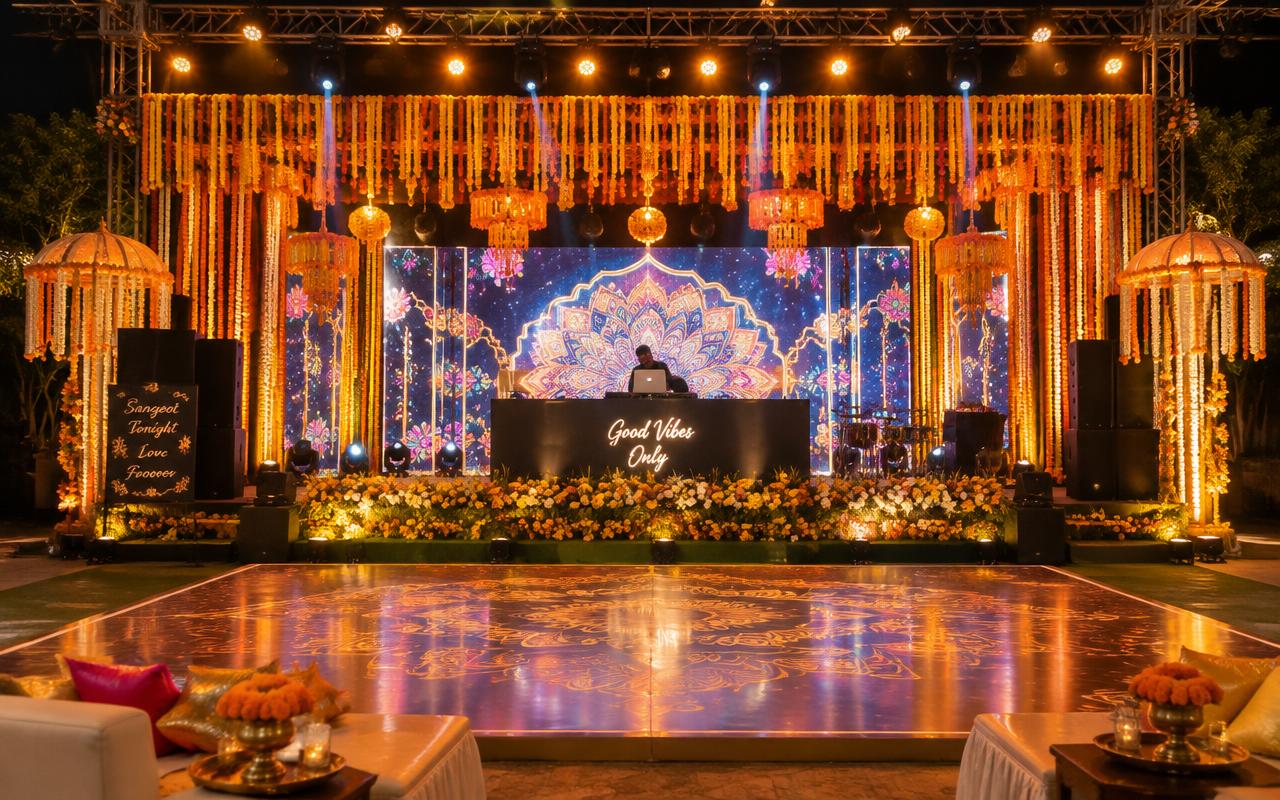
For a traditional palette a well-built floral backdrop photographs better and costs less. LED earns its place when you want live IMAG of the entries, montage films, or looks that change between functions.
- Decorator-supplied lighting instead of a lighting designerOur verdict
Decorators do beautiful static looks and often include uplighting in their package. If nothing needs to change on a cue, take it. The moment there are entries, performances and a first dance, you need a programmer and a cue stack.
- Reusing one rig across all functions instead of duplicatingOur verdict
Reuse is the right call when functions are a day apart. When two functions are six hours apart in different parts of the property, duplication costs less than the overtime, the risk and the guests watching a de-rig.
What you are comparing against
| Specification | Detail |
|---|---|
| Function zones | Separate designs for mehendi, sangeet, pheras, reception and after-party |
| Speech target level | 65 – 75 dBA at the guest position, distributed not centralised |
| Distributed fill spacing | One cabinet every 10 – 15 m, time-aligned to the primary source |
| Dance-floor SPL | 95 – 100 dBA for sangeet, 100 – 105 dBA for the after-party |
| Uplighter spacing | 3 m centres along drapes and perimeter walls |
| Colour reference | Single white point per function, typically 2,700 – 3,200 K for warm looks |
| Microphones | Lavalier, headset and handheld on coordinated UHF frequencies plus a held spare |
| Changeover window | 90 – 180 minutes between functions on a shared site |
| LED backdrop | P2.6 – P3.9 indoor, P4.8 outdoor, with live camera feed input |
The technical reality
Lighting on a wedding is architectural before it is theatrical. Battery or cabled uplighters on 3-metre centres wash drapes and walls in the palette the decorator has chosen; pixel-mapped tape and tubes carry the sangeet's beat; warm-white pin spots pick out the mandap, the cake and the entrance walkway so that photography and video have something to work with. Everything is colour-matched to one reference white point, typically around 3,000 K for warm functions, because a stage lit at 3,200 K beside decor lit at 5,600 K looks wrong in every photograph regardless of how good either looks alone.
Where the market is going
Indian clients increasingly specify for the camera as much as the room, fire sound, video and lighting from one timecoded cue list, and add a spectacle finale only where it earns its place. Get an itemised quote from Prime AV Solutions within 24 hours — call +91 93093 80958 or WhatsApp our producers.
Published 1 August 2026 by the Prime AV Solutions production team.