Key takeaway
Key takeaways
- Decorator-supplied uplighting instead of a lighting design
- A concert-style moving-head rig across the whole wedding
- Static colour all evening instead of a programmed cue list
- Letting the film crew bring all the lighting
The honest comparison
- Decorator-supplied uplighting instead of a lighting designOur verdict
Where the look is static and the palette simple, package uplighting from a good decorator is well-judged, sits inside work you are already buying, and is the right answer. It stops being enough once something has to change on a cue — an entry, a choreographed sangeet, a first dance — or once the film becomes the thing you actually care about.
- A concert-style moving-head rig across the whole weddingOur verdict
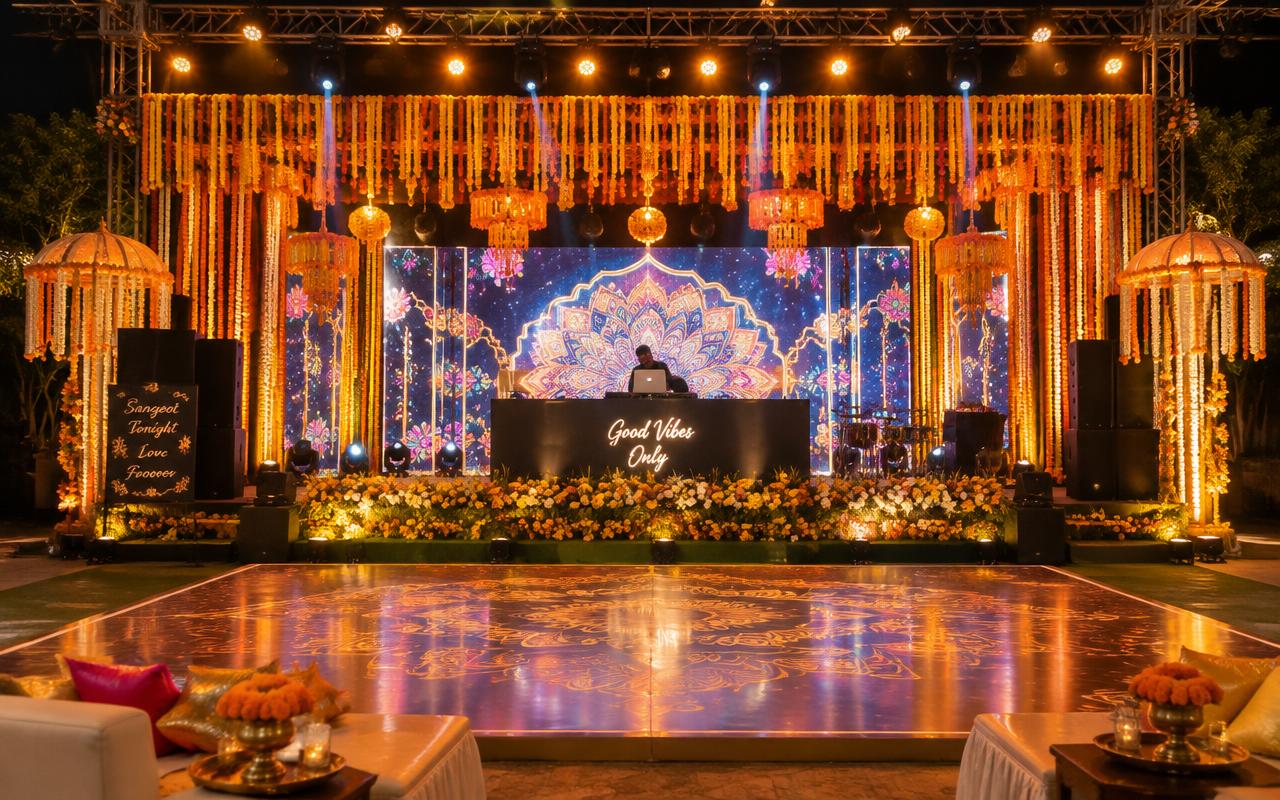
Moving heads earn their place over the sangeet stage and the dance floor, where looks must change and energy matters. Aimed at a mandap or a dining area they are too hard, too cool and too mobile, and they photograph badly. Most of a wedding wants soft, warm, high-CRI light from fixed positions, with movement reserved for the functions that want it.
- Static colour all evening instead of a programmed cue listOur verdict
Static colour is simple, safe and perfectly right at a mehendi or any daytime function where light is not doing dramatic work. Across a sangeet and a reception it flattens the whole evening: the entry, the performances, the first dance and the cake all look identical, and the edit has nothing to cut between.
- Letting the film crew bring all the lightingOur verdict
Film crews carry excellent key lighting and should use it for portraits and couple shoots. What they cannot do from a camera position is light a room, so a rig built only for the lens leaves guests sitting in an unlit hall. The two jobs are complementary, which is exactly why key level and white point get agreed between us rather than discovered on the night.
What you are comparing against
| Specification | Detail |
|---|---|
| Colour rendering | Ra above 90 with R9 deep-red verified on every fixture that lights a face |
| Colour temperature | One white point per function, typically 2,700 – 3,200 K for pheras and reception |
| Key light for camera | Faces keyed so the cinematographer can stop down rather than shoot wide open |
| Decor matching | Fixtures set against physical fabric and floral samples at focus, never against hex values |
| Battery fixtures | Wireless-DMX uplighters and tubes with runtime measured at the programmed output |
| Weather rating | IP65 or better on lawn, poolside and courtyard positions, with data and power under cover |
| Uplighter spacing | Roughly 3 m centres on drape and wall runs, tightened on textured stone to avoid scalloping |
| Pixel mapping | Pixel tape, tubes and mapped drape runs driven from the console or a small media server |
| Control | sACN or Art-Net to nodes, DMX512-A to fixtures, wireless DMX for untethered positions |
| Cue list | A programmed cue per beat of each function, run live by a dedicated operator |
The technical reality
Heritage and lawn venues dictate much of the method. A fort courtyard will not permit cable across stone, a lawn cannot have mains cable under a guest walkway in dew, and neither offers useful rigging positions. Battery uplighters on wireless DMX solve positions that cabling cannot reach, provided runtime is measured at the output actually programmed rather than read off a brochure. Open-air positions carry IP65-rated housings as a minimum, with data and distribution under hard cover. Everything still answers to one console, so a battery fixture inside a floral structure takes the same cue as a moving head on the stage truss.
Where the market is going
Indian clients increasingly specify for the camera as much as the room, fire sound, video and lighting from one timecoded cue list, and add a spectacle finale only where it earns its place. Get an itemised quote from Prime AV Solutions within 24 hours — call +91 93093 80958 or WhatsApp our producers.
Published 6 September 2026 by the Prime AV Solutions production team.