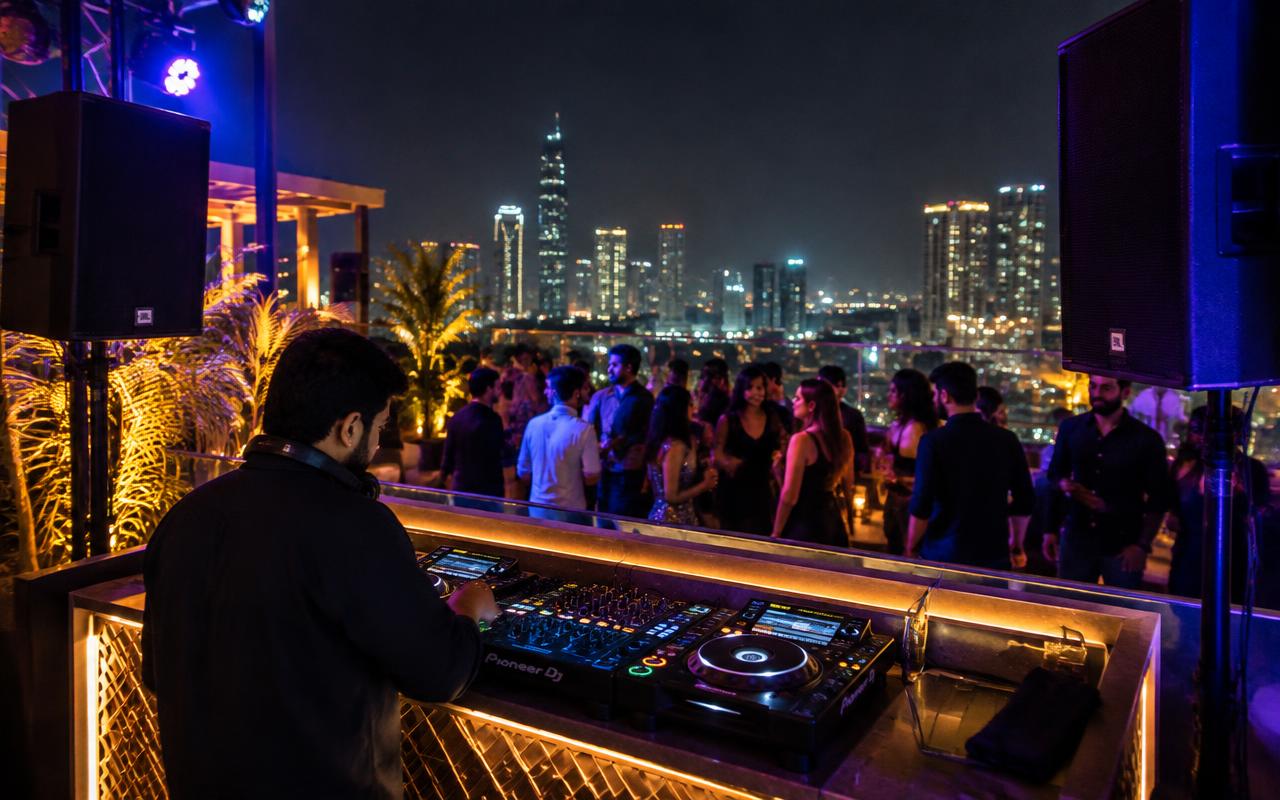
Key takeaway
Key takeaways
- A controller-and-laptop setup instead of a CDJ booth
- Sound-active lighting instead of a programmed rig with an operator
- More subs instead of better sub placement
- Lasers instead of beams and CO2
The honest comparison
- A controller-and-laptop setup instead of a CDJ boothOur verdict
For a resident DJ who owns their workflow, a controller is lighter and perfectly capable. Guest and touring artists expect CDJ-3000s and Pro DJ Link, and asking them to adapt on the night is where sets go wrong.
- Sound-active lighting instead of a programmed rig with an operatorOur verdict
Sound-active is adequate for a small private party where nobody is watching the lights. For anything photographed or filmed, an operator hitting the drop is the difference between a rig and a show.
- More subs instead of better sub placementOur verdict
Doubling the sub count buys about 6 dB and makes the comb pattern worse. Moving the same boxes into a centre cluster usually improves what the floor actually feels, for no extra rental.
- Lasers instead of beams and CO2Our verdict
Lasers look spectacular in haze and photograph brilliantly, but they add an operator, a safety plan and masking time. On a tight load-in, beams plus two CO2 jets deliver most of the impact with far less risk.
What you are comparing against
| Specification | Detail |
|---|---|
| Booth standard | 2 – 4 x Pioneer CDJ-3000 with DJM-A9 or DJM-V10, Pro DJ Link |
| Booth monitoring | Dedicated send, two coaxial or compact cabinets at ear height |
| Dance-floor SPL target | 100 – 105 dBA on the floor, clean with limiter headroom intact |
| Sub configuration | Centre cluster or four-box arc, never a bare left-right pair |
| Low-frequency band | Useful output to 35 – 40 Hz with crossover at 80 – 100 Hz |
| Top placement | Flown or pole-mounted above head height, aimed into the floor |
| Booth power | Dedicated circuit, isolated from lighting and effects phases |
| Effects | CO2 jets, low-fog, confetti and hazers on DMX with manual override |
| Laser safety | Beams masked above the audience plane; no audience scanning |
The technical reality
Lighting and effects are programmed to the music, not left on sound-active. Beams and washes are built as looks on a console with a busking layout so the operator can hit the drop, and strobes and CO2 jets are placed where they read on camera without blinding the DJ. Lasers, where used, are aimed and masked so no beam enters the audience plane at eye height — audience scanning is an avoidable risk and we simply do not take it. LED booth facades carry content or a live pixel-mapped feed, and the whole lighting world runs on a separate electrical phase from audio.
Where the market is going
Indian clients increasingly specify for the camera as much as the room, fire sound, video and lighting from one timecoded cue list, and add a spectacle finale only where it earns its place. Get an itemised quote from Prime AV Solutions within 24 hours — call +91 93093 80958 or WhatsApp our producers.
Published 20 July 2026 by the Prime AV Solutions production team.