Key takeaway
Key takeaways
- LED wall instead of projection mapping
- Stock content instead of bespoke animation
- Fewer, brighter projectors instead of more units
- Architectural lighting instead of mapping
The honest comparison
- LED wall instead of projection mappingOur verdict
LED beats projection on brightness, on reliability and in any lit environment. But it cannot map onto an existing building, a car or a cake, and at 400 square metres of heritage façade it is simply unaffordable. If the surface is the story, map it; if you need a rectangle that works in daylight, use LED.
- Stock content instead of bespoke animationOur verdict
Stock loops and generative visuals genuinely work for ambient architectural washes and for leaner budgets. They cannot do a reveal, a narrative or anything that respects the building's actual architecture, because they are not authored to your geometry.
- Fewer, brighter projectors instead of more unitsOur verdict
Fewer angles means fewer blends and a faster alignment, which is the right trade on a flat surface. Any building with depth, recesses or wings needs multiple angles regardless of total lumens, or the recesses stay dark.
- Architectural lighting instead of mappingOur verdict
For a façade that only needs to look beautiful, uplighting and colour washes cost a fraction, go up in a day and work in light rain. Mapping is for when the building has to perform rather than just glow.
What you are comparing against
| Specification | Detail |
|---|---|
| Projector class | 20,000 – 40,000 ANSI lumens, laser phosphor or RGB laser, 3-chip DLP |
| Surface reflectance assumption | 20 – 35 per cent for stone and painted plaster, lower for dark granite |
| Typical façade budget | Approximately 250 – 400 lumens per square metre of lit surface, ambient dependent |
| Blend overlap | 10 – 20 per cent soft-edge between adjacent projectors |
| Media servers | disguise gx/vx, AV Stumpfl Pixera, Dataton Watchout |
| Survey method | Photogrammetry or LiDAR scan to a 3D model accurate within a few centimetres |
| Alignment window | Night-time only, four to eight hours for a multi-projector façade |
| Content pipeline | Cinema 4D or Blender to UV-mapped render, delivered as image sequence |
| Show length | 3 – 12 minutes, usually looped with timecoded audio |
| Weather protection | IP-rated projector enclosures with filtered forced-air cooling for outdoor runs |
The technical reality
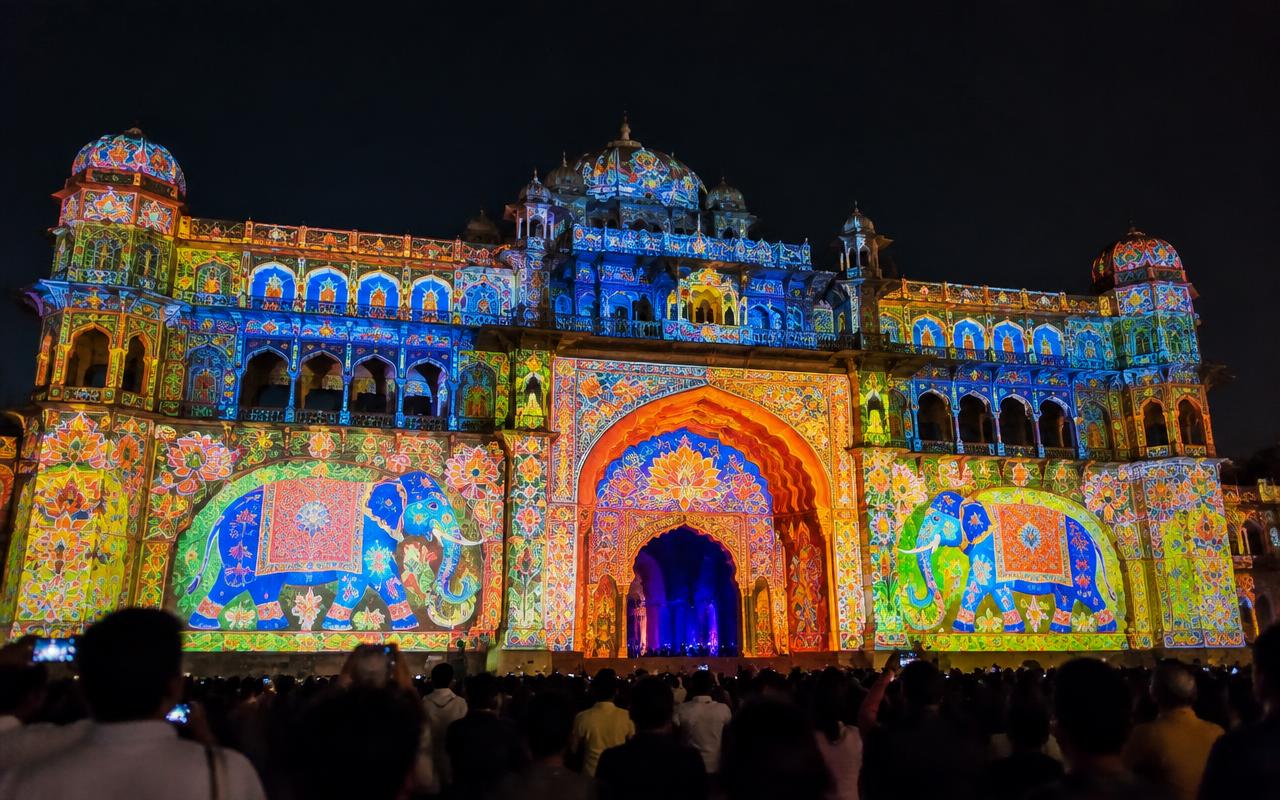
On site, the work is warping, blending and masking. Each projector's output is warped onto the surface geometry using a media server — disguise, Pixera or Watchout — with overlap regions of 10 to 20 per cent soft-edge blended so no seam is visible. Masks cut the beam off windows, balconies and anything that must stay dark. Alignment is done at night with the actual content and takes hours, not minutes, and it must be re-checked if a projector is bumped or a tower settles. We lock projector positions with ballasted towers and mark every position so a knocked unit can be returned to alignment rather than re-mapped.
Where the market is going
Indian clients increasingly specify for the camera as much as the room, fire sound, video and lighting from one timecoded cue list, and add a spectacle finale only where it earns its place. Get an itemised quote from Prime AV Solutions within 24 hours — call +91 93093 80958 or WhatsApp our producers.
Published 14 June 2026 by the Prime AV Solutions production team.