Spectacle · Kota, Rajasthan
3D Projection Mapping in Kota
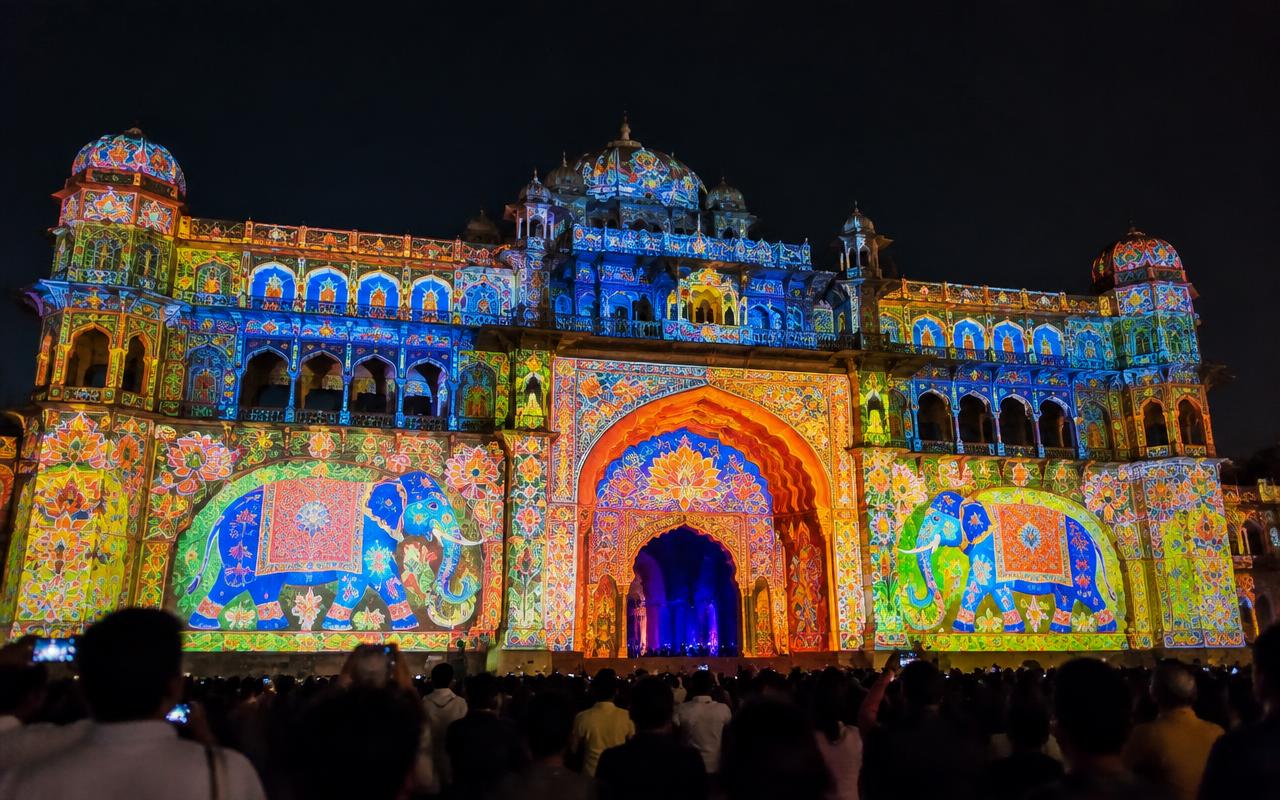
In Kota, coaching institute orientations, result felicitations and seminars set the standard everything else is measured against. Our 3D projection mapping is specified to clear that bar at Umed Bhawan Palace and anywhere else in the city.
- Lead time
- From 10 weeks
- Peak season
- Oct–Feb
- Coverage
- Kota & Rajasthan
Key takeaway
3D Projection Mapping for Kota’s biggest events
Projection mapping starts with a survey, not a storyboard. We photogrammetry-scan or LiDAR-measure the surface — a façade, a stage set, a car, a cake — and build a 3D model that matches the real object within a few centimetres. The projectors are then positioned virtually against that model to check throw ratio, keystone, shadowing from balconies or trees, and whether any part of the surface falls outside the beam. Only once the projector positions are fixed does content production begin, because a mapped animation is authored against a specific camera position and cannot simply be moved later.
The surface is the instrument here — its material, reflectance, depth and the audience's viewing axis decide projector count, angles and whether the illusion reads at all. In Kota that plays out at venues like Umed Bhawan Palace, Seven Wonders Park, Kota Dussehra Ground, and across Talwandi, Vigyan Nagar, Kunhari, Nayapura.
Brightness is the engineering constraint that decides the budget. Perceived image brightness depends on lumens, surface area, the reflectance of the material and the ambient light falling on it. Stone and painted plaster reflect perhaps 20 to 35 per cent of what hits them; dark stone far less. A heritage façade of 400 square metres with street lighting nearby can need 100,000 lumens or more in total, which is three or four stacked 30K-class laser projectors per angle. Laser phosphor sources are the standard now because they hold brightness and colour across a run, start instantly and tolerate the dust and heat of an outdoor build far better than lamps.
What’s included
- 20K–40K lumen laser projectors
- Custom 3D content & storyboards
- Edge blending & warping (Pixera, Disguise)
- Heritage façades, cars, cakes & stages
Equipment we carry
Why Kota chooses Prime AV
- Crews and trucks positioned for fast load-in at Kota Dussehra Ground and venues in Kunhari and Nayapura.
- The calculation includes measured surface reflectance, not an assumed figure, and a test projection on the actual material is done at survey wherever access allows.
- 3D geometry model of the mapped surface with the UV layout
- Working knowledge of Rajasthan venue rules, power sanctions and permission timelines.
Local conditions
Producing 3D projection mapping in Kota
Weather & the rig
Mapping is defeated by air as much as by rain — haze, dust and humidity scatter the beam and soften a blend, so brightness headroom is specified against local conditions. Hadoti heat is severe and dry, with May and June in the mid-forties and a loo wind that pushes dust into everything, while the Chambal valley generates thick persistent fog on December and January mornings that will flatten a daytime projection and delay a morning soundcheck. The monsoon from July is substantial by Rajasthan standards and the river catchment floods low ground quickly. April–June is unusable outdoors by day, and July–September monsoon with Chambal catchment flooding rules out riverside builds. Work around the coaching calendar too — the city is effectively full during JEE and NEET exam and result weeks, and accommodation for travelling crew disappears.
Power & redundancy
Stacked 30K-class projectors each draw several kilowatts continuously for the whole run, so projection needs a dedicated, stable, uninterrupted supply rather than a share of the event distribution. Kota sits beside major generation and the industrial feeders are strong, but the fair ground and park sites are fed from municipal points with little headroom, so DG covers anything with a serious lighting or LED load. Local generator and cable supply is competent because the plants sustain a maintenance ecosystem; insist on silent canopies for palace and residential-adjacent work.
Permits & noise rules
Mapping a building means permission to light it, towers on public or heritage ground, and usually a negotiated blackout of nearby street lighting for the show window. The Kota Municipal Corporation and the Dussehra Mela committee control fair-ground and public-park allotment, Kota police handle assembly and traffic licensing, and the Rajasthan noise rules with the 10 pm amplified-sound limit apply — with practical latitude during the sanctioned Mela that does not extend to private events. Student mass gatherings attract additional district-administration conditions on capacity and exits, given recent scrutiny of coaching-city safety. Drone use needs DGCA clearance plus district coordination.
Load-in & access
Projector towers, ballast and enclosures have to be placed on a precise viewing axis that is often a road or a public plaza, so access and closures drive the build plan. The city is well connected by rail on the Delhi–Mumbai line and by NH-27 road, so freight in is straightforward, but the Dussehra Ground and old-city Nayapura approaches are narrow and congested, with truck movement pushed to late night through the fair. Talwandi and Vigyan Nagar roads gridlock at institute shift changes, which has to be designed around when scheduling a load-in.
Season & booking
The Kota Dussehra Mela, running some three to four weeks from Navaratri into late October, is the defining lock on local inventory — staging, lighting, barricading and generators are all committed. Layer on the coaching calendar: orientation waves in April–May, exam season January–April, result events April–June. The Dec–Jan wedding run plus Teej and Gangaur observances complete the year. Peak demand runs Oct–Feb.
Crew & dispatch
Trucked from our Jaipur depot, 245 km via Bundi at about four and a half hours, with Udaipur and Indore as alternates; scaffolding and barricading are hired in Kota itself because the Mela trade keeps large stocks. Load-in support covers Kunhari, Nayapura and the rest of the city.
What it costs here
A value-driven market. Coaching groups buy at volume and expect institutional rates with tight payment discipline, while industrial clients tender properly and pay on terms. There is almost no appetite for premium branded specification for its own sake, so the proposition is reliability and scale per rupee rather than exotic kit.
Local expectations
Student-facing events want a lecture-hall sensibility scaled up: guaranteed intelligibility to the last row, large IMAG so faces read at distance, and a stage that supports long-form presentation. Mela programming is folk and devotional, rooted in Hadoti artists and the Ramlila tradition, with a standing rather than seated audience. Local business-community weddings are expressive but comparatively restrained against Jaipur or Udaipur tastes.
Specification
3D Projection Mapping: technical specification
| Specification | Detail |
|---|---|
| Projector class | 20,000 – 40,000 ANSI lumens, laser phosphor or RGB laser, 3-chip DLP |
| Surface reflectance assumption | 20 – 35 per cent for stone and painted plaster, lower for dark granite |
| Typical façade budget | Approximately 250 – 400 lumens per square metre of lit surface, ambient dependent |
| Blend overlap | 10 – 20 per cent soft-edge between adjacent projectors |
| Media servers | disguise gx/vx, AV Stumpfl Pixera, Dataton Watchout |
| Survey method | Photogrammetry or LiDAR scan to a 3D model accurate within a few centimetres |
| Alignment window | Night-time only, four to eight hours for a multi-projector façade |
| Content pipeline | Cinema 4D or Blender to UV-mapped render, delivered as image sequence |
| Show length | 3 – 12 minutes, usually looped with timecoded audio |
| Weather protection | IP-rated projector enclosures with filtered forced-air cooling for outdoor runs |
On site, the work is warping, blending and masking. Each projector's output is warped onto the surface geometry using a media server — disguise, Pixera or Watchout — with overlap regions of 10 to 20 per cent soft-edge blended so no seam is visible. Masks cut the beam off windows, balconies and anything that must stay dark. Alignment is done at night with the actual content and takes hours, not minutes, and it must be re-checked if a projector is bumped or a tower settles. We lock projector positions with ballasted towers and mark every position so a knocked unit can be returned to alignment rather than re-mapped.
Sizing
What size rig does your event actually need?
| Scale | Guests | Recommended setup |
|---|---|---|
| Single object | 50 – 300 | One object, 2 x 20K projectors, 10 – 30 sq m, 60 – 90 seconds of content |
| Stage set | 300 – 1,500 | Set faces plus floor, 4 x 20K, 50 – 120 sq m, blended and masked to scenic edges |
| Hotel façade | 500 – 2,000 | 6 x 30K from two angles, 250 – 400 sq m, three-minute show, ballasted towers |
| Palace or fort wall | 2,000 – 10,000 | 10 – 14 x 30K from three angles, 500 – 800 sq m, five-minute narrative, multi-night |
| Monument spectacle | 10,000+ | 20+ projectors, 1,000 sq m+, redundant servers, nightly alignment, licensed site |
Scope
3D Projection Mapping scope tiers in Kota
Object & Stage Mapping
Product reveals, car launches, cakes and set pieces up to 60 sq m
- 3D scan of the object and a matched virtual projector study
- Two to four 20K-class projectors with blending and masking
- 60 to 120 seconds of bespoke animation to the reveal beat
- Pixera or Watchout playback with timecoded audio
- Mapping technician, media server operator and a content artist
Façade Show
Heritage buildings, hotel and palace façades, 200 – 600 sq m
- Photogrammetry survey and full geometry model of the building
- Six to twelve 30K-class laser projectors on ballasted towers
- Three to six minutes of custom 3D content with sound design
- Night alignment across multiple sessions with masking of windows
- Projection crew, riggers, server operator and content studio time
Large-Scale Spectacle
City festivals, monuments and multi-surface installations, 800 sq m and above
- Multi-angle design covering several surfaces as one canvas
- Twenty-plus projectors with redundant servers and hot spares
- Full narrative content production with score and voiceover
- Weather-rated enclosures and a multi-night run with nightly re-alignment
- Full crew across survey, build, alignment, show run and strike
A value-driven market. Coaching groups buy at volume and expect institutional rates with tight payment discipline, while industrial clients tender properly and pay on terms. There is almost no appetite for premium branded specification for its own sake, so the proposition is reliability and scale per rupee rather than exotic kit.
Venues
Where we work in Kota
| Venue | Capacity | Production note |
|---|---|---|
| Umed Bhawan Palace | 400–900 across the lawns and durbar spaces | Heritage property with ornate interiors: no fixings, no heat-generating fixtures near surfaces, and lawn builds must stay off the formal garden axis, which pushes FOH into an awkward offset position. |
| Seven Wonders Park | 3,000–6,000 in open public layouts | A municipal park of replica monuments, so structures cannot obstruct the public circuit and power is cabled in from a distant point; permissions come event by event with ground-protection conditions. |
| Kota Dussehra Ground | Tens of thousands daily across the fair period | A twenty-plus-day fair site where the main stage, exhibition stalls and ride areas all compete for the same feeders; cable protection against continuous crowd traffic is the single biggest reliability factor. |
| Coaching institute auditoria in Talwandi and Jawahar Nagar | 1,500–5,000 seated in the largest halls | Purpose-built for mass lectures, so sightlines are excellent but the acoustics are tuned for one voice; music playback and live bands expose the reverberation and the house system rarely suffices for show use. |
| Chambal riverfront and Kishore Sagar settings | 1,000–4,000 outdoors | Water-adjacent ground that fogs heavily on winter mornings and carries high overnight dew — covered FOH and sealed connectors are not optional. |
Crew
Who turns up on show day
- Mapping technician
Builds the geometry model, warps each projector to the surface and maintains alignment across the run.
- Media server operator
Runs disguise, Pixera or Watchout, holds the show timeline to timecode and keeps a mirrored backup server.
- Content artist
Authors the animation against the UV-mapped geometry so it reads correctly from the audience viewing position.
- Projector technician
Rigs, powers, focuses and cools each unit, monitors lamp or laser hours and swaps a failed unit without losing alignment.
- Rigger
Builds and ballasts the projector towers, secures positions against wind and marks them for repeatable realignment.
What you receive
- 3D geometry model of the mapped surface with the UV layout
- Projector placement study with throw, brightness and coverage calculations
- Master render of the show content at delivery resolution
- Media server show file with timecode cues and a mirrored backup
- Masking map showing every excluded window, balcony and dark zone
- Audio stem and mixed show track used for synchronisation
- Full-length video capture of the show as performed from the audience position
Timeline
From enquiry to load-out
- T-10 weeks
Site survey and scan
Photogrammetry or LiDAR capture of the surface, plus ambient light readings taken at the intended show hour.
- T-8 weeks
Projector study and sign-off
Virtual projector placement, brightness calculation and tower positions agreed with the venue and the authority.
- T-7 to T-2 weeks
Content production
Storyboard, animatic review, then full 3D render against the UV map with sound design and score.
- Show day −3 to −2
Build and first alignment
Towers built and ballasted, projectors rigged, first night of warping, blending and masking.
- Show day −1
Technical rehearsal
Full show run at the actual hour, content reviewed from the audience position, and corrections rendered overnight.
- Show day to +2 days
Show run and strike
Nightly runs with a pre-show alignment check, then strike with projectors cased and towers de-ballasted.
Risk control
What goes wrong, and how we stop it
What can go wrong
How we prevent it
- What can go wrong
Brightness is calculated from lumens alone and the dark stone façade swallows the image.
How we prevent itThe calculation includes measured surface reflectance, not an assumed figure, and a test projection on the actual material is done at survey wherever access allows.
- What can go wrong
The audience ends up standing off the designed viewing axis and the 3D illusion collapses.
How we prevent itThe viewing position is part of the design and is barricaded or seated on site, with content checked from the extreme left and right of the intended crowd area.
- What can go wrong
Street lighting or a neighbouring building's floodlights wash the façade and the show looks grey.
How we prevent itAmbient readings are taken at the show hour during the survey, and the blackout of specific street and site lights is negotiated and written into the permission before content is budgeted.
- What can go wrong
Content is authored before projector positions are fixed, so the animation does not sit on the geometry.
How we prevent itContent production does not begin until the projector study is signed off, because the mapping is authored against those exact camera positions.
Honest comparison
Is this the right choice for your event?
- Fewer, brighter projectors instead of more unitsOur verdict
Fewer angles means fewer blends and a faster alignment, which is the right trade on a flat surface. Any building with depth, recesses or wings needs multiple angles regardless of total lumens, or the recesses stay dark.
- Architectural lighting instead of mappingOur verdict
For a façade that only needs to look beautiful, uplighting and colour washes cost a fraction, go up in a day and work in light rain. Mapping is for when the building has to perform rather than just glow.
- LED wall instead of projection mappingOur verdict
LED beats projection on brightness, on reliability and in any lit environment. But it cannot map onto an existing building, a car or a cake, and at 400 square metres of heritage façade it is simply unaffordable. If the surface is the story, map it; if you need a rectangle that works in daylight, use LED.
Demand
What Kota books most
Kota event mix
- Coaching institute orientations, result felicitations and seminars
- The Dussehra Mela and allied public cultural programmes
- Industrial safety days, dealer and vendor meets
- Weddings in the Hadoti business community
- Education fairs and competitive-exam counselling events
Ideal for
Events we power with 3D projection mapping in Kota
Process
From brief to standing ovation
01
Brief & recce
We visit the venue, map power and rigging, and understand your show flow.
02
Design & quote
CAD plans, 3D previews and an itemised quote within 24 hours.
03
Build & rehearse
Load-in, system tuning, content checks and full technical rehearsal.
04
Show & strike
Show-caller-led execution, then a quick, clean load-out.
FAQ
3D Projection Mapping in Kota: FAQs
More services in Kota
3D Projection Mapping in nearby cities
Areas we cover in Kota
Events in Kota