Event production · Kota, Rajasthan
Concerts & Live Shows AV in Kota
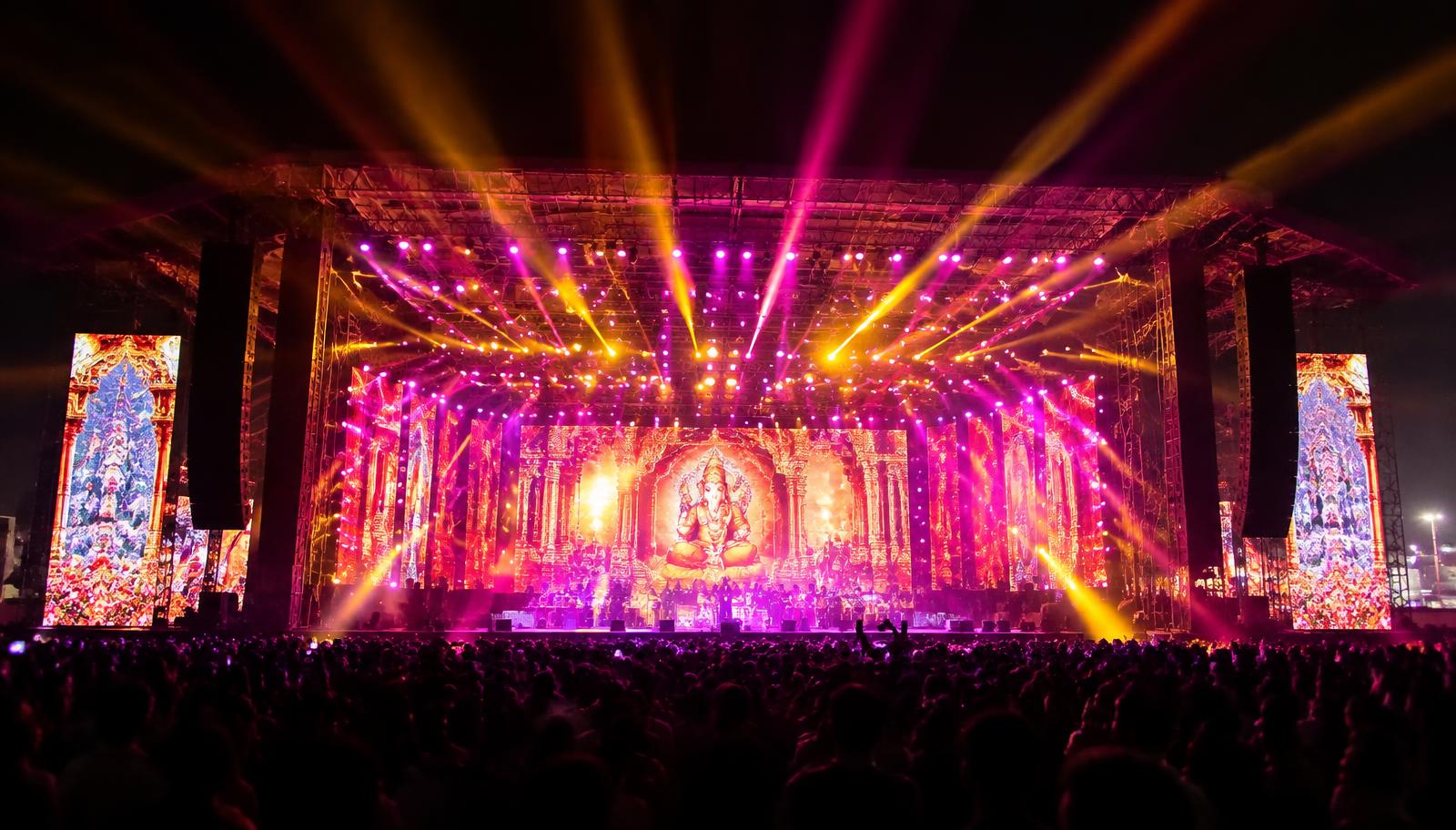
Kota runs on two engines: the coaching industry that draws well over a lakh aspirants into the city each year, and heavy industry along the Chambal — the thermal station, fertiliser and chemical plants. The result is a very particular event mix of mass student orientations and result felicitations, industrial safety and dealer meets, and the enormous public Dussehra Mela. Prime AV Solutions produces the concerts & live shows end of that calendar — rider-compliant PA & backline, monitor world & IEMs, stage roof & rigging — with one crew owning the whole stack.
- Lead time
- 8 weeks out
- Peak season
- Oct–Feb
- Coverage
- Kota & Rajasthan
Key takeaway
Complete AV for concerts & live shows in Kota
A concert begins with the rider, not the ground plan. The artist's technical rider specifies the PA, the front-of-house and monitor consoles, the microphone list, the backline, riser sizes and the number of in-ear channels, and the advance conversation with the tour manager is where you establish what is supplied exactly, what is substituted and what is genuinely unavailable in the country. Get every substitution approved in writing weeks ahead, because a console swap discovered at soundcheck costs you the headline act's goodwill and sometimes the show.
Grounds, stadiums and amphitheatres differ enormously in depth, rigging possibility and neighbour proximity, and those three things decide the whole system design. In Kota we work at Umed Bhawan Palace, Seven Wonders Park, Kota Dussehra Ground and venues across Talwandi, Vigyan Nagar, Kunhari, Nayapura, Mahaveer Nagar.
Coverage and crowd safety are engineered together. An open ground for fifteen thousand people needs array prediction in software before anything is hung, delay towers time-aligned to the main hangs so the back of the field hears one arrival rather than two, and a sound-pressure plan that respects the curfew and the neighbours at the boundary. The barricade line, the front-of-stage pit, the crowd-lighting state the security team needs to see faces, and the exit routes that must stay clear of cable runs are all production decisions, not afterthoughts.
What your event needs
- Rider-compliant PA & backline
- Monitor world & IEMs
- Stage roof & rigging
- LED walls & lighting show
Why Kota organisers choose Prime AV
- Crews and trucks positioned for fast load-in at Chambal riverfront and Kishore Sagar settings and venues in Mahaveer Nagar and Talwandi.
- Close out every substitution in writing during the advance, naming the exact model offered, and get the tour manager's acceptance before the kit leaves the warehouse.
- A standing Kota client base across coaching institute orientations, result felicitations and seminars and the dussehra mela and allied public cultural programmes, so the rig is specified from experience rather than a catalogue.
- Working knowledge of Rajasthan venue rules, power sanctions and permission timelines.
What you will be judged on afterwards
- The headline act's engineers walked into a stage and a rig that matched the approved rider without argument.
- The last row of the field heard the same show as the pit, in time and without a slapback echo.
- The set started and finished on the clock, so the curfew was never breached and the licence stayed clean.
- Nobody was injured at the barricade and the security team could see the crowd throughout.
- Changeovers between acts stayed inside their window, so no act lost stage time.
Local conditions
Producing concerts & live shows in Kota
Weather & the rig
An outdoor concert flies tonnes of audio and lighting under a roof on an open ground, which makes wind, rain and lightning thresholds operational numbers rather than background information. Hadoti heat is severe and dry, with May and June in the mid-forties and a loo wind that pushes dust into everything, while the Chambal valley generates thick persistent fog on December and January mornings that will flatten a daytime projection and delay a morning soundcheck. The monsoon from July is substantial by Rajasthan standards and the river catchment floods low ground quickly. April–June is unusable outdoors by day, and July–September monsoon with Chambal catchment flooding rules out riverside builds. Work around the coaching calendar too — the city is effectively full during JEE and NEET exam and result weeks, and accommodation for travelling crew disappears.
Power & redundancy
A concert rig draws hundreds of kilowatts across audio, lighting and LED, so sized silent generators with a changeover panel and separate clean audio distribution are the baseline anywhere. Kota sits beside major generation and the industrial feeders are strong, but the fair ground and park sites are fed from municipal points with little headroom, so DG covers anything with a serious lighting or LED load. Local generator and cable supply is competent because the plants sustain a maintenance ecosystem; insist on silent canopies for palace and residential-adjacent work.
Permits & noise rules
Ticketed live shows need crowd and capacity clearance, a loudspeaker permission with a hard curfew and police coordination, and the curfew is what sets the headline act's set time. The Kota Municipal Corporation and the Dussehra Mela committee control fair-ground and public-park allotment, Kota police handle assembly and traffic licensing, and the Rajasthan noise rules with the 10 pm amplified-sound limit apply — with practical latitude during the sanctioned Mela that does not extend to private events. Student mass gatherings attract additional district-administration conditions on capacity and exits, given recent scrutiny of coaching-city safety. Drone use needs DGCA clearance plus district coordination.
Load-in & access
A ground show arrives in multiple articulated trucks that need a marshalling area, a hard route onto the field and a strike window that clears the site by morning. The city is well connected by rail on the Delhi–Mumbai line and by NH-27 road, so freight in is straightforward, but the Dussehra Ground and old-city Nayapura approaches are narrow and congested, with truck movement pushed to late night through the fair. Talwandi and Vigyan Nagar roads gridlock at institute shift changes, which has to be designed around when scheduling a load-in.
Season & booking
The Kota Dussehra Mela, running some three to four weeks from Navaratri into late October, is the defining lock on local inventory — staging, lighting, barricading and generators are all committed. Layer on the coaching calendar: orientation waves in April–May, exam season January–April, result events April–June. The Dec–Jan wedding run plus Teej and Gangaur observances complete the year. Peak demand runs Oct–Feb.
Crew & dispatch
Trucked from our Jaipur depot, 245 km via Bundi at about four and a half hours, with Udaipur and Indore as alternates; scaffolding and barricading are hired in Kota itself because the Mela trade keeps large stocks.
What it costs here
A value-driven market. Coaching groups buy at volume and expect institutional rates with tight payment discipline, while industrial clients tender properly and pay on terms. There is almost no appetite for premium branded specification for its own sake, so the proposition is reliability and scale per rupee rather than exotic kit.
Local expectations
Student-facing events want a lecture-hall sensibility scaled up: guaranteed intelligibility to the last row, large IMAG so faces read at distance, and a stage that supports long-form presentation. Mela programming is folk and devotional, rooted in Hadoti artists and the Ramlila tradition, with a standing rather than seated audience. Local business-community weddings are expressive but comparatively restrained against Jaipur or Udaipur tastes.
Run of show
A typical concerts & live shows schedule
| Time | Moment | What AV is doing |
|---|---|---|
| T−2 days | Ground build and rigging | Stage, roof and ground support erected with load calculations signed off, motors and arrays flown, delay tower positions pegged. |
| 06:00 | Load-in | PA, consoles, backline and lighting loaded through a single marshalled route; stage multicore run, labelled and continuity tested. |
| 11:00 | System tune | Main hangs and subs aligned, delay towers time-aligned and level-matched, measurements taken at the boundary against the agreed limit. |
| 14:00 | Support soundcheck | Support acts checked on their own console files, lines patched to the shared stage box, monitor mixes stored and recalled. |
| 16:00 | Headline line check | Full input list verified channel by channel with the tour engineers, in-ear packs issued and RF coordinated across all users. |
| 18:00 | Doors | Walk-in music at a controlled level, crowd-lighting state live for the security team, LED on holding content. |
| 20:30 | Changeover to headline | Rolling risers out and in, pre-wired backline connected, monitor world reset to stored scene, five-minute line check behind the drape. |
| 21:00 | Headline set to curfew | Full show programming, pyro or effect cues on the lighting desk, SPL logged throughout, hard stop respected without negotiation on stage. |
Then there is the clock. Load-in, rigging, system tune, support soundcheck, headline line check, doors, two support acts, a thirty-minute changeover and a curfew that the police will enforce leaves no slack anywhere. Rolling risers with the backline pre-wired, split monitor positions, a labelled and tested stage multicore and a stage manager who runs changeovers like a drill are what keep the night on schedule. Everything that can be pre-built on a riser should be pre-built on a riser.
Scope
Concerts & Live Shows scope levels in Kota
Up to 2,000 guests: compact line array with subs, a digital front-of-house and monitor console, wedges or a small in-ear package, a modest moving-light rig and a decked stage.
5,000 – 10,000 guests: full line-array hangs with ground-stacked subs, separate monitor world, roofed stage with certified rigging, LED wall, a designed light show and barricade.
15,000 – 25,000 guests: multiple hangs plus time-aligned delay towers, large-format LED and IMAG, 150-plus fixture lighting rig, full generator redundancy and a touring-standard stage.
Multi-stage or 40,000-plus capacity with rider-compliant kit per stage, full rigging engineering, broadcast integration and a crew working rotating shifts across a multi-day build.
A value-driven market. Coaching groups buy at volume and expect institutional rates with tight payment discipline, while industrial clients tender properly and pay on terms. There is almost no appetite for premium branded specification for its own sake, so the proposition is reliability and scale per rupee rather than exotic kit.
Venues
Where concerts & live shows happen in Kota
| Venue | Capacity | Production note |
|---|---|---|
| Umed Bhawan Palace | 400–900 across the lawns and durbar spaces | Heritage property with ornate interiors: no fixings, no heat-generating fixtures near surfaces, and lawn builds must stay off the formal garden axis, which pushes FOH into an awkward offset position. |
| Seven Wonders Park | 3,000–6,000 in open public layouts | A municipal park of replica monuments, so structures cannot obstruct the public circuit and power is cabled in from a distant point; permissions come event by event with ground-protection conditions. |
| Kota Dussehra Ground | Tens of thousands daily across the fair period | A twenty-plus-day fair site where the main stage, exhibition stalls and ride areas all compete for the same feeders; cable protection against continuous crowd traffic is the single biggest reliability factor. |
| Coaching institute auditoria in Talwandi and Jawahar Nagar | 1,500–5,000 seated in the largest halls | Purpose-built for mass lectures, so sightlines are excellent but the acoustics are tuned for one voice; music playback and live bands expose the reverberation and the house system rarely suffices for show use. |
| Chambal riverfront and Kishore Sagar settings | 1,000–4,000 outdoors | Water-adjacent ground that fogs heavily on winter mornings and carries high overnight dew — covered FOH and sealed connectors are not optional. |
Demand
What Kota books most
Kota event mix
- Coaching institute orientations, result felicitations and seminars
- The Dussehra Mela and allied public cultural programmes
- Industrial safety days, dealer and vendor meets
- Weddings in the Hadoti business community
- Education fairs and competitive-exam counselling events
Services
Recommended production stack
Concert Sound Systems
Concert-grade PA built around L-Acoustics, d&b and JBL VTX class line arrays, tuned by system engineers for even coverage from front row to last.
Line Array Systems
Flown line array systems designed in prediction software for outdoor grounds, convention halls and arenas of 1,000 to 50,000 guests.
Intelligent Moving Head Lights
Beams, spots, washes and hybrids from Robe, Clay Paky and Martin — deployed in rigs of 24 to 300 fixtures with programmers on site.
Stage & Truss Fabrication
Modular stages, ground support, roof systems and custom truss structures engineered with load calculations and certified rigging crews.
LED Wall Rental
Indoor P2.6/P3.9 and outdoor P4.8 LED walls in any size or shape — curved, cubes, floor LED and kinetic panels — powered by Novastar processing.
Timeline
Planning milestones
- 8 weeks out
Rider received and advanced
Technical rider reviewed line by line, availability checked, substitutions proposed and the stage plot and input list agreed.
- 6 weeks out
System design and rigging engineering
Array prediction for the actual ground, roof and ground-support drawings, load calculations and barricade layout issued.
- 4 weeks out
Permissions and limits
Noise limit, curfew, crowd capacity and effect clearances confirmed so the SPL plan and set times are designed around real numbers.
- 2 weeks out
Substitutions closed out
Written acceptance from the tour manager on every item not supplied exactly as specified, plus the show file for pre-loading.
- T−2 days to T−1 day
Build and tune
Structure up, arrays flown, system tuned and measured, stage multicore tested, changeover drill rehearsed with the stage manager.
- T+1 day
Strike and reload
Overnight or next-morning derig to the ground's handover condition, with structural elements down first.
Risk control
What goes wrong, and how we stop it
What can go wrong
How we prevent it
- What can go wrong
A rider substitution is rejected by the touring engineer on the day.
How we prevent itClose out every substitution in writing during the advance, naming the exact model offered, and get the tour manager's acceptance before the kit leaves the warehouse.
- What can go wrong
The visiting monitor engineer arrives with a console file your desk cannot load.
How we prevent itConfirm console model and firmware version in the advance, ask for the show file a week early, and test-load it in the warehouse so patching differences are found before load-in.
- What can go wrong
Delay towers are mistimed and the back of the field hears a double arrival.
How we prevent itTime-align with measurement rather than by estimate, verify at several points on the field with a measurement rig, and re-check after any array trim change.
- What can go wrong
Stage power hum or a ground loop appears once lighting comes up.
How we prevent itRun audio and lighting from separate distribution with a single star earth point, isolate dimmer and LED fixture feeds, and test the full rig at show levels during the tune rather than at soundcheck.
Process
From brief to standing ovation
01
Brief & recce
We visit the venue, map power and rigging, and understand your show flow.
02
Design & quote
CAD plans, 3D previews and an itemised quote within 24 hours.
03
Build & rehearse
Load-in, system tuning, content checks and full technical rehearsal.
04
Show & strike
Show-caller-led execution, then a quick, clean load-out.
FAQ
Concerts & Live Shows AV in Kota: FAQs
Other events in Kota
Concerts & Live Shows AV in nearby cities
Services in Kota
Areas we cover in Kota