Lighting & Stage · Kota, Rajasthan
Wedding Lighting Design in Kota
The gap between adequate and excellent wedding lighting design in Kota is usually preparation: kota sits beside major generation and the industrial feeders are strong, but the fair ground and park sites are fed from municipal points with little headroom, so dg covers anything with a serious lighting or LED load. local generator and cable supply is competent because the plants sustain a maintenance ecosystem; insist on silent canopies for palace and residential-adjacent work, and a recce that finds the venue's real constraints before quote stage.
- Lead time
- From 8 weeks
- Peak season
- Oct–Feb
- Coverage
- Kota & Rajasthan
Key takeaway
Wedding Lighting Design for Kota’s biggest events
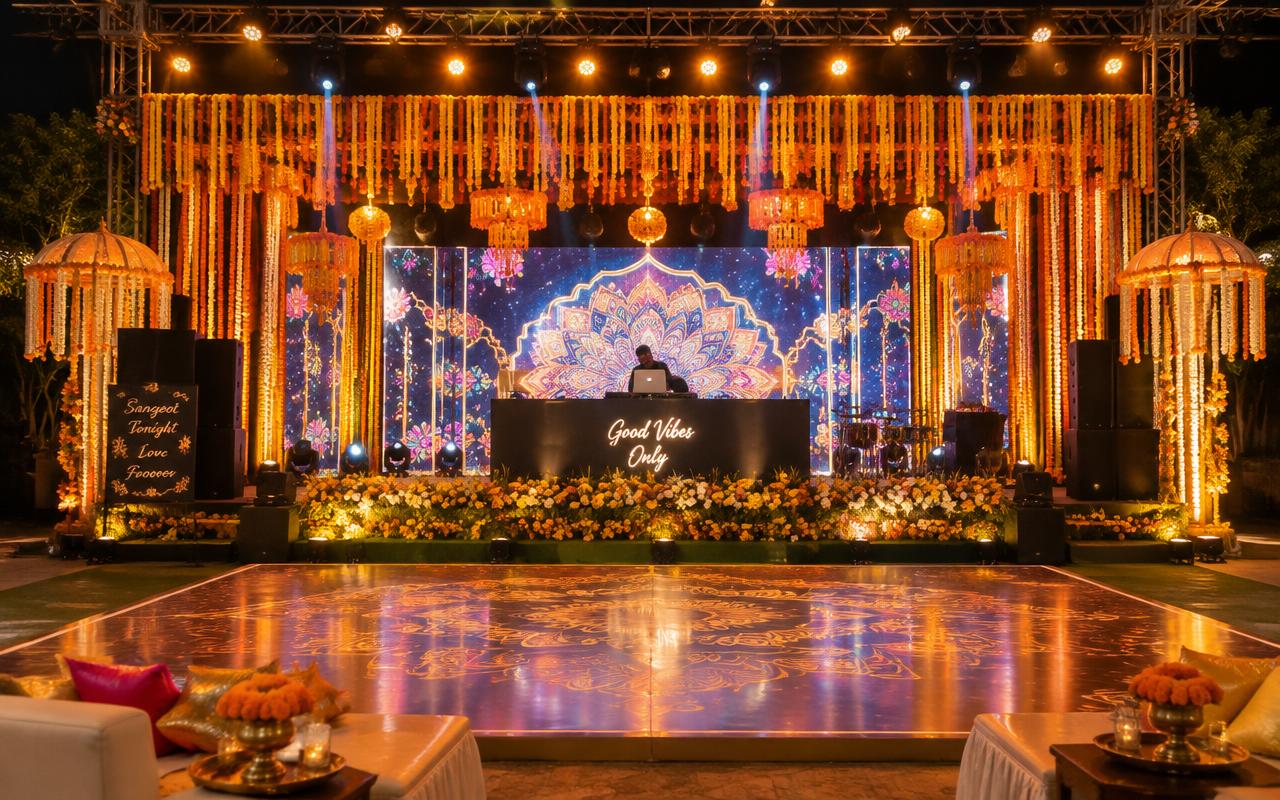
The artefact that survives a wedding is the film. Guests remember an evening; the family watches the edit for the next thirty years, which is why wedding lighting is designed to the camera's requirements first and the room's second. In practice that means high colour rendering — Ra above 90, with the R9 deep-red value that inexpensive LED fixtures quietly fail — so skin, gold and mehendi render as themselves rather than as sallow approximations. It means enough key on faces that the cinematographer can stop the lens down and keep depth of field, and one colour temperature across every fixture pointed at a person.
Lawns, banquet halls, forts and resort courtyards each give a different answer to the only question decor lighting really asks — where can a fixture stand, and can it be cabled. In Kota that plays out at venues like Umed Bhawan Palace, Seven Wonders Park, Kota Dussehra Ground, and across Talwandi, Vigyan Nagar, Kunhari, Nayapura.
The second discipline is working inside somebody else's design. The decorator owns the palette, the drape plan and the mandap, and lighting either flatters that work or fights it. Palette decisions are therefore made against physical material — a swatch of the drape, a stem from the floral mock-up, held under the actual fixture — because additive LED mixing lands somewhere other than where a monitor promised. Drapes and structures are pixel-mapped where the look needs movement, grazed from shallow angles where it needs texture, and pin-spotted where one floral centrepiece or the mandap canopy should carry the eye.
What’s included
- High-CRI key lighting tuned for skin tone on camera
- Pixel-mapped decor, drapes and mandap washes
- Battery uplighters for lawns and heritage venues with no cabling
- Programmed cue list per function with a dedicated operator
Equipment we carry
Why Kota chooses Prime AV
- Crews and trucks positioned for fast load-in at Chambal riverfront and Kishore Sagar settings and venues in Mahaveer Nagar and Talwandi.
- Focus is scheduled as a named slot after decor dressing rather than before it, and the plot marks which positions must stay accessible for the re-focus pass.
- Cue list per function mapped to the running order with fade times
- Working knowledge of Rajasthan venue rules, power sanctions and permission timelines.
Local conditions
Producing wedding lighting design in Kota
Weather & the rig
Wedding lighting lives in gardens, courtyards and open lawns across several consecutive nights, so IP ratings, covered distribution and a pre-programmed wet-weather look are specified against the season rather than added when a forecast turns. Hadoti heat is severe and dry, with May and June in the mid-forties and a loo wind that pushes dust into everything, while the Chambal valley generates thick persistent fog on December and January mornings that will flatten a daytime projection and delay a morning soundcheck. The monsoon from July is substantial by Rajasthan standards and the river catchment floods low ground quickly. April–June is unusable outdoors by day, and July–September monsoon with Chambal catchment flooding rules out riverside builds. Work around the coaching calendar too — the city is effectively full during JEE and NEET exam and result weeks, and accommodation for travelling crew disappears.
Power & redundancy
A decor lighting rig draws modestly but spreads across an entire property in dozens of small positions, so the real question is not total load but how many clean, stable circuits reach the far corners of the site. Kota sits beside major generation and the industrial feeders are strong, but the fair ground and park sites are fed from municipal points with little headroom, so DG covers anything with a serious lighting or LED load. Local generator and cable supply is competent because the plants sustain a maintenance ecosystem; insist on silent canopies for palace and residential-adjacent work.
Permits & noise rules
Façade and landscape washes at heritage and civic properties are governed by what may be fixed, aimed or illuminated after dark, and that is the venue's or the authority's call rather than the designer's. The Kota Municipal Corporation and the Dussehra Mela committee control fair-ground and public-park allotment, Kota police handle assembly and traffic licensing, and the Rajasthan noise rules with the 10 pm amplified-sound limit apply — with practical latitude during the sanctioned Mela that does not extend to private events. Student mass gatherings attract additional district-administration conditions on capacity and exits, given recent scrutiny of coaching-city safety. Drone use needs DGCA clearance plus district coordination.
Load-in & access
Fixtures go in after the decor has dressed and come out alongside it, which puts the lighting crew at the back of every load-in queue and makes the focus slot the most fragile hour in the whole schedule. The city is well connected by rail on the Delhi–Mumbai line and by NH-27 road, so freight in is straightforward, but the Dussehra Ground and old-city Nayapura approaches are narrow and congested, with truck movement pushed to late night through the fair. Talwandi and Vigyan Nagar roads gridlock at institute shift changes, which has to be designed around when scheduling a load-in.
Season & booking
The Kota Dussehra Mela, running some three to four weeks from Navaratri into late October, is the defining lock on local inventory — staging, lighting, barricading and generators are all committed. Layer on the coaching calendar: orientation waves in April–May, exam season January–April, result events April–June. The Dec–Jan wedding run plus Teej and Gangaur observances complete the year. Peak demand runs Oct–Feb.
Crew & dispatch
Trucked from our Jaipur depot, 245 km via Bundi at about four and a half hours, with Udaipur and Indore as alternates; scaffolding and barricading are hired in Kota itself because the Mela trade keeps large stocks. Load-in support covers Mahaveer Nagar, Talwandi and the rest of the city.
What it costs here
A value-driven market. Coaching groups buy at volume and expect institutional rates with tight payment discipline, while industrial clients tender properly and pay on terms. There is almost no appetite for premium branded specification for its own sake, so the proposition is reliability and scale per rupee rather than exotic kit.
Local expectations
Student-facing events want a lecture-hall sensibility scaled up: guaranteed intelligibility to the last row, large IMAG so faces read at distance, and a stage that supports long-form presentation. Mela programming is folk and devotional, rooted in Hadoti artists and the Ramlila tradition, with a standing rather than seated audience. Local business-community weddings are expressive but comparatively restrained against Jaipur or Udaipur tastes.
Specification
Wedding Lighting Design: technical specification
| Specification | Detail |
|---|---|
| Colour rendering | Ra above 90 with R9 deep-red verified on every fixture that lights a face |
| Colour temperature | One white point per function, typically 2,700 – 3,200 K for pheras and reception |
| Key light for camera | Faces keyed so the cinematographer can stop down rather than shoot wide open |
| Decor matching | Fixtures set against physical fabric and floral samples at focus, never against hex values |
| Battery fixtures | Wireless-DMX uplighters and tubes with runtime measured at the programmed output |
| Weather rating | IP65 or better on lawn, poolside and courtyard positions, with data and power under cover |
| Uplighter spacing | Roughly 3 m centres on drape and wall runs, tightened on textured stone to avoid scalloping |
| Pixel mapping | Pixel tape, tubes and mapped drape runs driven from the console or a small media server |
| Control | sACN or Art-Net to nodes, DMX512-A to fixtures, wireless DMX for untethered positions |
| Cue list | A programmed cue per beat of each function, run live by a dedicated operator |
Heritage and lawn venues dictate much of the method. A fort courtyard will not permit cable across stone, a lawn cannot have mains cable under a guest walkway in dew, and neither offers useful rigging positions. Battery uplighters on wireless DMX solve positions that cabling cannot reach, provided runtime is measured at the output actually programmed rather than read off a brochure. Open-air positions carry IP65-rated housings as a minimum, with data and distribution under hard cover. Everything still answers to one console, so a battery fixture inside a floral structure takes the same cue as a moving head on the stage truss.
Sizing
What size rig does your event actually need?
| Scale | Guests | Recommended setup |
|---|---|---|
| Intimate lawn | 100 – 250 | Sixteen battery uplighters, four pin spots, two high-CRI key fixtures on the couple, one operator |
| Banquet hall | 250 – 600 | Thirty-two uplighters, twelve pin spots, eight profiles keying the stage, two universes, cue list per function |
| Hotel lawn | 600 – 1,200 | Sixty uplighters, a pixel-mapped backdrop run, twenty-four moving heads for sangeet, generator-fed distribution |
| Palace courtyard | 800 – 1,500 | Fully wireless decor rig with daily charge rotation, façade wash from free-standing ground positions, no fixings to stone |
| Multi-venue resort | 1,000 – 2,000+ | Independent rigs per venue on one network, over a hundred fixtures, designer plus two operators |
Scope
Wedding Lighting Design scope tiers in Kota
Single Function Design
One function — sangeet or reception — in a hall or on a lawn for 200 to 500 guests
- Lighting plot drawn over the decorator's drape and mandap layout
- High-CRI key on the stage and the couple's positions, set against the camera
- Twenty-four to thirty-two uplighters colour-matched to physical samples
- Programmed cue list for entries, performances and the first dance
- One operator on console for the whole function
Wedding Weekend Design
Mehendi through reception across two or three days, 400 – 1,000 guests
- A separate design and cue list per function, from daylight-balanced mehendi to low warm pheras
- Pixel-mapped drapes and backdrops cued to the sangeet choreography
- Battery uplighters and tubes for decor positions that cannot be cabled
- Pin spots on mandap, cake, entry walkway and floral focal points
- Lighting designer plus operator and a focus crew across every function
Heritage & Destination Design
Palaces, forts, resorts and overseas venues with multiple courtyards, 600 – 2,000 guests
- Façade and landscape lighting designed alongside the function stages
- Fully wireless rig where cabling is prohibited, with a daily charge rotation planned
- Weatherised fixtures and covered control positions for open-air builds
- Previsualised look renders approved with the family and the decorator before travel
- Travelling design and programming crew with a spares inventory held on site
A value-driven market. Coaching groups buy at volume and expect institutional rates with tight payment discipline, while industrial clients tender properly and pay on terms. There is almost no appetite for premium branded specification for its own sake, so the proposition is reliability and scale per rupee rather than exotic kit.
Venues
Where we work in Kota
| Venue | Capacity | Production note |
|---|---|---|
| Umed Bhawan Palace | 400–900 across the lawns and durbar spaces | Heritage property with ornate interiors: no fixings, no heat-generating fixtures near surfaces, and lawn builds must stay off the formal garden axis, which pushes FOH into an awkward offset position. |
| Seven Wonders Park | 3,000–6,000 in open public layouts | A municipal park of replica monuments, so structures cannot obstruct the public circuit and power is cabled in from a distant point; permissions come event by event with ground-protection conditions. |
| Kota Dussehra Ground | Tens of thousands daily across the fair period | A twenty-plus-day fair site where the main stage, exhibition stalls and ride areas all compete for the same feeders; cable protection against continuous crowd traffic is the single biggest reliability factor. |
| Coaching institute auditoria in Talwandi and Jawahar Nagar | 1,500–5,000 seated in the largest halls | Purpose-built for mass lectures, so sightlines are excellent but the acoustics are tuned for one voice; music playback and live bands expose the reverberation and the house system rarely suffices for show use. |
| Chambal riverfront and Kishore Sagar settings | 1,000–4,000 outdoors | Water-adjacent ground that fogs heavily on winter mornings and carries high overnight dew — covered FOH and sealed connectors are not optional. |
Crew
Who turns up on show day
- Lighting designer
Translates the decorator's palette and the family's running order into a plot and a look for each function, and answers for how the night photographs.
- Programmer and operator
Builds the cue list per function and runs it live, holding entries, performances and the first dance on timed fades rather than on static colour.
- Focus and colour technician
Sets each fixture's angle, intensity and colour against the physical samples, then re-checks the rig once decor has dressed the room.
- Battery fixture technician
Owns the wireless rig — placement inside decor, link margin checks on every unit, and a charge rotation that keeps each fixture alive to the end of the night.
- Camera-side gaffer
Agrees key level and white point with the wedding film team, coordinates their practicals with the house rig and checks skin tone on their monitor at rehearsal.
- Rigging and cable crew
Hangs truss and floor positions, dresses cable clear of guest routes and photography lines, and removes fixtures alongside the decor team at strike.
What you receive
- Lighting plot per function, drawn over the decorator's layout
- Colour reference sheet naming the fixture setting matched to each fabric and floral sample
- Previsualisation renders of the key looks for every function
- Cue list per function mapped to the running order with fade times
- Battery fixture placement plan with its charge rotation schedule
- Console show file backed up to two drives and handed over
- Agreed key level and white point note shared with the photography and film team
Timeline
From enquiry to load-out
- T-8 weeks
Decor and film alignment
We take the decorator's palette, drape plan and mandap drawings together with the film team's camera plan, and design to both rather than to a fixture count.
- T-5 weeks
Function-by-function design
A plot and a look direction per function: daylight-balanced mehendi, bright informal haldi, show-lit sangeet, low warm pheras, keyed reception receiving line.
- T-3 weeks
Sample matching and previs
Physical fabric and floral samples tested under the actual fixtures, settings recorded, and the key looks previsualised and shared as renders.
- T-1 week
Cue build
Entries, performance tracks, the first dance and the pheras sequence turned into a timed cue list per function with fade times set.
- Show day −1
Focus and rehearsal
Rig focused after decor has dressed, colours re-checked against samples in the finished room, and looks reviewed on the film team's monitor.
- Day 1 to final function +4 hours
Functions and strike
Each function operated live from its own cue list, then fixtures inside decor removed carefully alongside the decorator at strike.
Risk control
What goes wrong, and how we stop it
What can go wrong
How we prevent it
- What can go wrong
Decor dresses the room after the rig has been focused and half the fixtures now point at a drape.
How we prevent itFocus is scheduled as a named slot after decor dressing rather than before it, and the plot marks which positions must stay accessible for the re-focus pass.
- What can go wrong
The room looks beautiful to the eye and the wedding film comes back with grey, sallow skin tones.
How we prevent itFixtures lighting faces are specified above Ra 90 with the R9 value verified, one white point is locked per function, and the look is reviewed on the film team's own monitor at rehearsal rather than trusted to the eye.
- What can go wrong
A saturated decor colour is matched from a hex code and the uplighters render it as a visibly different shade on the night.
How we prevent itPhysical fabric and floral samples are requested weeks ahead, tested under the actual fixtures, and the resulting setting is recorded on a colour reference sheet so focus is repeatable across every function.
- What can go wrong
Battery uplighters buried inside floral structures die partway through the reception.
How we prevent itRuntime is measured at the output level actually programmed rather than taken from the datasheet, a charge rotation is planned per day, and decor positions are built so a unit can be swapped without dismantling the arrangement.
Honest comparison
Is this the right choice for your event?
- A concert-style moving-head rig across the whole weddingOur verdict
Moving heads earn their place over the sangeet stage and the dance floor, where looks must change and energy matters. Aimed at a mandap or a dining area they are too hard, too cool and too mobile, and they photograph badly. Most of a wedding wants soft, warm, high-CRI light from fixed positions, with movement reserved for the functions that want it.
- Static colour all evening instead of a programmed cue listOur verdict
Static colour is simple, safe and perfectly right at a mehendi or any daytime function where light is not doing dramatic work. Across a sangeet and a reception it flattens the whole evening: the entry, the performances, the first dance and the cake all look identical, and the edit has nothing to cut between.
- Letting the film crew bring all the lightingOur verdict
Film crews carry excellent key lighting and should use it for portraits and couple shoots. What they cannot do from a camera position is light a room, so a rig built only for the lens leaves guests sitting in an unlit hall. The two jobs are complementary, which is exactly why key level and white point get agreed between us rather than discovered on the night.
Demand
What Kota books most
Kota event mix
- Coaching institute orientations, result felicitations and seminars
- The Dussehra Mela and allied public cultural programmes
- Industrial safety days, dealer and vendor meets
- Weddings in the Hadoti business community
- Education fairs and competitive-exam counselling events
Ideal for
Events we power with wedding lighting design in Kota
Process
From brief to standing ovation
01
Brief & recce
We visit the venue, map power and rigging, and understand your show flow.
02
Design & quote
CAD plans, 3D previews and an itemised quote within 24 hours.
03
Build & rehearse
Load-in, system tuning, content checks and full technical rehearsal.
04
Show & strike
Show-caller-led execution, then a quick, clean load-out.
FAQ
Wedding Lighting Design in Kota: FAQs
More services in Kota
Wedding Lighting Design in nearby cities
Areas we cover in Kota
Events in Kota