Lighting & Stage · Dehradun, Uttarakhand
Stage & Truss Setup in Dehradun
Uttarakhand's capital runs on three engines that all buy production: the state secretariat and its department conferences, an unusually dense institutional cluster — The Doon School, Welham, the Forest Research Institute, the Indian Military Academy, ONGC and Survey of India — and the Mussoorie hill-wedding trade 35 km up the road, which uses Dehradun as its staging city. Prime AV Solutions supplies the stage & truss fabrication behind those events — designed on paper, proven in rehearsal and run by our own crew.
- Lead time
- From 6 weeks
- Peak season
- Oct–Jun
- Coverage
- Dehradun & Uttarakhand
Key takeaway
Stage & Truss Fabrication for Dehradun’s biggest events
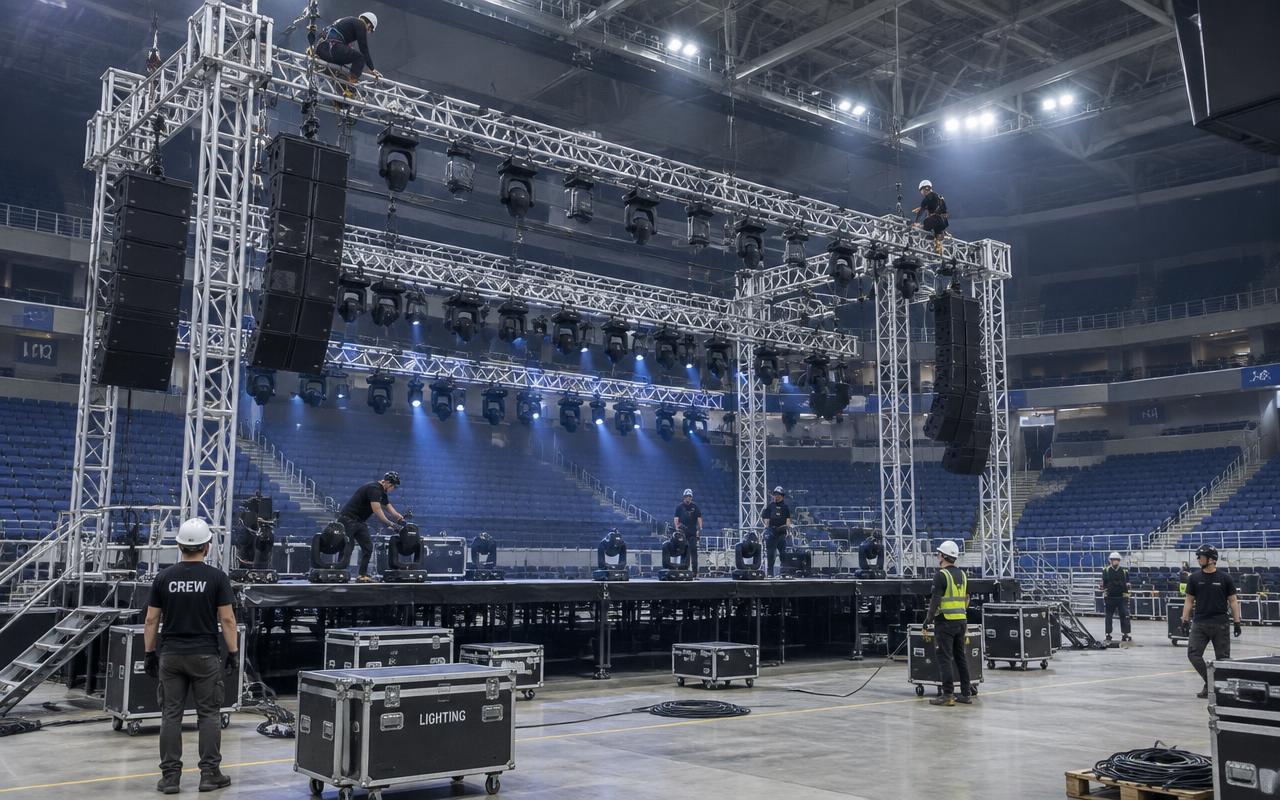
Structure is the one department where getting it wrong is not an aesthetic problem. Every stage and truss build starts from a load case: the dead load of the structure itself, the live load of performers and crew, the suspended loads of lighting, audio and LED, and — outdoors — wind load on any banner, roof or solid surface. We specify from manufacturer load tables for the exact truss type and span, with chain hoists rated well above the working load and point loads calculated per leg. Decks are Layher or aluminium framed systems with a published uniform load rating, and a performance stage is typically designed for 500 kg per square metre of distributed live load.
Everything here is set by the building and the ground: documented rigging capacity, floor loading, ceiling trim and whether there is room for towers to carry load to the floor. In Dehradun that plays out at venues like Hotel Pacific, JW Marriott Mussoorie, Parade Ground, and across Rajpur Road, Sahastradhara Road, Prem Nagar, Clement Town.
Ground support and roof systems are where wind becomes the governing factor. A solid or banner-clad roof is a sail, and the force on it rises with the square of wind speed, so every roof design comes with a wind management plan: a speed at which banners are removed, a higher speed at which the roof is lowered or the show stops, and a ballast or ground-anchor scheme calculated for the site's surface. Ballast is not a number we guess — concrete blocks or water ballast are specified against the structure's overturning calculation, and soft ground needs load-spreading plates or a different anchoring approach entirely.
What’s included
- Layher & aluminium deck stages
- Ground support & roof systems
- Motorised chain hoists
- Structural load calculations
Equipment we carry
Why Dehradun chooses Prime AV
- Crews and trucks positioned for fast load-in at Hotel Pacific and venues in Rajpur Road and Sahastradhara Road.
- Ground bearing capacity is assessed before the build, load-spreading plates are specified for soft surfaces, and plumb is re-checked after the first night.
- Ballast or ground-anchoring scheme with the overturning calculation
- Working knowledge of Uttarakhand venue rules, power sanctions and permission timelines.
Local conditions
Producing stage & truss setup in Dehradun
Weather & the rig
Structure is the department wind and rain act on directly — a clad roof behaves as a sail, ballast sinks into saturated ground, and the wind plan is written against the site's actual conditions. The Doon Valley is a rain trap — Jul–Sep delivers over 2,000 mm with the Rispana and Bindal in spate and fresh slips on the Mussoorie road. Apr–Jun touches 38°C on the valley floor while Mussoorie sits 10–12°C cooler, so one wedding weekend can need misting fans at the Dehradun welcome dinner and patio heaters at the hill venue. Dec–Jan dawn fog in the valley is thick enough to kill long-throw projection, and January snow on the ridge closes the upper road without notice. Jul–Sep valley monsoon and Mussoorie road slips; late Jan if the plan depends on the hill approach staying open.
Power & redundancy
Motorised hoists and the loading sequence need a reliable supply early in the build, well before the event distribution is energised, so structure usually works off its own temporary feed. UPCL supply on Rajpur Road and through the cantonment is adequate, but the Mussoorie hill feeders trip in storms and winter restoration runs to hours. Hill hotels carry DG sized for hotel services, not a show, so any real rig brings its own sets — and getting a 250 kVA set up the hairpins is a planned move in itself. Parade Ground and the open venues are DG-only.
Permits & noise rules
Stages, roofs and ground support frequently need structural sign-off and local authority approval in their own right, separate from the event permission itself. Dehradun Nagar Nigam for the licence and temporary-structure permission, the SSP Dehradun and district magistrate for assembly and loudspeaker permission, Uttarakhand's noise rules with the Supreme Court's 10 pm cut-off on outdoor amplified sound, and the district administration for Parade Ground itself. Mussoorie sits under its own Nagar Palika Parishad with hill-station vehicle-entry and parking rules, and Forest Department sign-off is needed where a venue abuts notified forest. Jolly Grant airport 25 km east plus IMA and cantonment airspace make drone clearance a slow Digital Sky and local-police exercise.
Load-in & access
Truss, decks and ballast are the heaviest and bulkiest loads on the job and must arrive first, which makes gate width, ground bearing and crane or forklift access the controlling constraints. Delhi is 240 km and the new Dehradun corridor has cut the run to roughly five hours, so Delhi-sourced trucks move overnight. The real job starts past Kempty: the climb to Mussoorie has tight hairpins, a practical length ceiling around 19 ft and timed hill-station entry, so plan a transfer, smaller vehicles and porters. In the city, Rajpur Road and Paltan Bazaar bar heavy vehicles through the day, pushing load-ins to 10 pm–7 am.
Season & booking
The IMA Passing Out Parade in June and December fills every room in the valley and brings its own security perimeter. Add school founder's-day and old-boys weekends, the May–Jun Mussoorie tourist peak when the hill road is at capacity, Kanwar Yatra diversions through Shravan, and the Nov–Dec and Feb–Apr wedding clusters that hill resorts sell out a year ahead. Peak demand runs Oct–Jun.
Crew & dispatch
Own Dehradun crew for valley work; heavy trucking and additional stock move up from Delhi overnight on the Dehradun corridor, roughly 5 hours. Hill jobs stage in Dehradun and transfer to small vehicles below Kempty. Load-in support covers Rajpur Road, Sahastradhara Road and the rest of the city.
What it costs here
Two tiers sit side by side. Government and institutional work is tendered, heavily documented and slow to pay, but repeats annually. Mussoorie hill weddings — largely Delhi and NRI clients — carry a real hill loading for transfer vehicles, porterage, crew accommodation and the extra build day, and experienced clients expect those lines shown rather than buried.
Local expectations
Garhwali custom sits alongside Delhi and Punjabi expectation inside the same wedding: mangal geet and dhol-damau need acoustic space, then the sangeet runs at plains sound levels until the curfew. Hill venues are bought for the view, so clients resist large LED walls across the valley and prefer warm practical lighting with projection onto architecture. Institutional work is formal — lamp-lighting protocol, exact name boards, Hindi-first scripting.
Specification
Stage & Truss Fabrication: technical specification
| Specification | Detail |
|---|---|
| Deck systems | Layher Allround and aluminium-framed modular decks with published load ratings |
| Live load design | Typically 500 kg per square metre distributed for performance stages |
| Truss types | 300 – 600 mm box and triangular truss, specified from manufacturer span and load tables |
| Chain hoists | Electric hoists in 500 kg – 2 t capacities, rated well above working load, inspected per build |
| Rigging safety factor | Hardware used within rated capacity with the factor appropriate to lifting over people |
| Roof systems | Ground support and mother-grid roofs with a documented wind management plan |
| Wind thresholds | Staged limits for banner removal, roof lowering and show stop, set per structure and site |
| Ballast | Concrete or water ballast calculated against the overturning case, with load-spreading on soft ground |
| Stage heights | 0.6 m to 2.4 m with code-compliant stairs, handrails and edge protection |
| Documentation | Load calculations, point-load report, hoist inspection records and a build sign-off |
The rigging discipline on site is what turns a design into a safe build. Hoists are inspected, chains checked for wear, steels and shackles used within rated capacity with a safety factor appropriate to lifting over people. Every hang point is bonded, every hoist is controlled from a single position, and nothing moves while people are underneath. We run a pre-show structural check after the full rig is loaded and again before doors, because a structure that was correct when empty can reveal a problem once 2 tonnes of lighting and LED is on it. The build sequence, the bolt torque, the hoist inspection and the final sign-off are all documented.
Sizing
What size rig does your event actually need?
| Scale | Guests | Recommended setup |
|---|---|---|
| Conference stage | 200 – 600 | 10 m x 6 m deck at 0.6 m, front truss on two uprights, 1 t suspended load |
| Wedding stage | 400 – 1,200 | 12 m x 8 m deck at 0.9 m with ramps, four uprights and a decor-integrated grid |
| Launch stage | 1,000 – 3,000 | 16 m x 10 m deck at 1.2 m, ground support grid, 3 – 5 t suspended load |
| Concert stage | 5,000 – 15,000 | 18 m x 12 m deck at 1.8 m, roof system, PA wings, 10 – 15 t suspended load |
| Festival main stage | 20,000+ | 24 m x 16 m with 2.4 m deck, engineered roof, mother grid, ballast and wind plan |
Scope
Stage & Truss Setup scope tiers in Dehradun
Modular Stage
Conference and wedding stages up to 100 sq m with a front truss
- Modular deck stage with skirting, stairs and edge protection
- Front and side truss on uprights with load calculations
- Point-load report issued to the venue
- Certified rigging crew and hoist inspection records
- Build and strike within the venue's load-in window
Ground Support System
Concert and launch stages, 150 – 400 sq m with a flown grid
- Ground support towers and a mother grid rated for the full rig load
- Motorised chain hoists with a single controlled lifting position
- Structural calculations covering dead, live and suspended loads
- Ballast scheme calculated against the overturning case
- Crew chief, certified riggers and a documented build sequence
Roof & Custom Structure
Festival stages, outdoor concerts and bespoke scenic structures
- Engineered roof system with a site-specific wind management plan
- Staged wind thresholds for banner removal, lowering and show stop
- Ground anchoring or ballast designed for the actual surface
- Pre-show structural checks after loading and again before doors
- Full rigging department with a nominated competent person on site
Two tiers sit side by side. Government and institutional work is tendered, heavily documented and slow to pay, but repeats annually. Mussoorie hill weddings — largely Delhi and NRI clients — carry a real hill loading for transfer vehicles, porterage, crew accommodation and the extra build day, and experienced clients expect those lines shown rather than buried.
Venues
Where we work in Dehradun
| Venue | Capacity | Production note |
|---|---|---|
| Hotel Pacific | Up to 900 seated across two banquet halls | Rajpur Road frontage with no service lane, so unloading happens in police-timed slots on a live arterial and everything transfers to the goods lift; the banquet slab caps a flown rig at roughly 4 m trim. |
| JW Marriott Mussoorie | Up to 600 across ballroom and valley-facing lawns | Reached by the Dehradun–Mussoorie hairpins; the gate takes nothing longer than a 19-ft truck and the final private drive is steep, so budget a transfer below Kempty and an extra half-day for the climb. At roughly 1,900 m the overnight temperature drop fogs optics and drains batteries. |
| Parade Ground | 10,000-plus standing on open ground | District-administration land in the middle of the city: bare surface, no show-grade mains, matting needed under every wheel, and an institutional-plus-residential ring that makes the 10 pm finish genuinely enforced. |
| Forest Research Institute lawns | Up to 1,500 across the colonnade forecourt and lawns | The 1920s brick colonnade is what clients come for, but this is a working ICFRE research campus — approvals run through the institute, nothing fixes to the masonry, vehicle movement on the lawns is rationed and power is a long cable run from the campus supply. |
| Hotel Madhuban | Up to 500 seated in the main hall | Compact Rajpur Road property with a lift-only load-in and a shallow beam-to-slab gap; suited to conferences and receptions rather than anything needing a motorised flown rig. |
Crew
Who turns up on show day
- Structural designer
Produces the load case and the calculations, specifies truss and hoist capacities and signs the point-load report.
- Crew chief
Owns the build sequence and the clock, and holds the authority to stop the build if anything departs from the drawing.
- Lead rigger
Inspects hoists and hardware, controls all lifting from a single position and signs off before anything goes to trim.
- Stage carpenter
Builds decks to level, fits stairs, handrails and edge protection, and closes every gap a heel or a cable could find.
- Competent person on site
Performs the structural checks after loading and before doors, and owns the wind management decisions on an outdoor roof.
What you receive
- Structural load calculations covering dead, live, suspended and wind cases
- Point-load report per leg issued to the venue or structural engineer
- Stage and truss CAD drawing with dimensions, heights and trim
- Hoist and rigging hardware inspection records for the build
- Ballast or ground-anchoring scheme with the overturning calculation
- Wind management plan with staged thresholds for outdoor roof systems
- Signed build completion and pre-doors structural check record
Timeline
From enquiry to load-out
- T-6 weeks
Load case and design
Dead, live, suspended and wind loads established from every department's requirements, then truss and hoist capacities specified.
- T-4 weeks
Calculations issued
Structural calculations, point-load report and ballast scheme sent to the venue or the appointed structural engineer for sign-off.
- T-3 weeks
Site and ground assessment
Surface bearing capacity, levels, access routes and anchoring feasibility checked on site for outdoor builds.
- Show day −3 to −1
Build
Decks, towers, grid and roof built in documented sequence with bolt torque and hoist inspection recorded.
- Show day −1
Load and structural check
Departments load the grid, then a structural check is performed with the rig in place and again before doors.
- Show +4 to +24 hours
Strike
De-rig in reverse build order with lifting operations supervised and the area cleared of all other crew.
Risk control
What goes wrong, and how we stop it
What can go wrong
How we prevent it
- What can go wrong
Ballast is placed on soft or wet ground and begins to sink, taking the structure out of plumb.
How we prevent itGround bearing capacity is assessed before the build, load-spreading plates are specified for soft surfaces, and plumb is re-checked after the first night.
- What can go wrong
The venue quotes a rigging capacity that turns out to be an assumption rather than a calculation.
How we prevent itWe require written sign-off on point loads and, where it is not forthcoming, quote a ground support system that carries its own load to the floor.
- What can go wrong
Stage gaps and unprotected edges become an injury risk once performers and guests are moving fast.
How we prevent itDeck gaps are closed and taped, edge protection and handrails are fitted to code, and the carpenter walks the whole deck surface before anyone is allowed on it.
- What can go wrong
Lifting continues while other crew work underneath because the build is behind schedule.
How we prevent itAll lifting is controlled from a single position with the area cleared, and the crew chief has explicit authority to stop a build that is being rushed.
Honest comparison
Is this the right choice for your event?
- Ground support towers instead of flying from the venue structureOur verdict
Ground support costs more and eats floor space, but it carries its own load to the floor and removes any dependence on a venue capacity you cannot verify. Where the venue has documented, engineered rigging points, flying is cheaper and cleaner.
- Scaffold stage instead of a modular deck systemOur verdict
Scaffold is cheaper and infinitely adaptable, and for a long-run outdoor build on uneven ground it is often the sensible choice. Modular decks are faster, flatter, quieter underfoot and look finished without extra cladding.
- A roof system instead of a tent or shamiana over the stageOur verdict
A fabric structure is cheaper and keeps rain off people, but it will not carry lighting or audio load and its own wind behaviour is usually undocumented. If anything needs to hang above the stage, it needs an engineered roof.
Demand
What Dehradun books most
Dehradun event mix
- Mussoorie and Doon Valley destination weddings
- State government and department conferences
- School founder's days, convocations and institutional ceremonies
- Defence and IMA-linked ceremonial functions
- Regional dealer meets and product launches
- Literary and cultural festivals on Parade Ground
Ideal for
Events we power with stage & truss fabrication in Dehradun
Process
From brief to standing ovation
01
Brief & recce
We visit the venue, map power and rigging, and understand your show flow.
02
Design & quote
CAD plans, 3D previews and an itemised quote within 24 hours.
03
Build & rehearse
Load-in, system tuning, content checks and full technical rehearsal.
04
Show & strike
Show-caller-led execution, then a quick, clean load-out.
FAQ
Stage & Truss Setup in Dehradun: FAQs
More services in Dehradun
Stage & Truss Setup in nearby cities
Areas we cover in Dehradun
Events in Dehradun