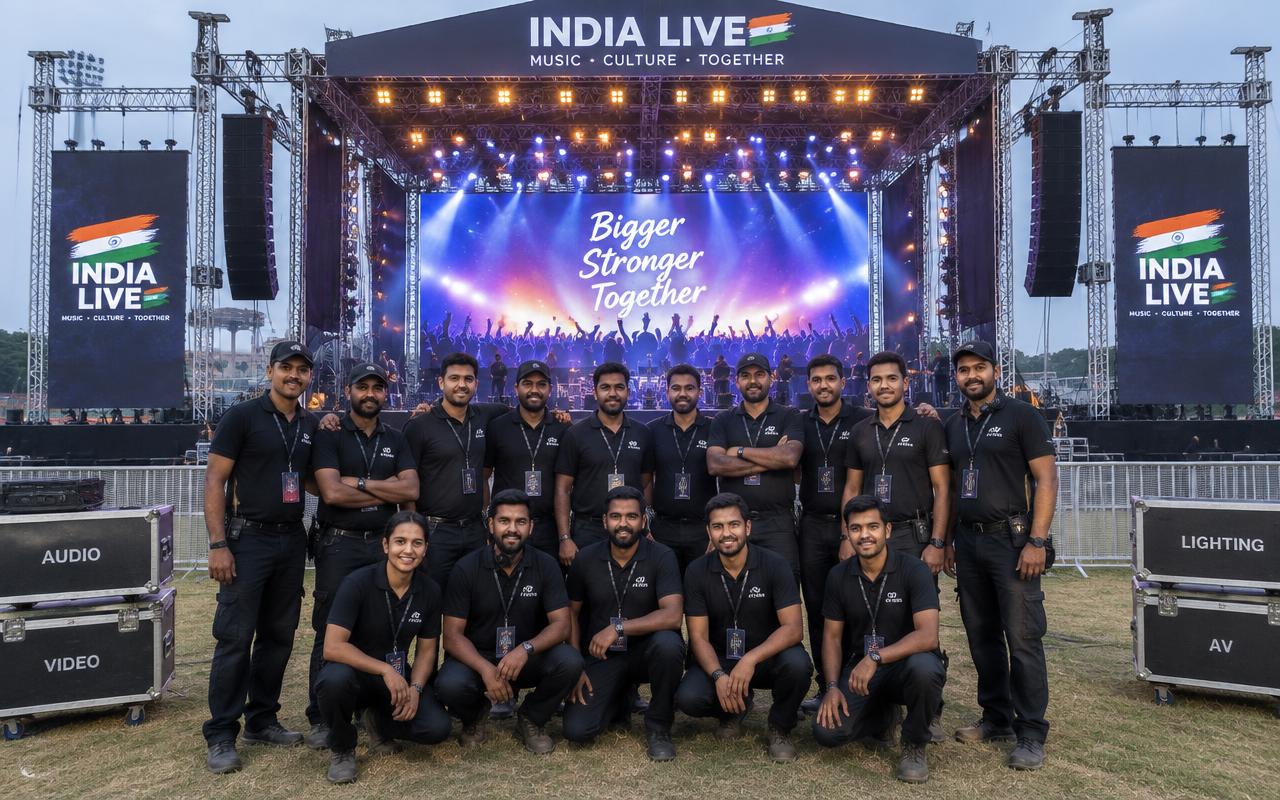
Full Production · Dehradun, Uttarakhand
Event Production Company in Dehradun
In Dehradun, mussoorie and doon valley destination weddings set the standard everything else is measured against. Our event production is specified to clear that bar at Hotel Pacific and anywhere else in the city.
- Lead time
- From 10 weeks
- Peak season
- Oct–Jun
- Coverage
- Dehradun & Uttarakhand
Key takeaway
Event Production for Dehradun’s biggest events
An event production company is an accountability structure before it is an equipment list. Split the work across a sound vendor, a lighting vendor, a screen supplier and a stage fabricator and every one of them will deliver exactly what they quoted; the gaps sit in between. Who owns the power distribution that the screen and the lighting rig both draw from? Who sets the truss trim height that lets the array hang and the backdrop fit? Who holds the schedule when the stage build runs three hours late and lighting cannot focus? Under one technical contract those questions have one answer, and that answer has a name.
A production partner's first deliverable is a measured survey of the room — point capacities, power positions, trim height, columns and sightlines — because the drawing that everything else depends on is only as good as those figures. In Dehradun that plays out at venues like Hotel Pacific, JW Marriott Mussoorie, Parade Ground, and across Rajpur Road, Sahastradhara Road, Prem Nagar, Clement Town.
The work happens on paper weeks before anything is loaded. The document set is the real deliverable: a scaled technical drawing in plan and section with stage, screen, truss, control and camera positions; a rigging load plan with calculated point loads; a power plan with per-phase balance and generator sizing; a build programme sequencing every department; a run of show against the client's agenda; and a cue sheet that all departments work from. These go to the venue and the agency for sign-off, because correcting a drawing at the issue stage takes a revision number, while discovering the build is wrong on site takes the schedule with it.
What’s included
- Single contract across sound, video, lighting and staging
- Named producer and show-caller from brief to strike
- Technical drawings, load plans and run of show issued before build
- In-house inventory rather than sub-rented equipment
Equipment we carry
Why Dehradun chooses Prime AV
- Crews and trucks positioned for fast load-in at Parade Ground and venues in Prem Nagar and Clement Town.
- One power plan with a per-phase load schedule is drawn before anything is ordered, and a single electrical contractor feeds every department from distribution we specify and label.
- Measured recce report with rigging capacities, power positions and access dimensions
- Working knowledge of Uttarakhand venue rules, power sanctions and permission timelines.
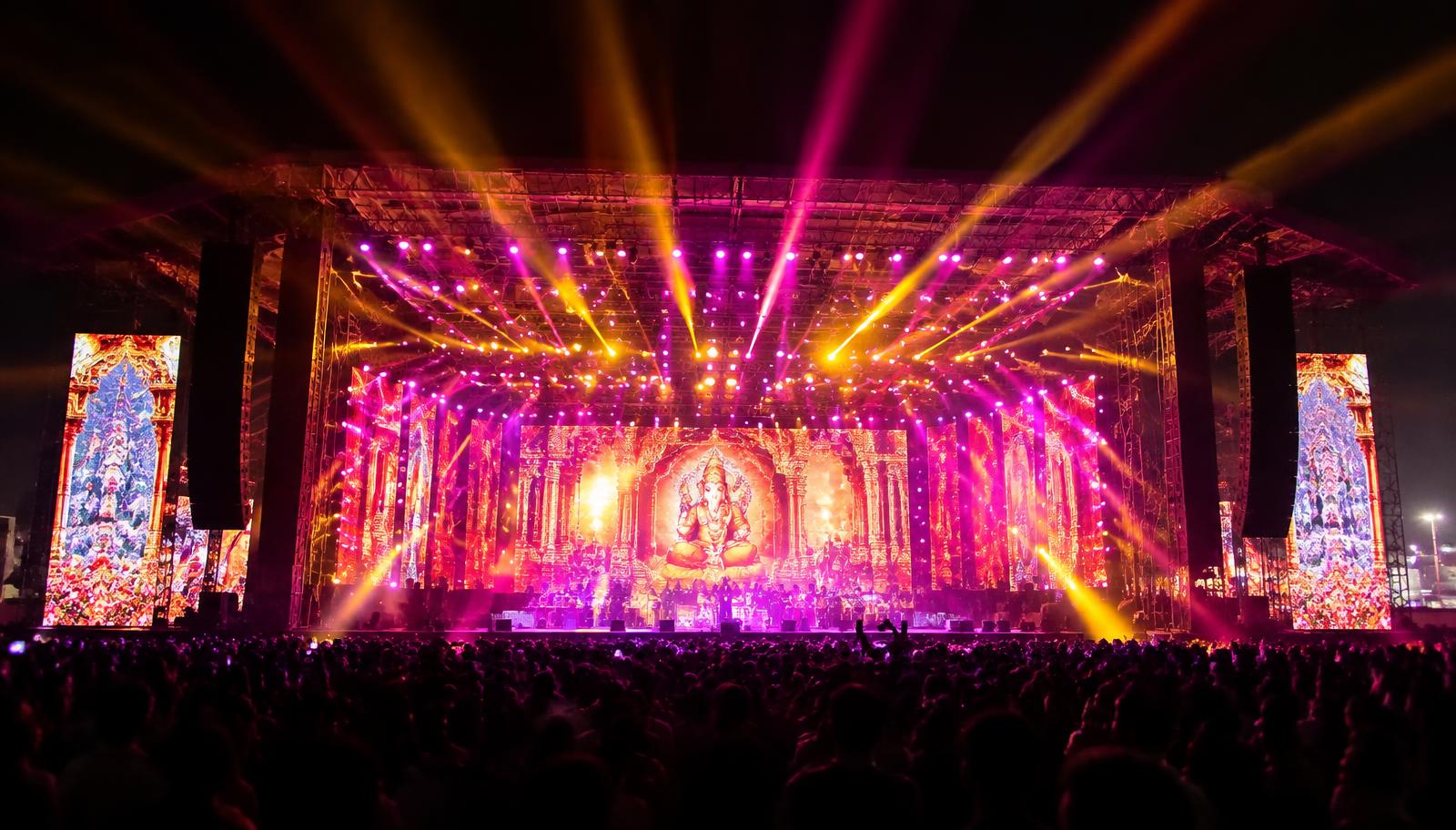
Local conditions
Producing event production company in Dehradun
Weather & the rig
Production management turns climate into dates and decision hours — which months a build can safely happen in, what covers the control positions, and the fixed time at which a wet-weather plan is called rather than debated. The Doon Valley is a rain trap — Jul–Sep delivers over 2,000 mm with the Rispana and Bindal in spate and fresh slips on the Mussoorie road. Apr–Jun touches 38°C on the valley floor while Mussoorie sits 10–12°C cooler, so one wedding weekend can need misting fans at the Dehradun welcome dinner and patio heaters at the hill venue. Dec–Jan dawn fog in the valley is thick enough to kill long-throw projection, and January snow on the ridge closes the upper road without notice. Jul–Sep valley monsoon and Mussoorie road slips; late Jan if the plan depends on the hill approach staying open.
Power & redundancy
Because one partner draws a single power plan covering every department, grid behaviour and local generator practice become design inputs at drawing stage instead of something each vendor discovers separately on build day. UPCL supply on Rajpur Road and through the cantonment is adequate, but the Mussoorie hill feeders trip in storms and winter restoration runs to hours. Hill hotels carry DG sized for hotel services, not a show, so any real rig brings its own sets — and getting a 250 kVA set up the hairpins is a planned move in itself. Parade Ground and the open venues are DG-only.
Permits & noise rules
Owning the whole technical scope means owning the permission file with it, so noise, structures, generators and any aerial or pyrotechnic element are tracked on one schedule against the build programme. Dehradun Nagar Nigam for the licence and temporary-structure permission, the SSP Dehradun and district magistrate for assembly and loudspeaker permission, Uttarakhand's noise rules with the Supreme Court's 10 pm cut-off on outdoor amplified sound, and the district administration for Parade Ground itself. Mussoorie sits under its own Nagar Palika Parishad with hill-station vehicle-entry and parking rules, and Forest Department sign-off is needed where a venue abuts notified forest. Jolly Grant airport 25 km east plus IMA and cantonment airspace make drone clearance a slow Digital Sky and local-police exercise.
Load-in & access
The build programme is the heart of production management, and it is written around the hours trucks can actually move and the dock a venue actually has, because every department's slot depends on when the first one can get in. Delhi is 240 km and the new Dehradun corridor has cut the run to roughly five hours, so Delhi-sourced trucks move overnight. The real job starts past Kempty: the climb to Mussoorie has tight hairpins, a practical length ceiling around 19 ft and timed hill-station entry, so plan a transfer, smaller vehicles and porters. In the city, Rajpur Road and Paltan Bazaar bar heavy vehicles through the day, pushing load-ins to 10 pm–7 am.
Season & booking
The IMA Passing Out Parade in June and December fills every room in the valley and brings its own security perimeter. Add school founder's-day and old-boys weekends, the May–Jun Mussoorie tourist peak when the hill road is at capacity, Kanwar Yatra diversions through Shravan, and the Nov–Dec and Feb–Apr wedding clusters that hill resorts sell out a year ahead. Peak demand runs Oct–Jun.
Crew & dispatch
Own Dehradun crew for valley work; heavy trucking and additional stock move up from Delhi overnight on the Dehradun corridor, roughly 5 hours. Hill jobs stage in Dehradun and transfer to small vehicles below Kempty. Load-in support covers Prem Nagar, Clement Town and the rest of the city.
What it costs here
Two tiers sit side by side. Government and institutional work is tendered, heavily documented and slow to pay, but repeats annually. Mussoorie hill weddings — largely Delhi and NRI clients — carry a real hill loading for transfer vehicles, porterage, crew accommodation and the extra build day, and experienced clients expect those lines shown rather than buried.
Local expectations
Garhwali custom sits alongside Delhi and Punjabi expectation inside the same wedding: mangal geet and dhol-damau need acoustic space, then the sangeet runs at plains sound levels until the curfew. Hill venues are bought for the view, so clients resist large LED walls across the valley and prefer warm practical lighting with projection onto architecture. Institutional work is formal — lamp-lighting protocol, exact name boards, Hindi-first scripting.
Specification
Event Production: technical specification
| Specification | Detail |
|---|---|
| Contract structure | One technical contract spanning sound, video, lighting, staging, rigging and crew |
| Document set | Technical drawing, rigging load plan, power plan, cable schedule, build programme, run of show |
| Drawing standard | Scaled plan and section in AutoCAD or Vectorworks, revision-numbered and issued |
| Recce output | Measured survey of rigging points and capacities, power positions, dock, lift and trim heights |
| Comms | Clear-Com or Riedel partyline with separate production, lighting and stage rings |
| Show control | One cue-marked run of show; timecode on locked segments, called cues on live ones |
| Power design | Load schedule per phase with generator sizing and spare capacity on critical feeds |
| Redundancy policy | Backup console, mirrored playback and duplicated show-critical paths agreed at design stage |
| Rigging governance | Point loads calculated against venue capacity and signed off before truss is ordered |
| Change control | Scope changes logged against a reissued drawing, not agreed verbally on the floor |
On site the producer manages interfaces and the show-caller runs the room. Interface management is unglamorous and decisive: agreeing with the decorator where loudspeakers may stand, with the venue which rigging points may be used, with the agency when content is locked, with catering when service noise cannot overlap a speech. The show-caller then holds a single cue stack across audio, video, lighting and stage management on headset comms, so a walk-on is one instruction rather than four people reacting to what they can see. Redundancy and contingency are settled at design stage and proved at rehearsal, never improvised at the moment they are needed.
Sizing
What size rig does your event actually need?
| Scale | Guests | Recommended setup |
|---|---|---|
| Boardroom briefing | 50 – 150 | One technician-producer, single-sheet technical drawing, no separate show-caller required |
| Conference hall | 300 – 800 | Producer, show-caller and four-department crew, two comms rings, drawing plus power plan |
| Awards or launch | 800 – 2,000 | Producer, production manager, show-caller, department heads, timecoded segments, rehearsal day |
| Multi-track summit | 2,000 – 5,000 | Production office, show-caller per room, floating engineers, revision-controlled drawing set |
| Arena or ground build | 5,000 – 25,000 | Site manager, certified rigging lead, phased build programme, generator-fed power with spare capacity |
Scope
Event Production Company scope tiers in Dehradun
Single-Session Production
One room and one running order — conferences, AGMs and launches up to 500 guests
- Named producer from brief through strike under one technical contract
- Scaled technical drawing and power plan issued for venue sign-off
- Cue-marked run of show with a show-caller on headset comms
- One crew covering audio, video, lighting and stage management
- Backup console and mirrored playback on show-critical paths
Multi-Format Event
Main stage plus dinner, awards or breakouts across one or two days, 500 – 2,000 guests
- Producer plus a production manager holding the build programme across rooms
- Full document set including rigging load plan, cable schedule and comms plan
- Interface schedule agreed with decor, venue, catering and the agency
- One cue stack spanning films, walk-ons, awards hand-offs and performance segments
- Rehearsal day with the full crew and the actual content
Multi-Day Production
Multi-venue summits, dealer meets and ground builds, 2,000+ guests over several days
- Production office on site with a published build programme and daily production meetings
- Department heads for audio, video, lighting, rigging and staging under one producer
- Revision-controlled drawing set with a change log and site instruction records
- Contingency plan per department with spares held on site rather than at the warehouse
- Show-caller per room with a production manager coordinating the floor
Two tiers sit side by side. Government and institutional work is tendered, heavily documented and slow to pay, but repeats annually. Mussoorie hill weddings — largely Delhi and NRI clients — carry a real hill loading for transfer vehicles, porterage, crew accommodation and the extra build day, and experienced clients expect those lines shown rather than buried.
Venues
Where we work in Dehradun
| Venue | Capacity | Production note |
|---|---|---|
| Hotel Pacific | Up to 900 seated across two banquet halls | Rajpur Road frontage with no service lane, so unloading happens in police-timed slots on a live arterial and everything transfers to the goods lift; the banquet slab caps a flown rig at roughly 4 m trim. |
| JW Marriott Mussoorie | Up to 600 across ballroom and valley-facing lawns | Reached by the Dehradun–Mussoorie hairpins; the gate takes nothing longer than a 19-ft truck and the final private drive is steep, so budget a transfer below Kempty and an extra half-day for the climb. At roughly 1,900 m the overnight temperature drop fogs optics and drains batteries. |
| Parade Ground | 10,000-plus standing on open ground | District-administration land in the middle of the city: bare surface, no show-grade mains, matting needed under every wheel, and an institutional-plus-residential ring that makes the 10 pm finish genuinely enforced. |
| Forest Research Institute lawns | Up to 1,500 across the colonnade forecourt and lawns | The 1920s brick colonnade is what clients come for, but this is a working ICFRE research campus — approvals run through the institute, nothing fixes to the masonry, vehicle movement on the lawns is rationed and power is a long cable run from the campus supply. |
| Hotel Madhuban | Up to 500 seated in the main hall | Compact Rajpur Road property with a lift-only load-in and a shallow beam-to-slab gap; suited to conferences and receptions rather than anything needing a motorised flown rig. |
Crew
Who turns up on show day
- Producer
Owns the scope, the document set and the client relationship from brief to strike, and is the one name accountable when two departments disagree.
- Production manager
Writes and holds the build programme, sequences departments so each gets the site when it needs it, and resolves clashes on the floor rather than escalating them.
- Show-caller
Calls the show live from a cue-marked run of show on comms — walk-ons, video rolls, lighting states, award hand-offs — so every department moves on one instruction.
- Department heads
Audio, video and lighting leads each own their system design, crew and signal path, and report readiness against the programme instead of negotiating with the client directly.
- Rigging lead
Verifies every point against the venue's capacity and the signed load plan, and controls who is permitted to work beneath a hang.
- Stage manager
Runs everything behind the curtain line — speaker and artist calls, props, award handling, entry and exit routes — on comms with the show-caller.
What you receive
- Scope document naming what each department owns and where the interfaces sit
- Measured recce report with rigging capacities, power positions and access dimensions
- Scaled technical drawing in plan and section, revision-numbered
- Rigging load plan with calculated point loads and venue sign-off
- Power plan with a per-phase load schedule and generator sizing
- Cue-marked run of show and the cue sheet every department works from
- Post-event as-run report recording each change, overrun and incident
Timeline
From enquiry to load-out
- T-10 weeks
Brief and scope definition
Agenda, guest count, venue shortlist and the client's non-negotiables turned into a scope document that names what each department owns and where the boundaries sit.
- T-8 weeks
Site recce
A measured survey rather than a walk-through: rigging points and what each will actually take, power positions and available load, dock and lift dimensions, trim height, columns and sightlines.
- T-5 weeks
Drawing and plan issue
Technical drawing, rigging load plan, power plan and cable schedule issued to the venue, the agency and every department for sign-off and comment.
- T-2 weeks
Run of show lock
Agenda converted into a cue-marked run of show, content deadlines enforced with a named owner, and the interface schedule with decor, catering and venue agreed in writing.
- Show day −2 to −1
Build and rehearsal
Departments build to the published programme, then a full rehearsal with the actual content and the actual microphones, with the cue stack called end to end.
- Show day to +6 hours
Show and strike
Show called live from the stack, then de-rig in the venue's mandated order with the as-run document completed before crew are released.
Risk control
What goes wrong, and how we stop it
What can go wrong
How we prevent it
- What can go wrong
Four vendors each deliver their own scope and nobody owns power distribution, so the LED wall and the lighting rig end up sharing an overloaded phase.
How we prevent itOne power plan with a per-phase load schedule is drawn before anything is ordered, and a single electrical contractor feeds every department from distribution we specify and label.
- What can go wrong
The stage build overruns, lighting loses its focus window, and the show opens with an unfocused rig.
How we prevent itThe build programme gives each department a named slot with float, and the production manager holds a documented decision point at which stage scope is reduced rather than allowed to consume the next department's time.
- What can go wrong
The venue refuses a rigging point on build day because no load plan was ever signed off.
How we prevent itPoint loads are calculated against the venue's own structural capacity and approved at drawing issue, with a ground-support fallback carried in the design for any point the venue will not confirm.
- What can go wrong
The agency reorders the running order the evening before and three departments hear about it separately.
How we prevent itThe run of show has one owner and one revision number, changes are reissued to the whole distribution list, and the show-caller calls only what is in the current revision.
Honest comparison
Is this the right choice for your event?
- Appointing separate vendors for sound, lighting, video and stagingOur verdict
Cheaper on the line items and genuinely sensible for a small single-room event where there is almost nothing to coordinate. It breaks down the moment departments share power, rigging points, a schedule and a cue, because those interfaces are real work — and when no contract covers them they get done badly on the day by whoever happens to be standing there.
- An agency coordinating several technical subcontractors itselfOur verdict
A strong agency owns creative, guest experience, hospitality and the client relationship, which is a different skill from technical delivery. The structure works well when the agency appoints one production partner and lets it own the technical layer. It works badly when the agency is placed between four technical vendors it has no way to technically assess.
- Conference AV only, without production managementOur verdict
If the event is one room, one screen, a handful of speakers and no scenic build, a conference AV setup with a good technician is the correct and simpler answer. Production management earns its place when there are multiple rooms or departments, a built set, cameras, a rehearsal, or a running order that somebody will be judged on.
Demand
What Dehradun books most
Dehradun event mix
- Mussoorie and Doon Valley destination weddings
- State government and department conferences
- School founder's days, convocations and institutional ceremonies
- Defence and IMA-linked ceremonial functions
- Regional dealer meets and product launches
- Literary and cultural festivals on Parade Ground
Ideal for
Events we power with event production in Dehradun
Process
From brief to standing ovation
01
Brief & recce
We visit the venue, map power and rigging, and understand your show flow.
02
Design & quote
CAD plans, 3D previews and an itemised quote within 24 hours.
03
Build & rehearse
Load-in, system tuning, content checks and full technical rehearsal.
04
Show & strike
Show-caller-led execution, then a quick, clean load-out.
FAQ
Event Production Company in Dehradun: FAQs
More services in Dehradun
Event Production Company in nearby cities
Areas we cover in Dehradun
Events in Dehradun