Lighting & Stage · Aurangabad, Maharashtra
Stage & Truss Setup in Aurangabad
Prime AV Solutions runs stage & truss fabrication across Aurangabad and the rest of Maharashtra. Served from the Mumbai base over the Samruddhi expressway in about six hours, with Pune as an alternative origin, and local labour, DG and water tankers arranged in the city. Every project is specified and quoted to its own brief.
- Lead time
- From 6 weeks
- Peak season
- Oct–Feb
- Coverage
- Aurangabad & Maharashtra
Key takeaway
Stage & Truss Fabrication for Aurangabad’s biggest events
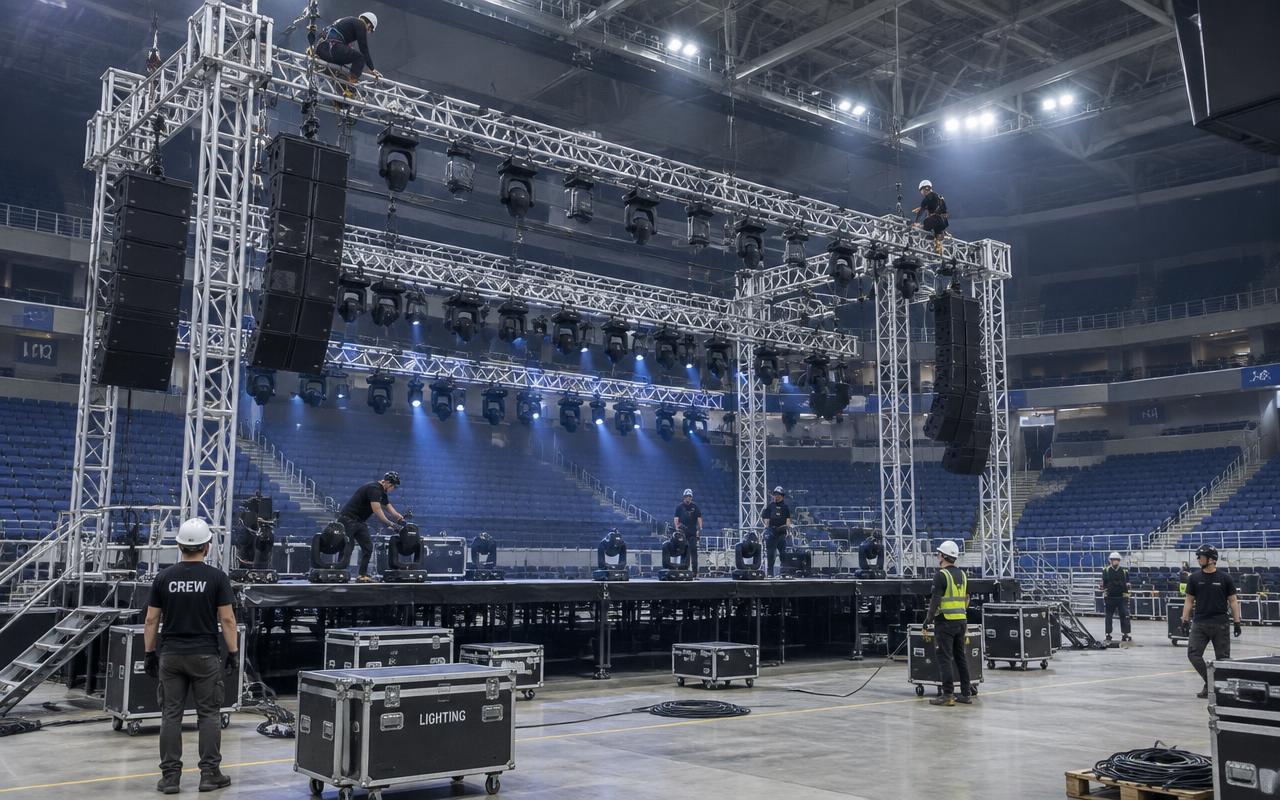
Structure is the one department where getting it wrong is not an aesthetic problem. Every stage and truss build starts from a load case: the dead load of the structure itself, the live load of performers and crew, the suspended loads of lighting, audio and LED, and — outdoors — wind load on any banner, roof or solid surface. We specify from manufacturer load tables for the exact truss type and span, with chain hoists rated well above the working load and point loads calculated per leg. Decks are Layher or aluminium framed systems with a published uniform load rating, and a performance stage is typically designed for 500 kg per square metre of distributed live load.
Everything here is set by the building and the ground: documented rigging capacity, floor loading, ceiling trim and whether there is room for towers to carry load to the floor. In Aurangabad that plays out at venues like Rama International, Vivanta Aurangabad, Prozone grounds, and across CIDCO, Jalna Road, Osmanpura, Beed Bypass.
Ground support and roof systems are where wind becomes the governing factor. A solid or banner-clad roof is a sail, and the force on it rises with the square of wind speed, so every roof design comes with a wind management plan: a speed at which banners are removed, a higher speed at which the roof is lowered or the show stops, and a ballast or ground-anchor scheme calculated for the site's surface. Ballast is not a number we guess — concrete blocks or water ballast are specified against the structure's overturning calculation, and soft ground needs load-spreading plates or a different anchoring approach entirely.
What’s included
- Layher & aluminium deck stages
- Ground support & roof systems
- Motorised chain hoists
- Structural load calculations
Equipment we carry
Why Aurangabad chooses Prime AV
- Crews and trucks positioned for fast load-in at Tapadiya Natya Mandir and venues in Beed Bypass and Waluj.
- We require written sign-off on point loads and, where it is not forthcoming, quote a ground support system that carries its own load to the floor.
- Structural load calculations covering dead, live, suspended and wind cases
- Working knowledge of Maharashtra venue rules, power sanctions and permission timelines.
Local conditions
Producing stage & truss setup in Aurangabad
Weather & the rig
Structure is the department wind and rain act on directly — a clad roof behaves as a sail, ballast sinks into saturated ground, and the wind plan is written against the site's actual conditions. Marathwada is a drought-prone rain-shadow region, and the practical consequence for production is unusual: water for dust suppression has to be sourced and paid for as a line item, which is not true of any other city in this set. Summers reach 41–42°C with dry heat and a fine basalt dust that fouls filters. Winter nights at 10–12°C on the plateau are dry and clear, which makes the October to February window genuinely dependable for outdoor work. Jun–Sep monsoon, though Marathwada's rainfall is erratic enough that the greater planning risk in Apr–May is water availability and heat rather than rain.
Power & redundancy
Motorised hoists and the loading sequence need a reliable supply early in the build, well before the event distribution is energised, so structure usually works off its own temporary feed. MSEDCL supply across the Waluj and Shendra MIDC belt is industrial-grade and stable, so a plant event can run on the factory's own feed with a changeover. Rural and heritage-adjacent venues towards Ellora sit on weaker feeders and need DG as the primary source. Maharashtra's acoustic enclosure requirement and the 10pm cut apply, enforced by MPCB.
Permits & noise rules
Stages, roofs and ground support frequently need structural sign-off and local authority approval in their own right, separate from the event permission itself. The municipal corporation grants ground and structure permission and the city police commissionerate licenses loudspeakers and gatherings, with MPCB applying the noise standards. The decisive layer for anything on the heritage circuit is the Archaeological Survey of India, which controls Ajanta, Ellora, Bibi Ka Maqbara and Daulatabad — no structures, fixings, amplified sound or drones within the protected limits without permission, and Ajanta specifically restricts lighting anywhere near the painted caves because of the conservation risk. Chikalthana airport sits inside the city, narrowing the usable drone airspace.
Load-in & access
Truss, decks and ballast are the heaviest and bulkiest loads on the job and must arrive first, which makes gate width, ground bearing and crane or forklift access the controlling constraints. The Samruddhi Mahamarg has transformed access: Mumbai is now around six hours and Nagpur similar, where both used to be a full day, so metro-grade inventory can reach the city on an overnight run. Jalna Road and the Beed Bypass take large trucks. The walled old city around Gulmandi, City Chowk and the historic gates is tight, and the runs out to Ellora at 30km and Ajanta at 100km are on roads that a 32-ft truck travels slowly.
Season & booking
The Ellora-Ajanta Aurangabad Festival runs in the winter months and takes local staging and sound. The October to February tourist high season fills the hotels, which compresses crew accommodation and raises its cost at exactly the time the wedding and conference seasons peak. Ganesh Chaturthi and Dussehra bring the MIDC townships' own mandal events. Peak demand runs Oct–Feb.
Crew & dispatch
Served from the Mumbai base over the Samruddhi expressway in about six hours, with Pune as an alternative origin, and local labour, DG and water tankers arranged in the city. Load-in support covers Beed Bypass, Waluj and the rest of the city.
What it costs here
MIDC clients buy to a corporate standard and will pay for documented reliability on a dealer conference, while local social events are price-sensitive. The honest framing is that the Samruddhi link has cut the travel loading this market used to carry, and the saving should show in the quotation.
Local expectations
Plant and dealer events here are safety-governed in a way social-events suppliers consistently get wrong: permit-to-work discipline, hot-work clearance for any rigging inside a plant, height-work certification and PPE compliance for every crew member are prerequisites for entry, not preferences. Marathi compering with Hindi for visiting dealers. Heritage-circuit MICE expects a cultural evening with classical or Marathwada folk programming and the restrained production a monument setting demands.
Specification
Stage & Truss Fabrication: technical specification
| Specification | Detail |
|---|---|
| Deck systems | Layher Allround and aluminium-framed modular decks with published load ratings |
| Live load design | Typically 500 kg per square metre distributed for performance stages |
| Truss types | 300 – 600 mm box and triangular truss, specified from manufacturer span and load tables |
| Chain hoists | Electric hoists in 500 kg – 2 t capacities, rated well above working load, inspected per build |
| Rigging safety factor | Hardware used within rated capacity with the factor appropriate to lifting over people |
| Roof systems | Ground support and mother-grid roofs with a documented wind management plan |
| Wind thresholds | Staged limits for banner removal, roof lowering and show stop, set per structure and site |
| Ballast | Concrete or water ballast calculated against the overturning case, with load-spreading on soft ground |
| Stage heights | 0.6 m to 2.4 m with code-compliant stairs, handrails and edge protection |
| Documentation | Load calculations, point-load report, hoist inspection records and a build sign-off |
The rigging discipline on site is what turns a design into a safe build. Hoists are inspected, chains checked for wear, steels and shackles used within rated capacity with a safety factor appropriate to lifting over people. Every hang point is bonded, every hoist is controlled from a single position, and nothing moves while people are underneath. We run a pre-show structural check after the full rig is loaded and again before doors, because a structure that was correct when empty can reveal a problem once 2 tonnes of lighting and LED is on it. The build sequence, the bolt torque, the hoist inspection and the final sign-off are all documented.
Sizing
What size rig does your event actually need?
| Scale | Guests | Recommended setup |
|---|---|---|
| Conference stage | 200 – 600 | 10 m x 6 m deck at 0.6 m, front truss on two uprights, 1 t suspended load |
| Wedding stage | 400 – 1,200 | 12 m x 8 m deck at 0.9 m with ramps, four uprights and a decor-integrated grid |
| Launch stage | 1,000 – 3,000 | 16 m x 10 m deck at 1.2 m, ground support grid, 3 – 5 t suspended load |
| Concert stage | 5,000 – 15,000 | 18 m x 12 m deck at 1.8 m, roof system, PA wings, 10 – 15 t suspended load |
| Festival main stage | 20,000+ | 24 m x 16 m with 2.4 m deck, engineered roof, mother grid, ballast and wind plan |
Scope
Stage & Truss Setup scope tiers in Aurangabad
Modular Stage
Conference and wedding stages up to 100 sq m with a front truss
- Modular deck stage with skirting, stairs and edge protection
- Front and side truss on uprights with load calculations
- Point-load report issued to the venue
- Certified rigging crew and hoist inspection records
- Build and strike within the venue's load-in window
Ground Support System
Concert and launch stages, 150 – 400 sq m with a flown grid
- Ground support towers and a mother grid rated for the full rig load
- Motorised chain hoists with a single controlled lifting position
- Structural calculations covering dead, live and suspended loads
- Ballast scheme calculated against the overturning case
- Crew chief, certified riggers and a documented build sequence
Roof & Custom Structure
Festival stages, outdoor concerts and bespoke scenic structures
- Engineered roof system with a site-specific wind management plan
- Staged wind thresholds for banner removal, lowering and show stop
- Ground anchoring or ballast designed for the actual surface
- Pre-show structural checks after loading and again before doors
- Full rigging department with a nominated competent person on site
MIDC clients buy to a corporate standard and will pay for documented reliability on a dealer conference, while local social events are price-sensitive. The honest framing is that the Samruddhi link has cut the travel loading this market used to carry, and the saving should show in the quotation.
Venues
Where we work in Aurangabad
| Venue | Capacity | Production note |
|---|---|---|
| Rama International | Several hundred banquet plus lawns at Chikalthana | On the airport road with straightforward highway truck access, which makes it the city's simplest large load-in and the practical base for a fly-in dealer meet. |
| Vivanta Aurangabad | Several hundred across banquet space and gardens | Heritage-style gardens where mature planting and the property's own guest-amenity rules dictate where towers and generators may stand, which usually means longer cable runs than the drawing assumed. |
| Prozone grounds | Several thousand on open ground beside the mall | Flat and well-connected but generated end to end, with Marathwada's fine basalt dust needing suppression and matting — and water for that suppression is itself a scarce, costed input in this district. |
| Tapadiya Natya Mandir | Around 1,000 seated | A traditional theatre with fixed seating and house rigging, where the build window between programmes is short and the proscenium geometry fixes the screen position. |
| MGM Rukmini Auditorium | Around 1,200 seated | A campus auditorium with institutional approvals and a vehicle gate process, used heavily for convocations and cultural programming in the winter months. |
Crew
Who turns up on show day
- Structural designer
Produces the load case and the calculations, specifies truss and hoist capacities and signs the point-load report.
- Crew chief
Owns the build sequence and the clock, and holds the authority to stop the build if anything departs from the drawing.
- Lead rigger
Inspects hoists and hardware, controls all lifting from a single position and signs off before anything goes to trim.
- Stage carpenter
Builds decks to level, fits stairs, handrails and edge protection, and closes every gap a heel or a cable could find.
- Competent person on site
Performs the structural checks after loading and before doors, and owns the wind management decisions on an outdoor roof.
What you receive
- Structural load calculations covering dead, live, suspended and wind cases
- Point-load report per leg issued to the venue or structural engineer
- Stage and truss CAD drawing with dimensions, heights and trim
- Hoist and rigging hardware inspection records for the build
- Ballast or ground-anchoring scheme with the overturning calculation
- Wind management plan with staged thresholds for outdoor roof systems
- Signed build completion and pre-doors structural check record
Timeline
From enquiry to load-out
- T-6 weeks
Load case and design
Dead, live, suspended and wind loads established from every department's requirements, then truss and hoist capacities specified.
- T-4 weeks
Calculations issued
Structural calculations, point-load report and ballast scheme sent to the venue or the appointed structural engineer for sign-off.
- T-3 weeks
Site and ground assessment
Surface bearing capacity, levels, access routes and anchoring feasibility checked on site for outdoor builds.
- Show day −3 to −1
Build
Decks, towers, grid and roof built in documented sequence with bolt torque and hoist inspection recorded.
- Show day −1
Load and structural check
Departments load the grid, then a structural check is performed with the rig in place and again before doors.
- Show +4 to +24 hours
Strike
De-rig in reverse build order with lifting operations supervised and the area cleared of all other crew.
Risk control
What goes wrong, and how we stop it
What can go wrong
How we prevent it
- What can go wrong
The venue quotes a rigging capacity that turns out to be an assumption rather than a calculation.
How we prevent itWe require written sign-off on point loads and, where it is not forthcoming, quote a ground support system that carries its own load to the floor.
- What can go wrong
Stage gaps and unprotected edges become an injury risk once performers and guests are moving fast.
How we prevent itDeck gaps are closed and taped, edge protection and handrails are fitted to code, and the carpenter walks the whole deck surface before anyone is allowed on it.
- What can go wrong
Lifting continues while other crew work underneath because the build is behind schedule.
How we prevent itAll lifting is controlled from a single position with the area cleared, and the crew chief has explicit authority to stop a build that is being rushed.
- What can go wrong
Departments add lighting, LED and audio beyond the load the grid was designed for.
How we prevent itA single suspended-load budget is published at T-4 weeks and every department's weight is booked against it; anything added later triggers a recalculation before it is hung.
Honest comparison
Is this the right choice for your event?
- Scaffold stage instead of a modular deck systemOur verdict
Scaffold is cheaper and infinitely adaptable, and for a long-run outdoor build on uneven ground it is often the sensible choice. Modular decks are faster, flatter, quieter underfoot and look finished without extra cladding.
- A roof system instead of a tent or shamiana over the stageOur verdict
A fabric structure is cheaper and keeps rain off people, but it will not carry lighting or audio load and its own wind behaviour is usually undocumented. If anything needs to hang above the stage, it needs an engineered roof.
- Lower stage height to save cost and build timeOur verdict
Often a good call indoors where the audience is close. On a deep standing audience, a 0.6 m stage means the back two thirds see nothing, and IMAG screens become the only reason they stay — which costs far more than the deck did.
Demand
What Aurangabad books most
Aurangabad event mix
- Industrial and dealer conferences for the MIDC belt
- Heritage-circuit MICE and incentive programmes
- Weddings across the CIDCO and Jalna Road belt
- Vendor and supplier exhibitions
- Educational institution events and convocations
- Cultural festivals and classical programming
Ideal for
Events we power with stage & truss fabrication in Aurangabad
Process
From brief to standing ovation
01
Brief & recce
We visit the venue, map power and rigging, and understand your show flow.
02
Design & quote
CAD plans, 3D previews and an itemised quote within 24 hours.
03
Build & rehearse
Load-in, system tuning, content checks and full technical rehearsal.
04
Show & strike
Show-caller-led execution, then a quick, clean load-out.
FAQ
Stage & Truss Setup in Aurangabad: FAQs
More services in Aurangabad
Stage & Truss Setup in nearby cities
Areas we cover in Aurangabad
Events in Aurangabad