Lighting & Stage · Nashik, Maharashtra
Stage & Truss Setup in Nashik
In Nashik, vineyard destination weddings and receptions set the standard everything else is measured against. Our stage & truss fabrication is specified to clear that bar at Sula Vineyards and anywhere else in the city.
- Lead time
- From 6 weeks
- Peak season
- Oct–Feb
- Coverage
- Nashik & Maharashtra
Key takeaway
Stage & Truss Fabrication for Nashik’s biggest events
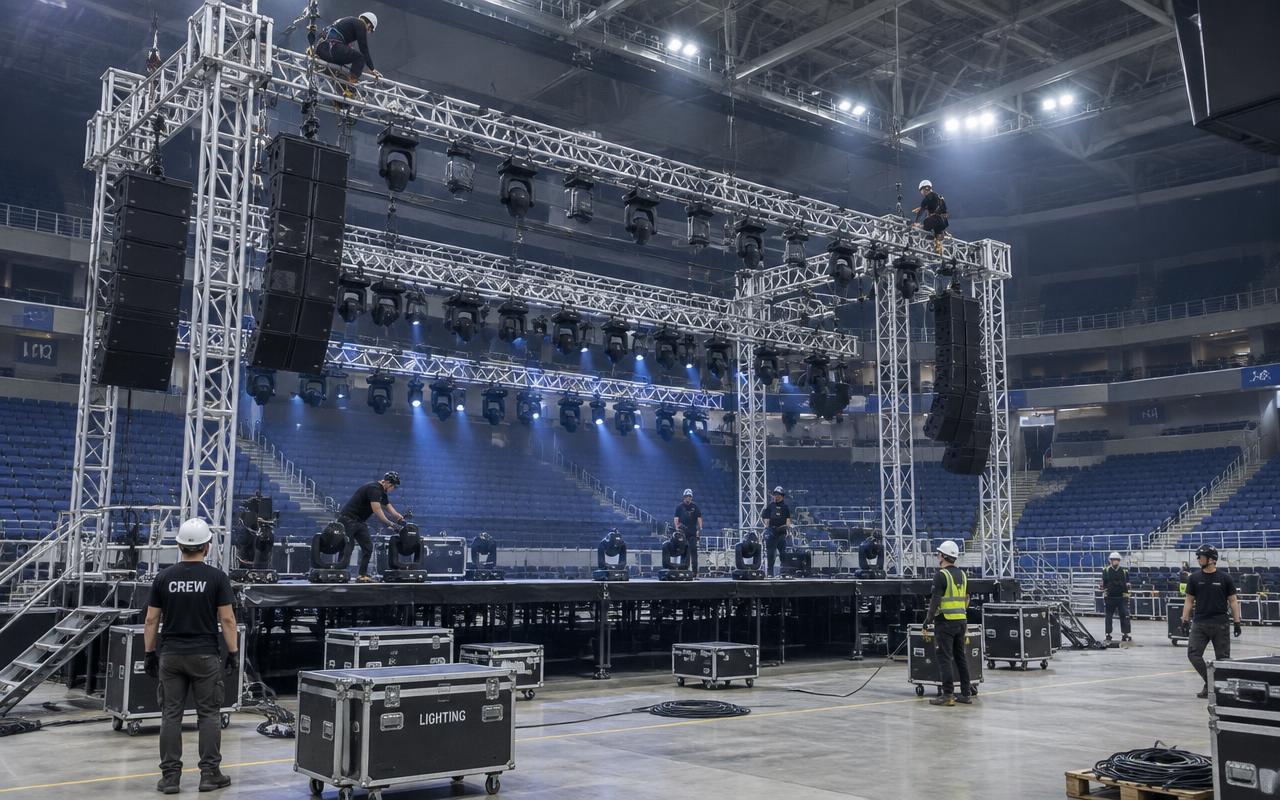
Structure is the one department where getting it wrong is not an aesthetic problem. Every stage and truss build starts from a load case: the dead load of the structure itself, the live load of performers and crew, the suspended loads of lighting, audio and LED, and — outdoors — wind load on any banner, roof or solid surface. We specify from manufacturer load tables for the exact truss type and span, with chain hoists rated well above the working load and point loads calculated per leg. Decks are Layher or aluminium framed systems with a published uniform load rating, and a performance stage is typically designed for 500 kg per square metre of distributed live load.
Everything here is set by the building and the ground: documented rigging capacity, floor loading, ceiling trim and whether there is room for towers to carry load to the floor. In Nashik that plays out at venues like Sula Vineyards, Express Inn, Gangapur Road lawns, and across Gangapur Road, College Road, Indira Nagar, Pathardi Phata.
Ground support and roof systems are where wind becomes the governing factor. A solid or banner-clad roof is a sail, and the force on it rises with the square of wind speed, so every roof design comes with a wind management plan: a speed at which banners are removed, a higher speed at which the roof is lowered or the show stops, and a ballast or ground-anchor scheme calculated for the site's surface. Ballast is not a number we guess — concrete blocks or water ballast are specified against the structure's overturning calculation, and soft ground needs load-spreading plates or a different anchoring approach entirely.
What’s included
- Layher & aluminium deck stages
- Ground support & roof systems
- Motorised chain hoists
- Structural load calculations
Equipment we carry
Why Nashik chooses Prime AV
- Crews and trucks positioned for fast load-in at Gangapur Road lawns and venues in Indira Nagar and Pathardi Phata.
- All lifting is controlled from a single position with the area cleared, and the crew chief has explicit authority to stop a build that is being rushed.
- Wind management plan with staged thresholds for outdoor roof systems
- Working knowledge of Maharashtra venue rules, power sanctions and permission timelines.
Local conditions
Producing stage & truss setup in Nashik
Weather & the rig
Structure is the department wind and rain act on directly — a clad roof behaves as a sail, ballast sinks into saturated ground, and the wind plan is written against the site's actual conditions. At 700m on the eastern edge of the Western Ghats, Nashik has the coldest winter nights in Maharashtra at 7–9°C in December and January, which is genuinely cold for guests at an outdoor vineyard dinner and needs heating in the plan. The vineyard belt itself catches Ghats weather, so June to September rainfall is heavy and the shoulder months bring evening wind across open vineyard ground that an unballasted structure cannot take. The dry, cool November to February air is precisely why the vineyard wedding season works at all. Jun–Sep, when estate roads turn to mud and lawn and vineyard venues are unusable for a build; also the SulaFest window in late January or February if the estate itself is the venue you need.
Power & redundancy
Motorised hoists and the loading sequence need a reliable supply early in the build, well before the event distribution is energised, so structure usually works off its own temporary feed. MSEDCL supply in the city and the MIDC belt is stable, but the vineyards and farm venues sit at the end of rural feeders with sanctioned loads that will not carry a show, so a vineyard event is a full DG design — sets placed downwind, acoustically screened from the dining terrace, and cabled a long way in. Maharashtra's acoustic enclosure rule and the 10pm cut apply.
Permits & noise rules
Stages, roofs and ground support frequently need structural sign-off and local authority approval in their own right, separate from the event permission itself. Which authority applies depends on where the venue sits: Nashik Municipal Corporation inside city limits, and the Collector or Gram Panchayat route outside them, which is where most of the vineyards are and which is a slower and less predictable approval path. Nashik Police license loudspeakers and gatherings, MPCB applies the noise standards, and Trimbakeshwar and the Godavari ghats carry religious-site sensitivities on top. Ozar airport and the HAL facility restrict drone flight north of the city.
Load-in & access
Truss, decks and ballast are the heaviest and bulkiest loads on the job and must arrive first, which makes gate width, ground bearing and crane or forklift access the controlling constraints. Nashik is four hours from Mumbai and five from Pune on good highway, which makes it the most practical destination-wedding market for Mumbai inventory. The last mile is the whole problem: estate roads are single-lane with gradients and soft shoulders, a loaded 32-ft trailer cannot turn inside most vineyards, so kit transfers to tractors or small trucks at the gate and trackway is laid over soft ground for every tower position.
Season & booking
The November to February vineyard wedding and festival season is the commercial core of the year. SulaFest in late January or February takes the estate and a substantial share of the region's staging and sound. The Nashik Kumbh Mela, on its roughly twelve-year cycle, transforms the city's infrastructure for months when it falls, and Ram Navami at the Kalaram temple and the Godavari ghat festivals commit local sound labour each year. Peak demand runs Oct–Feb.
Crew & dispatch
Served from the Mumbai base, four hours up the Kasara ghat route, which is close enough to rotate crew daily rather than house them for a long vineyard build. Load-in support covers Indira Nagar, Pathardi Phata and the rest of the city.
What it costs here
Vineyard weddings carry a premium and should, because the terrain, the full DG design, the trackway and the extended build window are genuine costs. City-side pharma and engineering conferences price closer to Pune's competitive level.
Local expectations
The vineyard brief is atmosphere rather than wattage: festoon and warm wash lighting that flatters vine rows, discreet speaker placement for a seated dinner, and a sound design that works at conversational level with a dance floor added later rather than a concert system turned down. Marathi compering for local and civic events. The guest list usually comes from Mumbai and Pune and expects metro-grade finish in a rural setting, which means the generator, the cable matting and the crew uniform all show.
Specification
Stage & Truss Fabrication: technical specification
| Specification | Detail |
|---|---|
| Deck systems | Layher Allround and aluminium-framed modular decks with published load ratings |
| Live load design | Typically 500 kg per square metre distributed for performance stages |
| Truss types | 300 – 600 mm box and triangular truss, specified from manufacturer span and load tables |
| Chain hoists | Electric hoists in 500 kg – 2 t capacities, rated well above working load, inspected per build |
| Rigging safety factor | Hardware used within rated capacity with the factor appropriate to lifting over people |
| Roof systems | Ground support and mother-grid roofs with a documented wind management plan |
| Wind thresholds | Staged limits for banner removal, roof lowering and show stop, set per structure and site |
| Ballast | Concrete or water ballast calculated against the overturning case, with load-spreading on soft ground |
| Stage heights | 0.6 m to 2.4 m with code-compliant stairs, handrails and edge protection |
| Documentation | Load calculations, point-load report, hoist inspection records and a build sign-off |
The rigging discipline on site is what turns a design into a safe build. Hoists are inspected, chains checked for wear, steels and shackles used within rated capacity with a safety factor appropriate to lifting over people. Every hang point is bonded, every hoist is controlled from a single position, and nothing moves while people are underneath. We run a pre-show structural check after the full rig is loaded and again before doors, because a structure that was correct when empty can reveal a problem once 2 tonnes of lighting and LED is on it. The build sequence, the bolt torque, the hoist inspection and the final sign-off are all documented.
Sizing
What size rig does your event actually need?
| Scale | Guests | Recommended setup |
|---|---|---|
| Conference stage | 200 – 600 | 10 m x 6 m deck at 0.6 m, front truss on two uprights, 1 t suspended load |
| Wedding stage | 400 – 1,200 | 12 m x 8 m deck at 0.9 m with ramps, four uprights and a decor-integrated grid |
| Launch stage | 1,000 – 3,000 | 16 m x 10 m deck at 1.2 m, ground support grid, 3 – 5 t suspended load |
| Concert stage | 5,000 – 15,000 | 18 m x 12 m deck at 1.8 m, roof system, PA wings, 10 – 15 t suspended load |
| Festival main stage | 20,000+ | 24 m x 16 m with 2.4 m deck, engineered roof, mother grid, ballast and wind plan |
Scope
Stage & Truss Setup scope tiers in Nashik
Modular Stage
Conference and wedding stages up to 100 sq m with a front truss
- Modular deck stage with skirting, stairs and edge protection
- Front and side truss on uprights with load calculations
- Point-load report issued to the venue
- Certified rigging crew and hoist inspection records
- Build and strike within the venue's load-in window
Ground Support System
Concert and launch stages, 150 – 400 sq m with a flown grid
- Ground support towers and a mother grid rated for the full rig load
- Motorised chain hoists with a single controlled lifting position
- Structural calculations covering dead, live and suspended loads
- Ballast scheme calculated against the overturning case
- Crew chief, certified riggers and a documented build sequence
Roof & Custom Structure
Festival stages, outdoor concerts and bespoke scenic structures
- Engineered roof system with a site-specific wind management plan
- Staged wind thresholds for banner removal, lowering and show stop
- Ground anchoring or ballast designed for the actual surface
- Pre-show structural checks after loading and again before doors
- Full rigging department with a nominated competent person on site
Vineyard weddings carry a premium and should, because the terrain, the full DG design, the trackway and the extended build window are genuine costs. City-side pharma and engineering conferences price closer to Pune's competitive level.
Venues
Where we work in Nashik
| Venue | Capacity | Production note |
|---|---|---|
| Sula Vineyards | A few hundred for seated dinners up to several thousand for festival configuration | Rolling terrain with soft soil between the vine rows, no fixed rigging anywhere, long cable runs from a single usable power point, and a strict discipline on vehicle movement because a truck off the track damages vines that take years to replace. |
| Express Inn | Over 1,000 in the pillarless banquet hall at Pathardi Phata | The city's largest convention hotel with proper dock access and reliable house power, which makes it the only venue in Nashik where a corporate conference can be built without a generator plan. |
| Gangapur Road lawns | Typically 500–2,000 across lawn and farmhouse venues | Open-air and generated, sitting on rural feeders with modest sanctioned loads, and close enough to housing that the 10pm cut is enforced on complaint rather than on principle. |
| Kalidas Kala Mandir | Around 1,000 seated | A civic auditorium with fixed seating and house rigging, booked through the municipal corporation with a short changeover window between programmes. |
| York and Soma estate venues | A few hundred across terraces and lawns | Smaller vineyard properties where the access road is single-lane with gradients, so the rig is sized to what a small truck can bring in over several trips rather than to the design brief. |
Crew
Who turns up on show day
- Structural designer
Produces the load case and the calculations, specifies truss and hoist capacities and signs the point-load report.
- Crew chief
Owns the build sequence and the clock, and holds the authority to stop the build if anything departs from the drawing.
- Lead rigger
Inspects hoists and hardware, controls all lifting from a single position and signs off before anything goes to trim.
- Stage carpenter
Builds decks to level, fits stairs, handrails and edge protection, and closes every gap a heel or a cable could find.
- Competent person on site
Performs the structural checks after loading and before doors, and owns the wind management decisions on an outdoor roof.
What you receive
- Structural load calculations covering dead, live, suspended and wind cases
- Point-load report per leg issued to the venue or structural engineer
- Stage and truss CAD drawing with dimensions, heights and trim
- Hoist and rigging hardware inspection records for the build
- Ballast or ground-anchoring scheme with the overturning calculation
- Wind management plan with staged thresholds for outdoor roof systems
- Signed build completion and pre-doors structural check record
Timeline
From enquiry to load-out
- T-6 weeks
Load case and design
Dead, live, suspended and wind loads established from every department's requirements, then truss and hoist capacities specified.
- T-4 weeks
Calculations issued
Structural calculations, point-load report and ballast scheme sent to the venue or the appointed structural engineer for sign-off.
- T-3 weeks
Site and ground assessment
Surface bearing capacity, levels, access routes and anchoring feasibility checked on site for outdoor builds.
- Show day −3 to −1
Build
Decks, towers, grid and roof built in documented sequence with bolt torque and hoist inspection recorded.
- Show day −1
Load and structural check
Departments load the grid, then a structural check is performed with the rig in place and again before doors.
- Show +4 to +24 hours
Strike
De-rig in reverse build order with lifting operations supervised and the area cleared of all other crew.
Risk control
What goes wrong, and how we stop it
What can go wrong
How we prevent it
- What can go wrong
Lifting continues while other crew work underneath because the build is behind schedule.
How we prevent itAll lifting is controlled from a single position with the area cleared, and the crew chief has explicit authority to stop a build that is being rushed.
- What can go wrong
Departments add lighting, LED and audio beyond the load the grid was designed for.
How we prevent itA single suspended-load budget is published at T-4 weeks and every department's weight is booked against it; anything added later triggers a recalculation before it is hung.
- What can go wrong
A banner-clad roof becomes a sail and the structure approaches its overturning limit in a squall.
How we prevent itThe wind management plan sets a numeric speed at which banners come off and a higher one at which the roof is lowered, with an anemometer on site and a named person empowered to act.
- What can go wrong
Ballast is placed on soft or wet ground and begins to sink, taking the structure out of plumb.
How we prevent itGround bearing capacity is assessed before the build, load-spreading plates are specified for soft surfaces, and plumb is re-checked after the first night.
Honest comparison
Is this the right choice for your event?
- Scaffold stage instead of a modular deck systemOur verdict
Scaffold is cheaper and infinitely adaptable, and for a long-run outdoor build on uneven ground it is often the sensible choice. Modular decks are faster, flatter, quieter underfoot and look finished without extra cladding.
- A roof system instead of a tent or shamiana over the stageOur verdict
A fabric structure is cheaper and keeps rain off people, but it will not carry lighting or audio load and its own wind behaviour is usually undocumented. If anything needs to hang above the stage, it needs an engineered roof.
- Lower stage height to save cost and build timeOur verdict
Often a good call indoors where the audience is close. On a deep standing audience, a 0.6 m stage means the back two thirds see nothing, and IMAG screens become the only reason they stay — which costs far more than the deck did.
Demand
What Nashik books most
Nashik event mix
- Vineyard destination weddings and receptions
- Wine, music and lifestyle festivals
- Corporate offsites and leadership retreats from Mumbai and Pune
- Pharma and engineering conferences for the MIDC belt
- Religious and pilgrimage events on the Godavari ghats
- Agricultural and horticultural exhibitions
Ideal for
Events we power with stage & truss fabrication in Nashik
Process
From brief to standing ovation
01
Brief & recce
We visit the venue, map power and rigging, and understand your show flow.
02
Design & quote
CAD plans, 3D previews and an itemised quote within 24 hours.
03
Build & rehearse
Load-in, system tuning, content checks and full technical rehearsal.
04
Show & strike
Show-caller-led execution, then a quick, clean load-out.
FAQ
Stage & Truss Setup in Nashik: FAQs
More services in Nashik
Stage & Truss Setup in nearby cities
Areas we cover in Nashik
Events in Nashik