Key takeaway
Key takeaways
- Count functions, not days — mehendi, sangeet, pheras and reception are four different technical briefs sharing one crew
- Changeover windows are the real constraint; when two functions sit hours apart in different parts of a property, duplicating a rig beats moving one
- Lighting is specified for the camera as much as for the eye — one white point per function is what keeps the photographs consistent
- A noise curfew compresses the whole evening, which pushes the sangeet and the after-party into a shorter window and changes the schedule, not just the volume
- Family performances carry a rehearsal load that professional acts do not, and it belongs in the plan from the start
You are not booking an evening, you are booking a grid
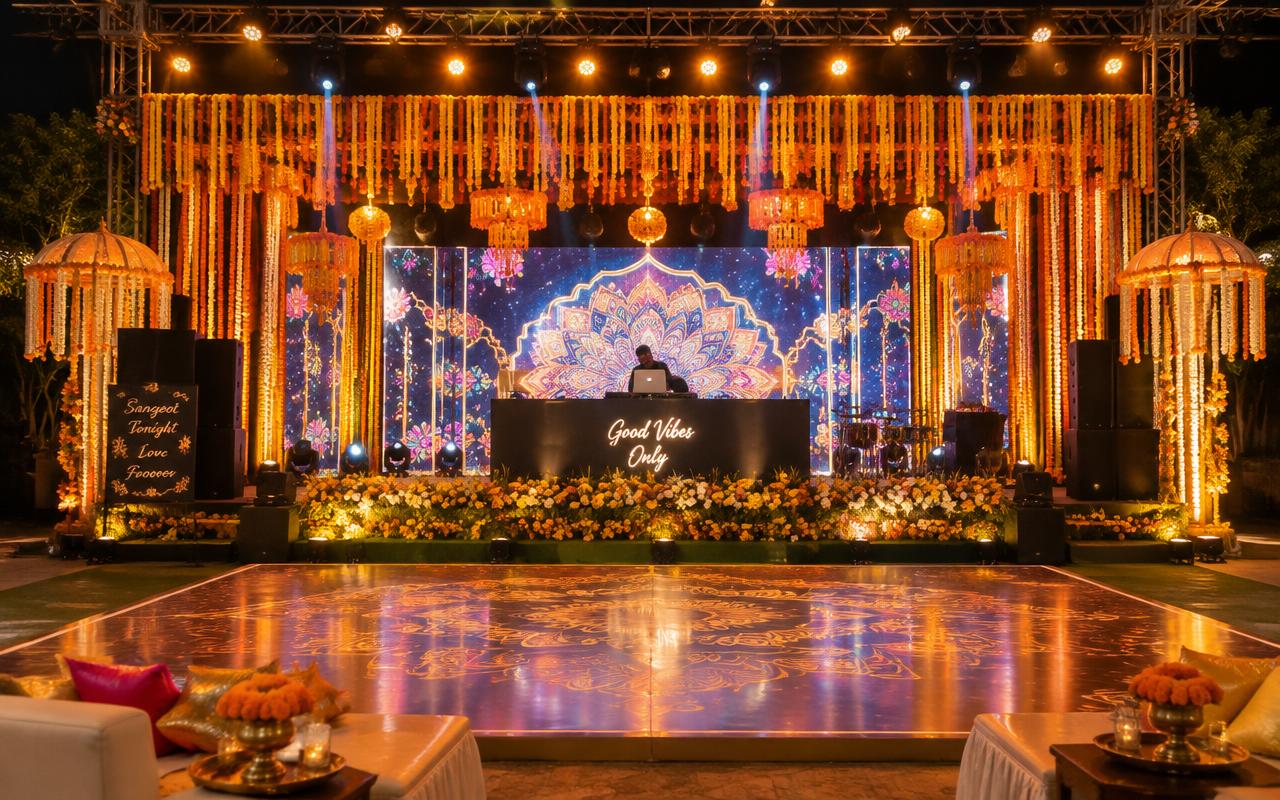
The most common misunderstanding in a wedding AV conversation is scale. Families picture the reception — the biggest stage, the loudest moment — and assume everything else is a smaller version of it. In practice the mehendi wants gentle daytime coverage and a live dholak that will not ring, the sangeet is a rehearsed performance show with a cue stack, the pheras need the system to be nearly invisible while the mantras stay intelligible, and the reception is speech first and a dance floor second. Four briefs, four designs, one crew moving between them. The grid is the quote.
The function grid: what to send a producer before asking for a number
Functions and timings
- Every function by name, with date, start time and expected finish
- Which space each one uses, and whether two functions share a space on the same day
- The gap between consecutive functions in the same space, in hours
- Guest count per function, which often varies more than families expect
Content of each function
- Live musicians, and whether they bring their own backline
- Choreographed performances, how many, and whether family members are performing
- Speeches, vows, a pandit's recitation — anything where intelligibility cannot fail
- Films, montages or live camera relay that need a screen and a playback operator
Site constraints
- The local noise curfew hour, and whether the venue enforces an earlier one
- Power available on site, and whether a generator is the venue's or yours to arrange
- Load-in hours, dock access and any restriction on trucks moving while guests are present
- The decorator's drape and mandap plan, as early as it exists in any form
How scope actually steps up across a wedding
Single function
One evening — a sangeet or a reception — for a few hundred guests
- Compact PA with distributed fills rather than one loud central cluster
- Uplighting across drapes and perimeter, colour-matched to the decor palette
- A small moving-head rig over the stage and dance floor
- A modest LED backdrop with content playback
- Sound engineer, lighting operator and a technician
Full wedding weekend
Three or four functions across two or three days on one property
- A separate zone design per function with rehearsed, timed changeovers
- Pixel-mapped decor lighting plus pin spots on the mandap, the cake and the entry walk
- A performance rig for the sangeet with monitors and in-ear sends
- LED surface carrying live relay of the entries from two cameras
- Full-time crew across every function, including a named show-caller
Destination production
Palace, resort and multi-venue weddings where functions sit far apart
- Separate builds for lawn, ballroom and poolside treated as distinct venues
- Duplicated systems so no function waits on another's de-rig
- Façade and landscape lighting as part of the design rather than an add-on
- Weatherised outdoor rig with covered racks and a tented control position
- Travelling crew, local labour coordination and a full spares inventory
Lighting is specified for the camera, not only for the room
The photographs and the film are what the family keeps, and they are unforgiving in a way the eye is not. A mandap lit warm while the decor behind it is lit cool produces a colour cast no editor can fully rescue, and faces lit only from above lose their shape on camera. So the lighting plan fixes a single warm reference white point per function, and every fixture is set against the decorator's actual fabric samples rather than a hex code, because LED fixtures render saturated colour differently from a screen. Front light on the mandap, the cake and the entry walk exists for the lens. It is also, incidentally, what makes the room look expensive.
Why the crew line does not shrink when the rig does
- Show-caller
Holds the running order against a family timeline that moves constantly, cues entries, and keeps sound, lighting and video in step when the schedule slips — which it will.
- Sound engineer
Mixes speech, live musicians and performances, and keeps ceremony level low enough to stay transparent while remaining intelligible past the third row.
- Lighting programmer
Builds and runs the cue stack for entries, performances and the first dance, and colour-matches every fixture to the decor samples at focus.
- Microphone technician
Fits and checks lavaliers and headsets, stays within arm's reach of the mandap, and swaps a failing pack without anyone in the room noticing.
- Changeover crew lead
Owns the clock between functions — strike, rebuild, test and clear the room before guests return. On a compressed grid this is the role that protects the whole weekend.
The planning sequence that keeps a multi-function build calm
- T-8 weeks
Decor alignment
The decorator's palette, drape plan and mandap design come first, and speaker positions and fixture placements are designed around them. Arguing about a speaker position after the drapes are made has only one outcome.
- T-4 weeks
Function-by-function plan
Zone plans, microphone counts, changeover sequence and power requirement issued per function, so the family can see what each one carries rather than one undifferentiated total.
- T-2 weeks
Content and cue build
Entry tracks, performance audio, LED content and the lighting cue stack are assembled and reviewed with the family and the planner — the stage where most late surprises surface.
- Show day −1
Rehearsal
Performers rehearse with the full system on the actual stage, entries are walked, and every microphone is checked in its real position. Family performers need more of this than professional acts do.
- Day 1 onwards
Function days
Crew works each function live while the changeover team runs the clock behind them, against the published guest schedule rather than the optimistic one.
- After the final function
Strike
De-rig in the order the venue mandates, with decor-integrated fixtures removed alongside the decor team so nothing is pulled through a floral structure in the dark.
What goes wrong on weddings, and what prevents it
What can go wrong
How we prevent it
- What can go wrong
The pandit's recitation is inaudible past the third row because decor claimed every sensible speaker position.
How we prevent itAgree positions with the decorator while the drape and mandap plans are still on paper, and carry slim-column cabinets and decor-matched finishes for positions where a visible box is unacceptable.
- What can go wrong
A lavalier fails during the vows, and that moment cannot be run again.
How we prevent itTwo packs on the couple and the officiant wherever it can be dressed, a technician within reach of the mandap, and a dressed handheld already live on a held frequency.
- What can go wrong
The changeover between the ceremony and the reception overruns and guests walk into a half-built room.
How we prevent itRehearse the changeover as a timed drill and duplicate anything that cannot be struck and rebuilt inside the real window, rather than hoping to move it faster on the night.
- What can go wrong
Sangeet dance-floor level drives older guests out of the room entirely.
How we prevent itZone the system so the floor runs hot while dining sits well below it, achieved with directional cabinets and separate level control rather than by asking the DJ to pull the whole room down.
- What can go wrong
An evening shower on a lawn build takes out uplighters and an amplifier rack.
How we prevent itIP-rated battery fixtures on decor positions, racks on raised deck under hard cover, cable runs away from low ground, and a canopy decision taken on the forecast at a fixed hour rather than on the first drop.
- What can go wrong
The curfew arrives with two performances still unperformed.
How we prevent itBuild the running order backwards from the curfew hour with the planner, agree in advance which items are cut if the schedule slips, and give the show-caller authority to call it.
Choices families face, answered honestly
- One central PA rather than distributed fillsOur verdict
Simpler and leaner, and perfectly correct in a compact hall. On a long lawn it forces the front rows to be punishingly loud so the back rows can hear anything at all, which is the single most common complaint guests make about wedding sound.
- Reusing one rig across functions rather than duplicatingOur verdict
Right when functions sit a day apart. Wrong when two sit a few hours apart in different parts of a property: duplication wins on crew overtime, on risk, and on guests not watching a de-rig while they eat.
- A floral backdrop instead of an LED surfaceOur verdict
For a traditional palette a well-built floral backdrop photographs beautifully and is the better choice. LED earns its place when you want live relay of the entries, montage films, or looks that change between functions on the same stage.
- Decorator-supplied lighting rather than a lighting designerOur verdict
Decorators produce lovely static looks and often include uplighting in their package. If nothing has to change on a cue, take it. The moment there are entries, choreographed performances and a first dance, you need a programmer and a cue stack.
- A DJ booking rather than a full sound and lighting designOur verdict
A DJ brings music, a console and usually a dance-floor system. That covers one function well. It does not cover ceremony reinforcement, speech intelligibility, decor-integrated lighting, cues for entries, or a crew to move all of it between functions.
Four constraints that quietly reshape the whole plan
The curfew is a scheduling constraint, not a volume one
Families read a noise curfew as an instruction to be quieter. It is really an instruction to finish earlier, and that compresses everything upstream. If the sangeet must end at a fixed hour, the performances, the speeches, the dinner service and the entries all have to fit before it, which usually means fewer items rather than faster ones. Build the running order backwards from the curfew with the planner, and decide in advance what gets cut.
Overnight changeovers are where crew hours accumulate
The visible work happens during functions; the expensive work happens between them. A ceremony striking at midnight for a reception that opens at noon in the same space is a full overnight rebuild, tested and cleared before the first guest arrives. That is a second crew or a very long shift, and it is the line item most often missed when a family compares two quotes with the same equipment list.
Family performers need rehearsal that professionals do not
A booked act arrives knowing its own set, needs a line check and a monitor mix, and is ready. Cousins performing a choreographed sangeet number need the stage, the track at performance level, their marks, their light cues and usually two run-throughs before they are comfortable. Protect that time in the schedule honestly rather than discovering it on the day, because the alternative is performances that under-deliver after weeks of practice.
Decor integration is design work, not concealment
Hiding fixtures and cabinets inside floral structures, behind drapes and within mandap frames takes a joint plan with the decorator and often bespoke positions. Done early it is nearly free and the room looks immaculate. Done on build day it means compromised sound positions, cable runs across guest paths, and a decor team and an AV crew competing for the same square metre while trucks wait.
Published 11 August 2026 by the Prime AV Solutions production team.