Key takeaway
Key takeaways
- Audience size and venue shape move the number more than anything else
- Single Function Design: One function — sangeet or reception — in a hall or on a lawn for 200 to 500 guests
- Wedding Weekend Design: Mehendi through reception across two or three days, 400 – 1,000 guests
- Heritage & Destination Design: Palaces, forts, resorts and overseas venues with multiple courtyards, 600 – 2,000 guests
- Insist on an itemised quote naming exact models and every crew role
What drives the price of wedding lighting design
The artefact that survives a wedding is the film. Guests remember an evening; the family watches the edit for the next thirty years, which is why wedding lighting is designed to the camera's requirements first and the room's second. In practice that means high colour rendering — Ra above 90, with the R9 deep-red value that inexpensive LED fixtures quietly fail — so skin, gold and mehendi render as themselves rather than as sallow approximations. It means enough key on faces that the cinematographer can stop the lens down and keep depth of field, and one colour temperature across every fixture pointed at a person.
Scope tiers
Single Function Design
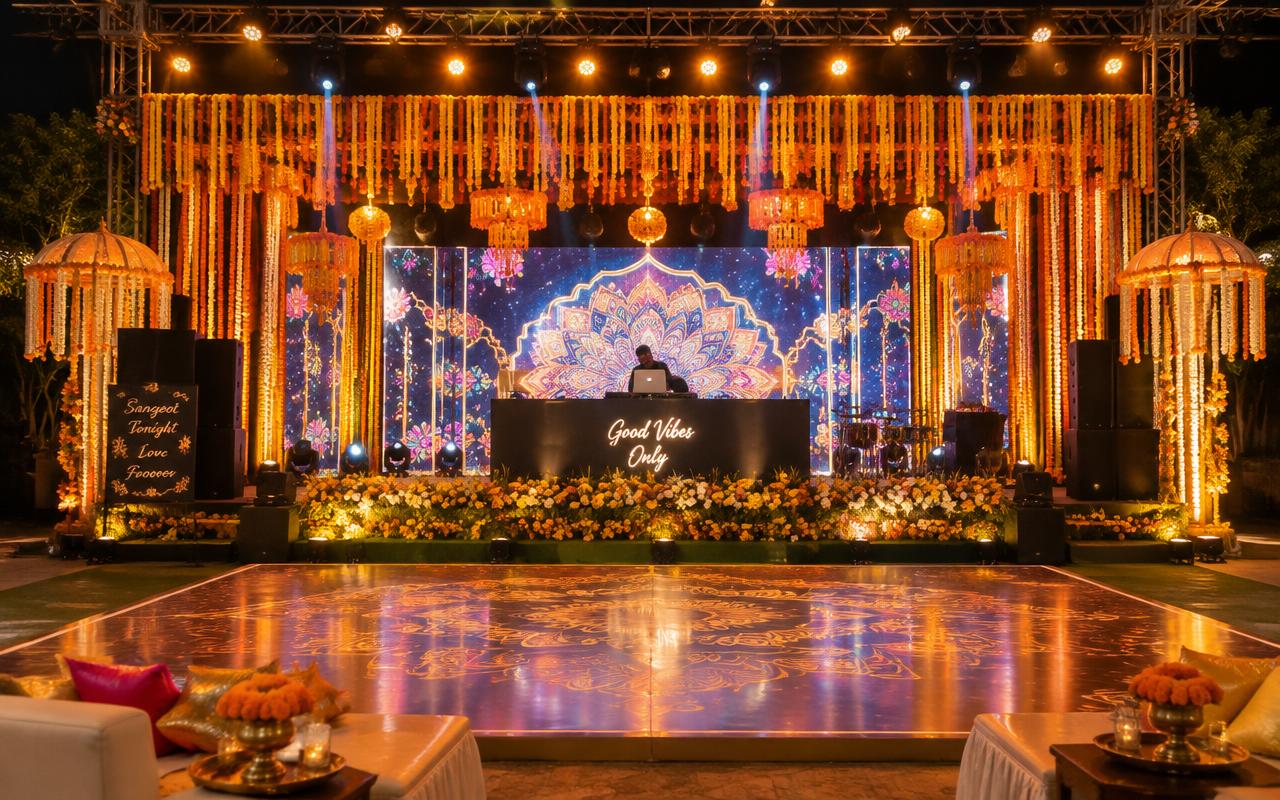
One function — sangeet or reception — in a hall or on a lawn for 200 to 500 guests
- Lighting plot drawn over the decorator's drape and mandap layout
- High-CRI key on the stage and the couple's positions, set against the camera
- Twenty-four to thirty-two uplighters colour-matched to physical samples
- Programmed cue list for entries, performances and the first dance
- One operator on console for the whole function
Wedding Weekend Design
Mehendi through reception across two or three days, 400 – 1,000 guests
- A separate design and cue list per function, from daylight-balanced mehendi to low warm pheras
- Pixel-mapped drapes and backdrops cued to the sangeet choreography
- Battery uplighters and tubes for decor positions that cannot be cabled
- Pin spots on mandap, cake, entry walkway and floral focal points
- Lighting designer plus operator and a focus crew across every function
Heritage & Destination Design
Palaces, forts, resorts and overseas venues with multiple courtyards, 600 – 2,000 guests
- Façade and landscape lighting designed alongside the function stages
- Fully wireless rig where cabling is prohibited, with a daily charge rotation planned
- Weatherised fixtures and covered control positions for open-air builds
- Previsualised look renders approved with the family and the decorator before travel
- Travelling design and programming crew with a spares inventory held on site
What your event size actually needs
| Scale | Guests | Recommended setup |
|---|---|---|
| Intimate lawn | 100 – 250 | Sixteen battery uplighters, four pin spots, two high-CRI key fixtures on the couple, one operator |
| Banquet hall | 250 – 600 | Thirty-two uplighters, twelve pin spots, eight profiles keying the stage, two universes, cue list per function |
| Hotel lawn | 600 – 1,200 | Sixty uplighters, a pixel-mapped backdrop run, twenty-four moving heads for sangeet, generator-fed distribution |
| Palace courtyard | 800 – 1,500 | Fully wireless decor rig with daily charge rotation, façade wash from free-standing ground positions, no fixings to stone |
| Multi-venue resort | 1,000 – 2,000+ | Independent rigs per venue on one network, over a hundred fixtures, designer plus two operators |
What a real quote specifies
| Specification | Detail |
|---|---|
| Colour rendering | Ra above 90 with R9 deep-red verified on every fixture that lights a face |
| Colour temperature | One white point per function, typically 2,700 – 3,200 K for pheras and reception |
| Key light for camera | Faces keyed so the cinematographer can stop down rather than shoot wide open |
| Decor matching | Fixtures set against physical fabric and floral samples at focus, never against hex values |
| Battery fixtures | Wireless-DMX uplighters and tubes with runtime measured at the programmed output |
| Weather rating | IP65 or better on lawn, poolside and courtyard positions, with data and power under cover |
| Uplighter spacing | Roughly 3 m centres on drape and wall runs, tightened on textured stone to avoid scalloping |
| Pixel mapping | Pixel tape, tubes and mapped drape runs driven from the console or a small media server |
| Control | sACN or Art-Net to nodes, DMX512-A to fixtures, wireless DMX for untethered positions |
| Cue list | A programmed cue per beat of each function, run live by a dedicated operator |
Where scope quietly expands
What can go wrong
How we prevent it
- What can go wrong
The room looks beautiful to the eye and the wedding film comes back with grey, sallow skin tones.
How we prevent itFixtures lighting faces are specified above Ra 90 with the R9 value verified, one white point is locked per function, and the look is reviewed on the film team's own monitor at rehearsal rather than trusted to the eye.
- What can go wrong
A saturated decor colour is matched from a hex code and the uplighters render it as a visibly different shade on the night.
How we prevent itPhysical fabric and floral samples are requested weeks ahead, tested under the actual fixtures, and the resulting setting is recorded on a colour reference sheet so focus is repeatable across every function.
- What can go wrong
Battery uplighters buried inside floral structures die partway through the reception.
How we prevent itRuntime is measured at the output level actually programmed rather than taken from the datasheet, a charge rotation is planned per day, and decor positions are built so a unit can be swapped without dismantling the arrangement.
- What can go wrong
The pheras are lit to a level that suits the cameras and destroys the intimacy of the ceremony.
How we prevent itCeremony looks are designed low and warm with tight pin spots on the couple and the fire instead of a flat wash, and the film team is briefed to bring faster glass or a discreet practical rather than asking for the mandap to be lifted.
How to get more value
Lock dates early in the October–March peak, combine services with one vendor so crew and transport are not duplicated, and schedule a single technical rehearsal rather than paying for idle build days. Get an itemised quote from Prime AV Solutions within 24 hours — call +91 93093 80958 or WhatsApp our producers.
Published 16 September 2026 by the Prime AV Solutions production team.