Key takeaway
Key takeaways
- Higher-resolution LED where cameras push in
- One timecoded cue list across departments
- Hybrid reach designed in, not bolted on
- One spectacle moment, properly funded
What is actually changing
Continuity and reach are the third pillar. Multi-day events run from before dawn until late evening with no gap in which to repair anything, so amplification, processing and playback are duplicated and power runs on redundant generators with automatic changeover. A large share of the congregation is watching the stream, often from abroad, which makes a stable encoder path, a regional-language commentary channel and an archive recording part of the core specification. Announcements for lost persons, medical help and crowd flow need a priority path over the music feed.
What each level includes
Up to 3,000 devotees in a pandal or hall: distributed speech-tuned PA, four microphones on the dais, a single screen, warm stage lighting and a basic single-camera stream.
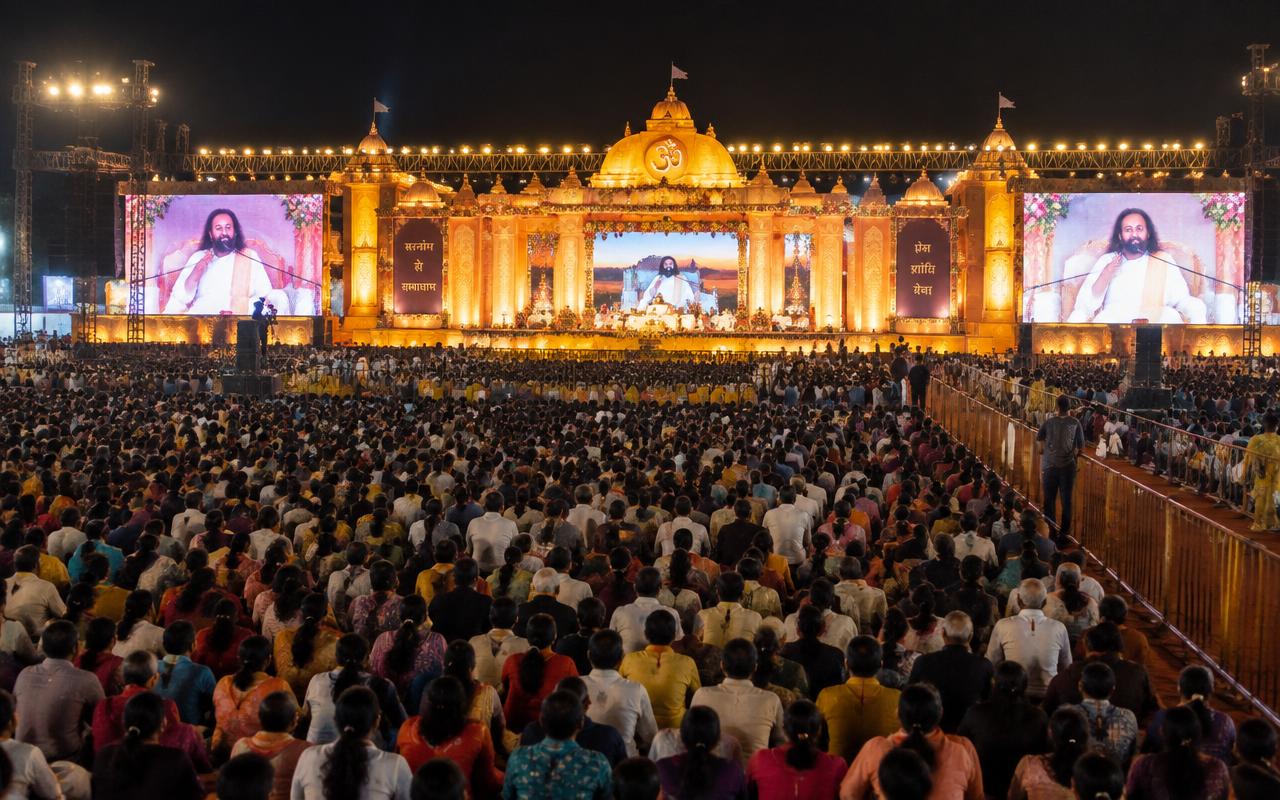
10,000 – 20,000 on open ground: line-array mains with one delay ring, two large screens with camera feed, redundant amplification, a two-camera stream and generator backup.
30,000 – 60,000 across a large maidan: multiple hangs and two delay rings, several giant screens, full duplicate signal chain, three or four cameras and a multi-day crew.
A 100,000-plus congregation or a multi-week festival: zoned coverage with many delay positions, screen clusters through the ground, broadcast-grade streaming in multiple languages and continuous redundant power.
What to ignore
Technology that does not survive contact with a run of show — anything needing a perfect network, an app download or an unrehearsed audience action — rarely earns its budget. Get an itemised quote from Prime AV Solutions within 24 hours — call +91 93093 80958 or WhatsApp our producers.
Published 29 October 2025 by the Prime AV Solutions production team.