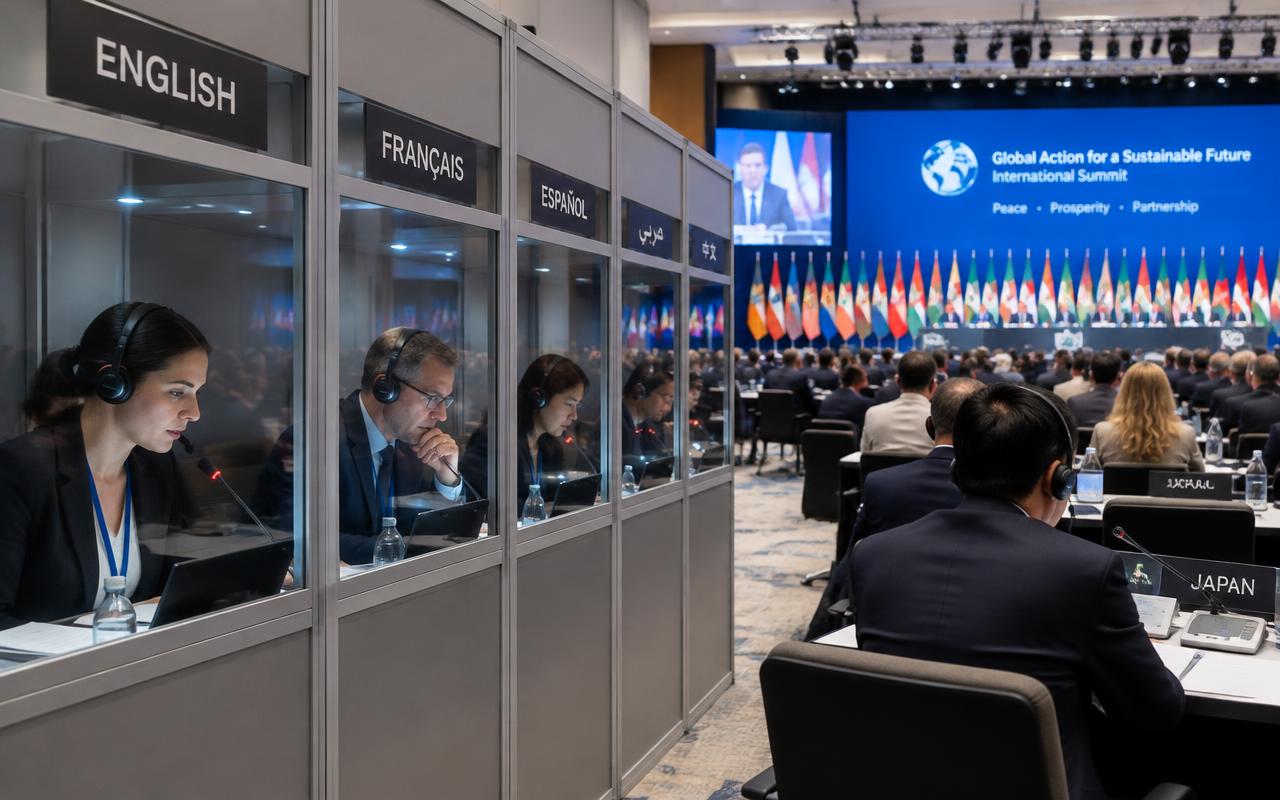
Key takeaway
Key takeaways
- Remote simultaneous interpretation instead of on-site booths
- Consecutive interpretation instead of simultaneous
- Radio or Wi-Fi distribution instead of infrared
- A curtained corner instead of an ISO 4043 booth
The honest comparison
- Remote simultaneous interpretation instead of on-site boothsOur verdict
RSI is dramatically cheaper, removes booth logistics and gives access to interpreters anywhere. It depends entirely on connectivity and on the interpreter having a clean feed and good sightlines on video, which is fine for a routine webinar and genuinely risky for a high-stakes multilateral session.
- Consecutive interpretation instead of simultaneousOur verdict
Consecutive needs no booths, no receivers and no equipment — the interpreter speaks after the speaker pauses. It roughly doubles the length of every session, which is acceptable for a bilateral meeting and impossible for a full-day agenda.
- Radio or Wi-Fi distribution instead of infraredOur verdict
Radio and app-based distribution cover more area and need no line of sight, which solves the shadowing problem. They also pass through walls, so a confidential session can be received outside the room — which is exactly why government and multilateral work stays on infrared.
- A curtained corner instead of an ISO 4043 boothOur verdict
There is no honest case for it on a session that matters. The booth exists to isolate the interpreter's own voice from the floor audio and to give them sight of the speaker; without both, accuracy falls and the delegates hear the result.
What you are comparing against
| Specification | Detail |
|---|---|
| Mobile booth standard | ISO 4043: approximately 1.6 x 1.6 x 2.0 m for two interpreters, insulated and ventilated |
| Built-in booth standard | ISO 2603 for permanently installed booths |
| Equipment standard | ISO 20109 for interpreter consoles, microphones and headphones |
| Distribution | Bosch Integrus infrared, confidential because it does not pass through walls |
| Channel capacity | Up to 16 language channels plus the floor channel on a typical deployment |
| Radiator coverage | Calculated from radiator power against floor area with line of sight to every seat |
| Interpreter staffing | Two interpreters per booth per language, swapping every 20 – 30 minutes |
| Audio feed | Clean direct feed from the console to each booth, never a room microphone |
| Relay interpretation | Pivot language routing where no direct language pair is available |
| Receiver logistics | Issued against delegate ID, counted back, charged overnight and sanitised between sessions |
The technical reality
The operational layer is the part clients underestimate. Interpreters work in pairs per booth and swap roughly every twenty to thirty minutes, because sustained simultaneous interpretation is cognitively unsustainable beyond that — a single interpreter per language is a false economy that degrades the session. They need the speaker's slides and script in advance, a clean direct audio feed from the console rather than a room microphone, and a technician who can patch relay interpretation when a language pair has no direct interpreter. Receivers are issued against delegate identification, counted back, charged overnight and sanitised between sessions, which is a logistics job in its own right at scale.
Where the market is going
Indian clients increasingly specify for the camera as much as the room, fire sound, video and lighting from one timecoded cue list, and add a spectacle finale only where it earns its place. Get an itemised quote from Prime AV Solutions within 24 hours — call +91 93093 80958 or WhatsApp our producers.
Published 3 April 2026 by the Prime AV Solutions production team.