Key takeaway
Key takeaways
- A phone on a tripod to a social platform instead of a produced stream
- Platform-native streaming instead of an external switcher
- Bonded cellular alone instead of a leased line
- Streaming without local recording
The honest comparison
- A phone on a tripod to a social platform instead of a produced streamOur verdict
Perfectly good for an informal update or a behind-the-scenes post, and genuinely better than an over-produced stream nobody watches. It fails the moment you need multiple sources, readable slides, decent audio or any guarantee of staying up.
- Platform-native streaming instead of an external switcherOur verdict
Streaming straight into a meeting platform is cheaper and simpler for a single-speaker webinar. An external switcher is what gives you camera cuts, graphics, playback, loudness-matched audio and encoder redundancy — things platforms do not provide.
- Bonded cellular alone instead of a leased lineOur verdict
Bonding across multiple carriers is remarkably reliable and avoids the lead time and cost of provisioning a circuit. For a short single-session stream it is often the whole answer. For a multi-day flagship event, a wired primary with bonding as backup is the right risk posture.
- Streaming without local recordingOur verdict
There is no good reason to skip it. The local full-quality recording costs almost nothing, survives every stream failure, and is what the marketing team will actually use afterwards — the stream itself is usually too compressed to re-edit.
What you are comparing against
| Specification | Detail |
|---|---|
| Switching | vMix, NewTek TriCaster or Blackmagic ATEM with graphics and playback |
| Camera count | 3 – 12 sources including PTZ, manned cameras and presentation feeds |
| Bitrate budget | 8 – 12 Mbps stable upstream for 1080p50, with headroom above the encode rate |
| Primary connectivity | Venue leased line or dedicated fibre with a static route |
| Backup connectivity | Bonded cellular aggregating multiple carrier SIMs (LiveU, Teradek) |
| Contribution protocol | SRT preferred for unreliable paths; RTMP where the platform requires it |
| Encoder redundancy | Two independent encoders running in parallel to the same or mirrored destinations |
| Audio | Clean console mix matched to broadcast loudness, never camera on-board sound |
| Monitoring | Confidence monitor showing the actual public stream, not the switcher output |
| Local recording | Full-quality programme recording independent of the stream path |
The technical reality
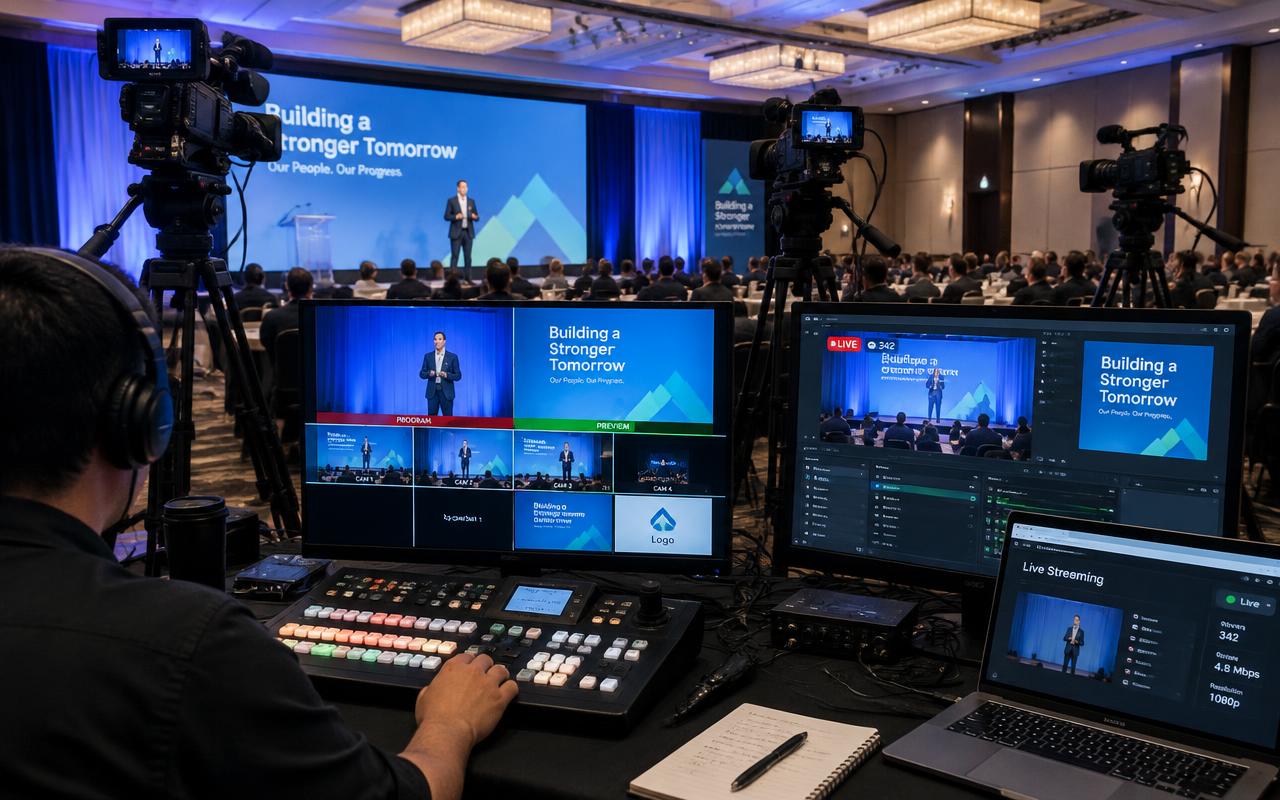
The production decisions matter as much as the plumbing. A stream audience has no peripheral vision and no room ambience, so they need tighter framing, more frequent cuts and on-screen graphics to know who is speaking. Presentation content is composited beside the speaker rather than cut to full screen for long stretches, because a stream that shows only slides loses viewers within minutes. We run a confidence monitor showing the actual public stream — not the switcher programme output — so the operator sees what the audience sees including any platform-side failure, and we record the programme locally at full quality regardless of what the stream delivers.
Where the market is going
Indian clients increasingly specify for the camera as much as the room, fire sound, video and lighting from one timecoded cue list, and add a spectacle finale only where it earns its place. Get an itemised quote from Prime AV Solutions within 24 hours — call +91 93093 80958 or WhatsApp our producers.
Published 22 March 2026 by the Prime AV Solutions production team.