Key takeaway
Key takeaways
- T-8 weeks: Design and decor alignment
- T-4 weeks: Function-by-function plan
- T-2 weeks: Content and cue build
- Show day −1: Rehearsal
How wedding sound & lighting is actually delivered
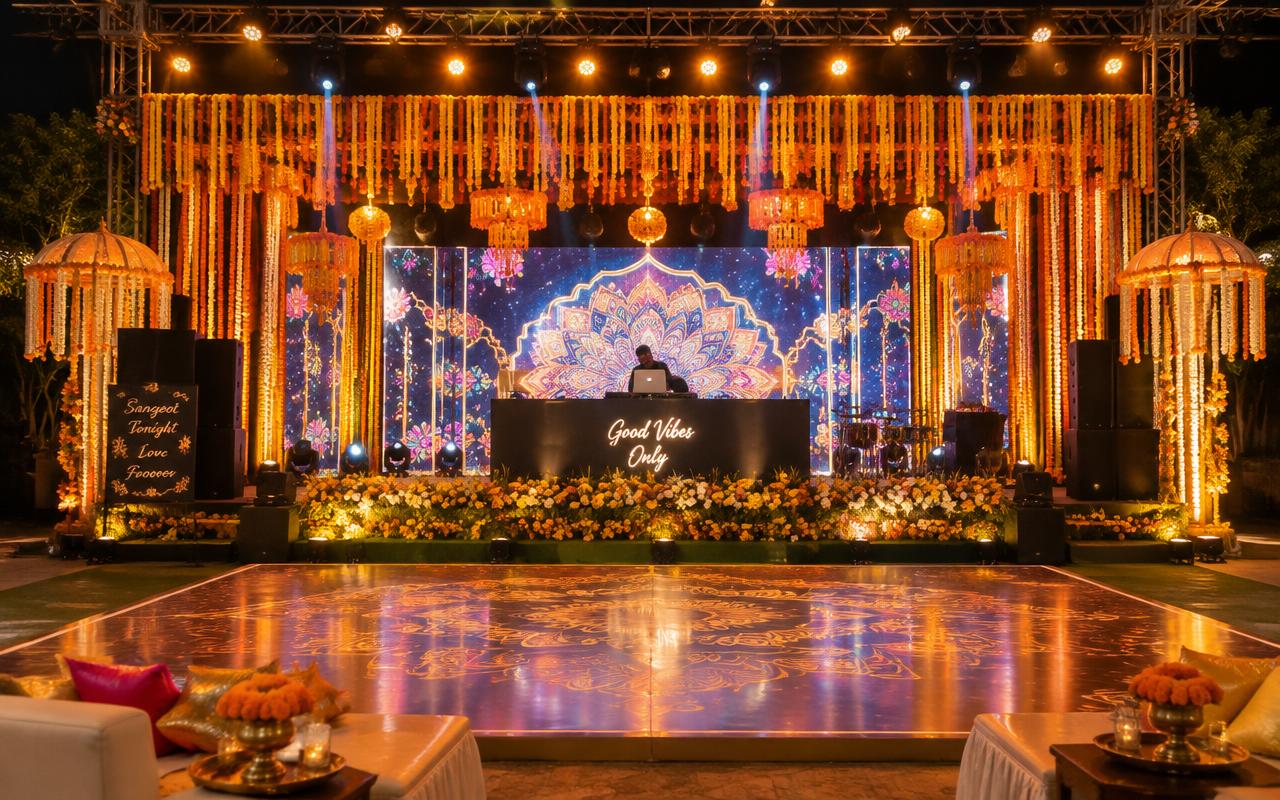
A wedding is not one event; it is four or five productions sharing a site and a crew. Mehendi wants soft daytime coverage and a live dholak that will not feed back. Sangeet needs performance-grade sound, a dance-floor rig and a cue stack that follows rehearsed choreography. The pheras demand near-silence from the system beyond gentle reinforcement of the mantras, and the reception needs speech intelligibility at conversational volume plus a band or DJ afterwards. We design each function as its own zone plan, then sequence the changeovers so the crew is never rebuilding a system while guests are in the room.
From enquiry to load-out
- T-8 weeks
Design and decor alignment
We take the decorator's palette, drape plan and mandap design and build the lighting and speaker placement around them.
- T-4 weeks
Function-by-function plan
Zone plans, microphone counts, changeover sequence and power requirement issued per function.
- T-2 weeks
Content and cue build
LED content, entry tracks, performance audio and the lighting cue stack are assembled and reviewed with the family.
- Show day −1
Rehearsal
Performers rehearse with full sound and lighting, entries are walked, and every microphone is checked on the actual stage.
- Day 1 to Day 3
Function days
Crew works each function live, with changeovers timed against the published guest schedule.
- Final function +4 hours
Strike
De-rig in venue-mandated order, with decor-integrated fixtures removed carefully alongside the decor team.
Who is on site
- Show caller
Runs the order of events against the family's timeline, cues entries and keeps sound, lighting and video in step.
- Sound engineer
Mixes speech, live musicians and performances, and holds the ceremony level low enough to stay transparent.
- Lighting programmer
Builds and runs the cue stack for entries, performances and the first dance, and colour-matches to decor samples.
- Microphone technician
Fits and checks lavaliers and headsets, stays within reach of the mandap, and swaps a failing pack silently.
- Changeover crew lead
Owns the clock between functions — strike, rebuild, test and clear before guests return.
What you should receive
Deliverables
- Zone plan and speaker placement drawing per function
- Lighting plot with colour references matched to decor samples
- Microphone allocation chart naming who wears which pack
- Order-of-events cue sheet shared with the planner and the family
- LED content playlist and backup on two drives
- Power requirement schedule and generator load sheet
- Rehearsal notes and the final running order as actually run
What we plan around
What can go wrong
How we prevent it
- What can go wrong
The pandit's recitation is inaudible past the third row because decor blocked every sensible speaker position.
How we prevent itSpeaker positions are agreed with the decorator at the drawing stage, and we carry slim-column cabinets and decor-matched finishes for the places a box cannot be seen.
- What can go wrong
A lavalier pack fails mid-vows and the moment cannot be re-run.
How we prevent itTwo packs on the officiant and the couple where possible, a technician within arm's reach, and a dressed handheld already live on a held frequency.
- What can go wrong
Stage lighting at 3,200 K beside decor lighting at 5,600 K ruins every photograph.
How we prevent itOne white point per function agreed with the photographer and videographer, and all fixtures colour-calibrated to it at focus.
- What can go wrong
The changeover between pheras and reception overruns and guests walk into a half-built room.
How we prevent itChangeovers are rehearsed as a timed drill, and anything that cannot be struck in the window is duplicated rather than moved.
The detail that matters
Speech is the part most often lost. Vows, speeches and the pandit's recitation sit at 65 to 75 dBA and compete with open-air ambience, clattering service and a decor team that hates visible speakers. The answer is distribution rather than volume: small cabinets on slim stands or hidden in decor every 10 to 15 metres, delayed to the source so the sound arrives coherently, with lavalier and headset microphones on separate coordinated frequencies and a technician holding a spare handheld within arm's reach of the mandap. Low frequency is deliberately restrained during ceremony so the system never muddies consonants.
Start the conversation
Get an itemised quote from Prime AV Solutions within 24 hours — call +91 93093 80958 or WhatsApp our producers.
Published 9 August 2026 by the Prime AV Solutions production team.