Key takeaway
Key takeaways
- High-CRI key lighting tuned for skin tone on camera
- Pixel-mapped decor, drapes and mandap washes
- Battery uplighters for lawns and heritage venues with no cabling
- Programmed cue list per function with a dedicated operator
Why destination weddings need a designed system
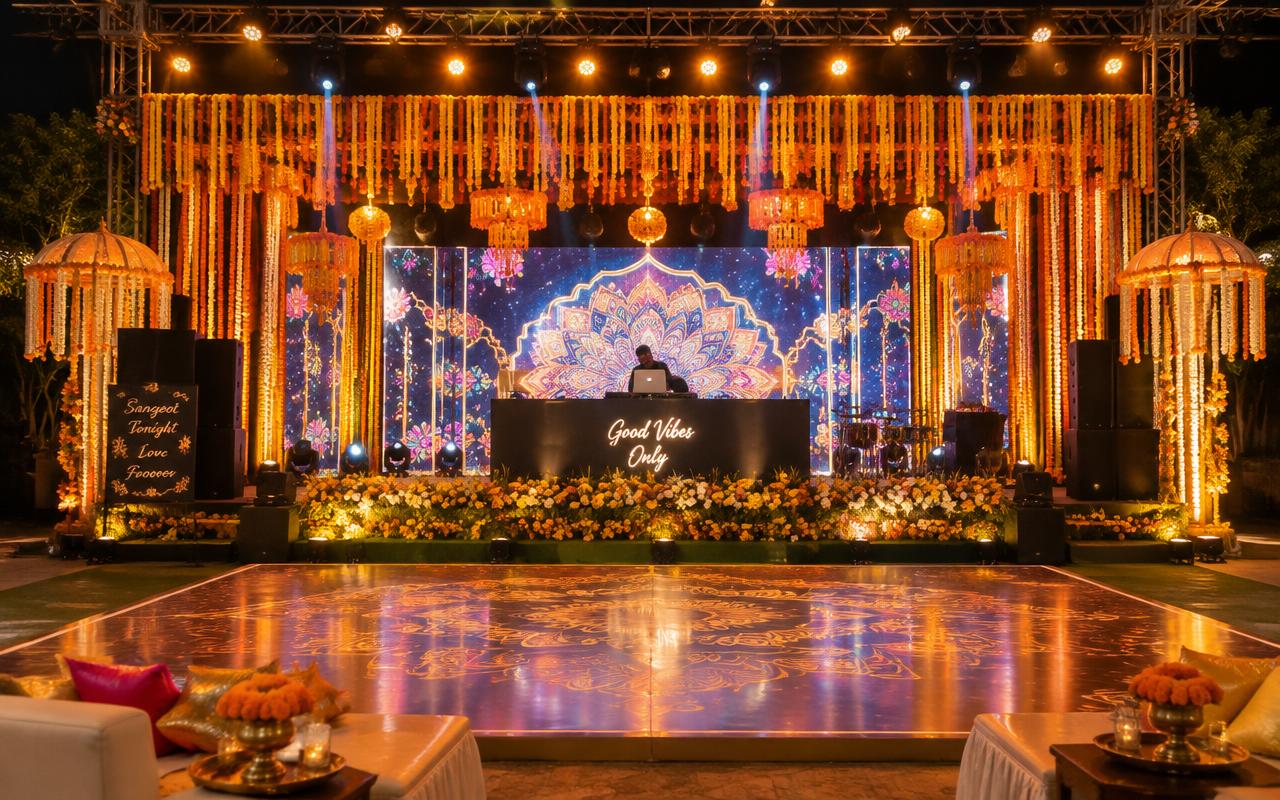
Lighting designed for the camera as much as the room — warm, high-CRI key on faces, pixel-mapped decor, and a programmed cue list that carries each function from mehendi to reception. The artefact that survives a wedding is the film. Guests remember an evening; the family watches the edit for the next thirty years, which is why wedding lighting is designed to the camera's requirements first and the room's second. In practice that means high colour rendering — Ra above 90, with the R9 deep-red value that inexpensive LED fixtures quietly fail — so skin, gold and mehendi render as themselves rather than as sallow approximations. It means enough key on faces that the cinematographer can stop the lens down and keep depth of field, and one colour temperature across every fixture pointed at a person.
Match the rig to the room
| Scale | Guests | Recommended setup |
|---|---|---|
| Intimate lawn | 100 – 250 | Sixteen battery uplighters, four pin spots, two high-CRI key fixtures on the couple, one operator |
| Banquet hall | 250 – 600 | Thirty-two uplighters, twelve pin spots, eight profiles keying the stage, two universes, cue list per function |
| Hotel lawn | 600 – 1,200 | Sixty uplighters, a pixel-mapped backdrop run, twenty-four moving heads for sangeet, generator-fed distribution |
| Palace courtyard | 800 – 1,500 | Fully wireless decor rig with daily charge rotation, façade wash from free-standing ground positions, no fixings to stone |
| Multi-venue resort | 1,000 – 2,000+ | Independent rigs per venue on one network, over a hundred fixtures, designer plus two operators |
Specification
| Specification | Detail |
|---|---|
| Colour rendering | Ra above 90 with R9 deep-red verified on every fixture that lights a face |
| Colour temperature | One white point per function, typically 2,700 – 3,200 K for pheras and reception |
| Key light for camera | Faces keyed so the cinematographer can stop down rather than shoot wide open |
| Decor matching | Fixtures set against physical fabric and floral samples at focus, never against hex values |
| Battery fixtures | Wireless-DMX uplighters and tubes with runtime measured at the programmed output |
| Weather rating | IP65 or better on lawn, poolside and courtyard positions, with data and power under cover |
| Uplighter spacing | Roughly 3 m centres on drape and wall runs, tightened on textured stone to avoid scalloping |
| Pixel mapping | Pixel tape, tubes and mapped drape runs driven from the console or a small media server |
| Control | sACN or Art-Net to nodes, DMX512-A to fixtures, wireless DMX for untethered positions |
| Cue list | A programmed cue per beat of each function, run live by a dedicated operator |
Honest alternatives
- Decorator-supplied uplighting instead of a lighting designOur verdict
Where the look is static and the palette simple, package uplighting from a good decorator is well-judged, sits inside work you are already buying, and is the right answer. It stops being enough once something has to change on a cue — an entry, a choreographed sangeet, a first dance — or once the film becomes the thing you actually care about.
- A concert-style moving-head rig across the whole weddingOur verdict
Moving heads earn their place over the sangeet stage and the dance floor, where looks must change and energy matters. Aimed at a mandap or a dining area they are too hard, too cool and too mobile, and they photograph badly. Most of a wedding wants soft, warm, high-CRI light from fixed positions, with movement reserved for the functions that want it.
- Static colour all evening instead of a programmed cue listOur verdict
Static colour is simple, safe and perfectly right at a mehendi or any daytime function where light is not doing dramatic work. Across a sangeet and a reception it flattens the whole evening: the entry, the performances, the first dance and the cake all look identical, and the edit has nothing to cut between.
Also suited to
Sangeet nights, Receptions. Get an itemised quote from Prime AV Solutions within 24 hours — call +91 93093 80958 or WhatsApp our producers.
Published 10 September 2026 by the Prime AV Solutions production team.