Key takeaway
Key takeaways
- T-8 weeks: Decor and film alignment
- T-5 weeks: Function-by-function design
- T-3 weeks: Sample matching and previs
- T-1 week: Cue build
How wedding lighting design is actually delivered
The artefact that survives a wedding is the film. Guests remember an evening; the family watches the edit for the next thirty years, which is why wedding lighting is designed to the camera's requirements first and the room's second. In practice that means high colour rendering — Ra above 90, with the R9 deep-red value that inexpensive LED fixtures quietly fail — so skin, gold and mehendi render as themselves rather than as sallow approximations. It means enough key on faces that the cinematographer can stop the lens down and keep depth of field, and one colour temperature across every fixture pointed at a person.
From enquiry to load-out
- T-8 weeks
Decor and film alignment
We take the decorator's palette, drape plan and mandap drawings together with the film team's camera plan, and design to both rather than to a fixture count.
- T-5 weeks
Function-by-function design
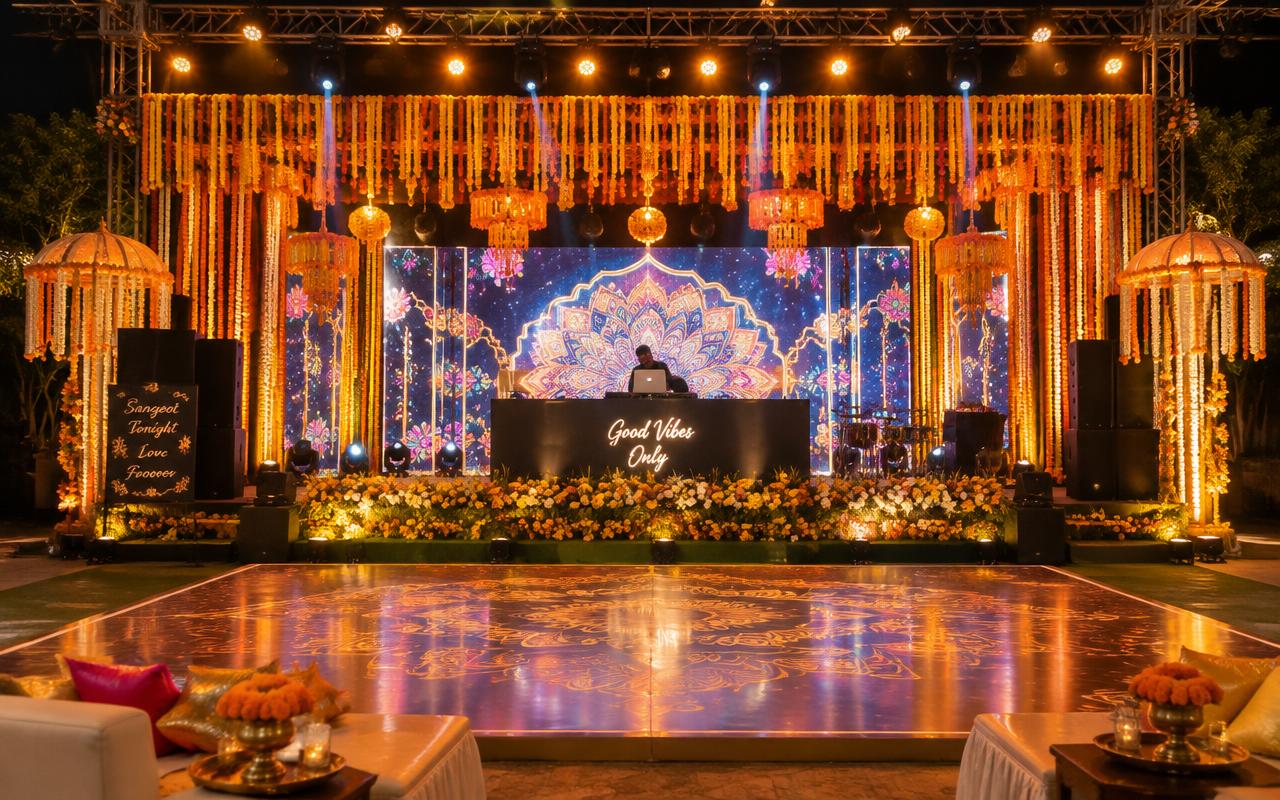
A plot and a look direction per function: daylight-balanced mehendi, bright informal haldi, show-lit sangeet, low warm pheras, keyed reception receiving line.
- T-3 weeks
Sample matching and previs
Physical fabric and floral samples tested under the actual fixtures, settings recorded, and the key looks previsualised and shared as renders.
- T-1 week
Cue build
Entries, performance tracks, the first dance and the pheras sequence turned into a timed cue list per function with fade times set.
- Show day −1
Focus and rehearsal
Rig focused after decor has dressed, colours re-checked against samples in the finished room, and looks reviewed on the film team's monitor.
- Day 1 to final function +4 hours
Functions and strike
Each function operated live from its own cue list, then fixtures inside decor removed carefully alongside the decorator at strike.
Who is on site
- Lighting designer
Translates the decorator's palette and the family's running order into a plot and a look for each function, and answers for how the night photographs.
- Programmer and operator
Builds the cue list per function and runs it live, holding entries, performances and the first dance on timed fades rather than on static colour.
- Focus and colour technician
Sets each fixture's angle, intensity and colour against the physical samples, then re-checks the rig once decor has dressed the room.
- Battery fixture technician
Owns the wireless rig — placement inside decor, link margin checks on every unit, and a charge rotation that keeps each fixture alive to the end of the night.
- Camera-side gaffer
Agrees key level and white point with the wedding film team, coordinates their practicals with the house rig and checks skin tone on their monitor at rehearsal.
- Rigging and cable crew
Hangs truss and floor positions, dresses cable clear of guest routes and photography lines, and removes fixtures alongside the decor team at strike.
What you should receive
Deliverables
- Lighting plot per function, drawn over the decorator's layout
- Colour reference sheet naming the fixture setting matched to each fabric and floral sample
- Previsualisation renders of the key looks for every function
- Cue list per function mapped to the running order with fade times
- Battery fixture placement plan with its charge rotation schedule
- Console show file backed up to two drives and handed over
- Agreed key level and white point note shared with the photography and film team
What we plan around
What can go wrong
How we prevent it
- What can go wrong
The room looks beautiful to the eye and the wedding film comes back with grey, sallow skin tones.
How we prevent itFixtures lighting faces are specified above Ra 90 with the R9 value verified, one white point is locked per function, and the look is reviewed on the film team's own monitor at rehearsal rather than trusted to the eye.
- What can go wrong
A saturated decor colour is matched from a hex code and the uplighters render it as a visibly different shade on the night.
How we prevent itPhysical fabric and floral samples are requested weeks ahead, tested under the actual fixtures, and the resulting setting is recorded on a colour reference sheet so focus is repeatable across every function.
- What can go wrong
Battery uplighters buried inside floral structures die partway through the reception.
How we prevent itRuntime is measured at the output level actually programmed rather than taken from the datasheet, a charge rotation is planned per day, and decor positions are built so a unit can be swapped without dismantling the arrangement.
- What can go wrong
The pheras are lit to a level that suits the cameras and destroys the intimacy of the ceremony.
How we prevent itCeremony looks are designed low and warm with tight pin spots on the couple and the fire instead of a flat wash, and the film team is briefed to bring faster glass or a discreet practical rather than asking for the mandap to be lifted.
The detail that matters
The second discipline is working inside somebody else's design. The decorator owns the palette, the drape plan and the mandap, and lighting either flatters that work or fights it. Palette decisions are therefore made against physical material — a swatch of the drape, a stem from the floral mock-up, held under the actual fixture — because additive LED mixing lands somewhere other than where a monitor promised. Drapes and structures are pixel-mapped where the look needs movement, grazed from shallow angles where it needs texture, and pin-spotted where one floral centrepiece or the mandap canopy should carry the eye.
Start the conversation
Get an itemised quote from Prime AV Solutions within 24 hours — call +91 93093 80958 or WhatsApp our producers.
Published 14 September 2026 by the Prime AV Solutions production team.