Key takeaway
Key takeaways
- 20K–40K lumen laser projectors
- Custom 3D content & storyboards
- Edge blending & warping (Pixera, Disguise)
- Heritage façades, cars, cakes & stages
Why product launches need a designed system
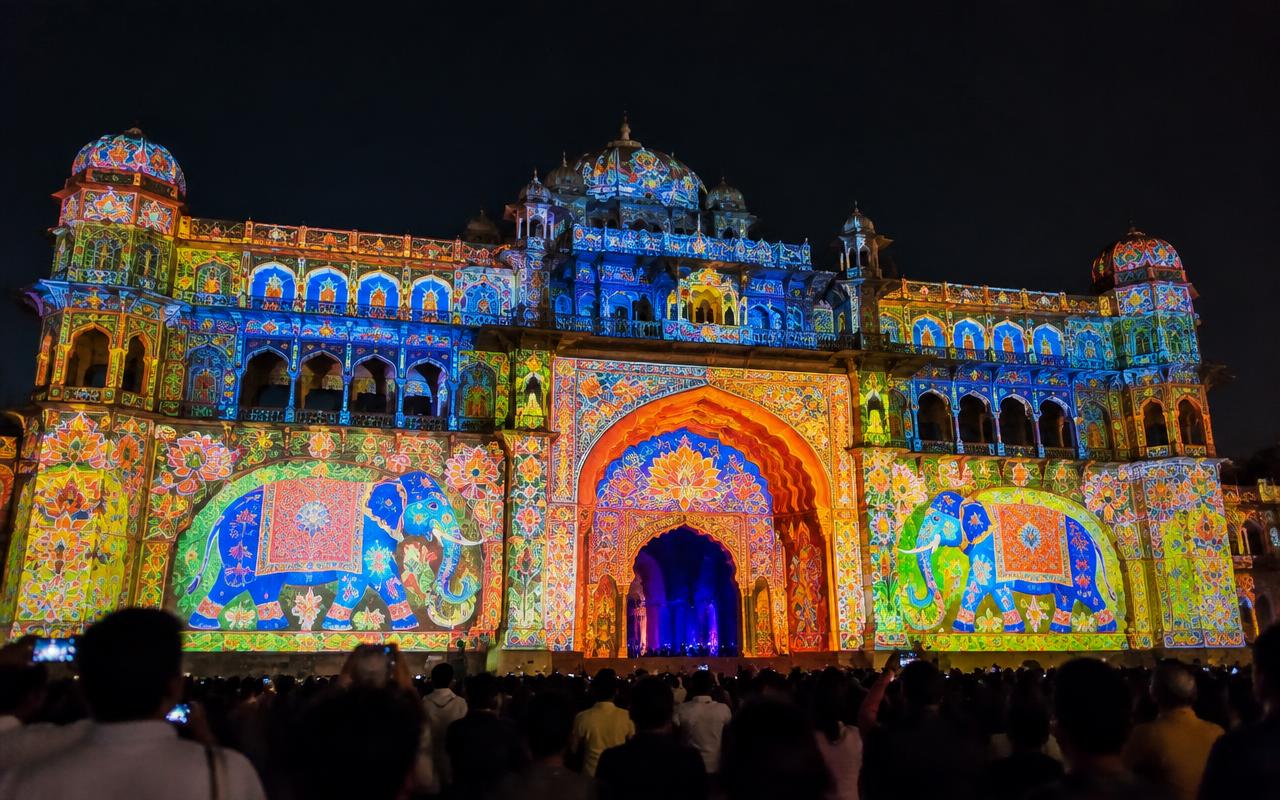
Building, stage and object projection mapping with 20K–40K lumen laser projectors and custom 3D content created by our in-house motion studio. Projection mapping starts with a survey, not a storyboard. We photogrammetry-scan or LiDAR-measure the surface — a façade, a stage set, a car, a cake — and build a 3D model that matches the real object within a few centimetres. The projectors are then positioned virtually against that model to check throw ratio, keystone, shadowing from balconies or trees, and whether any part of the surface falls outside the beam. Only once the projector positions are fixed does content production begin, because a mapped animation is authored against a specific camera position and cannot simply be moved later.
Match the rig to the room
| Scale | Guests | Recommended setup |
|---|---|---|
| Single object | 50 – 300 | One object, 2 x 20K projectors, 10 – 30 sq m, 60 – 90 seconds of content |
| Stage set | 300 – 1,500 | Set faces plus floor, 4 x 20K, 50 – 120 sq m, blended and masked to scenic edges |
| Hotel façade | 500 – 2,000 | 6 x 30K from two angles, 250 – 400 sq m, three-minute show, ballasted towers |
| Palace or fort wall | 2,000 – 10,000 | 10 – 14 x 30K from three angles, 500 – 800 sq m, five-minute narrative, multi-night |
| Monument spectacle | 10,000+ | 20+ projectors, 1,000 sq m+, redundant servers, nightly alignment, licensed site |
Specification
| Specification | Detail |
|---|---|
| Projector class | 20,000 – 40,000 ANSI lumens, laser phosphor or RGB laser, 3-chip DLP |
| Surface reflectance assumption | 20 – 35 per cent for stone and painted plaster, lower for dark granite |
| Typical façade budget | Approximately 250 – 400 lumens per square metre of lit surface, ambient dependent |
| Blend overlap | 10 – 20 per cent soft-edge between adjacent projectors |
| Media servers | disguise gx/vx, AV Stumpfl Pixera, Dataton Watchout |
| Survey method | Photogrammetry or LiDAR scan to a 3D model accurate within a few centimetres |
| Alignment window | Night-time only, four to eight hours for a multi-projector façade |
| Content pipeline | Cinema 4D or Blender to UV-mapped render, delivered as image sequence |
| Show length | 3 – 12 minutes, usually looped with timecoded audio |
| Weather protection | IP-rated projector enclosures with filtered forced-air cooling for outdoor runs |
Honest alternatives
- LED wall instead of projection mappingOur verdict
LED beats projection on brightness, on reliability and in any lit environment. But it cannot map onto an existing building, a car or a cake, and at 400 square metres of heritage façade it is simply unaffordable. If the surface is the story, map it; if you need a rectangle that works in daylight, use LED.
- Stock content instead of bespoke animationOur verdict
Stock loops and generative visuals genuinely work for ambient architectural washes and for leaner budgets. They cannot do a reveal, a narrative or anything that respects the building's actual architecture, because they are not authored to your geometry.
- Fewer, brighter projectors instead of more unitsOur verdict
Fewer angles means fewer blends and a faster alignment, which is the right trade on a flat surface. Any building with depth, recesses or wings needs multiple angles regardless of total lumens, or the recesses stay dark.
Also suited to
Wedding façades, Brand & city festivals. Get an itemised quote from Prime AV Solutions within 24 hours — call +91 93093 80958 or WhatsApp our producers.
Published 18 June 2026 by the Prime AV Solutions production team.