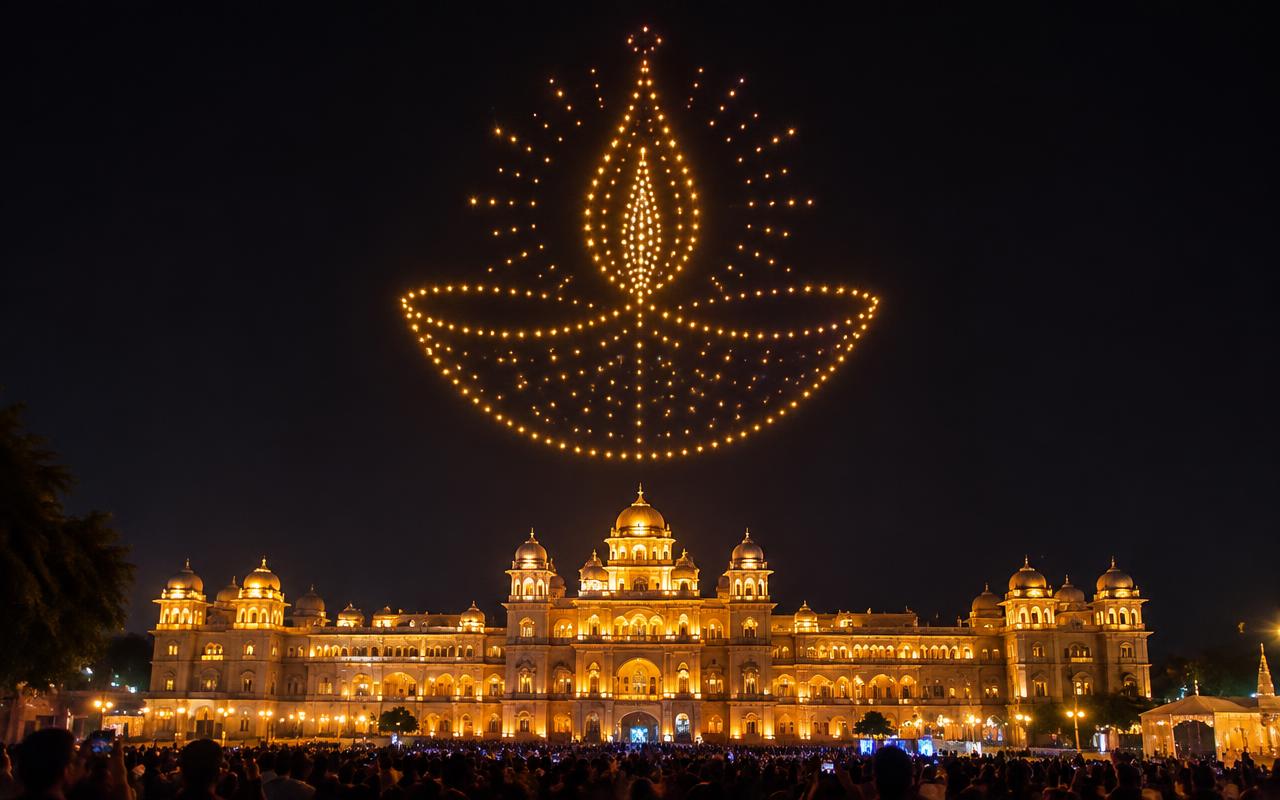
Spectacle · Aligarh, Uttar Pradesh
Drone Light Show in Aligarh
Two things define Aligarh: the university and the lock. Aligarh Muslim University drives a whole institutional calendar of convocations, Sir Syed Day, seminars and alumni gatherings in its historic halls, while Tala Nagri's lock and hardware cluster — one of India's oldest manufacturing clusters — generates buyer delegations, export meets and trade displays. The private wedding market along Ramghat Road rides on both. Prime AV Solutions supplies the drone light shows behind those events — designed on paper, proven in rehearsal and run by our own crew.
- Lead time
- From 10 weeks
- Peak season
- Oct–Feb
- Coverage
- Aligarh & Uttar Pradesh
Key takeaway
Drone Light Shows for Aligarh’s biggest events
A drone light show is a choreographed flight, and the choreography is written in three dimensions against hard safety envelopes. Each aircraft is a small multirotor in the sub-kilogram class carrying a single high-output RGBW LED module. Positioning is GNSS-based, augmented by an RTK base station on site that corrects satellite error down to roughly centimetre-level accuracy — without RTK, formations of several hundred drones cannot hold the tight spacing that makes a logo readable. Flight paths are designed in show software, collision-checked in simulation, then uploaded to each aircraft which flies its own pre-loaded trajectory rather than being joysticked live.
What matters here is the sky and the ground beneath it: an unobstructed viewing axis, a clear flight volume with no tall structures or trees, and an audience position outside the buffer. In Aligarh that plays out at venues like AMU Kennedy Hall, Hotel Grand Shivaay, Ramghat Road lawns, and across Ramghat Road, Civil Lines, Marris Road, Sasni Gate.
Permission is the critical path, not the content. Indian drone operations fall under the Drone Rules 2021 administered by the DGCA through the Digital Sky platform, with the airspace map dividing the country into green, yellow and red zones. A show of this kind needs registered aircraft with UINs, a certified remote pilot, operation inside a defined and approved volume, and — because a swarm show is flown beyond the pilot's ability to see and control each unit individually — specific permission for the operating concept, plus night-operation clearance. Any site near an aerodrome falls into controlled airspace and needs ATC coordination. We open the permission file the day the booking is confirmed because clearances take weeks, not days.
What’s included
- 100 – 1,000+ synchronized drones
- Custom 3D animation & logo reveals
- DGCA-compliant operations & permissions
- Music-synced, 8–15 minute shows
Equipment we carry
Why Aligarh chooses Prime AV
- Crews and trucks positioned for fast load-in at AMU Kennedy Hall and venues in Ramghat Road and Civil Lines.
- An RTK base station on site corrects satellite error to centimetre-level, and the rehearsal flight verifies formation tightness from the actual audience viewing position.
- DGCA and Digital Sky permission documents with the approved flight volume
- Working knowledge of Uttar Pradesh venue rules, power sanctions and permission timelines.
Local conditions
Producing drone light show in Aligarh
Weather & the rig
Wind decides whether a drone show flies at all — most light-show platforms stop at around 8 metres per second sustained, and rain is an outright no-fly, so the local weather pattern sets the date as much as the calendar does. Western Uttar Pradesh extremes apply: a dusty, dry April to June reaching 43–45°C with pre-monsoon dust squalls that will tear an unballasted banner, a July–September monsoon that waterlogs the unsurfaced lawn venues, and a December–January cold wave with fog thick enough to delay a morning soundcheck and ruin an outdoor projection plan. The dust is the persistent engineering problem — filters, covers and cleaning schedules on every job. April–June heat and dust storms make outdoor work unviable, and July–September monsoon turns the lawn circuit to mud. The AMU examination and vacation calendar also closes campus venues for long stretches, so confirm academic dates before promising anything. October–March is the season.
Power & redundancy
A drone show needs comparatively little power but needs it reliably, because hundreds of battery sets have to be charged and cycled on site between a rehearsal flight and the show. UPPCL supply is intermittent and the city's distribution network is overloaded, so generator provision is the default rather than the contingency. Campus venues run on university supply that is protected but not generous, and the lawn circuit draws from connections sized for lighting and nothing more. Expect to bring everything: two sets, a changeover panel, and an isolated feed for consoles and media servers.
Permits & noise rules
Drone shows live or die on airspace clearance, so we start the permission file the day you book. The Aligarh Nagar Nigam handles ground and pandal permissions, the district magistrate and senior superintendent of police license assembly, and the Uttar Pradesh noise rules with the 10 pm outdoor amplified-sound limit apply. Campus events are a separate and sometimes slower track through the AMU registrar and proctor, with student-body politics occasionally affecting approvals. There is no commercial airport here, which simplifies the drone question, but district permission and police intimation are still required and student gatherings attract additional scrutiny.
Load-in & access
The launch grid needs a flat, sterile, vehicle-accessible area of up to 100 metres square that stays clear of guests for the whole evening, which is often harder to find than the sky above it. No airport and no expressway exit directly into the city, so everything arrives by road on NH-34 or across from the Yamuna Expressway, roughly three hours from Delhi. Inside the city, the Dodhpur, Marris Road and Centre Point stretches are slow all day and the old city around Shah Jamal is tempo-only. Campus load-in has to work around teaching hours and pedestrian routes, which in practice means an evening and overnight call.
Season & booking
Sir Syed Day on 17 October is the fixed point of the academic year and the single biggest production date in the city, with alumni gatherings around it. AMU convocation, the examination season and summer vacation each close campus venues at predictable times. Ramzan, Eid and the Numaish-style winter trade fairs, plus the Nov–Feb wedding and walima run, fill the rest. Peak demand runs Oct–Feb.
Crew & dispatch
Dispatched from our Delhi depot, 130 km via the Yamuna Expressway and NH-34 at about three hours, which makes same-day turnarounds genuinely possible; local labour and tent structure hired in Aligarh, with Agra 85 km away as the nearer source for additional staging. Load-in support covers Ramghat Road, Civil Lines and the rest of the city.
What it costs here
A low-price market with two exceptions. University work is budget-bound and procedurally slow, and tent-house competition keeps the wedding reference price very low. Export buyer meets, however, are judged by overseas visitors and the hardware exporters will spend to avoid embarrassment, and alumni endowment functions are funded by a diaspora with metro expectations.
Local expectations
Campus ceremony here is formal and tradition-heavy: academic procession order, the university tarana, Urdu and English oratory that must be intelligible in a difficult room, and an audience that includes senior alumni who notice when a microphone fails. Wedding and walima production is decor-forward with a strong preference for warm lighting and a restrained approach to effects, and qawwali and ghazal sets are common enough that a proper vocal and harmonium reinforcement chain earns its keep.
Specification
Drone Light Shows: technical specification
| Specification | Detail |
|---|---|
| Fleet size | 100 – 1,000+ aircraft, scaled to the figure complexity required |
| Positioning | GNSS with on-site RTK base station, approximately centimetre-level accuracy |
| Aircraft class | Sub-1 kg multirotor with a single high-output RGBW LED module |
| Flight duration | 8 – 15 minutes per battery set, extended by staged launches |
| Flight volume | Typically 120 – 180 m above ground inside an approved and geofenced volume |
| Wind limit | Approximately 8 m/s sustained, with a lower documented gust ceiling |
| Audience separation | A buffer zone with no audience beneath the formation at any point |
| Regulatory framework | DGCA Drone Rules 2021, Digital Sky registration, UINs, certified remote pilot |
| Airspace | Green-zone siting preferred; yellow zone and near-aerodrome sites need ATC coordination |
| Fail-safes | Hard geofence, automatic return-to-launch, redundant radio link and an all-stop command |
On the ground, the show is a safety operation. A launch grid is laid out with fixed spacing per aircraft, surveyed and marked. A geofence is programmed as a hard boundary: aircraft that drift outside it are commanded to land or return automatically, and a separate buffer separates the flight volume from the audience, which never sits underneath the formation. Wind is the binding environmental limit — most light-show platforms are rated to roughly 8 metres per second sustained, with gust limits lower, and we hold a documented go/no-go wind figure. Rain is a hard stop. Every show carries a return-to-launch and an all-stop command on a redundant radio link.
Sizing
What size rig does your event actually need?
| Scale | Guests | Recommended setup |
|---|---|---|
| Private reveal | 100 – 500 | 100 – 150 drones, 6 formations, readable text up to about 12 characters, 80 m x 80 m launch grid |
| Wedding spectacle | 500 – 1,500 | 200 – 300 drones, 8 – 10 formations, two names plus a 3D ring, 120 m flight ceiling |
| Brand launch | 1,500 – 5,000 | 400 – 500 drones, logo with gradient fill and a product morph, 150 m ceiling |
| City festival | 10,000 – 50,000 | 700 – 1,000 drones, narrative sequence with script text, staged launches, 180 m ceiling |
| Civic landmark show | 50,000+ | 1,000+ drones, dual ground stations, redundant fleet, full ATC-coordinated volume |
Scope
Drone Light Show scope tiers in Aligarh
Signature Reveal
Weddings and private reveals, 100 – 200 drones, 6 – 8 minute show
- Up to six formations including names, a logo and a heart or ring motif
- RTK-corrected flight with full geofencing and automatic return-to-launch
- DGCA permission file, UIN-registered fleet and a certified remote pilot
- Music-synced show with a mixed audio track
- Launch grid survey, safety marshals and ground crew
Brand Spectacle
Product launches and corporate events, 250 – 500 drones, 8 – 12 minutes
- Ten to fifteen formations with 3D animated transitions and a product morph
- Bespoke 3D choreography designed and collision-simulated in show software
- Full airspace file including ATC coordination where the site requires it
- Original score or licensed track with timecoded synchronisation
- Backup aircraft pool and a rehearsal flight the night before
Festival & Civic Show
City festivals and government events, 600 – 1,000+ drones, 12 – 15 minutes
- Narrative show across twenty-plus formations with text in multiple scripts
- Staged multi-battery launches for extended runtime
- Full permission package including police, district and airspace clearances
- On-site weather station with a documented go/no-go decision protocol
- Full flight operations team, dual ground control stations and medical standby
A low-price market with two exceptions. University work is budget-bound and procedurally slow, and tent-house competition keeps the wedding reference price very low. Export buyer meets, however, are judged by overseas visitors and the hardware exporters will spend to avoid embarrassment, and alumni endowment functions are funded by a diaspora with metro expectations.
Venues
Where we work in Aligarh
| Venue | Capacity | Production note |
|---|---|---|
| AMU Kennedy Hall | Around 1,200 seated in the hall, with lawn overflow | A colonial-era university auditorium: a fixed stage, a low grid with no usable rigging capacity, and a reverberant masonry shell that demands a point-source design with delays rather than a large flown system. Every element needs the university's proctorial and engineering office clearance. |
| Hotel Grand Shivaay | 500–900 across hall and lawn | The city's most dependable commercial venue, but it sits on a congested stretch where the police will not permit a truck to stand, so delivery is a timed rotation. |
| Ramghat Road lawns | 800–2,500 across the lawn and marriage-hall belt | The default wedding ground, with rudimentary single-phase or light three-phase connections and no drainage, so a late shower leaves standing water around cable runs and dimmer positions. |
| AMU Strachey Hall and the Victoria Gate quadrangles | 400–1,500 depending on configuration | Protected heritage architecture where fixings are forbidden outright and temporary structures must be ground-supported and kept clear of the facades; load-in routes cross pedestrian campus paths that cannot be blocked during teaching hours. |
| Tala Nagri industrial exhibition grounds | 2,000–6,000 in a trade-fair layout | Industrial estate ground with good truck access and real three-phase capacity nearby, but a dusty unsurfaced site that needs matting for buyer walkways and daily cleaning on everything fan-cooled. |
Crew
Who turns up on show day
- Remote pilot in command
Holds the DGCA certification and the legal authority for the flight, makes the go/no-go call and owns the all-stop.
- Show designer
Builds the 3D choreography, runs collision simulation and times every formation transition to the audio.
- Ground control operator
Runs the ground station, monitors telemetry and battery state across the fleet and triggers the launch sequence.
- RTK and comms technician
Sets up and verifies the RTK base station and the redundant radio link, and watches link margin throughout.
- Launch grid crew
Surveys and marks the grid, places and powers every aircraft, and recovers them in order after landing.
- Safety marshal
Holds the audience buffer, keeps the launch and landing zone sterile and reports any incursion to the pilot immediately.
What you receive
- DGCA and Digital Sky permission documents with the approved flight volume
- Approved storyboard with every formation rendered in sequence
- Flight plan and collision-simulation report for the full fleet
- Launch grid survey drawing with aircraft positions and spacing
- Geofence and emergency procedure document including the all-stop protocol
- Timecoded show audio master used for synchronisation
- Aerial and ground video capture of the show as flown
Timeline
From enquiry to load-out
- T-10 weeks
Airspace and site assessment
We check the Digital Sky airspace map for the site, identify zone classification and aerodrome proximity, and confirm feasibility before anything is promised.
- T-8 weeks
Permission file submission
DGCA and Digital Sky filings, UIN verification, pilot certification, ATC coordination where required, plus police and district permissions.
- T-6 to T-3 weeks
Choreography and simulation
Formations designed in show software, collision-checked in simulation, and the storyboard approved with the client.
- Show day −2
Site build and grid survey
Launch grid surveyed and marked, RTK base established, geofence programmed and the flight volume walked.
- Show day −1
Rehearsal flight
A full or partial flight at the show hour to verify positioning, link margin, lighting levels and audio sync.
- Show day to +3 hours
Show and recovery
Final weather call, launch, show, landing in sequence, then grid recovery, battery management and fleet inspection.
Risk control
What goes wrong, and how we stop it
What can go wrong
How we prevent it
- What can go wrong
GNSS positioning drifts and a 300-drone logo reads as a blur rather than a shape.
How we prevent itAn RTK base station on site corrects satellite error to centimetre-level, and the rehearsal flight verifies formation tightness from the actual audience viewing position.
- What can go wrong
Text in a logo or a name is unreadable because the fleet is too small for the character count.
How we prevent itCharacter legibility is calculated against fleet size and viewing distance at the design stage, and we reduce the character count or raise the drone count rather than flying something illegible.
- What can go wrong
Guests or press drift under the flight volume for a better photograph.
How we prevent itThe audience buffer is physically barricaded, safety marshals are briefed to report incursions directly to the pilot, and the pilot holds the formation until the volume is sterile.
- What can go wrong
A battery set is marginal and aircraft begin landing early, cutting the final formation.
How we prevent itBattery state is monitored per aircraft on the ground station, every set is cycled and capacity-tested before the show, and the choreography is designed with a runtime margin.
Honest comparison
Is this the right choice for your event?
- Fireworks instead of a drone showOur verdict
Fireworks are cheaper, louder and far easier to permit in most places, and nothing matches the physical shock of a shell. Drones win on precision — logos, names, product shapes — on reusability, on noise, on smoke and on sites where open flame is forbidden. Many clients do both, with drones for the story and a short pyro finale.
- A smaller fleet to save budgetOur verdict
Sometimes correct. At 100 to 150 drones you get clean simple shapes and short text, which is plenty for a wedding reveal. It becomes a false economy when the brief includes a detailed logo or long names, because the shape simply will not resolve.
- Projection mapping instead of a drone showOur verdict
Mapping needs a surface and gives you detail, texture and narrative at a lower per-minute cost. A drone show needs sky and gives you scale and the surprise of looking up. If the venue has a façade, map it; if it has an open horizon, fly.
Demand
What Aligarh books most
Aligarh event mix
- University convocations, Sir Syed Day and academic seminars
- Lock and hardware export buyer meets and trade displays
- Weddings and walima receptions on the Ramghat Road lawn circuit
- Alumni association gatherings and endowment functions
- Political rallies and student-body events
- School and coaching-sector annual functions
Ideal for
Events we power with drone light shows in Aligarh
Process
From brief to standing ovation
01
Brief & recce
We visit the venue, map power and rigging, and understand your show flow.
02
Design & quote
CAD plans, 3D previews and an itemised quote within 24 hours.
03
Build & rehearse
Load-in, system tuning, content checks and full technical rehearsal.
04
Show & strike
Show-caller-led execution, then a quick, clean load-out.
FAQ
Drone Light Show in Aligarh: FAQs
More services in Aligarh
Drone Light Show in nearby cities
Areas we cover in Aligarh
Events in Aligarh