Conference & Broadcast · Aligarh, Uttar Pradesh
Hybrid Event Production in Aligarh
In Aligarh, university convocations, sir syed day and academic seminars set the standard everything else is measured against. Our hybrid event production is specified to clear that bar at AMU Kennedy Hall and anywhere else in the city.
- Lead time
- From 6 weeks
- Peak season
- Oct–Feb
- Coverage
- Aligarh & Uttar Pradesh
Key takeaway
Hybrid Event Production for Aligarh’s biggest events
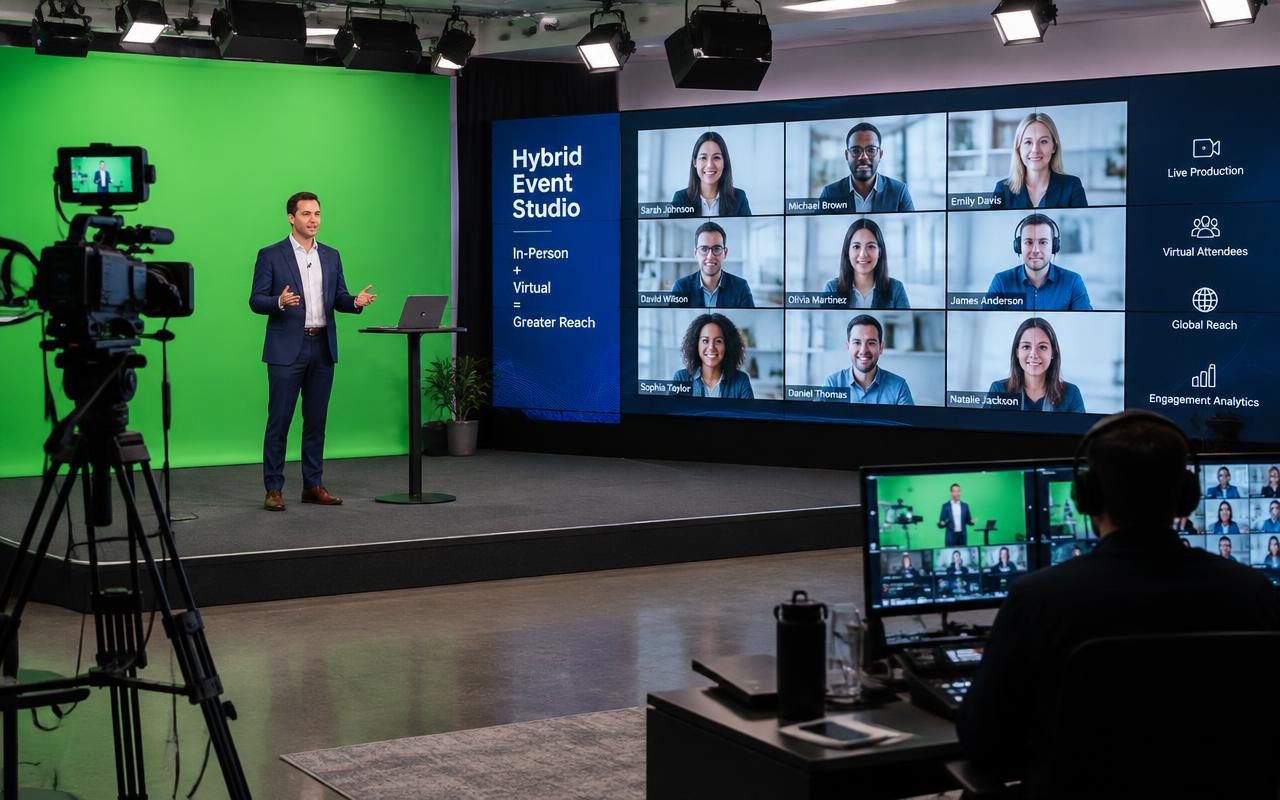
A hybrid event is two shows with one running order, and the hard part is that the two audiences have opposite needs. The room wants energy, pauses and eye contact; the online audience wants close framing, legible content, captions and something to do. We build a single production that serves both by designing the stage for camera first — key light on faces, a background that reads on screen, a lectern position that does not put the speaker in silhouette — then layering the in-room experience on top. The running order is marked with cues for both audiences, so a networking break in the room becomes a curated segment online rather than fifteen minutes of a holding slate.
The room has to work as a studio: camera positions, a background that reads on screen, acoustic separation for the control position, and network capacity that supports contribution. In Aligarh that plays out at venues like AMU Kennedy Hall, Hotel Grand Shivaay, Ramghat Road lawns, and across Ramghat Road, Civil Lines, Marris Road, Sasni Gate.
Remote speakers are a technical discipline of their own. A contributor joining from another city appears on the room's screens and in the stream, which means they need a clean programme return minus their own voice — a mix-minus — or they will hear themselves delayed and stop being able to speak. Video latency between the remote feed and the room audio has to be compensated so the conversation on stage does not develop a two-second stutter. We pre-test every remote contributor on the actual platform, from the actual room they will use, with the actual laptop, and we hold a pre-recorded fallback for any speaker whose connection proves marginal.
What’s included
- Virtual studio & green screen
- Remote speaker integration
- Interactive Q&A and polls
- Engagement analytics
Equipment we carry
Why Aligarh chooses Prime AV
- Crews and trucks positioned for fast load-in at Ramghat Road lawns and venues in Marris Road and Sasni Gate.
- The set is designed and lit for camera first, with levels and colour temperature agreed with the vision engineer, and the in-room look built on top of that baseline.
- Pre-recorded fallback files for any marginal remote segment
- Working knowledge of Uttar Pradesh venue rules, power sanctions and permission timelines.
Local conditions
Producing hybrid event production in Aligarh
Weather & the rig
A hybrid production depends on the connectivity of every remote contributor as well as the venue, so a storm anywhere on the contributor list can affect a segment of the show. Western Uttar Pradesh extremes apply: a dusty, dry April to June reaching 43–45°C with pre-monsoon dust squalls that will tear an unballasted banner, a July–September monsoon that waterlogs the unsurfaced lawn venues, and a December–January cold wave with fog thick enough to delay a morning soundcheck and ruin an outdoor projection plan. The dust is the persistent engineering problem — filters, covers and cleaning schedules on every job. April–June heat and dust storms make outdoor work unviable, and July–September monsoon turns the lawn circuit to mud. The AMU examination and vacation calendar also closes campus venues for long stretches, so confirm academic dates before promising anything. October–March is the season.
Power & redundancy
Hybrid adds a studio-grade control position, contribution hardware and engagement systems that all need UPS-backed supply, because a half-second interruption drops every remote speaker at once. UPPCL supply is intermittent and the city's distribution network is overloaded, so generator provision is the default rather than the contingency. Campus venues run on university supply that is protected but not generous, and the lawn circuit draws from connections sized for lighting and nothing more. Expect to bring everything: two sets, a changeover panel, and an isolated feed for consoles and media servers.
Permits & noise rules
Hybrid work raises consent and rights questions in two places at once — filming the in-room audience and recording remote contributors across jurisdictions. The Aligarh Nagar Nigam handles ground and pandal permissions, the district magistrate and senior superintendent of police license assembly, and the Uttar Pradesh noise rules with the 10 pm outdoor amplified-sound limit apply. Campus events are a separate and sometimes slower track through the AMU registrar and proctor, with student-body politics occasionally affecting approvals. There is no commercial airport here, which simplifies the drone question, but district permission and police intimation are still required and student gatherings attract additional scrutiny.
Load-in & access
A hybrid build needs a quiet control space with real network access next to the hall, plus a remote green room, which is more floor space than clients usually set aside. No airport and no expressway exit directly into the city, so everything arrives by road on NH-34 or across from the Yamuna Expressway, roughly three hours from Delhi. Inside the city, the Dodhpur, Marris Road and Centre Point stretches are slow all day and the old city around Shah Jamal is tempo-only. Campus load-in has to work around teaching hours and pedestrian routes, which in practice means an evening and overnight call.
Season & booking
Sir Syed Day on 17 October is the fixed point of the academic year and the single biggest production date in the city, with alumni gatherings around it. AMU convocation, the examination season and summer vacation each close campus venues at predictable times. Ramzan, Eid and the Numaish-style winter trade fairs, plus the Nov–Feb wedding and walima run, fill the rest. Peak demand runs Oct–Feb.
Crew & dispatch
Dispatched from our Delhi depot, 130 km via the Yamuna Expressway and NH-34 at about three hours, which makes same-day turnarounds genuinely possible; local labour and tent structure hired in Aligarh, with Agra 85 km away as the nearer source for additional staging. Load-in support covers Marris Road, Sasni Gate and the rest of the city.
What it costs here
A low-price market with two exceptions. University work is budget-bound and procedurally slow, and tent-house competition keeps the wedding reference price very low. Export buyer meets, however, are judged by overseas visitors and the hardware exporters will spend to avoid embarrassment, and alumni endowment functions are funded by a diaspora with metro expectations.
Local expectations
Campus ceremony here is formal and tradition-heavy: academic procession order, the university tarana, Urdu and English oratory that must be intelligible in a difficult room, and an audience that includes senior alumni who notice when a microphone fails. Wedding and walima production is decor-forward with a strong preference for warm lighting and a restrained approach to effects, and qawwali and ghazal sets are common enough that a proper vocal and harmonium reinforcement chain earns its keep.
Specification
Hybrid Event Production: technical specification
| Specification | Detail |
|---|---|
| Production approach | Designed for camera first, with the in-room experience layered on top |
| Remote contribution | Zoom, Teams or a dedicated contribution platform into the switcher |
| Return feed | Mix-minus programme return to every remote contributor |
| Latency handling | Video and audio delay compensation so on-stage conversation stays natural |
| Virtual studio | Green screen keying or LED background driven by disguise or Unreal Engine |
| Engagement tools | Live polls, moderated Q&A and chat surfaced to a presenter-facing monitor |
| Dual running order | Cue-marked for both audiences, including online-only break content |
| Captioning | Live captions or ASR-assisted captioning on the stream output |
| Contributor testing | Pre-tested on the actual platform, room and laptop, with a pre-recorded fallback held |
| Analytics | Attendance curve, poll response rate, question volume and drop-off points |
Engagement is what distinguishes a hybrid event from a streamed one. Live polls, moderated Q&A and chat have to be visible to the person on stage, which means a producer filtering questions into a presenter-facing monitor rather than a moderator reading a screen on their phone. Where the budget supports it, a virtual studio with green screen or a disguise-driven LED background lets remote presenters appear inside the event's own design rather than in a hotel room. Afterwards, the platform's engagement analytics — attendance curves, poll responses, question volume, drop-off points — are more useful to the client than any viewer count, because they show where the agenda lost people.
Sizing
What size rig does your event actually need?
| Scale | Guests | Recommended setup |
|---|---|---|
| Town hall | 50 – 200 in room, any online | Three cameras, two remote speakers, Q&A, captions, single producer |
| Departmental summit | 200 – 500 in room | Four cameras, four remote panellists, polls, online break content, engagement desk |
| Conference | 500 – 1,500 in room | Six cameras, dual running order, six remote contributors, per-session analytics |
| Investor or results meeting | 100 – 400 in room | Camera-first set, redundant contribution paths, moderated Q&A with compliance review |
| Global broadcast | Any | Virtual studio, multi-region contribution, pre-recorded fallbacks, full technical producer team |
Scope
Hybrid Event Production scope tiers in Aligarh
Hybrid Session
Single-session town halls and training with a remote audience
- Camera-first stage setup with three sources and a presentation feed
- Two remote speakers with mix-minus returns, pre-tested beforehand
- Moderated Q&A surfaced to a presenter-facing monitor
- Live captions on the stream output
- Hybrid producer, vision mixer and a remote contributor wrangler
Hybrid Conference
Multi-session conferences and investor meets with a substantial online audience
- Dual running order with online-only segments across the breaks
- Four to six cameras designed for both room and stream framing
- Up to six remote panellists with individual latency compensation
- Live polling, moderated Q&A and engagement analytics reporting
- Full crew with a dedicated online-audience producer
Virtual Studio Production
Global town halls and flagship broadcasts with remote presenters in-set
- Green screen or LED virtual studio with disguise-driven environments
- Remote presenters composited into the event's own set design
- Multi-region contribution with redundant paths per contributor
- Rehearsed show with pre-recorded fallbacks for every remote segment
- Technical producer, studio crew, graphics and an engagement desk
A low-price market with two exceptions. University work is budget-bound and procedurally slow, and tent-house competition keeps the wedding reference price very low. Export buyer meets, however, are judged by overseas visitors and the hardware exporters will spend to avoid embarrassment, and alumni endowment functions are funded by a diaspora with metro expectations.
Venues
Where we work in Aligarh
| Venue | Capacity | Production note |
|---|---|---|
| AMU Kennedy Hall | Around 1,200 seated in the hall, with lawn overflow | A colonial-era university auditorium: a fixed stage, a low grid with no usable rigging capacity, and a reverberant masonry shell that demands a point-source design with delays rather than a large flown system. Every element needs the university's proctorial and engineering office clearance. |
| Hotel Grand Shivaay | 500–900 across hall and lawn | The city's most dependable commercial venue, but it sits on a congested stretch where the police will not permit a truck to stand, so delivery is a timed rotation. |
| Ramghat Road lawns | 800–2,500 across the lawn and marriage-hall belt | The default wedding ground, with rudimentary single-phase or light three-phase connections and no drainage, so a late shower leaves standing water around cable runs and dimmer positions. |
| AMU Strachey Hall and the Victoria Gate quadrangles | 400–1,500 depending on configuration | Protected heritage architecture where fixings are forbidden outright and temporary structures must be ground-supported and kept clear of the facades; load-in routes cross pedestrian campus paths that cannot be blocked during teaching hours. |
| Tala Nagri industrial exhibition grounds | 2,000–6,000 in a trade-fair layout | Industrial estate ground with good truck access and real three-phase capacity nearby, but a dusty unsurfaced site that needs matting for buyer walkways and daily cleaning on everything fan-cooled. |
Crew
Who turns up on show day
- Hybrid producer
Owns both running orders and decides what the online audience sees whenever the room does something that does not translate.
- Remote contributor wrangler
Pre-tests every remote speaker, holds their green room on the call and gets them to air on cue without the room noticing.
- Vision mixer
Cuts a programme that works for camera framing and for the screens in the room simultaneously.
- Engagement producer
Moderates Q&A and chat, filters questions to the presenter-facing monitor and runs polls to the agenda.
- Audio engineer
Builds mix-minus returns for every remote contributor and keeps the room PA from feeding back into the conference bridge.
- Virtual studio operator
Runs keying or the LED environment, tracks camera and set alignment and keeps composited presenters correctly scaled.
What you receive
- Dual running order marked with cues for the room and for the online audience
- Mix-minus and contribution routing diagram per remote speaker
- Pre-recorded fallback files for any marginal remote segment
- Programme recording plus per-session files for both audiences
- Engagement analytics report covering attendance curve, polls and question volume
- Moderated Q&A transcript with questions answered and unanswered
- Virtual studio environment files where a virtual set was used
Timeline
From enquiry to load-out
- T-6 weeks
Dual audience design
Agenda reviewed for what works online, with online-only break content and engagement moments designed in rather than added later.
- T-4 weeks
Platform and contribution plan
Contribution platform, return feed method, latency budget and engagement tooling selected and documented.
- T-2 weeks
Remote contributor testing
Every remote speaker tested on the actual platform, room and device, with a pre-recorded fallback captured where the connection is marginal.
- Show day −1
Build and camera-first setup
Stage lit and dressed for camera, mix-minus returns built and proved, virtual studio aligned and keyed.
- Show day, T-4 hours
Full rehearsal
Both running orders rehearsed including remote hand-offs, poll launches and the Q&A flow to the stage monitor.
- Show day to +72 hours
Show and analytics delivery
Show run, recordings offloaded, and the engagement analytics report compiled against the agenda.
Risk control
What goes wrong, and how we stop it
What can go wrong
How we prevent it
- What can go wrong
The stage is lit beautifully for the room and leaves every speaker in silhouette on camera.
How we prevent itThe set is designed and lit for camera first, with levels and colour temperature agreed with the vision engineer, and the in-room look built on top of that baseline.
- What can go wrong
A key remote speaker's connection fails ten minutes before their slot.
How we prevent itA pre-recorded fallback is captured in advance for every remote segment that matters, and the producer can drop it in as a scheduled item rather than improvising an apology.
- What can go wrong
A remote speaker hears themselves delayed, stumbles and loses the thread entirely.
How we prevent itEvery remote contributor gets a true mix-minus return that excludes their own voice, built and proved on the actual path during the contributor test rather than on the day.
- What can go wrong
The room takes a networking break and the online audience stares at a holding slate for fifteen minutes.
How we prevent itOnline-only break content is designed into the running order — an interview, a sponsor segment, a studio chat — and crewed as a deliberate part of the show.
Honest comparison
Is this the right choice for your event?
- Just streaming the in-room event instead of producing a hybridOur verdict
Streaming is cheaper and right when the online audience is a secondary record. It becomes the wrong choice when online attendance is a stated objective, because an unproduced stream of a room-facing event reliably loses most of its viewers in the first fifteen minutes.
- A fully virtual event instead of hybridOur verdict
Fully virtual is far cheaper, has no venue constraint and reaches further. It also loses the corridor conversations that are often the actual reason people attend. If the business value is in the room, hybrid is worth the cost; if it is in the content, go virtual.
- A virtual studio instead of a physical stage setOur verdict
A green screen or LED environment lets you change the set between segments and place remote presenters inside it, which is powerful for a global broadcast. For an event with a real in-room audience, a physical set almost always looks better and costs less.
Demand
What Aligarh books most
Aligarh event mix
- University convocations, Sir Syed Day and academic seminars
- Lock and hardware export buyer meets and trade displays
- Weddings and walima receptions on the Ramghat Road lawn circuit
- Alumni association gatherings and endowment functions
- Political rallies and student-body events
- School and coaching-sector annual functions
Ideal for
Events we power with hybrid event production in Aligarh
Process
From brief to standing ovation
01
Brief & recce
We visit the venue, map power and rigging, and understand your show flow.
02
Design & quote
CAD plans, 3D previews and an itemised quote within 24 hours.
03
Build & rehearse
Load-in, system tuning, content checks and full technical rehearsal.
04
Show & strike
Show-caller-led execution, then a quick, clean load-out.
FAQ
Hybrid Event Production in Aligarh: FAQs
More services in Aligarh
Hybrid Event Production in nearby cities
Areas we cover in Aligarh
Events in Aligarh