Event production · Goa, Goa
College Fests AV in Goa
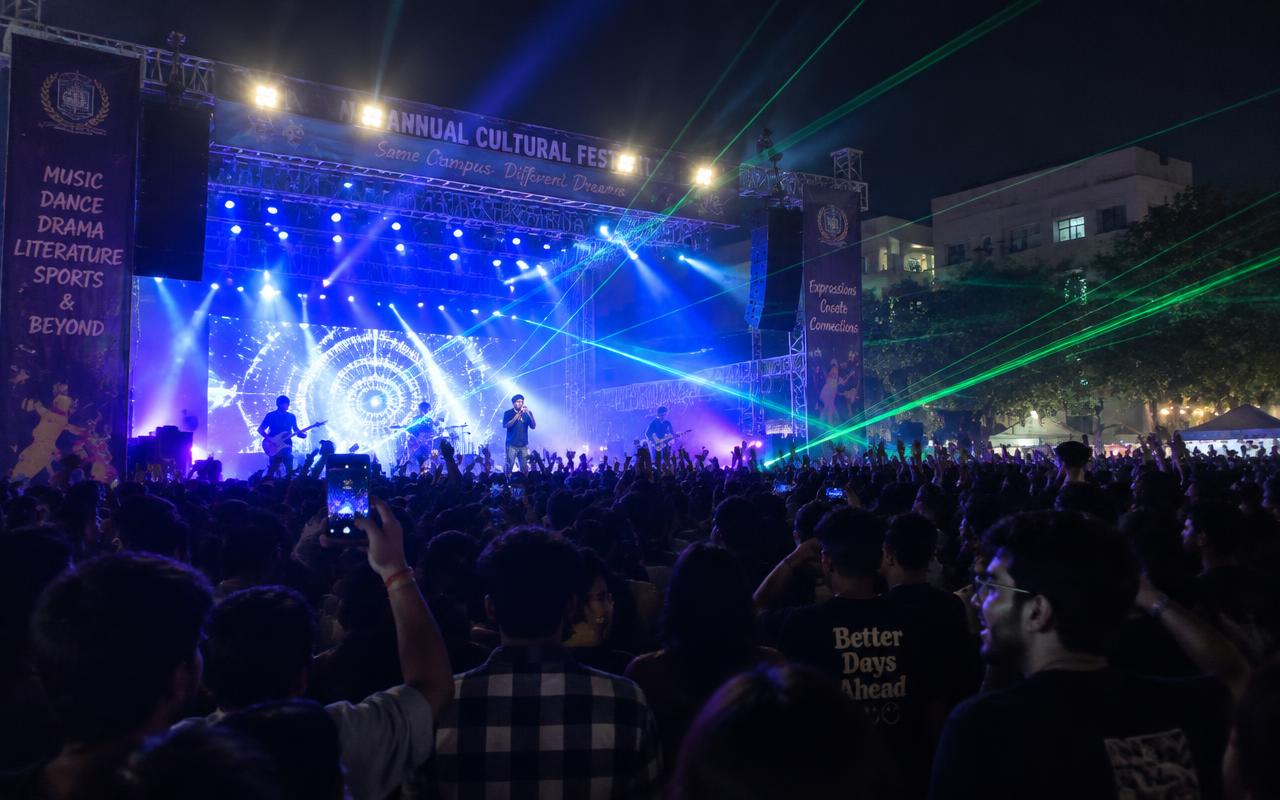
Goa sells two things to the events industry: beachfront destination weddings for Mumbai, Delhi and NRI families, and a December festival-and-nightlife circuit that draws national touring production. Underneath both sits a MICE market at the Bambolim and Dona Paula convention properties and the state's own film and tourism calendar. Prime AV Solutions produces the college fests end of that calendar — artist rider fulfilment, concert PA for 10,000+, beam & laser shows — with one crew owning the whole stack.
- Lead time
- 8 weeks out
- Peak season
- Nov–Mar
- Coverage
- Goa & Goa
Key takeaway
Complete AV for college fests in Goa
A college fest runs on a budget that was raised, not allocated, and is decided by a committee that changes every year. The way to protect both the show and the students is a written scope with named quantities, a single student point of contact with authority, and clear payment milestones tied to build stages. Scope the rig to the ground and the realistic crowd rather than to the poster, and be explicit about what is not included, because the gap between what a sponsorship deck promised and what the budget buys is where fests get into trouble two days before the pro-show.
College grounds and auditoriums offer no rigging, no loading dock and usually a cricket pitch or turf nobody is allowed to drive over. In Goa we work at Grand Hyatt Goa, Taj Exotica, Dr. SPM Stadium and venues across Panaji, Calangute, Candolim, Vagator, Cavelossim.
Crowd safety is the part that actually matters. A campus ground holding eight to fifteen thousand students needs a barricade line with a working front-of-stage pit, delay towers so the back of the field hears the set rather than an echo, a crowd-lighting state the security team can call for in one button, clear exit routes that cables do not cross, and an agreed stop-show protocol. Sound-pressure limits near hostels, examination blocks and residential neighbours are real and enforced, so they belong in the system design rather than in a conversation at eleven at night.
What your event needs
- Artist rider fulfilment
- Concert PA for 10,000+
- Beam & laser shows
- Stage and barricades
Why Goa organisers choose Prime AV
- Crews and trucks positioned for fast load-in at Dr. SPM Stadium and venues in Candolim and Vagator.
- Get the permitted end time in writing, print it on the cue sheet, brief the artist management in the advance, and give the stage manager authority to run a play-off at the agreed minute.
- A standing Goa client base across multi-day beachfront and resort destination weddings and festival, concert and nightlife-circuit production, so the rig is specified from experience rather than a catalogue.
- Working knowledge of Goa venue rules, power sanctions and permission timelines.
What you will be judged on afterwards
- The headline set started and finished on the permitted time, so the college kept its clearance for next year.
- Nobody was injured at the barricade and security had light on the crowd whenever they asked for it.
- Students at the back of the ground heard a real mix rather than a distant echo.
- The committee stayed inside the budget they raised, with no surprise additions on show day.
- The phone footage that circulated afterwards made the fest look bigger than it cost.
Local conditions
Producing college fests in Goa
Weather & the rig
Fests sit on open grounds in fest season, and an unseasonal shower on a student budget has nowhere to retreat to, so the roof and covers are the whole contingency. Coastal salt is the engineering problem here. Aerosol off the Arabian Sea pits truss couplers and corrodes connector shells and amplifier heatsinks measurably across a four-day build, which is why coastal rigs get freshwater rinse and contact treatment on strike rather than straight into the truck. Humidity at 85% condenses inside racks overnight, and the afternoon sea breeze of 20–30 km/h is a genuine wind load on flown arrays and shade sails. The Jun–Sep monsoon delivers around 3,000 mm. Jun–Sep monsoon, when beach shacks and temporary beachfront structures come down for the season and no beachfront build is permissible.
Power & redundancy
Campus supply was built for classrooms and laboratories, so a pro-show rig almost always runs on hired generators parked at the edge of the ground. The Goa Electricity Department's supply is reasonable in the Panaji and Bambolim belt, but the beach-stretch feeders at Candolim, Calangute and Benaulim are thin and sag badly at peak occupancy, so beach venues run entirely on DG. Goa also expects canopied silent sets meeting CPCB norms anywhere near a residential or shack belt, and the panchayats ask about DG placement specifically.
Permits & noise rules
A campus event still needs police intimation, crowd clearance and a loudspeaker permission with a hard end time, and the administration layers its own conditions on top. The binding layer is coastal, not municipal. The Goa Coastal Zone Management Authority's CRZ rules bar permanent structures in the no-development zone and allow temporary beach structures only in the notified season, which is why the beachfront season runs roughly Oct–May. On top of that: Goa Tourism Department event registration, village panchayat NOC — Calangute, Candolim and Anjuna are notoriously particular — Goa Police sound permission, and the High Court of Bombay at Goa's standing orders restricting amplified music on and near beaches after 10 pm, enforced here far more rigorously than in most states. Dabolim is a civil enclave of INS Hansa and Mopa is the new international field, so drone work near either is effectively closed.
Load-in & access
Trucks have to reach a campus built for two-wheelers, through narrow gates, across paver blocks and between academic buildings during term time. Mumbai is 590 km and 11–12 hours by road, which is the standard trucking run; crew often fly and meet the trucks. The last mile is the real work — beachfront venues need tractor or soft-tyre transfer across sand with the build timed against the tide, and the Calangute-to-Candolim village lanes and the Anjuna approach will not accept a 32-ft container at all. Mandovi and Zuari bridge routing adds time between north and south Goa, and a north-south double-venue wedding effectively needs two crews.
Season & booking
Mid-December to early January is a different market: the festival run and the New Year hospitality circuit absorb every truck, generator, rigger and hotel room in the state, and national touring production arrives with its own inventory. IFFI lands in late November at Panaji, Goa Carnival runs four days before Lent in Feb or Mar, Shigmo follows in the spring, and the Oct–May shack season frames everything else. Peak demand runs Nov–Mar.
Crew & dispatch
Trucked from Mumbai, 11–12 hours up the coast, with crew flown in and local labour and rigging hands engaged in Goa; Belagavi is 2.5 hours over the ghat and is a useful source for consumables and backup stock.
What it costs here
The peak-season loading is real and unavoidable — mid-December to early January costs sharply more on crew, trucking and accommodation because the whole state is sold out. Destination weddings budget across three or four days of separate rigs, which is where the value sits. The shoulder months of October and March to May are the genuine value window and worth steering clients towards.
Local expectations
The brief is almost always beach-casual in look and uncompromising in specification — concealed cabling, a white and natural palette, no visible black steel, and speakers that disappear into the design. Sunset timing drives the run of show, so the schedule is built backwards from the actual sunset, not a round number. Expect a multi-day sequence with separate welcome, haldi, sangeet, ceremony and after-party rigs, and Goan Catholic nuptial formats running alongside North Indian destination weddings at the same property.
Run of show
A typical college fests schedule
| Time | Moment | What AV is doing |
|---|---|---|
| T−2 days | Ground build | Stage, roof and ground support up with load calculations, barricade line set with security, delay tower positions pegged and power routed. |
| T−1 day | Rig and programme | Arrays flown and tuned, lighting rig focused and the show programmed, LED built and content loaded, campus boundary levels measured. |
| 08:00 | Day events on the main stage | Speech-level audio and basic wash for competitions, with the pro-show rig protected and the stage surface covered. |
| 16:00 | Stage reset for pro-show | Day-event kit struck, backline placed on rolling risers and pre-wired, stage plot checked against the rider. |
| 17:30 | Line check | Full input list verified with each act, monitor scenes stored per act, radio and in-ear frequencies coordinated across all users. |
| 19:00 | Doors and opening acts | Crowd lighting live for security, walk-in level controlled, first acts run from stored scenes with a drilled changeover between them. |
| 21:30 | Headline changeover | Risers rolled, pre-wired backline connected, monitor world recalled, five-minute line check behind a drape with the clock visible to all. |
| 22:00 | Headline set to hard stop | Full programmed show, SPL logged, lighting and LED cues run, set ends on the permitted time without negotiation from the stage. |
Pro-show night is a turnaround exercise. Three or four student and opening acts feeding into one headliner, with a hard campus stop, means changeovers of twenty to thirty minutes with no room to lose any. Rolling risers with pre-wired backline, stored console scenes per act, a split monitor position and a stage manager running the move as a drill are what hold it together. The headline artist's rider frequently lands seventy-two hours out, so build the advance process early and treat the rider as a document to be negotiated rather than received.
Scope
College Fests scope levels in Goa
Day events plus a modest evening show: compact PA for up to 2,000, four radio mics, a basic moving-light rig, a decked stage and a small LED backdrop.
A 5,000-capacity ground: line-array PA with subs, separate monitor position, roofed stage with certified rigging, barricade, a programmed light show and an LED wall.
10,000-plus crowd: full hangs with a delay ring, rider-grade consoles and backline, large LED with IMAG, a 100-plus fixture rig with beams and lasers, and generator redundancy.
Multi-day, multi-stage fest with an arena-scale pro-show night, rider compliance for a touring act, full crowd-safety infrastructure and a crew on rotating shifts.
The peak-season loading is real and unavoidable — mid-December to early January costs sharply more on crew, trucking and accommodation because the whole state is sold out. Destination weddings budget across three or four days of separate rigs, which is where the value sits. The shoulder months of October and March to May are the genuine value window and worth steering clients towards.
Venues
Where college fests happen in Goa
| Venue | Capacity | Production note |
|---|---|---|
| Grand Hyatt Goa | Up to 2,500 across convention halls and lagoon-side lawns | The state's largest conference infrastructure with real ballroom spans and a proper dock, but the Bambolim site's lawns face open water, so the afternoon sea breeze loads flown and shade structures and the brackish lagoon air is hard on exposed hardware over a multi-day build. |
| Taj Exotica | Up to 1,200 across lawns and beachfront | Benaulim beachfront where the ceremony sits in the CRZ zone — temporary structures only, no ground anchoring into the beach, tide-window planning for the build, and tractor or soft-tyre transfer to move cases across the sand because no truck will cross it. |
| Dr. SPM Stadium | Roughly 19,000 seated for concert configuration | Goa's principal athletics and football stadium at Bambolim, used for concert-scale shows; it has usable tower positions and field access, but outfield and track protection, Sports Authority of Goa permission and the state's rigidly enforced sound deadline shape the entire show schedule. |
| Taj Fort Aguada | Up to 800 across terraces and the fort-side lawns | Dramatic cliff-and-fort setting on multiple terraces, which means no single continuous build level, steep internal paths that rule out trolleying, and heritage-adjacent conditions on anything fixed to the old walls. |
| Vagator and Anjuna cliff venues | 2,000–8,000 standing depending on the site | The clifftop party sites deliver the atmosphere clients come for, but access is via village lanes that will not take a 32-ft container, the village panchayats at Anjuna and Vagator issue their own NOCs with conditions, and the residential belt makes the 10 pm music cut-off absolute. |
Demand
What Goa books most
Goa event mix
- Multi-day beachfront and resort destination weddings
- Festival, concert and nightlife-circuit production
- Corporate incentive groups and offsites at convention resorts
- New Year and Christmas-fortnight hospitality events
- Film, fashion and brand content shoots
- Goa Carnival, Shigmo and state cultural programmes
Services
Recommended production stack
Concert Sound Systems
Concert-grade PA built around L-Acoustics, d&b and JBL VTX class line arrays, tuned by system engineers for even coverage from front row to last.
Intelligent Moving Head Lights
Beams, spots, washes and hybrids from Robe, Clay Paky and Martin — deployed in rigs of 24 to 300 fixtures with programmers on site.
Stage & Truss Fabrication
Modular stages, ground support, roof systems and custom truss structures engineered with load calculations and certified rigging crews.
LED Wall Rental
Indoor P2.6/P3.9 and outdoor P4.8 LED walls in any size or shape — curved, cubes, floor LED and kinetic panels — powered by Novastar processing.
Timeline
Planning milestones
- 8 weeks out
Scope and budget agreed
Ground, crowd estimate, stage size and quantities written down with inclusions, exclusions and payment milestones signed by the committee.
- 6 weeks out
Campus permissions
Police intimation, crowd and capacity clearance, loudspeaker permission with its end time, and the administration's own conditions obtained.
- 4 weeks out
Artist advance
Rider reviewed, substitutions proposed and accepted in writing, stage plot and input list issued to the ground design.
- 3 weeks out
Site design and safety plan
Array prediction on the actual ground, barricade and exit layout, generator placement, cable routes clear of crowd paths.
- T−2 to T−1 day
Build and programme
Structure, arrays, lighting and LED complete; show programmed, boundary levels measured, changeover drill rehearsed.
- T+1 day
Strike and ground handover
Overnight or next-morning derig, ground returned to the condition the college signed for, with turf and surfaces inspected together.
Risk control
What goes wrong, and how we stop it
What can go wrong
How we prevent it
- What can go wrong
The campus hard stop arrives mid-set and nobody on stage respects it.
How we prevent itGet the permitted end time in writing, print it on the cue sheet, brief the artist management in the advance, and give the stage manager authority to run a play-off at the agreed minute.
- What can go wrong
Crowd surge builds at the front-of-stage barricade.
How we prevent itSpecify a pit with real working width, staff it with a barrier crew carrying water and an extraction route, keep a one-button crowd-lighting state, and agree a stop-show protocol with campus security beforehand.
- What can go wrong
Campus electrical supply cannot carry a concert rig.
How we prevent itMeasure what is actually available at the recce, hire sized silent generators parked at the ground's edge with a changeover panel, and keep audio on separate clean distribution from the lighting feed.
- What can go wrong
The committee adds scope after a sponsor signs late.
How we prevent itIssue a written scope with quantities and a clear change-order process, price additions as variations rather than absorbing them, and give the committee one person who can approve changes.
Process
From brief to standing ovation
01
Brief & recce
We visit the venue, map power and rigging, and understand your show flow.
02
Design & quote
CAD plans, 3D previews and an itemised quote within 24 hours.
03
Build & rehearse
Load-in, system tuning, content checks and full technical rehearsal.
04
Show & strike
Show-caller-led execution, then a quick, clean load-out.
FAQ
College Fests AV in Goa: FAQs
Other events in Goa
College Fests AV in nearby cities
Services in Goa
Areas we cover in Goa