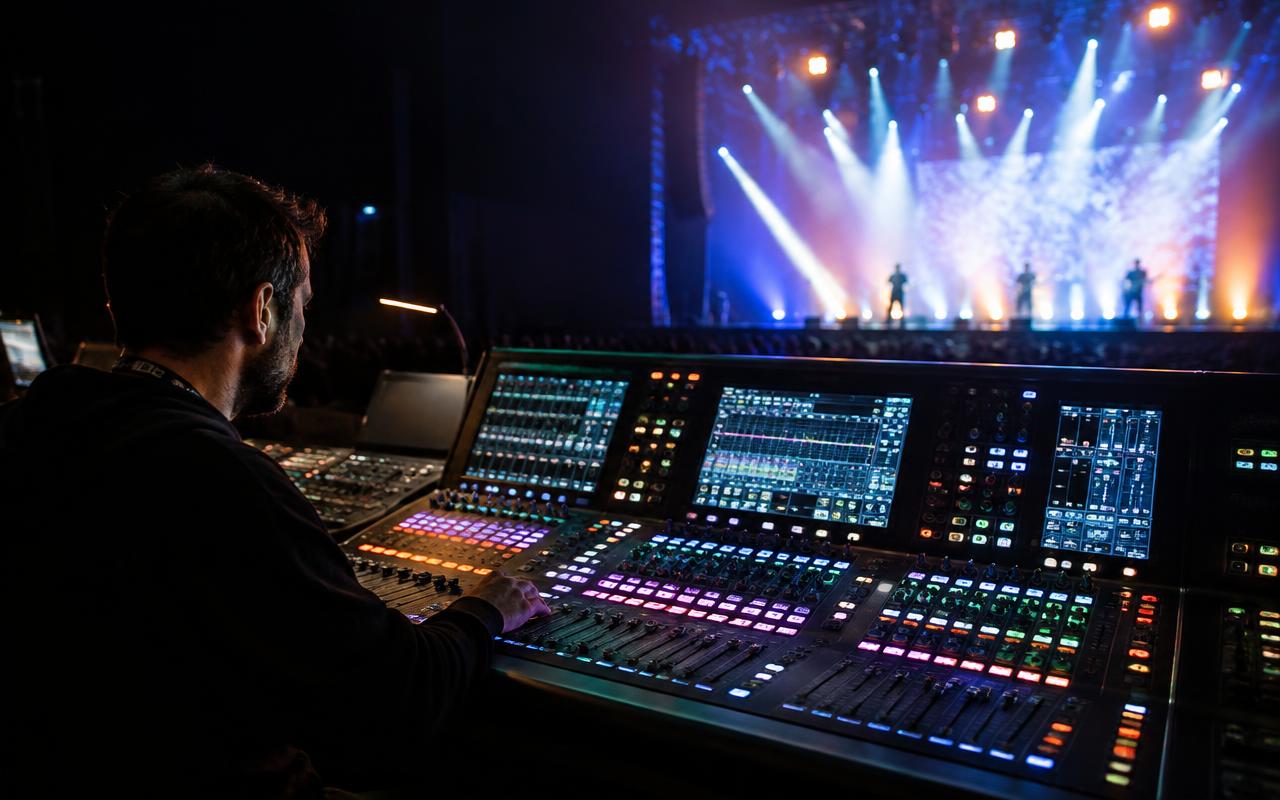
Sound · Goa, Goa
Line Array Rental in Goa
Goa sells two things to the events industry: beachfront destination weddings for Mumbai, Delhi and NRI families, and a December festival-and-nightlife circuit that draws national touring production. Underneath both sits a MICE market at the Bambolim and Dona Paula convention properties and the state's own film and tourism calendar. Prime AV Solutions supplies the line array systems behind those events — designed on paper, proven in rehearsal and run by our own crew.
- Lead time
- From 5 weeks
- Peak season
- Nov–Mar
- Coverage
- Goa & Goa
Key takeaway
Line Array Systems for Goa’s biggest events
A line array is a coverage engineering exercise, not a stack of boxes. We model the room or the ground in prediction software — Soundvision for L-Acoustics, ArrayCalc for d&b — using the actual seating geometry, trim height and surface materials. The output is a splay-angle schedule for each box in the hang, a rigging plot with point loads, and an SPL map that shows what the last row receives against the front row. The design target for speech-heavy and large-crowd work is coverage within about ±3 dB across the audience, with energy deliberately kept off ceilings, rear walls and any surface that returns a late reflection.
The prediction model is only as good as the geometry you feed it, so trim height, seating depth, balcony overhangs and rigging capacity are the first things we measure. In Goa that plays out at venues like Grand Hyatt Goa, Taj Exotica, Dr. SPM Stadium, and across Panaji, Calangute, Candolim, Vagator.
Distance is solved with time, not volume. Beyond roughly 50 to 60 metres the direct sound from the main hang has lost too much level and high frequency to carry intelligibility, so we add delay positions. Each one is timed against the measured distance from the main array at the local speed of sound — about 2.9 milliseconds per metre, adjusted for air temperature, which moves measurably across a hot afternoon into a cool night. We usually add one to three milliseconds of extra delay so the main system still arrives first and the audience localises the stage rather than the tower beside them.
What’s included
- Array prediction & rigging plots
- Delay towers for long throws
- Redundant amplification & power
- Certified riggers
Equipment we carry
Why Goa chooses Prime AV
- Crews and trucks positioned for fast load-in at Grand Hyatt Goa and venues in Panaji and Calangute.
- We require a point-load sign-off from the venue or a structural engineer at T-2 weeks, and keep a ground-support tower design as the fallback.
- Soundvision or ArrayCalc coverage model with SPL prediction map
- Working knowledge of Goa venue rules, power sanctions and permission timelines.
Local conditions
Producing line array rental in Goa
Weather & the rig
Array design is sensitive to air itself — temperature and humidity change the speed of sound and how fast high frequencies are absorbed over distance, so delay timings and top-end EQ are set against the conditions expected at show time. Coastal salt is the engineering problem here. Aerosol off the Arabian Sea pits truss couplers and corrodes connector shells and amplifier heatsinks measurably across a four-day build, which is why coastal rigs get freshwater rinse and contact treatment on strike rather than straight into the truck. Humidity at 85% condenses inside racks overnight, and the afternoon sea breeze of 20–30 km/h is a genuine wind load on flown arrays and shade sails. The Jun–Sep monsoon delivers around 3,000 mm. Jun–Sep monsoon, when beach shacks and temporary beachfront structures come down for the season and no beachfront build is permissible.
Power & redundancy
Distributed amplification across main hangs and delay positions means multiple supply drops that all have to hold voltage under bass transients, which makes generator headroom and cable sizing a design input rather than an afterthought. The Goa Electricity Department's supply is reasonable in the Panaji and Bambolim belt, but the beach-stretch feeders at Candolim, Calangute and Benaulim are thin and sag badly at peak occupancy, so beach venues run entirely on DG. Goa also expects canopied silent sets meeting CPCB norms anywhere near a residential or shack belt, and the panchayats ask about DG placement specifically.
Permits & noise rules
A flown array is simultaneously a rigging question and a noise question — point loads need structural sign-off and the boundary decibel limit decides whether the subs are cardioid. The binding layer is coastal, not municipal. The Goa Coastal Zone Management Authority's CRZ rules bar permanent structures in the no-development zone and allow temporary beach structures only in the notified season, which is why the beachfront season runs roughly Oct–May. On top of that: Goa Tourism Department event registration, village panchayat NOC — Calangute, Candolim and Anjuna are notoriously particular — Goa Police sound permission, and the High Court of Bombay at Goa's standing orders restricting amplified music on and near beaches after 10 pm, enforced here far more rigorously than in most states. Dabolim is a civil enclave of INS Hansa and Mopa is the new international field, so drone work near either is effectively closed.
Load-in & access
Arrays, motors, ballast and delay towers are heavy, tall and need to go up first, so a line array build is the department most affected by dock width, crane access and load-in windows. Mumbai is 590 km and 11–12 hours by road, which is the standard trucking run; crew often fly and meet the trucks. The last mile is the real work — beachfront venues need tractor or soft-tyre transfer across sand with the build timed against the tide, and the Calangute-to-Candolim village lanes and the Anjuna approach will not accept a 32-ft container at all. Mandovi and Zuari bridge routing adds time between north and south Goa, and a north-south double-venue wedding effectively needs two crews.
Season & booking
Mid-December to early January is a different market: the festival run and the New Year hospitality circuit absorb every truck, generator, rigger and hotel room in the state, and national touring production arrives with its own inventory. IFFI lands in late November at Panaji, Goa Carnival runs four days before Lent in Feb or Mar, Shigmo follows in the spring, and the Oct–May shack season frames everything else. Peak demand runs Nov–Mar.
Crew & dispatch
Trucked from Mumbai, 11–12 hours up the coast, with crew flown in and local labour and rigging hands engaged in Goa; Belagavi is 2.5 hours over the ghat and is a useful source for consumables and backup stock. Load-in support covers Panaji, Calangute and the rest of the city.
What it costs here
The peak-season loading is real and unavoidable — mid-December to early January costs sharply more on crew, trucking and accommodation because the whole state is sold out. Destination weddings budget across three or four days of separate rigs, which is where the value sits. The shoulder months of October and March to May are the genuine value window and worth steering clients towards.
Local expectations
The brief is almost always beach-casual in look and uncompromising in specification — concealed cabling, a white and natural palette, no visible black steel, and speakers that disappear into the design. Sunset timing drives the run of show, so the schedule is built backwards from the actual sunset, not a round number. Expect a multi-day sequence with separate welcome, haldi, sangeet, ceremony and after-party rigs, and Goan Catholic nuptial formats running alongside North Indian destination weddings at the same property.
Specification
Line Array Systems: technical specification
| Specification | Detail |
|---|---|
| Prediction software | L-Acoustics Soundvision, d&b ArrayCalc, Meyer MAPP |
| Coverage tolerance target | ±3 dB across the defined audience area |
| Array sizes | 6 – 24 boxes per hang, single or double hangs plus outfills |
| Delay timing constant | ≈2.9 ms per metre, temperature-corrected on the day |
| Delay position spacing | Every 50 – 70 m of audience depth beyond the main hang |
| Sub configurations | Cardioid blocks, end-fire lines, flown sub hangs, ground-stacked arcs |
| Rigging | Certified motors with load cells, point loads documented per hang |
| Amplification redundancy | N+1 at rack level with dual feeds and ring-topology audio network |
| Verification | Smaart transfer-function measurement at a minimum of six audience positions |
| Practical crowd range | 1,000 – 50,000 guests depending on hang count and delay rings |
Subwoofers get their own geometry. An end-fire or cardioid sub array cancels rearward energy, which keeps low frequency off the stage, out of the microphones and away from the nearest residential boundary — often the single most useful thing we can do for a noise condition. Amplification is specified with redundancy at the rack level, dual supply feeds where the site allows, and a network topology that survives a cut cable. Final alignment is measured with Smaart at multiple positions in the audience, not set from a factory preset, and the measured traces are part of the handover documentation.
Sizing
What size rig does your event actually need?
| Scale | Guests | Recommended setup |
|---|---|---|
| Ballroom | 300 – 800 | Twelve-box compact line array per side, four subs, no delays, two front fills |
| Convention hall | 1,000 – 3,000 | Twelve to sixteen boxes per side, six to eight subs, front fill line, one under-balcony fill |
| Open ground | 5,000 – 10,000 | Sixteen-box hangs per side with outfills, twelve cardioid subs, one delay position |
| Arena | 12,000 – 25,000 | Main and side hangs, flown sub hangs, two to three delay positions with towers |
| Stadium or maidan | 30,000 – 50,000+ | Four to six hangs, distributed delay rings every 60 m, 500 kW+ of amplification |
Scope
Line Array Rental scope tiers in Goa
Hall Coverage Design
Convention halls, ballrooms and indoor gatherings up to 3,000 guests
- Soundvision or ArrayCalc model of the actual room geometry
- Twelve-box compact array per side with four to six subs
- Front fill line for the first four rows
- On-site Smaart alignment with measured traces handed over
- System engineer and two technicians for the build
Open Ground Array
Outdoor grounds and large weddings, 5,000 – 20,000 guests
- Main hangs plus outfills with cardioid or end-fire sub array
- One to two delay positions with towers, ballast and power
- Rigging plot with point loads and certified rigging crew
- Boundary SPL measurement against the site noise condition
- Redundant amplification and dual supply distribution
Arena & Mass Gathering
Arenas, stadiums, political and spiritual gatherings, 25,000 – 50,000+
- Multi-hang design with 270° or 360° coverage and delay rings
- Three to six delay positions, each individually timed and aligned
- Full SPL prediction map and intelligibility modelling for speech
- Distributed amplification with generator-side power coordination
- Crew chief, two system engineers and a rigging team
The peak-season loading is real and unavoidable — mid-December to early January costs sharply more on crew, trucking and accommodation because the whole state is sold out. Destination weddings budget across three or four days of separate rigs, which is where the value sits. The shoulder months of October and March to May are the genuine value window and worth steering clients towards.
Venues
Where we work in Goa
| Venue | Capacity | Production note |
|---|---|---|
| Grand Hyatt Goa | Up to 2,500 across convention halls and lagoon-side lawns | The state's largest conference infrastructure with real ballroom spans and a proper dock, but the Bambolim site's lawns face open water, so the afternoon sea breeze loads flown and shade structures and the brackish lagoon air is hard on exposed hardware over a multi-day build. |
| Taj Exotica | Up to 1,200 across lawns and beachfront | Benaulim beachfront where the ceremony sits in the CRZ zone — temporary structures only, no ground anchoring into the beach, tide-window planning for the build, and tractor or soft-tyre transfer to move cases across the sand because no truck will cross it. |
| Dr. SPM Stadium | Roughly 19,000 seated for concert configuration | Goa's principal athletics and football stadium at Bambolim, used for concert-scale shows; it has usable tower positions and field access, but outfield and track protection, Sports Authority of Goa permission and the state's rigidly enforced sound deadline shape the entire show schedule. |
| Taj Fort Aguada | Up to 800 across terraces and the fort-side lawns | Dramatic cliff-and-fort setting on multiple terraces, which means no single continuous build level, steep internal paths that rule out trolleying, and heritage-adjacent conditions on anything fixed to the old walls. |
| Vagator and Anjuna cliff venues | 2,000–8,000 standing depending on the site | The clifftop party sites deliver the atmosphere clients come for, but access is via village lanes that will not take a 32-ft container, the village panchayats at Anjuna and Vagator issue their own NOCs with conditions, and the residential belt makes the 10 pm music cut-off absolute. |
Crew
Who turns up on show day
- System designer
Builds the prediction model, sets splay angles and box counts, and signs the SPL map before anything is quoted.
- System engineer
Executes the design on site, measures with Smaart, times every delay position and owns the final alignment.
- Lead rigger
Verifies rigging points and load capacity, sets motors and load cells, and signs off before a hang leaves the ground.
- Amplification technician
Builds and monitors the amplifier racks, watches network and driver health, and manages redundant feed switching.
- Delay position technician
Builds, ballasts, powers and aligns the delay towers, then holds position during the show in case a feed drops.
What you receive
- Soundvision or ArrayCalc coverage model with SPL prediction map
- Box-by-box splay angle schedule for every hang
- Rigging plot with point loads and bridle calculations
- Measured Smaart traces from the audience positions used for alignment
- Delay timing sheet with distances, computed delays and temperature correction
- Amplifier and network topology diagram showing redundancy paths
- Boundary noise measurement log against the venue condition
Timeline
From enquiry to load-out
- T-5 weeks
Geometry capture
Site survey or drawing review to get trim heights, seating depth, surfaces and rigging capacity into the model.
- T-3 weeks
Prediction and design issue
Coverage map, splay schedule, rigging plot and point-load report go to the venue and the structural engineer.
- T-2 weeks
Rigging approval
Venue or structural sign-off on hang points, and generator and distribution coordination for delay positions.
- Show day −1
Build and hang
Motors, arrays, subs and delay towers go up; power and network are proved end to end.
- Show day, T-6 hours
Alignment
Smaart measurement at audience positions, delay timing with temperature correction, final EQ and limiter settings.
- Show +2 to +8 hours
Strike
Delay positions down first, main hangs last, with rigging de-rig supervised by the lead rigger.
Risk control
What goes wrong, and how we stop it
What can go wrong
How we prevent it
- What can go wrong
The venue's published rigging capacity turns out to be theoretical and will not take the hang.
How we prevent itWe require a point-load sign-off from the venue or a structural engineer at T-2 weeks, and keep a ground-support tower design as the fallback.
- What can go wrong
Delay towers are timed at noon and sound wrong at 9 pm as the air cools and the speed of sound drops.
How we prevent itDelays are computed with the forecast show-time temperature and re-measured just before doors, which typically moves each tower a fraction of a millisecond.
- What can go wrong
Low frequency from ground-stacked subs rolls straight into the nearest housing and triggers a complaint.
How we prevent itA cardioid or end-fire sub array cuts rearward output by 15 dB or more in the problem direction, measured at the boundary before the show.
- What can go wrong
Coverage is modelled for the drawn seating plan, then the client adds 1,500 chairs on the flanks the day before.
How we prevent itWe design the hang with outfill capacity in reserve and keep the splay schedule adjustable, so flank coverage is a change of angle rather than a change of system.
Honest comparison
Is this the right choice for your event?
- Point source clusters instead of a flown arrayOur verdict
For a room under about 25 m deep with a low ceiling, point source is cheaper and arguably better — less rigging, less reflection. The array earns its cost when depth, crowd size or intelligibility targets take over.
- More boxes instead of delay towersOur verdict
Adding boxes to a hang buys you a few more metres of throw, then stops. Past roughly 60 m the physics is against you and a properly timed delay position delivers far more intelligibility per rupee.
- Ground-stacked subs instead of a cardioid arrayOur verdict
Ground stacks are faster and cheaper, and perfectly correct on an isolated site. If there is housing within a few hundred metres or microphones on stage, the cardioid array is what keeps the show running.
Demand
What Goa books most
Goa event mix
- Multi-day beachfront and resort destination weddings
- Festival, concert and nightlife-circuit production
- Corporate incentive groups and offsites at convention resorts
- New Year and Christmas-fortnight hospitality events
- Film, fashion and brand content shoots
- Goa Carnival, Shigmo and state cultural programmes
Ideal for
Events we power with line array systems in Goa
Process
From brief to standing ovation
01
Brief & recce
We visit the venue, map power and rigging, and understand your show flow.
02
Design & quote
CAD plans, 3D previews and an itemised quote within 24 hours.
03
Build & rehearse
Load-in, system tuning, content checks and full technical rehearsal.
04
Show & strike
Show-caller-led execution, then a quick, clean load-out.
FAQ
Line Array Rental in Goa: FAQs
More services in Goa
Line Array Rental in nearby cities
Areas we cover in Goa
Events in Goa